
At least one student in every new class asks me the same question — “Sir, should I write ‘myself’ or ‘my self’?” It’s such a common mix-up that I call it my favorite grammar mistake to teach, because the two sound exactly alike, yet they mean completely different things.
In this guide, I’ll walk you through the exact method I teach my students — when to use “myself,” when “my self” is actually correct, and the mistakes even professionals make in emails. You’ll also get a simple test at the end so you never have to second-guess it again.
Myself vs My Self: The Quick Answer
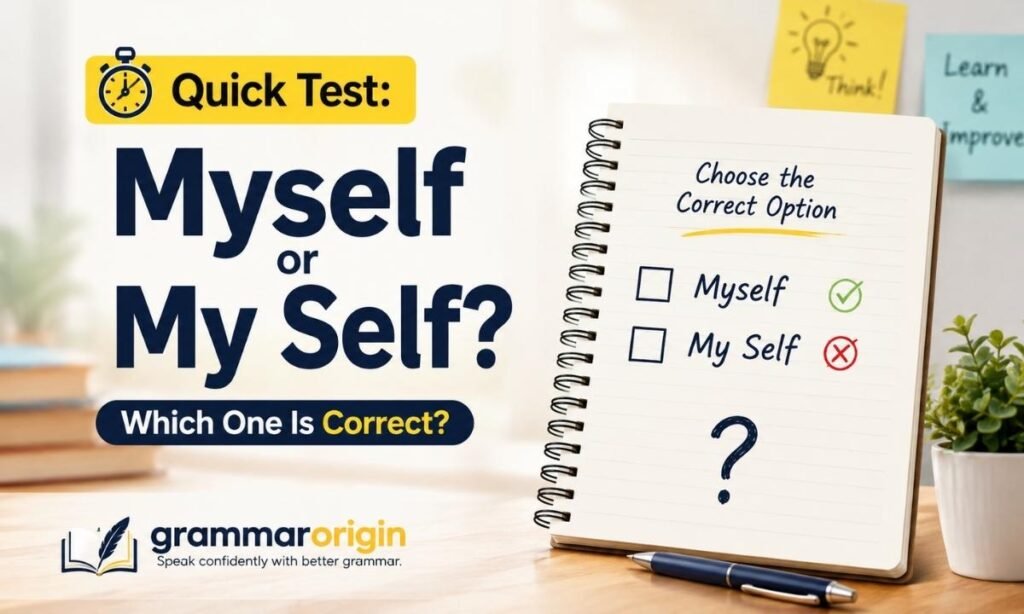
“Myself” is almost always the word you want. It’s a reflexive or intensive pronoun, and it’s the standard, grammatically correct choice in everyday and professional writing.
“My self” (two words) is rare. It shows up only when “self” is being used as a noun — usually in psychology, therapy, or reflective writing about identity.
So if you’re writing a normal sentence like “I taught myself Spanish” or “I’ll handle it myself,” always use one word: myself.
Where Does This Confusion Come From?

Honestly, the confusion isn’t really about grammar. It’s about sound.
“Myself” and “my self” are pronounced exactly the same way. Your ear can’t tell the difference, so when you’re typing fast or thinking out loud, your fingers sometimes split the word without you noticing.
I see this a lot with students who are proofreading their own work. They read the sentence in their head, it sounds fine, and the extra space slips right past them.
Autocorrect doesn’t always catch it either. “My self” is technically two real words, so most spellcheckers won’t flag it as an error — even though it’s wrong in that sentence. That’s the real trap here, and it’s why this mix-up is so common even among confident writers.
What “Myself” Really Means
READ MORE RELATED POSTE CLICK ME
“Myself” is a reflexive and intensive pronoun. In simple terms, it either reflects an action back to you, or it adds emphasis to something you did.
Reflexive use
the subject and the object are the same person:
- I taught myself how to cook.
- I hurt myself in gym class.
- I remind myself to stay calm before exams.
Intensive use
“myself” just stresses that you personally did something:
- I fixed the printer myself.
- I wrote this lesson plan myself.
Here’s a quick test I give my students: remove “myself” from the sentence. If the sentence still makes sense, it was intensive. If the sentence falls apart without it, it’s reflexive.
- I fixed the printer. (still works → intensive)
- I taught myself. (needs an object → reflexive)
This one trick solves 90% of the confusion.
Incorrect Uses of “Myself” (Very Common!)
This is the mistake I correct the most, even with advanced students and working professionals.
People use “myself” as a “fancier” or more polite version of me or I. It isn’t. “Myself” can only work when it reflects back to a subject that’s already in the sentence.
Wrong:
- Please send the file to Sarah or myself.
- Myself and John will handle the meeting.
Right:
- Please send the file to Sarah or me.
- John and I will handle the meeting.
Here’s the test again: take the other person out of the sentence. “Send the file to myself” sounds wrong immediately — because it is. That’s your signal to use “me” instead.
One more thing students always ask me: “myselves” does not exist. “I” is always singular, so there’s no plural form of “myself.” If you’re talking about a group, the correct word is ourselves.
Common Mistakes Even Professionals Make

I’ve edited enough work emails to know this mistake doesn’t stop at school — it actually gets worse in the workplace, where people try to sound formal.
The classic email error:
❌ “Please loop in David or myself on this thread.”
✔️ “Please loop in David or me on this thread.”
The meeting-notes error:
❌ “Myself and the design team reviewed the draft.”
✔️ “The design team and I reviewed the draft.”
Why does this happen so much in professional writing? Because “myself” sounds more formal and careful, so people reach for it when they’re trying to impress a boss or client. But using it incorrectly actually does the opposite — it’s one of the fastest ways to make a polished email look unpolished.
My rule for proofreading your own writing: anytime you use “myself” next to someone else’s name, stop and remove that name. If the sentence still sounds right with just “myself” in it, keep it. If it sounds off, switch to “me” or “I.”
Understanding “My Self”
“My self” is not a pronoun — it’s a noun phrase. “My” is a possessive adjective, and “self” is a noun meaning your identity, your inner being, or your true nature.
Think of it the same way you’d think of “my house” or “my idea.” “Self” is just another thing you can possess or describe.
You’ll mostly see “my self” in:
- Psychology and therapy — “Therapy helped me reconnect with my self.”
- Meditation and mindfulness writing — “I found my self again after months of stress.”
- Philosophy — “The nature of my self has always fascinated me.”
Here’s a simple check I give students: try replacing “self” with “identity.” If the sentence still makes sense, “my self” is correct.
- I feel disconnected from my identity. ✔️ (works → “my self” is correct here)
- I did it by my identity. ❌ (doesn’t work → you need “myself” instead)
This is genuinely rare in everyday writing. Outside of reflective or therapeutic contexts, you almost never need it.
A Little History: How “My Self” Became “Myself”
This part surprises most of my students. “My self” wasn’t always wrong — it used to be completely normal.
In Old and Early Modern English, “self” worked as an intensifying word attached loosely to a pronoun, and writers often wrote it as two separate words. Shakespeare did this constantly. In Othello, he wrote “I do betray my self with blushing” — two words, and perfectly correct for his time.
As English grammar became more standardized through the 1700s and 1800s, grammarians started treating reflexive pronouns as single, fixed words. “My self” slowly merged into “myself,” the same way “any one” eventually became “anyone.”
So today, when you see “my self” in an old text, it’s not a mistake — it’s a snapshot of English before the rules settled. Modern English kept the two-word form alive only in its newer, identity-focused meaning.
British English vs American English Usage
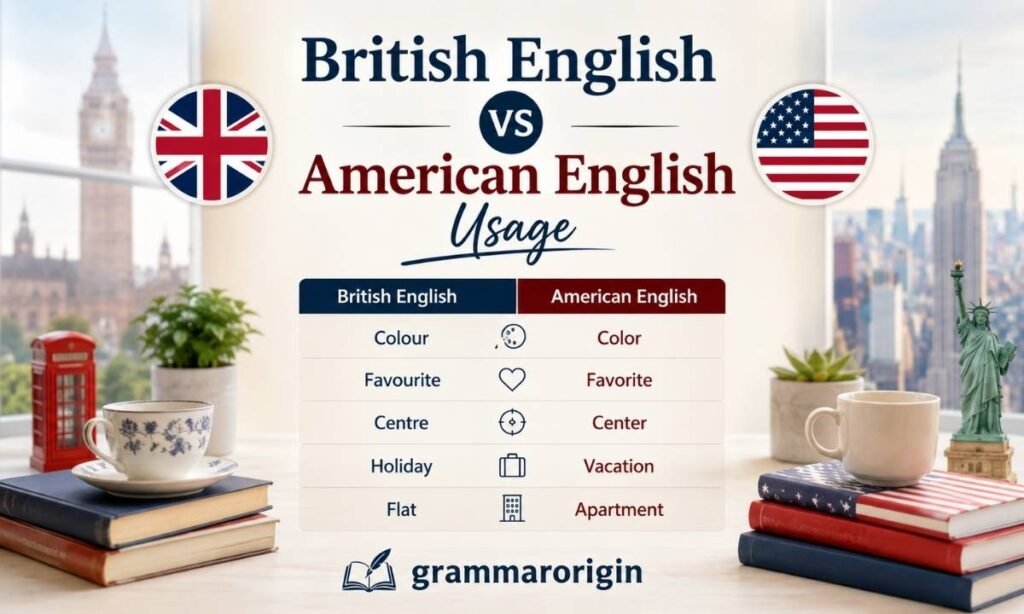
Good news here: this one doesn’t change across dialects. Both British and American English treat “myself” the same way — as a reflexive and intensive pronoun, with identical rules for correct and incorrect use.
You’ll find the same “contact John or myself” mistake in offices in London and New York alike. Style guides on both sides — including Oxford in the UK and Merriam-Webster in the US — agree that “myself” cannot replace “me” or “I.”
The only real difference is stylistic, not grammatical: British academic and philosophical writing tends to use “my self” (identity sense) slightly more often, especially in psychology and literary criticism, while American writing leans more toward the direct “sense of self” phrasing instead. But this is a matter of style, not a grammar rule — both are correct in either dialect.
Quick Test: Myself or My Self?

Whenever you’re stuck, run through these three quick questions:
1. Does the action point back to you?
I taught myself guitar. → Use myself.
2. Are you just adding emphasis to something you did?
I fixed it myself. → Use myself.
3. Are you talking about your identity, feelings, or inner self?
I’m reconnecting with my self. → Use my self.
One more safety check: try swapping in “herself” or “himself.” If it fits naturally, go with myself. If it sounds strange, you’re probably in identity territory, and my self is the better choice.
Still unsure? Default to myself. It’s correct in the vast majority of real sentences, and “my self” is the rare exception, not the rule.
Real-Life Examples
Workplace email:
❌ Please send your questions to Karen or myself.
✔️ Please send your questions to Karen or me.
This is the single most common mistake I see in professional writing.
Personal journaling:
✔️ This year taught me to slow down and listen to my self.
Correct — this is about identity and reflection, not action.
Classroom grammar:
❌ I gave myself and Ali a gift.
✔️ I gave Ali and me a gift.
Reflexive pronouns can’t share the object spot with another person.
Everyday conversation:
✔️ I cleaned the whole house myself.
Correct intensive use — it emphasizes you did it alone, and removing “myself” still leaves a complete sentence.
Therapy/mindfulness context:
✔️ Meditation brought me closer to my self.
Correct — “self” here means your inner identity, not a grammatical object.
Frequently Asked Questions
What is the difference between “myself” and “my self”?
“Myself” is a reflexive/intensive pronoun used in grammar, while “my self” is a noun phrase referring to your identity or inner being. In almost all everyday writing, you want “myself” — “my self” only appears in reflective or psychological contexts.
What is the correct use of “myself” in professional writing?
Use “myself” only when it reflects back to “I” in the same sentence, like “I’ll handle it myself.” Never use it to replace “me” or “I,” as in “contact John or myself” — that’s one of the most common workplace writing mistakes.
When should I use “myself” instead of “me”?
Use “myself” only when the subject of the sentence is also “I.” If someone else is the subject — like “Please send it to Sarah and “ — the correct word is “me,” not “myself.”
Is “my self” a grammatically acceptable phrase?
Yes, but only in specific contexts. “My self” is acceptable when “self” is used as a noun meaning identity or inner being, such as in therapy, meditation, or philosophical writing. It’s not a substitute for the pronoun “myself.”
Does “myselves” exist as a word?
No. “I” is always singular, so it has no plural form. When referring to a group, the correct reflexive pronoun is “ourselves,” not “myselves.”
Can I start a sentence with “myself”?
Yes, but only for emphasis, as in “Myself, I’d choose the second option.” You can’t use it as a regular subject, like “Myself will present the findings” — that should be “I will present the findings.”
Why do “myself” and “my self” sound exactly the same?
Because “self” was historically written as a separate word attached to “my,” and both forms are pronounced identically today. The spelling difference exists only in writing, which is why this mix-up happens so often, even to careful writers.
Final Thoughts
At the end of the day, the myself vs my self debate comes down to one simple rule: use “myself” for almost everything, and save “my self” for moments when you’re talking about your identity or inner world.
Next time you catch yourself pausing over that space bar, run through the quick test from this guide — it’ll take you two seconds to get it right.

Muhammad Waqas is an English language teacher and grammar expert with over 8 years of experience helping students and professionals improve their writing skills. He specializes in English grammar, vocabulary, communication, and practical language learning. Through GrammarOrigin, Waqas shares clear, easy-to-understand content that helps readers write and speak English with confidence.