
You’ve probably typed “ola” into a text message and wondered if you just made a mistake. Hola or ola, the two words look almost identical, sound the same out loud, and yet they mean completely different things in Spanish.
One word says hello. The other talks about a wave crashing on a beach. Get the spelling wrong, and your friendly greeting turns into something about the ocean. This guide breaks down exactly when to use each one, plus the Portuguese twist most people never learn about.
Hola or Ola: What Is the Difference?
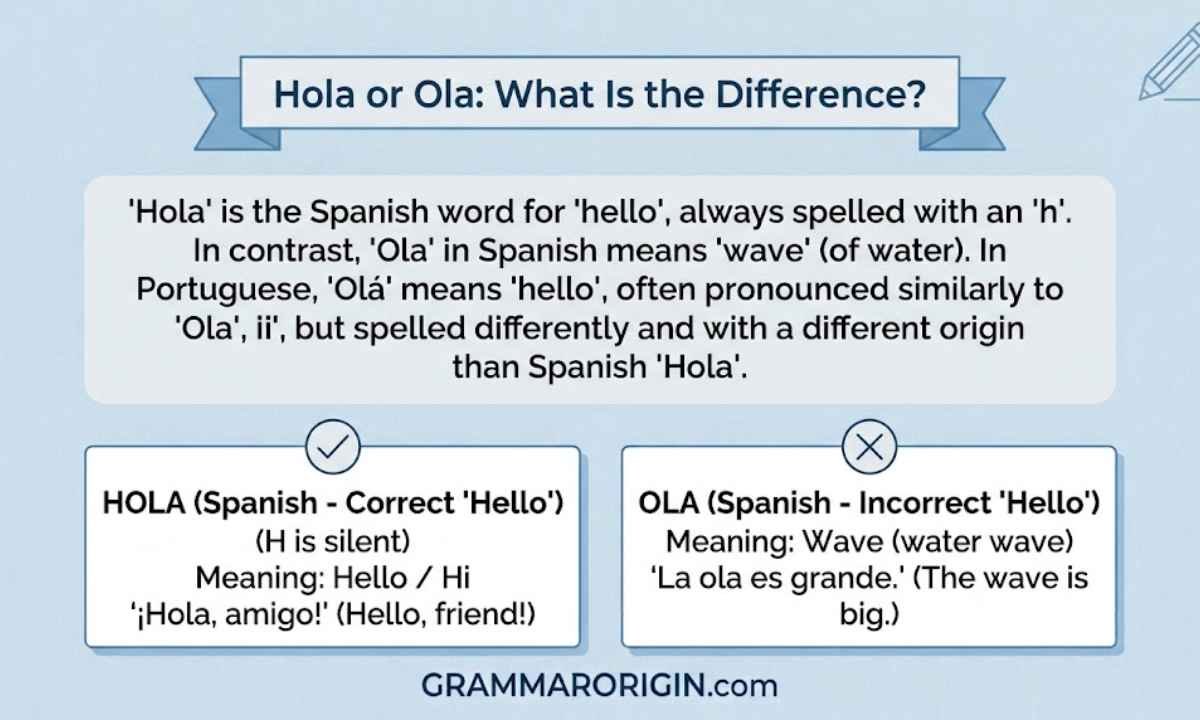
Hola means “hello” in Spanish, while ola means “wave.” That single silent letter, the h, is the entire difference between greeting someone and talking about the sea.
Spanish speakers pronounce both words identically, which is why linguists call hola and ola a homophone pair. Written Spanish is where the meaning splits apart completely, so spelling carries all the weight here.
Hola Meaning in Spanish
Hola is an interjection Spanish speakers use as a casual greeting, similar to “hi” or “hey” in English. The Real Academia Española (RAE), Spain’s official language authority, defines it simply as a word used to greet someone informally. You’ll hear it constantly in everyday conversation, in texting, and even in formal introductions once it’s softened with a follow-up phrase.
Example: ¡Hola, Sofía! ¿Cómo estás? means “Hi, Sofia! How are you?” Notice the greeting sits right at the front of the sentence, exactly where “hi” or “hello” would go in English.
Ola Meaning in Spanish
Ola is a feminine noun that refers to a wave, usually one you’d see at the beach, though it also shows up in figurative phrases about a sudden rise in something. Spanish-language dictionaries such as WordReference list this wave meaning as the word’s primary and only common definition.
Example: La ola derribó el castillo de arena. means “The wave knocked down the sandcastle.” You’ll also spot ola in expressions like ola de frío (cold wave), which has nothing to do with the ocean at all.
Olá Meaning in Portuguese
Olá, spelled with an accent mark over the final a, is the standard Portuguese word for “hello.” It’s a completely separate language convention, not a misspelling of Spanish hola.
Example: Olá, tudo bem? means “Hello, how’s it going?” A Brazilian speaker might shorten this in casual speech to just “oi,” but olá stays correct in both Portugal and Brazil.
Hola or Ola: Which One Should You Use?
Use hola when you’re greeting someone in Spanish, and use ola only when you’re referring to an actual wave. The two words are never interchangeable, no matter how similar they sound.
Use Hola When Greeting Someone
Anytime you’re starting a conversation, saying hi to a friend, or opening a message in Spanish, hola is the word you want. Drop the h, and you’ve accidentally written about ocean waves instead.
Example: Someone messaging a Spanish-speaking coworker for the first time would write Hola, buenas tardes, never Ola, buenas tardes, even though it sounds the same when spoken aloud.
Use Ola When Talking About a Wave
Reach for ola only when the sentence is actually about a wave, literal or figurative. Surfers, weather reports, and news stories about heat spells all lean on this word regularly.
Example: Los surfistas esperaban la ola perfecta. means “The surfers were waiting for the perfect wave.” Swap in hola here, and the sentence stops making sense entirely.
Use Olá in Portuguese
If you’re writing in Portuguese rather than Spanish, olá is your correct greeting, not hola, and not ola either. It’s a different vocabulary system, even though the two languages share a lot in common as sister Romance languages.
Example: A Brazilian shopkeeper might greet a customer with Olá! Em que posso ajudar?, meaning “Hello! How can I help?” Try that same line in Spain, and locals would expect Hola instead.
Why Do Hola and Ola Cause So Much Confusion?
The confusion happens because hola and ola sound exactly alike when spoken, so learners often write down what they hear instead of what’s actually correct. Spanish has a silent h, and that one small detail trips up beginners constantly.
They Sound the Same in Spanish
Spanish never pronounces the letter h, so hola comes out as “OH-la,” identical to how ola is pronounced. Your ears simply can’t tell the two words apart in speech.
Example: Listen to ¡Hola, amigo! and Una ola gigante back to back, and the first syllable sounds the same in both, even though only one of them is a greeting.
The Meaning Depends on Context
Since the sound gives you no clues, the surrounding sentence has to do all the work of telling you which word is meant. A greeting sits at the start of a conversation, while a wave usually shows up alongside water, beaches, or weather.
Example: Hola, ¿nos vemos mañana? is clearly a greeting because of the question that follows, while La ola cubrió toda la orilla is obviously about water because of “orilla” (shore).
English Learners May Rely Too Heavily on Sound
English speakers are used to spelling that closely follows pronunciation, so they naturally try to sound out Spanish words the same way. That habit backfires here, because the silent h leaves no audible trace to guide the spelling.
Example: A beginner hearing “OH-la” for the first time in a language app might type “ola” without thinking twice, not realizing they’ve just spelled a completely different word.
Hola or Ola Pronunciation: How to Say Each Word Correctly
Both hola and ola are pronounced the same way in Spanish: “OH-lah,” with the stress on the first syllable and a fully silent h. The pronunciation gives you no hint at all about which spelling is correct.
Portuguese olá sounds a little different, closer to “oh-LAH,” with the stress shifting to the final syllable because of that accent mark. That accent isn’t decorative. It actually changes where the emphasis falls when you speak.
Example: Say “hola” and “ola” out loud in Spanish, and you’ll notice they sound genuinely identical. That’s exactly why native speakers rely on spelling and context, not sound, to keep the words straight.
Hola vs Ola: A Simple Comparison Guide
The fastest way to keep these words straight is a simple mental shortcut: h means hello, and no h means wave. Once that clicks, the confusion mostly disappears.
The Easy Memory Trick
Picture the letter H standing for “Hello.” Both words start with the same letter, which makes the connection stick almost instantly. For ola, picture the O as the start of “ocean,” since that’s exactly what the word describes.
Example: Next time you’re unsure, ask yourself, “Am I saying hello?” If yes, the h belongs there. If you’re picturing water, drop it.
Quick Decision Checklist
Run through two quick questions before you type either word. Are you greeting someone? Are you talking about water? The answer tells you exactly which spelling to use.
| Situation | Correct Word | Example |
| Greeting someone in Spanish | Hola | Hola, ¿qué tal? |
| Talking about a wave | Ola | La ola es enorme. |
| Greeting someone in Portuguese | Olá | Olá, tudo bem? |
| Multiple waves | Olas | Las olas son grandes. |
| Greeting a group in Spanish | Hola a todos | Hola a todos, chicos. |
| Greeting a group in Portuguese | Olá a todos | Olá a todos! |
Common Mistakes With Hola and Ola
Most mistakes with these two words come down to writing what you hear rather than what’s actually correct in Spanish. Here are the slip-ups that show up most often.
Mistake 1: Writing Ola as a Spanish Greeting
Dropping the h and writing “Ola, ¿cómo estás?” is the single most common error learners make. It reads as a wave asking how you are, which obviously isn’t what anyone intends.
Example: Fix it by double-checking greetings before you hit send. Hola, ¿cómo estás? is the version you actually want.
Mistake 2: Adding an Accent to Spanish Hola
Some learners borrow the Portuguese accent and write “Holá,” assuming it looks more correct. Standard Spanish never places an accent on hola.
Example: Compare Hola (Spanish, no accent) with Olá (Portuguese, accented) side by side, and you’ll see the two languages simply don’t share this spelling rule.
Mistake 3: Assuming Olá Is Always Wrong
Because olá isn’t standard in Spanish, some learners assume it’s just a mistake everywhere. In Portuguese, though, it’s the completely correct and expected spelling.
Example: A Portuguese greeting card that reads Olá, feliz aniversário! (“Hello, happy birthday!”) is spelled exactly right. It just isn’t Spanish.
Mistake 4: Confusing Ola With Other Types of “Waves”
Ola doesn’t only mean an ocean wave. It also covers figurative surges, like a heat wave or a crime wave. Learners sometimes assume the word only applies to water.
Example: Una ola de calor azotó la ciudad means “A heat wave hit the city,” and it uses ola without a single drop of actual water involved.
Read More Related Posts Incomplete vs Uncomplete: Difference & Correct Usage
A Real-Life Example: The Beginner Who Wrote “Ola”
Picture a new Spanish student named Mia, three weeks into her first course. She hears her teacher say “hello” pronounced like “OH-la” and, without thinking twice, texts a classmate: Ola! ¿Cómo estás?
Her classmate understands the message fine, since context makes the intent obvious, but the spelling is technically wrong. A few days later, Mia reads a sentence in her textbook, La ola es enorme, and suddenly realizes she’d been writing a real word the whole time, just the wrong one.
Her tutor gives her one line to remember: hola has an h because it’s a hello. Mia starts pairing the words in practice sentences, and within a week the mix-up stops happening entirely.
Hola and Ola in Modern Language Learning: 2025–2026 Data
Spanish remains one of the most widely learned languages in the world, and that scale is exactly why a small spelling distinction like this one still matters. Recent reporting from Instituto Cervantes put the global pool of Spanish speakers, native plus second-language, well above 600 million people, with native speakers alone numbering in the hundreds of millions.
Formal Spanish certification exams have also kept growing. Instituto Cervantes reported a noticeable year-over-year rise in candidates sitting the official DELE exams in 2025 compared with the year before, which points to steady, ongoing demand for Spanish learning worldwide.
No official source tracks how many people specifically search for the hola-versus-ola confusion, but the sheer size of the global learner base makes it easy to see why the mix-up keeps coming up in classrooms and language apps everywhere.
How to Remember Hola vs Ola Forever
A handful of simple memory habits can make this distinction permanent instead of something you keep second-guessing.
Method 1: Remember “H = Hello”
Both words start with the same letter, so let that be your anchor: H for Hello, H for Hola. It’s a small trick, but it sticks fast because the connection is right there in the spelling.
Example: Whenever you’re about to type a greeting, pause and ask, “Does this need an H?” If you’re saying hello, the answer is always yes.
Method 2: Associate Ola With the Ocean
Link ola to “ocean” instead. Both start with O, and both are about water. This pairing works especially well for visual learners who picture the beach when they think of waves.
Example: Picture a surfer paddling toward an ola every time you see the word without an h, and the wave meaning becomes automatic.
Method 4: Remember the Portuguese Exception
Add a third mental note for olá, since it breaks the “no h” pattern entirely by using an accent instead. Think of it as Portuguese carrying the “hello” meaning but dressing it differently.
Example: If you’re switching between Spanish and Portuguese lessons in the same week, keep a mental note: Spanish drops the accent, Portuguese adds it.
Method 3: Practice Them Together
Rather than memorizing hola and ola separately, learn them as a contrasting pair in the same sitting. Write two sentences back to back, one greeting and one wave, until the difference feels automatic.
Example: Try repeating Hola, amigo followed right away by La ola es grande a few times out loud. The rhythm helps your brain file them as opposites, not lookalikes.
Hola or Ola in English: What Does It Mean If You See It Written?
If you see “hola” written in an English conversation, it almost always means someone borrowed the Spanish greeting casually, the same way English speakers use “adios” or “amigo.” It translates directly to “hello” or “hi.”
“Ola,” on the other hand, rarely appears in English at all unless someone is talking about an actual wave, referencing the ride-hailing app by that name, or simply misspelling hola. Context matters here too.
Example: A text that reads “Hola! You free tonight?” is just a playful English-Spanish greeting. Nothing about the ocean is implied.
Where Does “Hola” Come From? (Origin & Etymology)
Hola’s exact origin is debated among language historians, but one common theory traces it back to older Iberian expressions used to call out or get someone’s attention, rather than a formal greeting from the very start. Over the centuries, it settled into the casual, everyday greeting Spanish speakers use today.
This history helps explain why hola feels more like a friendly attention-grabber than a formal salutation, closer in spirit to “hey there” than a ceremonial hello.
Example: That’s also part of why hola works everywhere, from texting a close friend to greeting a stranger on the street. Its roots were never tied to formality in the first place.
Hola vs Ola vs Oi: Spanish, Portuguese & Brazilian Portuguese Compared
Spanish uses hola, standard Portuguese uses olá, and casual Brazilian Portuguese leans heavily on a third option: oi. All three mean “hello,” but each one belongs to a different language or a different level of formality.
Oi feels noticeably more relaxed than olá, similar to the gap between “hi” and “good day” in English. Brazilians use it constantly in daily conversation, while olá tends to show up in slightly more formal or written settings.
Example: A Brazilian answering the phone might say Oi, tudo bem? with friends, but switch to Olá, boa tarde when speaking with a customer at work.
Read More Related Posts Incomplete vs Uncomplete: Difference & Correct Usage
Is “Ola” the Cab App? Clearing Up a Common Search Confusion
Yes, Ola is also the name of a well-known ride-hailing app, and it has nothing to do with the Spanish word for “wave” beyond sharing the same four letters. If you landed here searching for the company instead of the grammar rule, this guide focuses only on the language side, not the app itself.
The overlap is just a coincidence, but it’s common enough that search results for “ola” sometimes mix language lessons with app reviews.
Example: Searching “book an ola” is clearly about the ride service, while “la ola en el mar” is unmistakably the Spanish grammar term. Same spelling, two entirely different worlds.
Mini Quiz: Hola or Ola
Test what you’ve learned with these quick questions.
Quiz 1. Quick Pick: Which Means “Hello” in Spanish?
A) Ola B) Hola C) Olá D) Holla Answer: B) Hola
Quiz 2. Fill in the Blank
_____! ¿Cómo estás? A) Ola B) Hola C) Olá D) Olla Answer: B) Hola
Quiz 3. What Does “Ola” Mean?
A) Hello B) Goodbye C) Wave D) Friend Answer: C) Wave
Quiz 4. Spot the Correct Sentence
A) Ola, Maria. B) Hola, Maria. C) Holá, Maria. D) Olla, Maria. Answer: B) Hola, Maria.
Quiz 5. Fill in the Blank: Think Ocean
La _____ es enorme. A) hola B) olá C) ola D) holla Answer: C) ola
Quiz 6. Spanish or Portuguese?
Which word means “hello” in Portuguese? A) Hola B) Ola C) Olá D) Olla Answer: C) Olá
Quiz 7. True or False?
Hola and ola can sound the same in Spanish. Answer: True. The h in Spanish hola is always silent.
Quiz 8. Fill in the Blank: Greeting Time
_____! Mucho gusto. Answer: Hola
Quiz 9. Which One Means “Wave”?
Una _____ golpeó la playa. A) Hola B) Ola C) Olá D) Hóla Answer: B) Ola
Quiz 10. Don’t Let the Silent H Fool You!
Why does hola contain an h even though you don’t hear it? A) The h is pronounced softly B) The h is silent and separates it from ola C) It turns the word Portuguese D) The h is optional Answer: B
Quiz 11. Fill in the Blank: Portuguese Edition
_____! Tudo bem? A) Hola B) Ola C) Olá D) Olla Answer: C) Olá
Quiz 12. Which Sentence Talks About a Wave?
A) Hola, Carlos. B) Hola a todos. C) La ola era enorme. D) Hola, ¿cómo estás? Answer: C
Quiz 13. The Easy Memory Test
Which trick helps you remember hola? A) H = Hello B) O = Ocean C) L = Language D) A = Answer Answer: A
Quiz 14. Fill in the Blank: Final Challenge
_____ a todos, bienvenidos. A) Ola B) Olá C) Hola D) Olla Answer: C) Hola
Quiz 15. Final Boss: Can You Get This Right?
A) Hola means “wave” in Spanish B) Ola means “hello” in Spanish C) Hola means “hello,” ola means “wave” D) They always mean the same thing Answer: C
Frequently Asked Questions
Is “hola” or “ola” correct for hello?
Hola is correct when you mean “hello” in Spanish. Ola instead means “wave,” and if you’re writing Portuguese, olá is the word you’d want for a greeting.
Is ola a real Spanish word?
Yes, ola is a completely legitimate Spanish noun meaning “wave,” including figurative uses like a heat wave or a crime wave, not just literal ocean waves.
Why does hola have a silent h?
The h exists to distinguish hola from ola in writing, since Spanish pronunciation drops the h sound entirely. Without it, both words would look identical on the page too.
Does hola mean hello in every Spanish-speaking country?
Yes, hola is understood as “hello” across every Spanish-speaking country, from Mexico to Argentina to Spain itself, even though regional slang for greetings can vary.
Is “holá” ever correct?
No, standard Spanish never places an accent on hola. That spelling belongs to Portuguese olá, and mixing the two is one of the most common learner mistakes.
Can “ola” ever mean hello?
Not in standard Spanish. It only carries a “hello” meaning if it’s actually the Portuguese word olá, written with its accent mark, or used informally as a shorthand typo.
Are hola and ola pronounced differently?
No, they’re pronounced exactly the same way in Spanish because the h is silent. The only real difference lives in the spelling and the meaning it carries.
Final Verdict: Hola or Ola?
If you’re greeting someone in Spanish, hola is the word you want, always with the silent h in place. If your sentence is about an actual wave, literal or figurative, ola is correct instead, and if you’ve switched over to Portuguese, olá takes the greeting role with its accent mark included.
The spelling gap between these words is tiny, but it changes the entire meaning of a sentence. Once you connect each spelling to its meaning through a few practice examples, the mix-up disappears for good.

Muhammad Waqas is an English language teacher and grammar expert with over 8 years of experience helping students and professionals improve their writing skills. He specializes in English grammar, vocabulary, communication, and practical language learning. Through GrammarOrigin, Waqas shares clear, easy-to-understand content that helps readers write and speak English with confidence.