
Incomplete vs Uncomplete Incomplete is the correct word. In the incomplete or uncomplete choice, uncomplete is a rare variant that standard writing avoids.
This guide shows why, how to say each word, and how both differ from uncompleted and unfinished. You’ll also get a simple prefix rule, the other meanings of incomplete, and a short quiz to test yourself.
Definition of “Incomplete” and “Uncomplete”
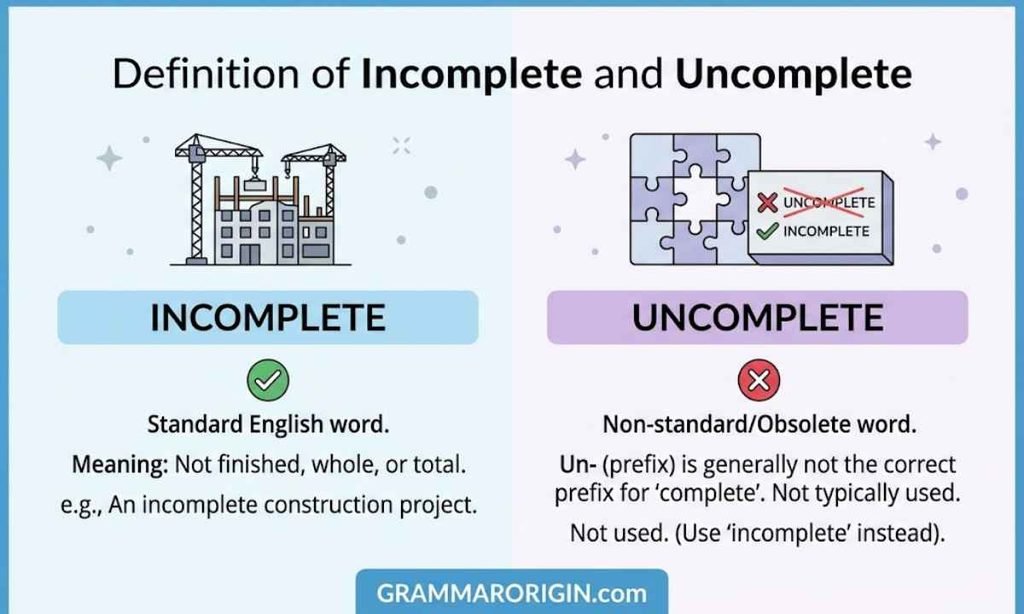
Incomplete is a standard adjective that means not whole, not finished, or missing a part. Uncomplete is a rare, nonstandard variant that most writers never use.
The report is incomplete because the last chart is missing.
Dictionaries such as Merriam-Webster and Dictionary.com list incomplete as a normal word. Uncomplete, on the other hand, shows up mainly as a rare synonym on some word lists. If you want your writing to look careful, settle the incomplete or uncomplete question by picking incomplete every time. The mix-up usually starts when people assume un- is the default way to say “not.”
The odd capital letters in “InComplete or UnComplete” are just how people type the search. In normal writing, both words are lowercase.
InComplete or UnComplete: Key Differences
The main difference is status. Incomplete is standard English, while uncomplete is a rare variant you should avoid.
Here’s the quick side-by-side view:
| Point | Incomplete | Uncomplete |
| Status | Standard English | Rare, nonstandard |
| Meaning | Missing parts or not finished | Same idea, but not accepted in careful writing |
| Dictionaries | Listed as a main entry | Not a main entry in major dictionaries |
| Safe for school and work? | Yes | No |
| Example | The form is incomplete. | The form is uncomplete. (avoid) |
In the incomplete or uncomplete pair, the meaning is nearly the same, so the real gap is about trust. Readers see incomplete as normal and uncomplete as a slip.
Wrong: Her answer was uncomplete.
Right: Her answer was incomplete.
Pronunciation (IPA)
Say incomplete as in-kuhm-PLEET, with the stress on the last syllable. The same stress pattern works in both US and UK English.
IPA means International Phonetic Alphabet, a system that writes down speech sounds. The table shows how the related words sound:
| Word | IPA | Respelling |
| incomplete | /ˌɪnkəmˈpliːt/ | in-kuhm-PLEET |
| uncompleted | /ˌʌnkəmˈpliːtɪd/ | un-kuhm-PLEE-tid |
The first vowel is the only real clue. In incomplete, “in” sounds like the word “pin.” In uncompleted, “un” sounds like the word “sun.” That small vowel shift is where the incomplete or uncomplete confusion starts.
Say it out loud: The essay is incomplete, so please add a conclusion.
Say it again: The bridge stayed uncompleted for two years.
Why “Incomplete” Is the Correct Word
In the incomplete or uncomplete contest, incomplete is correct because it has been the established word for centuries, and every major dictionary lists it. Merriam-Webster dates its first known use to the 14th century.
The word is built from the prefix in-, meaning “not,” plus complete, which comes from the Latin completus. That Latin link matters, because in- is the usual prefix for words that came into English this way.
Here are a few common partners you’ll see in real writing:
- incomplete information
- incomplete data
- incomplete application
- incomplete sentence
The word has a family too: incompletely (adverb), incompleteness (noun), and incompletion (noun, often used in sports).
The data was incompletely entered, so the totals were off.
The online order was incomplete, so the shop sent a reminder email.
Because the word is so common, readers don’t stop to think about it, and the incomplete or uncomplete doubt never comes up. That’s exactly what you want from a spelling choice.
Why “Uncomplete” Is Incorrect or Rare
Uncomplete is rare because English already has a settled negative for complete, and that word is incomplete. A second version just sounds like a mistake, which is why the incomplete or uncomplete debate is so one-sided.
Native English un- does attach to many words, but it tends to join participles, such as completed. That’s why uncompleted exists as a word and uncomplete never caught on.
Major dictionaries point the same way. Dictionary.com sends a search for uncomplete to incomplete, and some learner dictionaries mark uncomplete as nonstandard.
Wrong: The homework is uncomplete.
Right: The homework is incomplete.
A copy editor would most likely change uncomplete to incomplete without a second thought.
Common Mistakes and Confusions
The most common incomplete or uncomplete mistake is writing uncomplete when you mean incomplete. A few other slips show up often too.
| Mistake | Fix | Why |
| The form is uncomplete. | The form is incomplete. | Uncomplete is nonstandard |
| He was in complete control. (meaning unfinished) | He was in complete control. (meaning total) | “In complete” as two words means total, not unfinished |
| Writing InComplete in a sentence | Writing incomplete | The odd capitals are only a search habit |
| Using uncompleted for missing parts | Using incomplete | Incomplete stresses missing parts |
The two-word version also trips people up, even once the incomplete or uncomplete question is settled. “In complete silence” means fully silent, while “incomplete silence” would be a strange phrase.
Mix-up: The room fell in complete silence.
One word: The film felt incomplete without its final scene.
Read More Related posts Salvadoran or Salvadorian: Which Spelling Is Correct? (Dictionary Proof)
Examples of “Incomplete” in Sentences
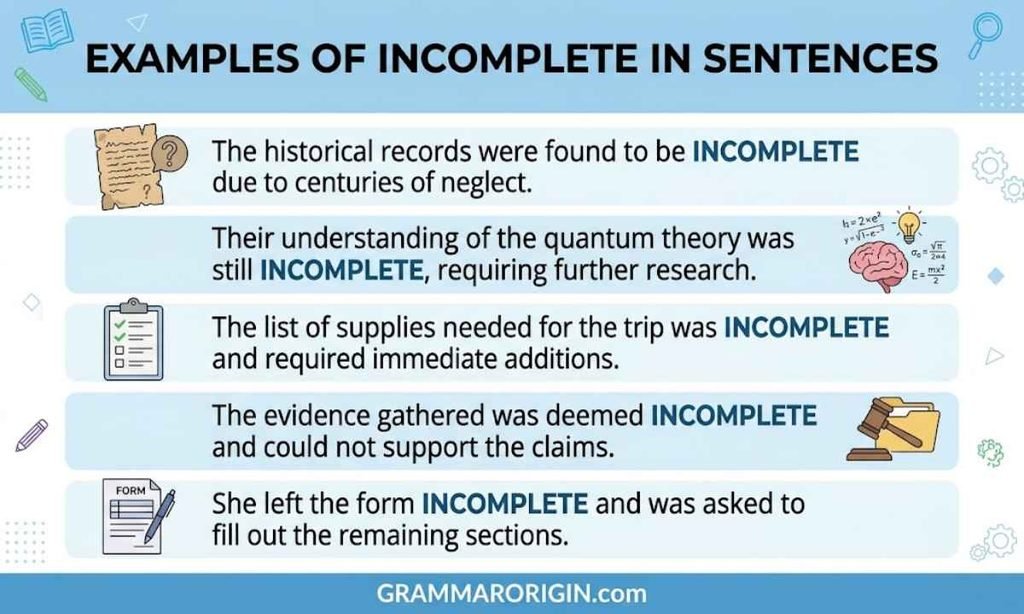
Incomplete works in school, work, sports, and daily life. Here are real-life examples by context.
School: Her essay is incomplete because the conclusion is missing.
Work: The project plan is incomplete until legal signs off.
Online form: Your application is incomplete, so we can’t process it yet.
Sports: The quarterback threw an incomplete pass on third down.
Daily life: The jigsaw puzzle stayed incomplete after one piece went missing.
Feelings: He felt incomplete whenever his best friend was away.
Notice that the word can describe things, plans, and even feelings. The spelling never changes, so the incomplete or uncomplete choice is easy here.
Can “Uncomplete” Ever Be Used?
Short answer: for the incomplete or uncomplete choice, almost never pick uncomplete. You may meet uncomplete as a rare variant in some word lists, but you shouldn’t use it in your own writing.
There are only a few narrow cases:
- Quoting someone else’s text exactly
- Writing about the word itself, such as in a language article
- Software, where some menus or code may use “uncomplete” as a command name for undoing a finished task
Software example: The app has an uncomplete button that moves a task back to your to-do list.
Outside those cases, choose incomplete. If you need a verb meaning “mark as not done,” a phrase like “reopen” or “mark as incomplete” reads more naturally.
Incomplete vs Uncompleted vs Unfinished
All three describe something that isn’t done, but they feel different. Incomplete stresses missing parts, unfinished is the everyday choice, and uncompleted is a formal word for a task that was never carried to the end.
| Word | Best for | Feels | Example |
| incomplete | Something missing parts | Neutral, very common | An incomplete set of cards |
| unfinished | Work that isn’t done yet | Casual, natural | An unfinished painting |
| uncompleted | A task or form left undone | Formal, less common | An uncompleted form |
You’ll usually see uncompleted with nouns like task, form, project, or draft. Dictionaries also use it in sports, such as an uncompleted pass.
Look at how each word changes the picture:
The museum kept an unfinished sketch in a drawer.
The collection is incomplete because two volumes are missing.
The bridge stayed uncompleted until the town found more funding.
Other near-synonyms include partial, fragmentary, and lacking, though each has its own shade. Partial and fragmentary suit pieces of a larger whole.
The survey gave only a partial picture of the problem.
If you’re unsure, unfinished and incomplete are the safest picks, and that settles any incomplete or uncomplete worry.
Linguistic Insight: Prefix “In-” vs “Un-”
Both prefixes mean “not,” but they come from different sources. In- came into English from Latin, while un- is the native English prefix.
In- tends to join Latin-based words, such as inactive, invisible, and incorrect. Un- joins many kinds of words, including adjectives (unhappy), participles (unopened), and verbs (undo).
That means the old idea that “un- is only for verbs” isn’t true. Un- is very common with adjectives, as in unclear and unfinished.
In- also changes shape before some letters:
- im- before b, m, and p: impossible, immature
- il- before l: illegal
- ir- before r: irregular
in- plus complete gives incomplete.
un- plus happy gives unhappy.
in- plus possible gives impossible.
This is a strong habit, not an iron law. English has exceptions, so the final proof for incomplete or uncomplete is always a dictionary entry. For complete, the entry says incomplete.
Read More Related posts Salvadoran or Salvadorian: Which Spelling Is Correct? (Dictionary Proof)
Other Meanings of Incomplete
Beyond “not finished,” incomplete has a few special meanings in school, sports, science, and daily talk.
A school grade: Dictionary.com lists “incomplete” as a temporary grade, given when a student hasn’t met every course requirement yet. It can later change to a final grade.
Sports: In football, an incomplete pass is one that no receiver catches.
Biology: In genetics, incomplete dominance describes a trait that blends two versions instead of letting one win.
Botany: An incomplete flower lacks one or more parts, such as stamens.
Feelings: People also use it for a sense that something is missing in life.
My grade is incomplete until I hand in the lab report.
The pass was incomplete, so the clock stopped.
These uses show that incomplete is also a noun in school talk, as in “I got an incomplete in chemistry.” That’s one more reason incomplete wins the incomplete or uncomplete contest.
Expert Opinion on Correct Usage
The strongest evidence in the incomplete or uncomplete debate is what major dictionaries show. They list incomplete as the standard word and treat uncomplete as, at most, a rare variant.
Merriam-Webster gives incomplete a full entry and dates it to the 14th century. Dictionary.com also gives it a full entry, with senses for school, sports, and engineering, and it redirects a search for uncomplete to incomplete.
Vocabulary.com lists uncomplete only as a synonym under uncompleted. That placement shows how minor the word is.
No made-up quote is needed here, because the dictionary pattern is clear. In practice, an editor, a teacher, or a hiring manager would almost certainly fix uncomplete.
If you want a simple rule for your own writing, use incomplete for missing parts, unfinished for everyday work, and uncompleted for formal task language.
Self-Assessment: Test Your Understanding
Try these six questions on incomplete or uncomplete before you check the answers.
- His essay is ________ because the last page is missing. (incomplete / uncomplete)
- The quarterback threw an ________ pass. (incomplete / uncomplete)
- Which word is NOT standard English? (incomplete / uncompleted / uncomplete)
- Fix this sentence: “The report is uncomplete.”
- Which one is a sentence fragment? (a) “When the bell rang.” (b) “The bell rang.”
- Which is right? “She stayed calm in ________ silence.” (incomplete / in complete)
Answers to Self-Assessment
- Incomplete. It’s the standard word for something missing a part.
- Incomplete. An incomplete pass is a normal sports term.
- Uncomplete. Uncompleted is formal but real, while uncomplete is nonstandard.
- “The report is incomplete.” Swap uncomplete for incomplete.
- (a). “When the bell rang” doesn’t finish its thought.
- In complete. Two words, meaning “totally,” as in “in complete silence.”
Incomplete or uncomplete sentence
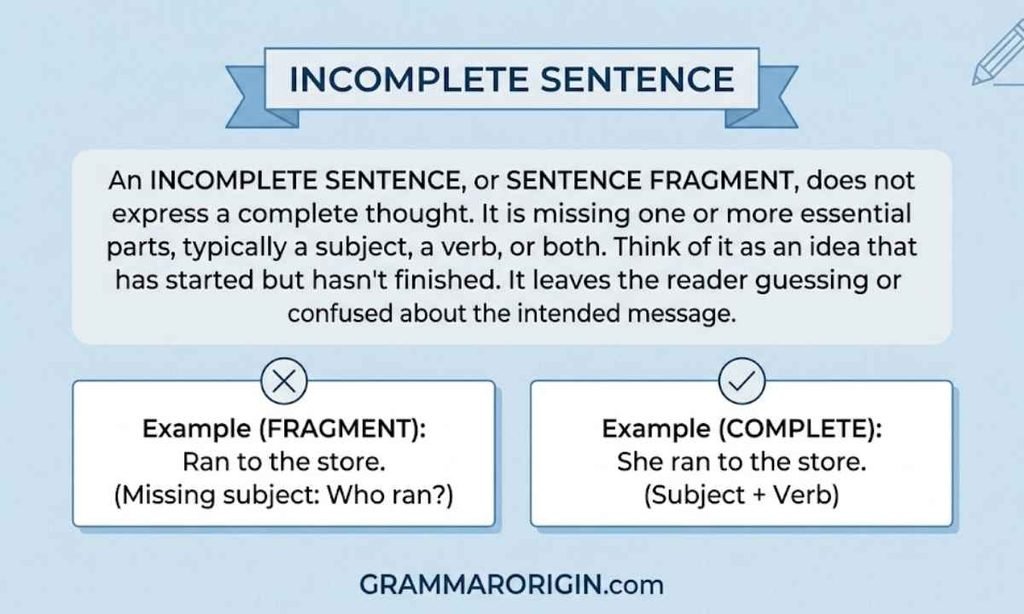
An incomplete sentence is a grammar term for a sentence fragment. An “uncomplete sentence” is not the standard way to say it.
A fragment is a group of words that doesn’t give a full thought. It may lack a subject, a verb, or a main clause.
Fragment: Running down the street.
Fix: She was running down the street.
Fragment: Because it was raining.
Fix: We stayed home because it was raining.
Use unfinished sentence when someone trails off on purpose, as in dialogue.
Here’s how the incomplete or uncomplete question plays out with sentences. A teacher marks a fragment as an incomplete sentence, and nobody writes uncomplete sentence in a grammar note.
Conclusion
The incomplete or uncomplete question has a clear answer: write incomplete. It’s the standard word that major dictionaries list, and it works in school, work, sports, and daily life.
Keep uncomplete for rare cases like quoting or discussing the word itself. For formal task language, uncompleted is the one to know, and unfinished is the friendly everyday choice.
Frequently Asked Questions
Is uncomplete a real word?
It appears as a rare variant on some word lists, but it isn’t standard English. Use incomplete instead.
Which is correct, incomplete or uncomplete?
In the incomplete or uncomplete choice, incomplete is correct. Uncomplete is nonstandard and best avoided.
What is the difference between incomplete and uncompleted?
Incomplete stresses missing parts, while uncompleted describes a task or form left undone. Uncompleted is more formal and less common.
Why is it incomplete and not uncomplete?
Complete came from Latin, and the in- prefix usually joins Latin-based words. Incomplete has been the standard form since the 14th century.
Is incomplete a noun or an adjective?
It is mainly an adjective. In school talk, it can also be a noun, meaning a temporary grade.
What is an incomplete sentence?
It’s a sentence fragment, meaning a group of words that doesn’t express a full thought. Adding a subject, a verb, or a main clause fixes it.

Muhammad Waqas is an English language teacher and grammar expert with over 8 years of experience helping students and professionals improve their writing skills. He specializes in English grammar, vocabulary, communication, and practical language learning. Through GrammarOrigin, Waqas shares clear, easy-to-understand content that helps readers write and speak English with confidence.