
Wondering whether to write people do or people does? You’re not alone — this is one of the most common subject-verb agreement mix-ups in English.
The good news is the rule is simple once you see why “people” behaves the way it does.In this guide, you’ll learn the correct form, the grammar logic behind it, and real examples so you never second-guess this again.
Quick Answer: Is It “People Do” or “People Does”?
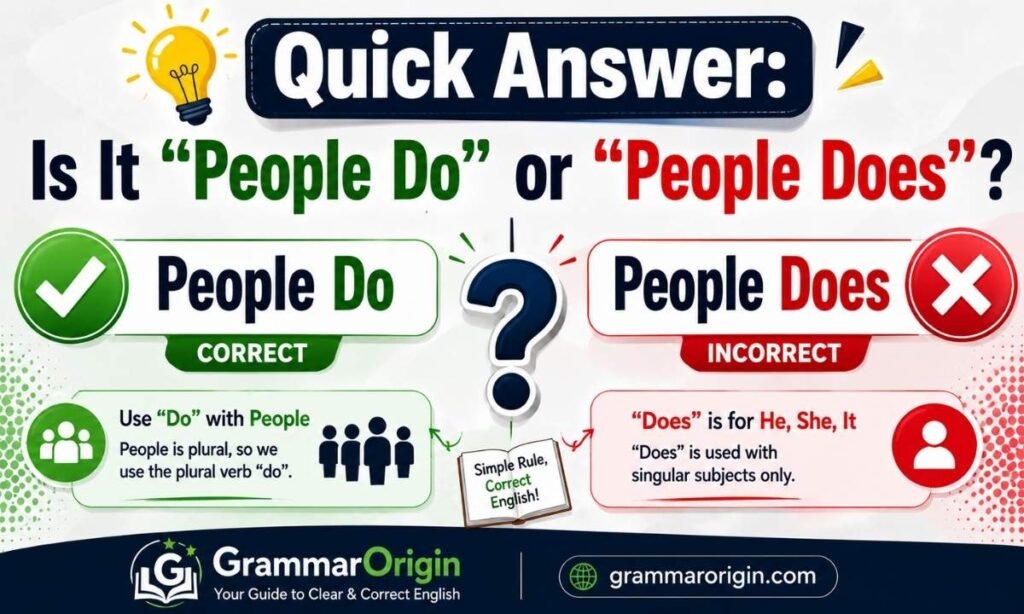
“People do” is correct. “People does” is incorrect.
“People” is a plural noun, and plural subjects always take the plural verb “do,” not “does.” “Does” only pairs with singular subjects like he, she, or it.
- ✅ People do care about honesty.
- ❌ People does care about honesty.
That’s the short version. Now let’s look at why.
What Does “People Do or People Does” Mean?
This phrase describes a common grammar question: which verb form matches the word “people” in the present tense.
“People” is the plural form of “person.” It refers to more than one individual, so grammatically it acts like “they,” “we,” or “you.” That’s why “do” fits and “does” doesn’t.
Think of it this way: one person does something, but many people do it together. The verb changes because the number of the subject changes.
Why “People Do” Is Correct (Subject-Verb Agreement Explained)
Subject-verb agreement is a core rule in English grammar. It simply means the verb must match the subject in number.
- Singular subject → singular verb (he does, she does, it does)
- Plural subject → plural verb (they do, we do, people do)
Since “people” is plural, it needs a plural verb. Using “does” with “people” breaks this agreement and sounds incorrect to native speakers.
A simple test: swap “people” with “they.” If “they do” sounds right, “people do” is right too.
- They do their best. ✅
- People do their best. ✅
- They does their best. ❌
- People does their best. ❌
History: Why Is “Do” Irregular?
“Do” is one of English’s oldest and most irregular verbs. It comes from Old English “dōn,” and it has never followed the standard “-s” pattern that most verbs use for third-person singular.
Most present-tense verbs simply add “-s” for singular subjects (he walks, she runs). But “do” changes its spelling entirely, becoming “does.” This irregularity is inherited from centuries of language change, not a modern rule invented to confuse learners.
Knowing this history helps explain why “people,” despite not ending in “-s,” still follows plural logic — English plural nouns don’t need an “-s” to be grammatically plural, and irregular verbs like “do” don’t follow the usual singular pattern either.
Examples of “People Do” in Sentences
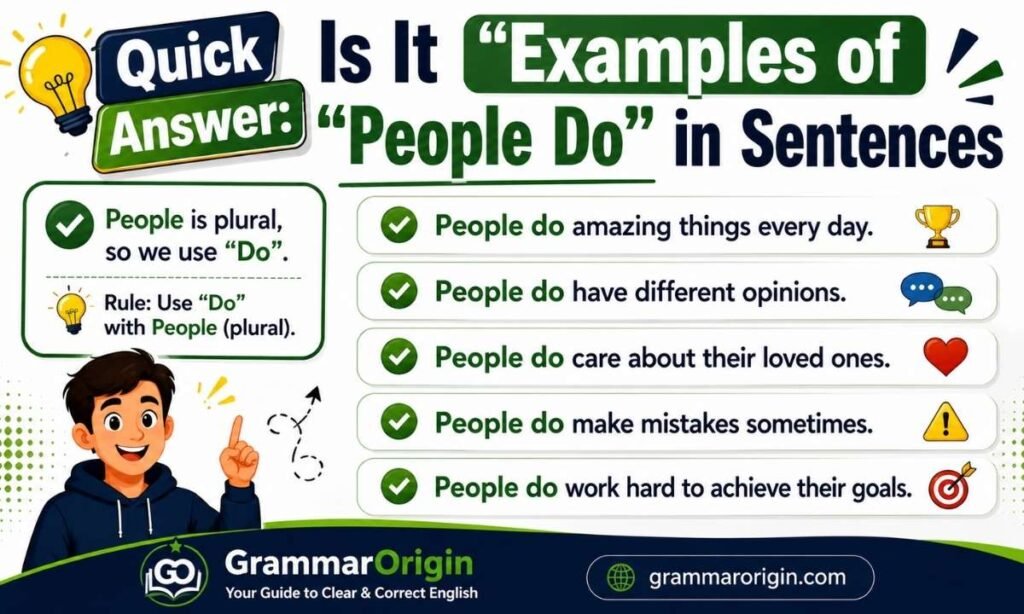
Seeing “people do” in different contexts makes the rule easier to remember.
Everyday examples:
- People do make mistakes sometimes.
- People do enjoy good food.
- People do care about the environment.
Formal writing examples:
- People do contribute to their communities through volunteer work.
- People do respond differently to stress and pressure.
Conversational examples:
- “People do that sometimes.”
- “People do say strange things online.”
Notice that in every sentence, “people” pairs naturally with “do,” never “does.”
MORE RELATED POSTS CLICK ME
Common Mistakes & How to Fix Them
Here are the most frequent errors learners make with “people,” and how to correct them.
Mistake 1: Using “does” with “people” ❌ People does understand the rule. ✅ People do understand the rule.
Mistake 2: Confusing “person” and “people” ❌ A people is responsible for this. ✅ A person is responsible for this.
Mistake 3: Assuming “people” sounds singular, so it needs “does” This happens because “people” doesn’t end in “-s” like typical plural nouns (dogs, books). But it’s still fully plural.
Mistake 4: Mixing verb forms in the same sentence ❌ People does their job because he likes it. ✅ People do their jobs because they like them.
“Do People” vs “Does People” in Questions
The same rule applies in questions. Since “people” is plural, questions must use “do,” not “does.”
- ✅ Do people understand this rule?
- ❌ Does people understand this rule?
- ✅ Why do people make the same mistake?
- ❌ Why does people make the same mistake?
If you can rephrase the question with “they,” the correct verb becomes obvious: “Do they understand?” not “Does they understand?”
Negative Form: “People Don’t” or “People Doesn’t”?
The negative form follows the exact same plural rule.
- ✅ People don’t always agree.
- ❌ People doesn’t always agree.
- ✅ People do not like being ignored.
- ❌ People does not like being ignored.
“Don’t” is the contraction of “do not,” and since “people” always takes “do,” it also always takes “don’t” — never “doesn’t.”
“Some People Do or Does”? / “Everyone Do or Does”?
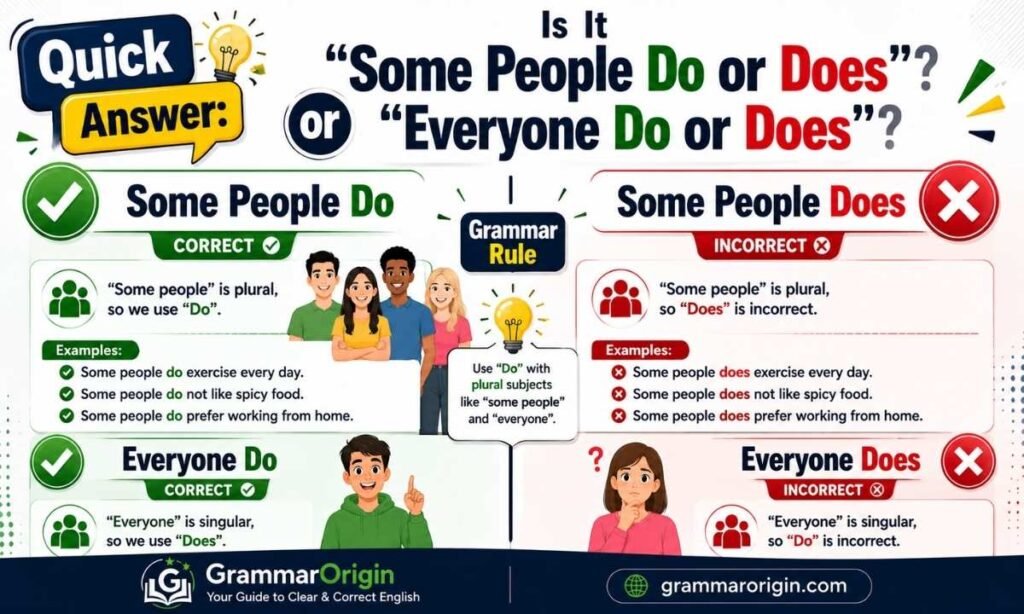
These two phrases often get confused, but they follow different rules.
“Some people” is still plural, so it takes “do.”
- ✅ Some people do prefer working alone.
- ❌ Some people does prefer working alone.
“Everyone” is grammatically singular, even though it refers to a group, so it takes “does.”
- ✅ Everyone does their own part.
- ❌ Everyone do their own part.
The difference comes down to grammar, not meaning. “Some people” is a true plural noun phrase. “Everyone” is treated as one singular unit in English.
People Do vs Everyone Does — Why They’re Different
This comparison confuses many learners because both words can describe groups.
| Word | Grammatical Number | Correct Verb | Example |
| People | Plural | do | People do their best. |
| Everyone | Singular | does | Everyone does their best. |
| Everybody | Singular | does | Everybody does their best. |
| Someone | Singular | does | Someone does the dishes. |
“People” refers to many individuals as a group. “Everyone,” “everybody,” and “someone” refer to each person individually, so English treats them as one singular unit — even though the meaning feels plural.
Is “A People” Ever Singular?
Rarely, yes — but only in a specific sense. “A people” can refer to a nation, ethnic group, or cultural group, treated as one unit.
Example: A people is defined by its shared history and traditions.
However, native speakers often debate this in practice. In discussions like those on WordReference forums, speakers note that phrases such as “the Mohawk people” typically still take a plural verb — “the Mohawk people are the largest tribe,” not “is.” The singular “a people” construction is mostly limited to formal, academic, or historical writing, not everyday conversation.
For daily English, stick to the standard rule: “people” is plural, and it takes “do.”
MORE RELATED POSTS CLICK ME
Other Plural Nouns That Follow the Same Rule
“People” isn’t the only irregular plural noun that confuses learners. These words are also plural in meaning, even though they don’t end in “-s”:
| Noun | Correct Verb | Example |
| People | do | People do care about fairness. |
| Children | do | Children do learn through play. |
| Men | do | Men do experience stress too. |
| Women | do | Women do hold leadership roles. |
| Police | do | The police do investigate crimes. |
| Cattle | do | Cattle do graze in open fields. |
If you can replace the noun with “they,” it needs “do,” not “does.” This trick works for every word on this list.
“People Do or Does” in Other Tenses
The do/does confusion only applies to the simple present tense. Other tenses use the same form for both singular and plural subjects, which removes the confusion entirely.
- Present: People do their homework. / A person does their homework.
- Past: People did their homework. (same for singular and plural)
- Future: People will do their homework. (same for singular and plural)
- Present continuous: People are doing their homework.
- Present perfect: People have done their homework.
Notice that “did,” “will do,” and “have done” don’t change based on number. The do/does distinction is unique to the present simple tense.
Formal vs Informal Usage
The grammar rule doesn’t change based on setting — “people do” is correct everywhere. But how strictly it’s judged does change.
| Context | Correct Form | Notes |
| Academic writing | People do | Required; errors reduce credibility |
| Business emails | People do | Signals professionalism |
| Casual conversation | People do | Still correct and natural |
| Social media | People do | Informal tone, but grammar still noticed |
| Dialects/slang | Varies | “People does” may appear informally but isn’t standard |
Even in casual speech, “people do” is the natural, expected form. There’s no context where “people does” becomes acceptable in standard English.
Quick Reference Table
| Subject | Correct Verb | Example |
| People | do | People do their best. |
| A person | does | A person does their best. |
| They | do | They do their best. |
| Everyone | does | Everyone does their best. |
| Some people | do | Some people do agree. |
| A people (nation) | is / are | A people is/are defined by its culture. |
Quiz: Test Yourself
Choose the correct word for each sentence.
- People ______ (do/does) their best under pressure.
- Everyone ______ (do/does) their own work.
- Some people ______ (do/does) not like change.
- A person ______ (do/does) what is asked.
- Why ______ (do/does) people make the same mistake?
- People ______ (don’t/doesn’t) always agree.
- Children ______ (do/does) learn through play.
- The police ______ (do/does) patrol this area.
Answers: 1. do — 2. does — 3. do — 4. does — 5. do — 6. don’t — 7. do — 8. do
Frequently Asked Questions
Is it correct to say “people does”?
No. “People” is a plural noun, so it always takes the plural verb “do,” never “does.”
Why do people confuse “do” and “does” with the word “people”?
Because “people” doesn’t end in “-s” like most plural nouns, some learners mistakenly treat it as singular.
Is “people” always plural?
In everyday English, yes. It’s only used as singular in the rare “a people” sense, meaning a nation or ethnic group.
What is the singular form of “people”?
The singular form is “person,” which correctly pairs with “does.”
Does the do/does rule change in questions or negatives?
No. Questions use “do people,” and negatives use “people don’t,” following the same plural agreement rule.
Can “people does” ever be correct in any dialect?
It may appear informally in some dialects or online humor, but it’s not standard and shouldn’t be used in formal or professional writing.
What’s the difference between “people do” and “everyone does”?
“People” is grammatically plural, so it takes “do.” “Everyone” is grammatically singular, even though it implies a group, so it takes “does.”
Conclusion
The rule is simple: people do, not people does. “People” is a plural noun, and plural subjects always pair with plural verbs in English.
Whether you’re writing an email, an essay, or a casual message, remembering that “people” behaves like “they” will keep your grammar correct every time.

Muhammad Waqas is an English language teacher and grammar expert with over 8 years of experience helping students and professionals improve their writing skills. He specializes in English grammar, vocabulary, communication, and practical language learning. Through GrammarOrigin, Waqas shares clear, easy-to-understand content that helps readers write and speak English with confidence.