
You’ve probably typed sweetie, sweety, or even sweatie in a text and paused, unsure which one actually looks right. All three seem almost identical, but only one or two are truly standard English.
This guide clears up the confusion for good — using dictionary-backed definitions, not guesswork.
You’ll learn the correct spelling for each context, what each word really means, and when to use them naturally in everyday conversation. We’ll also cover the one detail most guides get wrong: whether “sweety” is really a mistake, or just a different standard.
Quick Comparison Table: Sweetie vs Sweety vs Sweatie
Here’s the short answer before the details.
| Word | Status | Meaning | Common Region |
| Sweetie | Standard spelling | Term of endearment; also British slang for candy | US, UK, worldwide |
| Sweety | Standard British variant (not a typo) | Same meaning as sweetie | UK, South Asia, Commonwealth English |
| Sweatie | Not a real word | Almost always a typo or autocorrect slip for “sweaty” | Not used anywhere as a real spelling |
In short: sweetie and sweety are both legitimate, just used in different regions. Sweatie is the only one that’s actually wrong.
Sweetie vs Sweety: The Real Difference
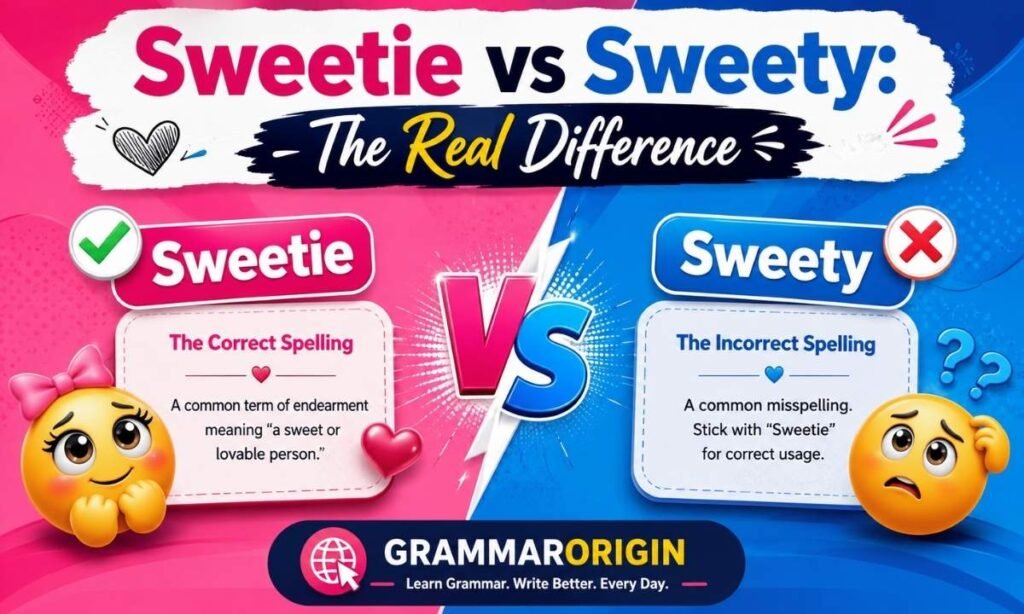
Sweetie is a warm, affectionate way to address someone you care about. It’s used by partners, parents, friends, and family.
Sweety means exactly the same thing. The only real difference is spelling style, not meaning.
Both words work as terms of endearment. Neither one changes tone, warmth, or intent. The choice mostly comes down to where you learned English.
Examples:
- “Thanks for helping me out, sweetie.”
- “Good morning, sweety! Sleep well?”
Both sentences are correct. Neither sounds wrong to a native speaker.
Is “Sweety” Actually Wrong? What Cambridge & Merriam-Webster Say
Short answer: No, “sweety” is not wrong. It’s a recognized British spelling of “sweetie,” not a misspelling.
Most grammar sites claim sweety is incorrect. That claim doesn’t hold up against the actual dictionaries.
Merriam-Webster’s entry for “sweety” defines it directly as the British spelling of sweetie. That’s not a warning label — it’s a standard cross-reference, the same way dictionaries treat “colour” as the British spelling of “color.”
Cambridge Dictionary does the same thing. Its “sweety” entry simply points to “sweetie” as an equivalent word, not a flagged error.
So if you’ve been told sweety is a typo, that’s outdated or incomplete advice. It’s a regional spelling difference, not a mistake.
Sweetie vs Sweety: US vs UK Spelling
This is the clearest way to remember it:
- American English almost always uses sweetie.
- British English commonly uses both sweetie and sweety, with sweety appearing more in casual and spoken contexts.
Neither version will confuse a native speaker. The gap is stylistic, similar to “favorite” vs “favourite.”
If you’re writing for a US audience, stick with sweetie. If you’re writing for a UK or international audience, either spelling reads naturally.
READ MORE RELATED POSTES CLICK ME
Sweetie in Different English-Speaking Countries
Spelling habits shift slightly by region:
- United States: Sweetie is the default. Sweety is rare and can look like a typo to American readers.
- United Kingdom: Both spellings are common. Sweety shows up often in informal writing and speech.
- South Asia (India, Pakistan, Bangladesh): Sweety is widely used, including as a nickname or informal first name.
- Australia & Canada: Sweetie is more common, though sweety appears occasionally due to British influence.
None of these regional habits make one version “more correct” than the other. They’re just different norms.
How to Pronounce Sweetie, Sweety & Sweatie
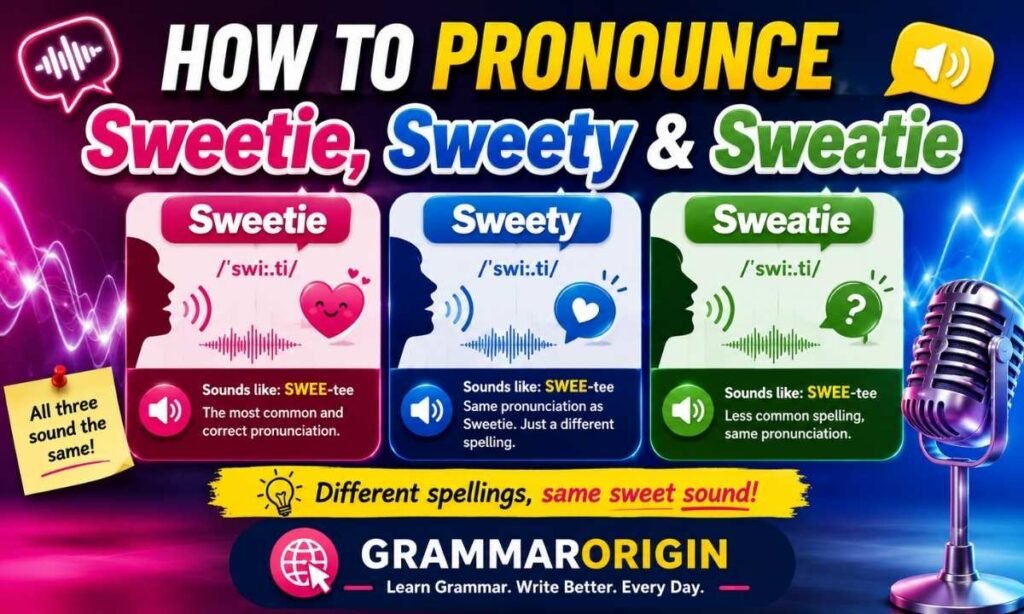
All three words are pronounced almost identically, which is exactly why the spelling confusion happens.
- Sweetie: /ˈswiː.ti/ — “SWEE-tee”
- Sweety: /ˈswiː.ti/ — same pronunciation as sweetie
- Sweatie: Not a standard word, so it has no official pronunciation. If someone reads it aloud, it usually comes out sounding like “sweh-tee” (like “sweaty”) rather than “swee-tee.”
This is the core reason typos happen. The ear can’t catch a spelling difference that doesn’t change the sound.
What About “Sweatie”? (Common Autocorrect Mistake)
Sweatie is not a real word. It has no dictionary entry and no accepted meaning as a term of endearment.
Most of the time, “sweatie” shows up because of one of two things:
- Autocorrect, which swaps “sweetie” for “sweaty” mid-sentence
- A phonetic guess, where someone types the word the way it sounds without checking the spelling
If you see “sweatie” in a message, it almost always means the sender meant “sweetie” and got autocorrected — or meant “sweaty” and misspelled that instead. Either way, it’s worth double-checking before you hit send.
Where “Sweetie” Comes From (Brief Etymology)
“Sweetie” comes from the word sweet, which entered English from Old English swēte, originally describing taste.
Over time, “sweet” expanded to describe personality and affection, not just flavor. Adding -ie to a word is a common way English creates affectionate, smaller-sounding versions of nouns — the same pattern you see in “doggie” or “birdie.”
“Sweety” follows the exact same pattern, just with a -y ending instead of -ie. Both endings are standard diminutive suffixes in English, which is part of why sweety isn’t actually a spelling error — it’s built the same way sweetie is.
Sweetie Beyond Pet Names: Candy & the Sweetie Fruit
“Sweetie” has two other common meanings that most guides skip entirely.
1. British slang for candy. In UK English, “sweets” or “sweeties” refers to candy, especially when adults are talking to children.
- “The sweetie jar is empty again.”
- “If you behave, you can have a sweetie.”
2. A citrus fruit. “Sweetie” is also the name of a fruit — a cross between a grapefruit and a pomelo, originally developed in Israel. It’s sold in some grocery stores under that exact name.
Neither of these meanings has anything to do with romance or affection, so context makes it easy to tell which one is meant.
What Does It Mean When Someone Calls You Sweetie?

Short answer: it usually signals warmth or friendliness, not necessarily romance. The exact meaning depends on who’s saying it.
When a Girl Calls You Sweetie
It often means friendly affection or comfort. It can be romantic, but it’s just as commonly used between close friends or as a caring gesture.
When a Guy Calls You Sweetie
It’s typically affectionate too, and slightly more likely to carry a romantic tone, especially outside of family contexts. Still, plenty of men use it platonically with friends or younger relatives.
Tone, relationship, and context matter more than the word itself. The same word can mean comfort from a parent or flirtation from a partner.
Sweetie Pie: What It Means
“Sweetie pie” is an extra-affectionate version of “sweetie.” It’s used the same way, just with a warmer, more playful tone.
It’s common between:
- Parents and children
- Grandparents and grandkids
- Romantic partners
- Close friends, often teasingly
Example: “Come here, sweetie pie, let me fix your collar.”
Is Sweetie Pie Formal or Informal?
It’s informal. “Sweetie pie” belongs in casual, personal conversation only.
Avoid it in:
- Work emails
- Professional meetings
- Formal writing
It fits naturally in texting, family conversations, and close friendships — never in a business context.
Sweetie vs Sweetheart: Are They the Same?
They’re very close in meaning, but not identical in tone.
“Sweetheart” tends to sound slightly more romantic or formal, often used for partners. “Sweetie” feels more flexible and works comfortably with friends, kids, and family, not just romantic partners.
Both are safe, standard English terms of endearment. The choice usually comes down to how intimate or casual you want the tone to feel.
READ MORE RELATED POSTES CLICK ME
Context Matters: When to Use (and Avoid) These Terms
Use sweetie or sweety when:
- Talking to a partner, close friend, or family member
- Comforting a child
- The relationship is already warm and familiar
Avoid them when:
- You’re speaking to a stranger
- The setting is professional
- You’re unsure how the other person will take it
| Situation | Appropriate? |
| Texting a partner | Yes |
| Talking to a child | Yes |
| Emailing a coworker | No |
| Speaking to a customer | No |
| First conversation with someone new | No |
Can You Call a Coworker or Stranger “Sweetie”?
Short answer: generally, no. In professional or first-time interactions, it can come across as overly familiar or even condescending.
Even if you mean it kindly, the other person has no context for your tone. It can feel patronizing, especially across different levels of seniority, like a manager speaking to an employee.
Stick to a name or a neutral term like “friend” or “colleague” in professional settings, and save sweetie for people you’re actually close to.
Other Common Pet Names Similar to Sweetie
If you want variety, here are a few natural alternatives:
- Honey — warm, common in close relationships
- Darling — slightly more formal, often romantic
- Sweetheart — similar warmth, slightly more intimate
- Love — common in British English
- Dear — polite, works in both casual and semi-formal writing
Each one carries a similar tone to sweetie, so switching between them keeps conversation from feeling repetitive.
Frequebtly Asked Questions
Is “sweetie” or “sweety” the correct spelling?
Both are correct. Sweetie is standard in American English, while sweety is a recognized British spelling of the same word.
Is sweety a misspelling of sweetie?
No. Dictionaries like Merriam-Webster and Cambridge list sweety as a valid British variant, not an error.
What does sweatie mean?
Nothing. Sweatie isn’t a real word — it’s almost always a typo for “sweetie” or “sweaty.”
Can sweetie mean something other than a pet name?
Yes. In British English, “sweetie” can mean candy, and it’s also the name of a grapefruit-pomelo hybrid fruit.
Is it okay to call a coworker sweetie?
No, it’s best avoided in professional settings. It can come across as too familiar or condescending.
Is sweetie pie the same as sweetie?
Almost. “Sweetie pie” is a more playful, affectionate version of “sweetie,” used in the same casual situations.
Is sweetie the same as sweetheart?
They’re close but not identical. Sweetheart tends to sound more romantic, while sweetie works for friends, family, and partners alike.
Conclusion
Sweetie and sweety are both correct — the difference is regional, not right versus wrong. Sweatie is the only one of the three that isn’t a real word, usually showing up by accident through autocorrect or a quick typo.
Once you know the context — who you’re talking to, and where English norms come from — choosing between sweetie and sweety becomes easy. Save sweetie or sweety for people you’re genuinely close to, and skip pet names altogether in professional settings.

Muhammad Waqas is an English language teacher and grammar expert with over 8 years of experience helping students and professionals improve their writing skills. He specializes in English grammar, vocabulary, communication, and practical language learning. Through GrammarOrigin, Waqas shares clear, easy-to-understand content that helps readers write and speak English with confidence.