
You’ve probably typed “I will response tomorrow” or “thank you for your quick respond” and paused, unsure if it looked right. Respond vs response trips up even confident writers because the words look and sound almost identical. The good news: the fix is a one-line rule, not a grammar lecture.
This guide breaks down exactly when to use respond vs response, with quick tests you can apply instantly, common-mistake fixes, and real examples from everyday, professional, medical, and even technical or legal writing — so you never second-guess the choice again.
Quick Answer: Respond vs Response at a Glance
Respond is a verb — it’s the action of replying or reacting. Response is a noun — it’s the reply or reaction itself.
Simple test: if you can put “a,” “the,” or “my” in front of it, use response. If you can add “-ed,” “will,” or “should” in front of it, use respond.
- ✅ “Please respond by Friday.” (action)
- ✅ “I received your response.” (thing)
Where Do “Respond” and “Response” Come From?
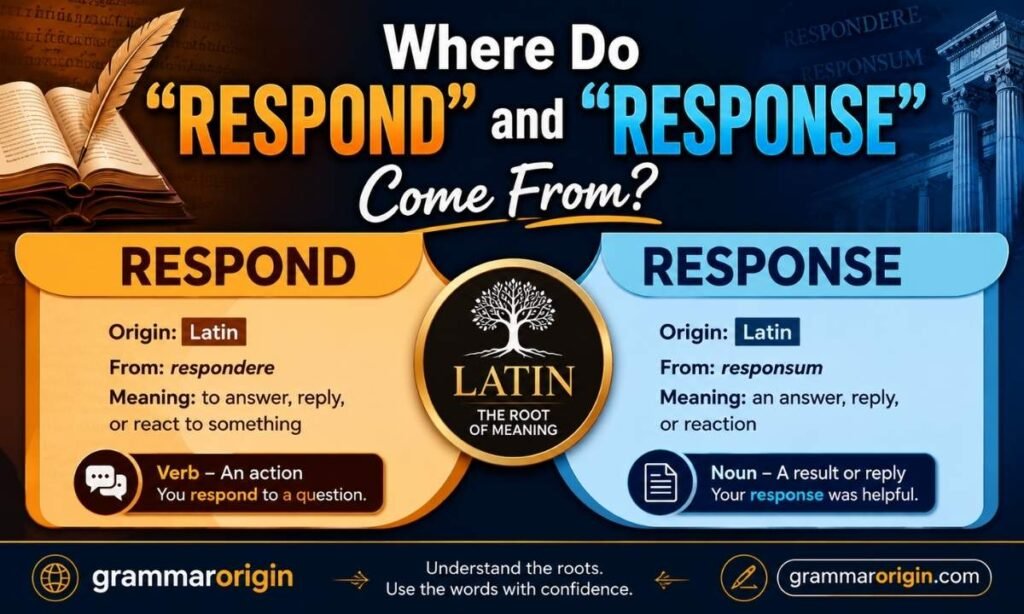
Both words trace back to the Latin verb respondere, meaning “to answer” or “to promise in return” — a combination of re- (“back”) and spondere (“to pledge”). English absorbed the verb form as respond through Old French, while response developed as the corresponding noun. That shared root explains why the two feel so interchangeable even though they play completely different grammatical roles today.
What “Response” Means (Noun)
Response names a thing — the outcome, reply, or reaction produced by an action. It’s a countable noun (plural: responses) and typically follows a determiner like a, the, my, or his.
Examples:
- “Her response was thoughtful and quick.”
- “We received over 300 responses to the survey.”
- “The company’s official response addressed every concern.”
What “Respond” Means
Respond is a regular verb (respond / responds / responded / responding) describing the act of replying, reacting, or engaging. It’s usually followed by “to” when there’s an object.
Examples:
- “Please respond to the invitation by Monday.”
- “He didn’t respond to my last two messages.”
- “The team responds quickly to customer complaints.”
Quick Rule: Action vs. Result
Three fast tests settle almost every case:
- Article test — Can you say “a ___” or “the ___”? → It’s response.
- Subject test — Does “she ___s” sound natural? → It’s respond (as responds).
- Auxiliary test — Does it follow do/does/did? → Use the base verb respond.
If you’re still unsure, swap in “answer” (noun) or “reply” (verb) — whichever fits is your clue.
READ MORE RELATED POSTES CLICK ME
Respond vs Response: Comparison Table
| Feature | Respond | Response |
| Part of speech | Verb | Noun |
| Meaning | To reply, react, or answer | The reply, reaction, or answer itself |
| Plural form | N/A (conjugates: respond/responds/responded) | Responses |
| Typical position | After a subject (I, she, they) | After an article/adjective (a, the, quick) |
| Example | “They will respond soon.” | “Their response was quick.” |
| In medicine | “The patient didn’t respond to treatment.” | “The patient’s treatment response was strong.” |
Common Mistakes and How to Fix Them
| ❌ Wrong | ✅ Right |
| “Please response soon.” | “Please respond soon.” |
| “He gave a quick respond.” | “He gave a quick response.” |
| “Did they response?” | “Did they respond?” |
| “I didn’t get a respond.” | “I didn’t get a response.” |
| “Thank you for your responds.” | “Thank you for your response.” |
Respond vs Response in Everyday Life
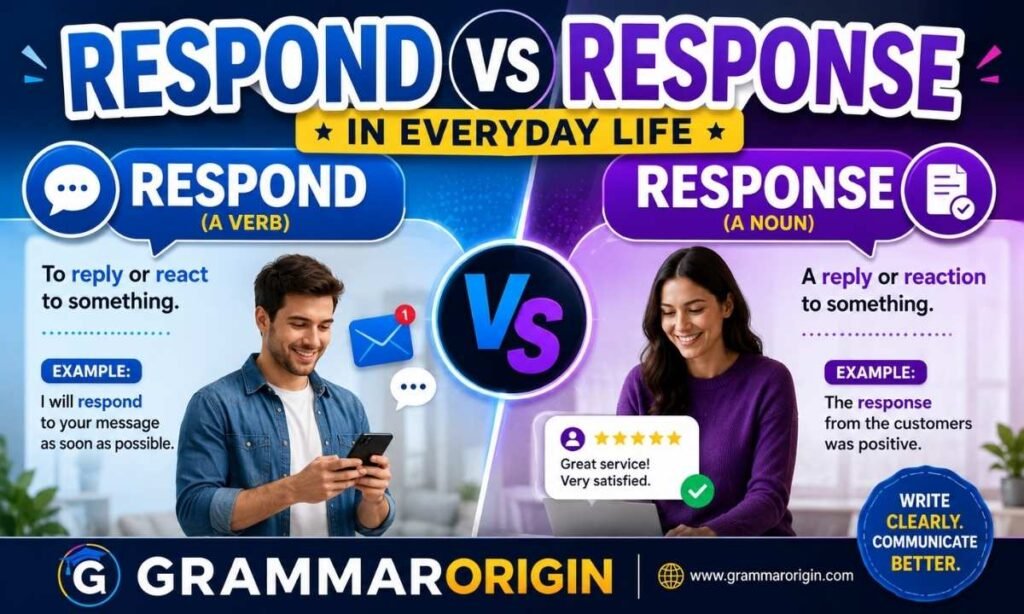
In Chat and Texting
Both words show up constantly in casual digital conversation.
- “Why didn’t you respond to my text?”
- “Thanks for the quick response 🙌”
In Email
This is where the mix-up is most common because “response” sits so close to “respond” in tone.
- “I’ll respond to your email by end of day.” (you’re describing the action you’ll take)
- “Thank you for your response.” (you’re thanking them for what they sent back)
“Thank you for your respond” or “response”? Always response — you’re thanking someone for the thing they gave you, not the act itself.
“Sorry for the late response” or “respond”? Also response — you’re apologizing for how long the reply took, not for a delayed action in isolation.
“In Response To” vs “In Respond To” — Which Is Correct?
Only “in response to” is correct. This is a fixed phrase where “response” functions as a noun object of the preposition “in.” “In respond to” is never grammatically valid, no matter the context.
- ✅ “In response to your question, the deadline has been extended.”
- ❌ “In respond to your question…”
Respond vs Reply vs Answer: How They’re Different
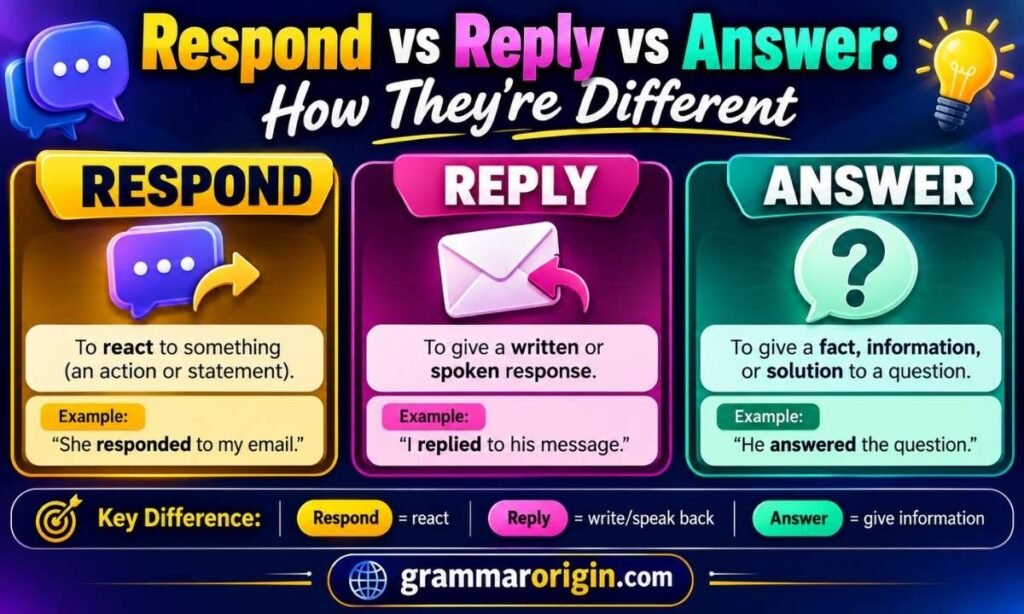
All three relate to giving something back after being addressed, but they’re not perfect substitutes:
- Answer usually implies resolving a specific question (“answer the question”).
- Reply is a direct, often written or spoken comeback to a message (“reply to an email”).
- Respond is broader — it can be verbal, written, physical, or even behavioral (“respond to criticism,” “respond to a stimulus”).
A useful distinction: you can “answer” a question and “reply” to a letter, but only “respond” covers reactions that aren’t communication at all — like a patient responding to medication or a plant responding to light.
Correspond / Correspondence vs Respond / Response
These are a separate, easily confused pair with the same Latin root family:
- Correspond (verb) means to match, align, or exchange letters over time — not to reply to a single message.
- Correspondence (noun) refers to an ongoing exchange of letters or messages, not a single reply.
Example distinction:
- “Her explanation didn’t correspond with the facts.” (matches/aligns)
- “Their business correspondence spanned two years.” (the exchange, not one reply)
- “She responded to his letter within a day.” (a single reply — not correspondence)
Medical & Clinical Usage
In medicine, the noun/verb distinction carries real diagnostic weight.
- Respond describes the patient’s action or reaction: “The patient didn’t respond to the first round of antibiotics.”
- Response describes the measured outcome: “Treatment response was documented at each follow-up visit.”
Quick Case Example
A patient starts a new medication for chronic pain. Day one: no response. Day three: partial response. Day seven: strong response at a lower dose. Notice how “response” tracks the outcome at each stage — the action of responding isn’t really being described here, the result is.
Psychology & Human Behavior
Psychology relies on both words to separate the act from the outcome:
- Behavioral: “A loud noise triggers a startle response.” (the reaction, named)
- Emotional: “People often respond to anxiety with tension.” (the process of reacting)
- Cognitive: “He didn’t respond right away — he took time to think it through, and his eventual response was measured and deliberate.” (both the action and the result appear in one thought)
The pattern holds throughout: respond describes the doing, response describes the produced reaction.
Technical & Computing Usage — API/HTTP Response
Outside grammar and medicine, “response” has a very specific, widely used technical meaning that most language guides skip entirely.
- A server responds to a request — that’s the action.
- The data or status code it sends back is called the response — for example, an HTTP response (like a “200 OK” or “404 Not Found”) or an API response (the JSON or data returned after a request).
Example:
- “The server responds within 200 milliseconds.”
- “We logged the full API response for debugging.”
Same noun/verb rule as everywhere else — it just happens to be machines doing the responding.
Legal Usage — Response to a Complaint
In legal writing, a response is a formal, filed document — not just any reply.
- “The defendant must respond to the complaint within 30 days.” (the action, often with a deadline)
- “The defendant’s response denied all allegations.” (the actual filed document/argument)
You’ll also see the noun form in terms like response brief or motion response — always referring to the written submission itself, never the act of writing it.
Response Time vs Response Rate (Business & Customer Service)
Two closely related business metrics that are easy to mix up:
- Response time = how quickly someone responds (e.g., “our support team’s average response time is 2 hours”).
- Response rate = what percentage of people respond at all (e.g., “the survey had a 40% response rate”).
Both use “response” as a noun because they’re measuring an outcome — a duration or a percentage — not describing the act of replying itself.
“Response” in Surveys, Forms & Feedback
When collecting feedback, each individual reply is called a response:
- “We received 1,200 survey responses.”
- “Please select one response per question.”
The action of filling it out is what someone “responds” to — the completed answer is their “response.”
Word Family: Respond, Response, Responsive, Responsible, Respondent
These related words share a root but mean different things, and mixing them up is a separate common error:
| Word | Part of Speech | Meaning |
| Respond | Verb | To reply or react |
| Response | Noun | The reply or reaction |
| Responsive | Adjective | Quick to react or reply (“a responsive team”) |
| Responsible | Adjective | Accountable or reliable — not related in meaning despite the similar spelling |
| Respondent | Noun | A person who responds — used especially in surveys and legal cases (“the respondent denied the claim”) |
Note that responsible shares the root but has drifted in meaning entirely — don’t assume every “respon-” word relates to replying.
Collocations: Words That Pair With Respond/Response
Certain word pairings show up constantly in natural English — learning them speeds up fluency:
- With respond: respond promptly, respond quickly, respond calmly, respond to criticism, fail to respond
- With response: prompt response, quick response, in response to, response rate, emotional response, immune response, no response
British vs American English: Any Usage Difference?
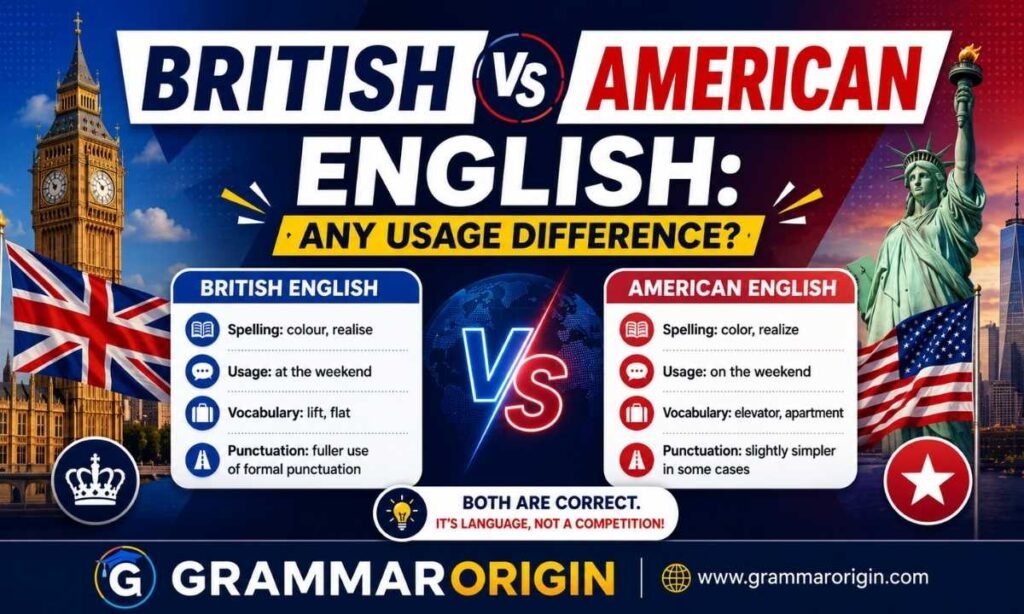
No meaningful difference exists between British and American English here — both varieties use respond as the verb and response as the noun identically. The grammar rule, spelling, and common phrases (like “in response to”) are consistent across regions.
READ MORE RELATED POSTS CLICK ME
How to Pronounce “Respond” and “Response”
- Respond: ri-SPOND (stress on the second syllable)
- Response: ri-SPONS (stress on the second syllable)
Both words stress the second syllable, which is part of why they sound so similar in fast speech — the ending is really the only audible difference (a “d” sound vs. an “s” sound).
Visual Guide: Respond → Response (Cause & Effect Diagram)
ACTION RESULT
┌───────────┐ produces ┌────────────┐
│ RESPOND │ ───────────────▶ │ RESPONSE │
│ (verb) │ │ (noun) │
└───────────┘ └────────────┘
“I will respond” “I got a response”
Think of it as cause and effect: the verb respond is the cause, and the noun response is the effect it produces.
Self-Test: Check Your Understanding
Fill in the blank with respond or response, then check your answer right below.
- Please ______ to my email by Friday. → respond
- Her ______ was calm and clear. → response
- The patient didn’t ______ to the medication. → respond
- We got a great ______ from the audience. → response
- Thank you for your quick ______. → response
- He refused to ______ to the accusation. → respond
- In ______ to your question, yes, it’s confirmed. → response
- The server ______s within milliseconds. → respond
Key Takeaways
- Respond = verb (action). Response = noun (result).
- Article test: “a/the ___” → response. Subject test: “she ___s” → respond.
- “In response to” is always correct; “in respond to” never is.
- The same rule holds across contexts — everyday chats, medicine, psychology, tech, law, and business metrics.
- Watch out for related-but-different words: correspond/correspondence and responsible aren’t interchangeable with respond/response.
Frequently Asked Questions
Is “response” plural?
Yes — the plural is responses (“we received 200 responses”).
Is “respond back” correct?
It’s redundant. “Respond” already implies giving something back, so just say “respond.”
“Thank you for your response” or “respond”? Always response — you’re thanking them for the thing they gave, not the act itself.
What’s the difference between respond and reply?
“Reply” usually refers to a direct answer to a specific message; “respond” is broader and covers verbal, written, physical, or behavioral reactions.
Is “response” used in computing?
Yes — an API response or HTTP response refers to the data or status a server sends back after a request.
Can “respond” be used without an object?
Yes — “He responded quickly” is complete on its own, though “respond to [something]” is more common.
Is this mistake common in professional writing?
Very — especially in fast-typed emails and messages, where “response” and “respond” get swapped under time pressure.
Final Thoughts
The difference between respond and response comes down to one dependable rule: respond is the action, response is the result. Once that clicks, the article test, subject test, and auxiliary test give you a fast way to check any sentence — whether you’re writing a quick text, a formal email, a medical note, or an API log. Keep the cause-and-effect image in mind — you respond, and that produces a response — and you’ll never second-guess the choice again.

Muhammad Waqas is an English language teacher and grammar expert with over 8 years of experience helping students and professionals improve their writing skills. He specializes in English grammar, vocabulary, communication, and practical language learning. Through GrammarOrigin, Waqas shares clear, easy-to-understand content that helps readers write and speak English with confidence.