
You type “smoothe” without thinking twice. It looks right — after all, words like breathe and clothe end in a silent e.
But is “smoothe” actually correct, or just a common mistake that spread online?
This guide gives you the direct answer, the real reason English never added that extra e here, and clear examples for every use of the word.
Smooth vs. Smoothe: The Direct Answer
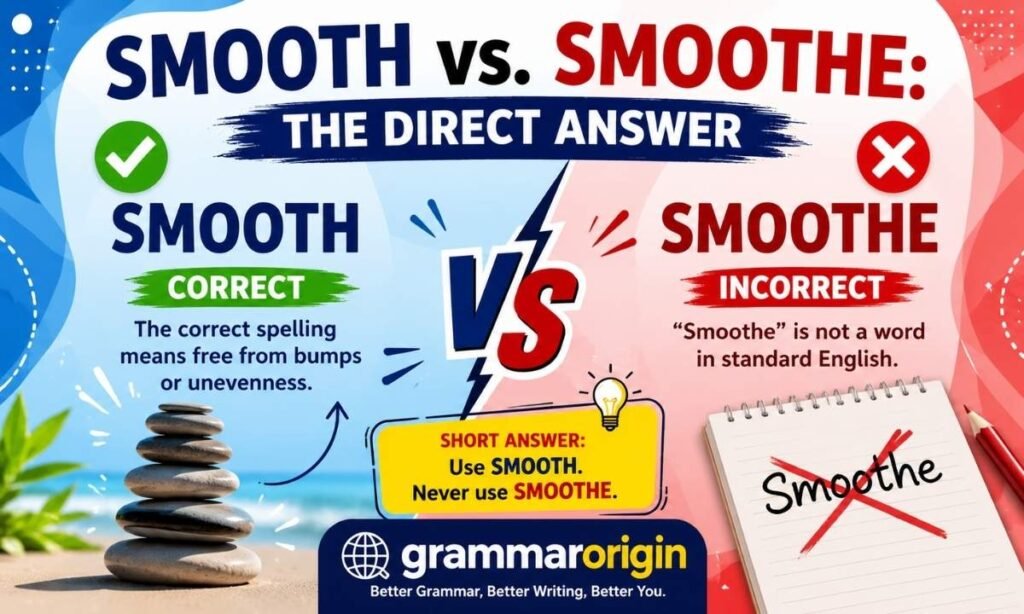
Smooth is correct. Smoothe is not a recognized word in standard English.
You’ll see “smoothe” in comments, product names, and even a few low-quality grammar sites. None of that makes it correct.
Whether you’re using it as an adjective or a verb, the spelling never changes: smooth.
Why “Smoothe” Feels Right (But Isn’t)
English does add a silent e to plenty of verbs. That’s exactly why this mistake spreads so easily.
Words like breathe, clothe, and teethe all follow a pattern: a noun form without the e, and a verb form with it. “Breath” becomes “breathe.” “Cloth” becomes “clothe.”
“Smooth” doesn’t have that split. There’s no separate noun form waiting for an e to turn it into a verb — smooth already works as both, without any change in spelling.
Autocorrect adds to the confusion too. Depending on the app, “smoothe” sometimes slips past spell check unflagged, which makes writers assume it must be fine.
Where “Smooth” Comes From: A Quick Origin Note
Smooth comes from the Old English word smōð, meaning calm or free of roughness. It has kept a consistent spelling for centuries, long before “silent e” verb patterns became common in English.
Because it was never paired with a shorter noun form the way breathe and clothe were, it never picked up an extra e along the way.
Smooth as an Adjective and a Verb
Smooth is one of the few English words that works as both an adjective and a verb without changing its spelling.
Smooth as an Adjective
As an adjective, smooth describes something even, flat, or free from bumps.
- A smooth road
- Smooth skin
- A smooth flight
It also describes ease or charm in behavior:
- A smooth presentation
- A smooth talker
Smooth as a Verb
As a verb, smooth means to make something even or to reduce tension.
- Smooth the fabric
- Smooth out a disagreement
- Smooth over a mistake
Notice the pattern: smooth often pairs with a preposition — out, over, or away — to add a more specific meaning.
Conjugation of “Smooth” (Verb)
Here’s how “smooth” changes across tenses. No form ever adds an extra e.
| Tense | Form | Example |
| Present | smooth / smooths | She smooths the dough. |
| Past | smoothed | We smoothed the edges. |
| Future | will smooth | They will smooth the path. |
| Present participle | smoothing | He is smoothing the surface. |
| Past participle | smoothed | The paint was smoothed evenly. |
Smooth Out vs. Smoothen Out
“Smooth out” is the standard phrase for removing bumps, wrinkles, or problems.
“Smoothen” does exist in some dictionaries, but it’s rare and adds nothing that “smooth” doesn’t already do. A few major publications have occasionally used “smoothen” in headlines and reports, which shows it isn’t a total myth — just an uncommon, less-preferred choice.
For everyday and professional writing, stick with smooth out or smooth over. It’s shorter, more common, and never questioned by readers.
READ MORE RELATED POST DROVE VS DRIVEN
Why Some Sources Incorrectly Call “Smoothe” a Word
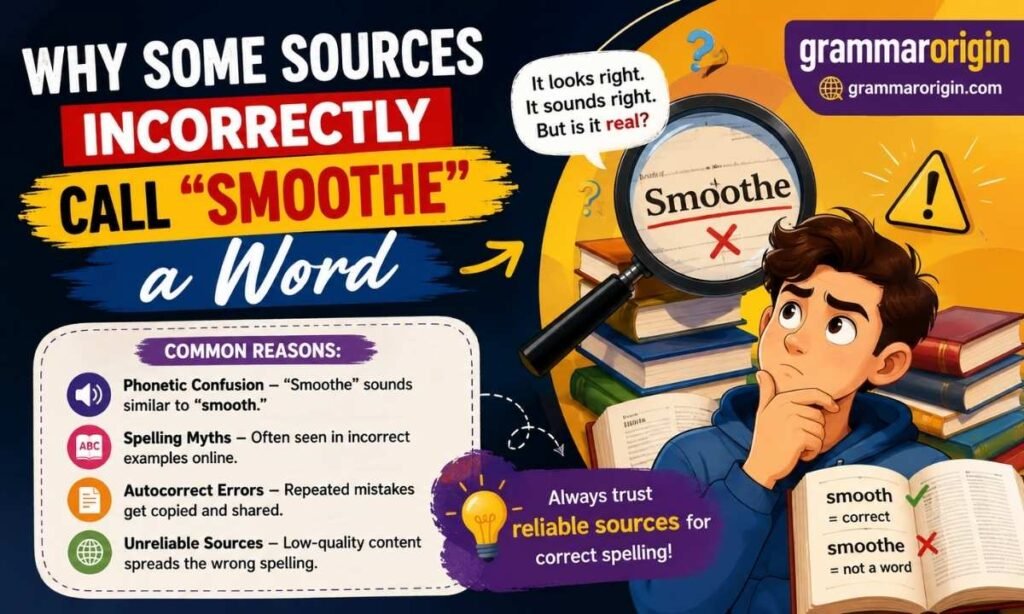
A few grammar sites and language tools describe “smoothe” as a legitimate verb form, separate from “smooth.” This is inaccurate.
No major dictionary — Merriam-Webster, Oxford, or Cambridge — lists “smoothe” as a standard entry. When a source treats it as valid, it’s repeating a common online error rather than reflecting actual English usage.
If you see conflicting advice about this word elsewhere, trust the dictionaries over informal grammar guides.
Is Smooth or Smoothe Correct in UK English?
There’s no regional exception here. British English and American English both use smooth, with no added e.
You won’t find “smoothe” listed as a British variant in the Cambridge Dictionary or any other UK-based reference. The confusion isn’t regional — it’s simply a spelling mistake that spreads regardless of location.
Smooth vs. Smoove: What’s the Difference?
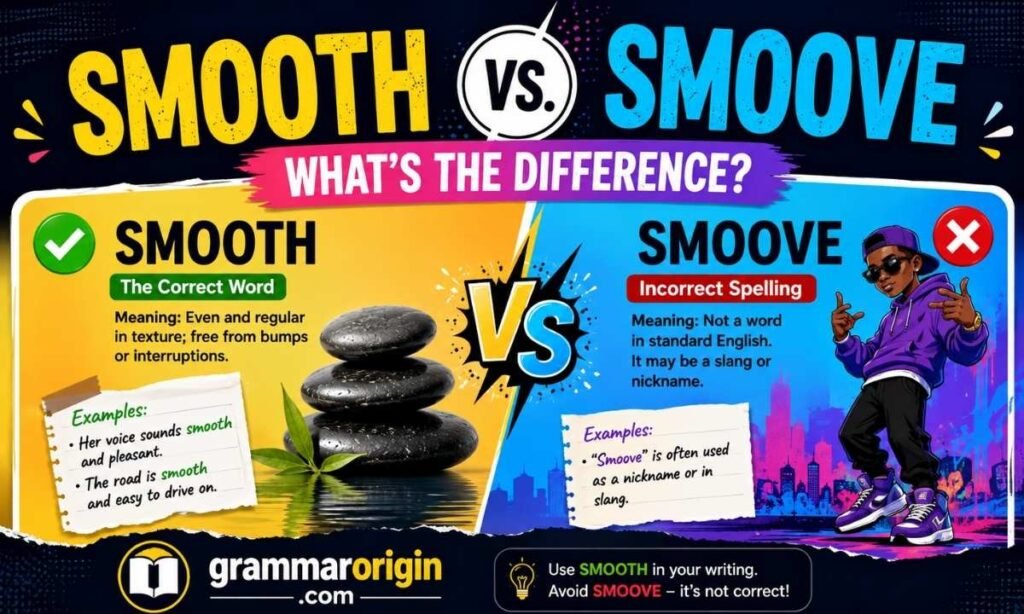
“Smoove” isn’t a standard spelling either, but it serves a different purpose than “smoothe.”
People use “smoove” intentionally, usually in music, slang, or casual branding, to represent a relaxed pronunciation of “smooth.” Think of song titles or nicknames where the spelling is a stylistic choice, not a mistake.
“Smoothe,” on the other hand, is almost always an accidental misspelling, not a deliberate style. That’s the key difference: one is a knowing stylistic spelling, the other is a common error.
READ MORE RELATED POST DROVE VS DRIVEN
Smooth vs. Sleek vs. Polished
These words overlap, but each carries a slightly different focus.
Smooth vs. Sleek
Smooth describes texture, ease, or flow. Sleek focuses on appearance — something glossy, streamlined, or stylish.
- Smooth skin (texture)
- Sleek design (appearance)
Smooth vs. Polished
Smooth means even and free of rough spots. Polished implies a higher level of refinement, often the result of deliberate effort.
- A smooth surface (basic evenness)
- A polished performance (refined, practiced)
Examples of Correct Usage
As an adjective:
- The table felt smooth under my hand.
- She gave a smooth, confident answer.
As a verb:
- He smoothed the icing with a spatula.
- They smoothed out the disagreement before the meeting.
Incorrect vs. correct:
- ❌ The road is smoothe. → ✔ The road is smooth.
- ❌ She smoothes her hair. → ✔ She smooths her hair.
Quick Comparison Table: Smooth vs. Smoothe vs. Smoothen
| Word | Correct? | Notes |
| Smooth | Yes | Standard adjective and verb form |
| Smoothe | No | Common misspelling, not in dictionaries |
| Smoothen | Rare | Technically valid but uncommon; “smooth” is preferred |
Frequently Asked Questions
Is it smooth or smoothe?
It’s smooth. “Smoothe” is a common misspelling with no dictionary backing.
Is smooth or smoothe correct in the UK?
Both American and British English use smooth. There’s no regional variant that adds an e.
Is smoothen a real word?
Yes, but it’s rare. “Smooth” already works as a verb, so “smoothen” is unnecessary in most writing.
What does smoove mean?
“Smoove” is an intentional stylistic spelling of “smooth,” often used in music or slang — not a standard spelling.
Why do some websites say smoothe is correct?
A few grammar sites repeat this error. No major dictionary recognizes “smoothe” as a standard word.
Is it smooth out or smoothen out?
“Smooth out” is the standard, more natural phrase. “Smoothen out” is technically usable but far less common.
Final Takeaway
Smooth is the only correct spelling, whether you’re using it as an adjective or a verb. Smoothe is a common mistake, and smoothen, while technically real, is rarely worth using over smooth.
Next time you’re describing a surface, a process, or a conversation, trust the simple spelling: smooth. It works everywhere, without exceptions.

Muhammad Waqas is an English language teacher and grammar expert with over 8 years of experience helping students and professionals improve their writing skills. He specializes in English grammar, vocabulary, communication, and practical language learning. Through GrammarOrigin, Waqas shares clear, easy-to-understand content that helps readers write and speak English with confidence.