
If you’ve ever paused mid-sentence wondering whether it’s “divet” or “divot,” you’re not alone. This mix-up trips up golfers, writers, and casual readers alike, mostly because of how the word sounds out loud.
This guide settles the spelling question for good and walks through the meaning, origin, pronunciation, and real-world usage of divot — plus a few related golf and turf terms people often search alongside it.
Divet or Divot – Quick Answer
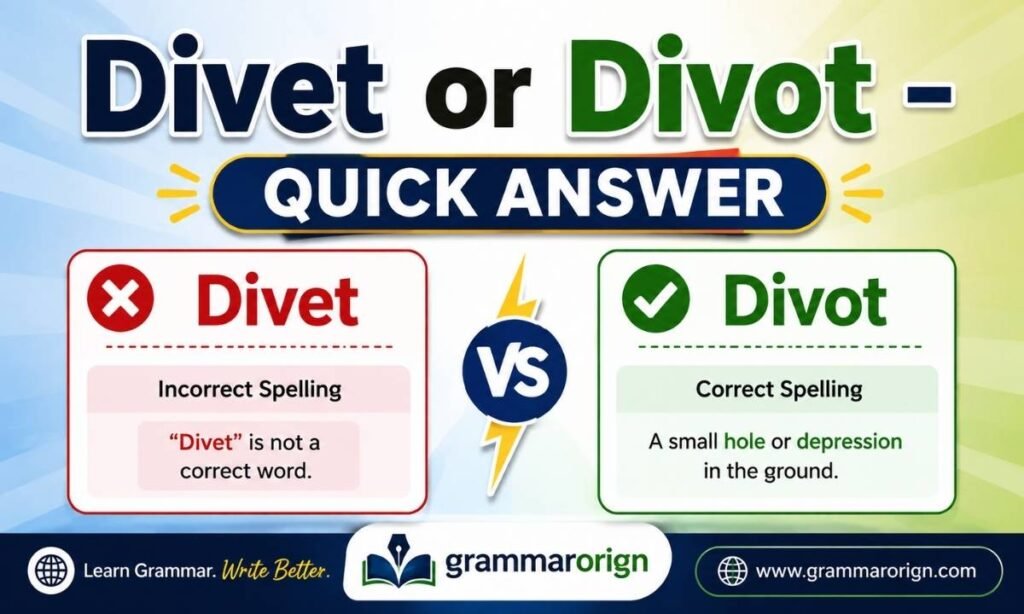
“Divot” is the spelling you want. The other version simply isn’t recognized in any major English dictionary, and it never has been.
- Correct: divot
- Incorrect: divet
Whenever you’re unsure mid-sentence, picture a golf course — that visual alone usually jogs the right spelling back into memory. Style guides, grammar checkers, and dictionaries all point the same direction, so there’s no gray area to navigate here the way there sometimes is with other confusing word pairs.
Divot or Divet Meaning
A divot is a chunk of turf, soil, or grass torn loose from the ground, most often during a golf swing when the club face digs into the fairway just after contact with the ball. The term also stretches to cover a small dent or hollow left in a surface.
Golfers use it constantly, but greenkeepers, landscapers, groundskeeping crews, and even bakers (think of a small dip pressed into dough) reach for the same word too. The alternate spelling carries none of these meanings — it’s simply a misheard version of the real one, with no separate definition of its own in standard English lexicons.
- “He left a deep divot after that iron shot.”
- “The pitch was covered in loose divots by halftime.”
Context usually makes the meaning obvious even without a golf club nearby — a hiking trail with uneven, torn-up patches of grass, or a garden bed disturbed by foot traffic, both get described the same way.
The Origin of Divet or Divot
This word traces back to Scots, an older form of English spoken across Scotland. Its earliest ancestor was likely “devat” or “duvat,” tied to cutting turf for roofing thatch and household fuel long before golf ever existed as an organized sport.
Dictionaries date the first recorded use to around the 1540s, well over a century before golf terminology as we know it took shape. The word only entered mainstream sporting vocabulary much later, once golf spread across Britain and needed a way to describe the grass chunk a club kicks up mid-swing.
As golf grew into an international sport through the nineteenth and twentieth centuries, sports journalists and course commentators carried the term into American and international English almost unchanged. That’s a big part of why there’s so little regional variation today — the word travelled through a fairly narrow channel of golf writing rather than spreading through dozens of independent regional dialects.
That Scottish root also explains why the softer-sounding version never caught on as an accepted variant. Etymology dictionaries and standard reference works consistently trace one lineage only, which is part of why the alternate spelling has no historical footing at all.
Unlike some English words that picked up alternate spellings through centuries of regional printing differences, this one moved through a fairly small, specialized community of golf writers and course staff. That narrow path of transmission is a big reason the spelling stayed consistent instead of splintering the way broader everyday vocabulary sometimes does.
British English vs American English Spelling
Here’s some good news: this isn’t a British-versus-American split, unlike “colour” and “color” or “organise” and “organize.” Both sides of the Atlantic settled on the same form, and every major style guide agrees.
| Region | Accepted Spelling |
| United Kingdom | Divot |
| United States | Divot |
| Canada | Divot |
| Australia | Divot |
No dialect, region, or style guide treats the other version as legitimate. It’s a spelling slip everywhere, not a regional quirk, and spell-checkers across English-speaking countries flag the same version as wrong regardless of locale settings.
Major dictionaries on both sides of the Atlantic, including both British and American references, list identical definitions and identical spellings for this entry. That kind of full agreement is fairly rare for a word with Scottish roots and sporting associations, which makes this one of the easier spelling questions to settle with total confidence.
Compare that to word pairs like “gray” and “grey,” where regional preference genuinely shapes which version editors accept, and it’s clear how unusual this level of consensus really is. Writers producing content for international or mixed audiences don’t need to adjust anything region by region here, which simplifies style-guide decisions considerably.
Which Spelling Should You Use?
Stick with the standard form every time, in every context — casual, professional, or academic. There’s no scenario where the alternate spelling is the safer choice, and using it in published or client-facing content can quietly undercut your credibility.
For content creators specifically, spelling accuracy on niche sporting vocabulary tends to matter more than average, since golf-savvy readers notice these details quickly and associate mistakes with a lack of subject familiarity. Editors reviewing sports copy will often flag this exact error faster than more common typos, simply because it’s such a well-known point of confusion within golf writing circles.
That reputation effect matters more than it might seem. A single wrong spelling in a headline or opening paragraph can make an otherwise well-researched piece look rushed, and readers who play golf themselves tend to notice immediately.
For Different Audiences
Different readers, same rule:
- Golfers and sports fans expect the correct form without exception.
- Students and academic writers should treat the alternate spelling as a flagged error.
- Content writers and journalists risk credibility by publishing it incorrectly.
- Casual social posts still read better with accurate spelling, even informally.
Common Mistakes with Divet or Divot
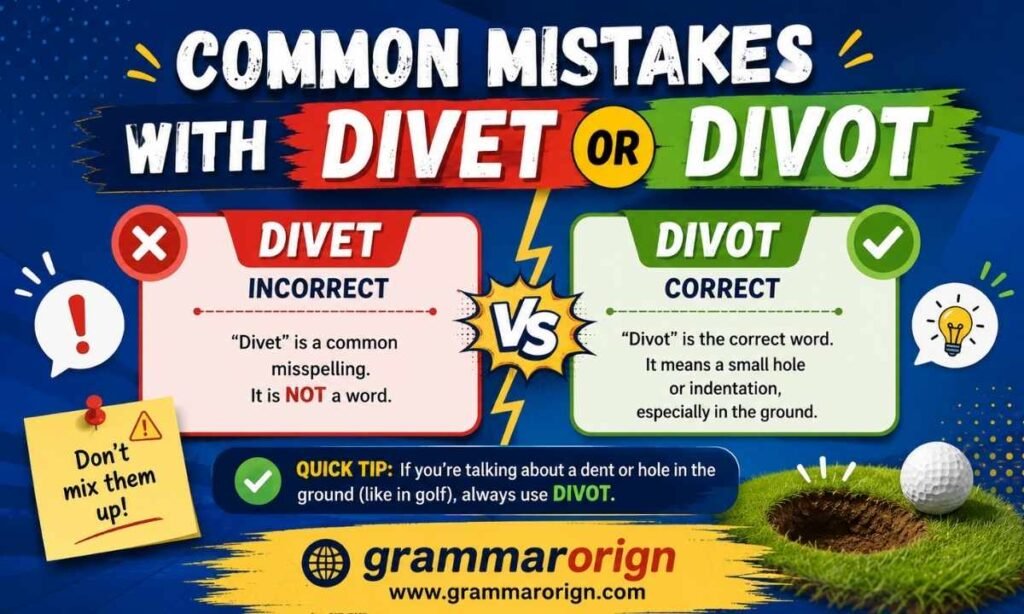
The most frequent slip is straightforward: writers spell the word the way it sounds rather than the way it’s actually built. Pronunciation-based guessing is one of the most common sources of English spelling errors in general, and this word is a textbook example.
| Mistake | Fix |
| “The golfer hit a divet” | “The golfer hit a divot” |
| Assuming the softer spelling is a regional variant | It isn’t — treat it as an error everywhere |
| Relying on autocorrect without checking | Manually verify against a dictionary |
| Guessing the spelling from pronunciation alone | Learn the written form separately |
A quick trick: the correct spelling and “golf” share the letter “o” — that small link can help it stick in memory, especially for writers who cover sports content regularly. Reading the word in context a few times, rather than just memorizing a rule, also tends to lock the correct spelling in faster than rote repetition alone.
Keyboard autocorrect tools have gotten better at catching this particular slip over the past few years, but they’re not perfect, especially on mobile devices where typing tends to move faster than proofreading. Running a final pass through a grammar checker before publishing is still worth the extra minute, particularly for golf, sports, or landscaping content where this exact word tends to appear more than once in a single piece.
Divot in Everyday Examples
This word shows up across writing styles, not just sports commentary. Here’s how it looks in different formats.
Emails
“Please have the grounds team patch the divot near the ninth hole before Saturday’s tournament.”
News
“The championship round paused briefly after a stray divot struck a spectator near the ropes.”
Social Media
“That drive was clean, but wow — huge divot left behind! ⛳”
Academic Writing
“Repeated foot traffic and equipment use gradually increase divot formation across turfgrass surfaces.”
Sports Writing
“Course etiquette requires players to replace every divot they create during a round.”
Read Also This Amount or Ammount
Divot vs Pitch Mark
These two terms get confused constantly, but they describe different kinds of course damage. One comes from a club striking the ground during a swing — turf that’s been displaced from the fairway or rough.
A pitch mark, by contrast, forms when the ball itself lands hard on the green and dents the putting surface. One gets replaced by hand and pressed back into place; the other gets repaired with a small two-pronged tool that lifts the compressed grass back up from underneath rather than being physically replaced.
Golf etiquette guides generally treat both repairs as basic course courtesy, and most clubs expect players to fix either kind of damage before moving on to the next shot. Mixing the two terms up isn’t a spelling issue — it’s a golf-knowledge one, but it’s worth clearing up since both appear side by side in course etiquette guides and greenkeeping manuals.
Beginners often learn these terms in reverse order from how they’ll actually use them — reading about repair etiquette in a rulebook long before they’ve hit enough shots to recognize either type of damage on their own. Course marshals and playing partners tend to be the ones who eventually clarify the difference in person, usually the first time a new player asks why everyone keeps stopping to press something back into the ground.
Divot as a Verb
Less commonly, this word also functions as a verb, describing the act of gouging out that patch of turf during a shot. You’ll mostly see this usage in casual golf conversation and commentary rather than formal or academic writing.
- “He divoted the fairway pretty badly on that approach shot.”
The noun form remains far more common in published writing, so lean on that unless the verb genuinely fits the tone and rhythm of your sentence. Broadcast commentators sometimes use the verb form for variety mid-commentary, which is likely how casual usage picked it up in the first place.
Divet or Divot – Google Trends & Usage Data

Why People Search This Keyword
Most searches around this spelling pair come from people who’ve heard the word spoken, often on television golf coverage, and want written confirmation before using it themselves. It’s largely a spelling check rather than a meaning question, which is typical for word pairs built around a single mispronounced vowel sound.
Popular Regions
Search interest clusters heaviest in countries where golf carries strong cultural roots — the United States, the United Kingdom, Australia, and Canada all show consistent volume for this kind of query, tracking closely with regional golf participation rates. Countries with growing golf tourism and course development also show gradual increases in related search activity.
Usage Contexts
The term turns up most often in golf commentary, turf-care and landscaping content, groundskeeping and course-maintenance discussions, and general spelling-help searches from students and writers double-checking themselves before publishing. Recipe and baking contexts account for a smaller but steady share too, tied to the dent-related sense of the word. Language-learning forums and ESL discussion boards also contribute a noticeable slice of search volume, since irregular vowel-ending words like this one are a common stumbling block for non-native English speakers building sports vocabulary.
Comparison Table (Keyword Variations)
| Term | Correct Form? | Meaning | Part of Speech |
| Divot | Yes | Turf, soil, or grass removed from the ground | Noun (occasionally verb) |
| Divet | No | Misspelling of the correct form | N/A |
| Divots | Yes | Plural form | Noun |
| Pitch mark | Yes (separate term) | Dent from a ball landing on a green | Noun |
Divet or Divot Synonym
Depending on context, a few words come close to this term without meaning exactly the same thing:
- Turf chunk
- Sod piece
- Dent or hollow (for the non-golf sense)
- Gouge (informal, for damaged ground)
None of these are exact substitutes, but they’re useful when you want to avoid repeating the same word too often in a piece, especially in longer sports or landscaping content where variety helps readability.
Is Divet a Word
No. This spelling isn’t listed in Merriam-Webster, Oxford, Cambridge, or any other standard reference dictionary. It’s a phonetic guess that stuck around simply because the real word is easy to mishear in casual speech.
If a spell-checker or dictionary search comes back empty for this version, that’s expected — it confirms the alternate form has no independent standing anywhere in the English language. Search engines and browser dictionaries typically auto-correct it on the fly, which is part of why the mistake rarely survives long in typed content even when it slips into a first draft.
Divot in French
French doesn’t borrow the English term directly in everyday speech, but golf terminology in French often uses “motte de gazon,” which translates roughly to “clump of turf” or “sod chunk.” Some French golf commentary also simply borrows the English word outright as a loanword, especially in international tournament broadcasts.
There’s no single, universally fixed French translation — usage shifts depending on the speaker, the publication, and how closely French golf media follows English-language terminology. Golf remains a comparatively niche sport in France relative to countries like the United States or the United Kingdom, which partly explains why the vocabulary hasn’t fully standardized in French-language coverage. Translation apps and bilingual golf glossaries sometimes list both options side by side, leaving the final choice up to whichever term sounds more natural in context.
Divot Dent
Beyond golf, this word can describe a small dent or shallow depression on almost any surface — not just grass or turf. Bakers, for instance, sometimes press one into dough before adding a filling, and the same idea occasionally shows up describing dents in other soft or malleable materials.
This dent-related sense is less common than the golf meaning but still valid and fully dictionary-recognized, appearing in general usage well outside sports contexts — from culinary writing to descriptions of worn pathways and trail surfaces.
Read Also This Amount or Ammount
Divot in a Sentence
Seeing the word in varied contexts helps the spelling stick faster than memorizing a rule:
- “The golfer apologized after his divot nearly hit another player.”
- “Grounds crews repair hundreds of divots after a single tournament weekend.”
- “She twisted her ankle stepping into a hidden divot on the trail.”
- “A well-struck iron shot almost always leaves a clean divot behind.”
- “The recipe calls for pressing a small divot into the center of the dough.”
- “The coach reminded players to always replace their divots after practice.”
Divot Pronunciation
This word is pronounced DIV-ət, with the stress landing firmly on the first syllable. In IPA, that’s written as /ˈdɪvət/.
The ending sounds soft and clipped, almost like “-uht” rather than a clear “-ot” — which is exactly why so many people end up guessing the wrong spelling when they try to write it from memory rather than checking a reliable source. Regional accents can soften that ending even further, which only adds to the confusion for anyone learning the word by ear rather than by reading it first. Listening to a few golf broadcasts with captions turned on is a surprisingly effective way to connect the sound to the correct written form, especially for learners still building confidence with sports vocabulary.
Frequently Asked Questions
Is it divet or divot?
Divot is correct. The other spelling is a common mistake with no dictionary backing anywhere in standard English.
What does divot mean?
It’s a piece of turf, soil, or grass removed from the ground, most often during a golf swing, or a small dent in a surface.
Why do people write it the wrong way?
Because of how the word sounds when spoken — the ending is easy to mishear, leading to a phonetic guess instead of the actual written form.
Is the spelling the same in British and American English?
Yes. There’s no regional difference — both use the same standard form exclusively, across every major English-speaking country.
Is this only a golf term?
No. It also applies to landscaping, turf damage from foot traffic, and small dents in other surfaces like dough or soft materials.
What’s the difference between a divot and a pitch mark?
One comes from a club striking the ground; the other comes from the ball landing and denting the green. They’re repaired using completely different techniques.
Can the word be used as a verb?
Occasionally, yes — mostly in casual golf conversation, as in “he divoted the fairway.” The noun form is far more common in written content.
Final Thoughts
The spelling question comes down to one simple fact: “divot” is correct, and the softer-sounding alternative isn’t recognized anywhere in standard English. The mix-up is understandable given how the word sounds, but the fix is easy once you’ve seen it written a few times.
Whether you’re writing about golf, landscaping, or just want to use the term correctly in everyday writing, sticking with the standard spelling keeps your content accurate and credible. It’s a small detail, but small details are often exactly what separates careful writing from content that reads as rushed.

Muhammad Waqas is an English language teacher and grammar expert with over 8 years of experience helping students and professionals improve their writing skills. He specializes in English grammar, vocabulary, communication, and practical language learning. Through GrammarOrigin, Waqas shares clear, easy-to-understand content that helps readers write and speak English with confidence.