
You’ve probably typed one of these words and then stopped, unsure if autocorrect just betrayed you. Homey or homie trips up even confident writers because the two words sound identical when spoken.
The short version: homey describes a feeling or place, and homie describes a person. Once you separate “place” from “person,” the confusion mostly disappears — and this guide walks through every angle, from origin to grammar to real-world examples.
Homey or Homie – Quick Answer
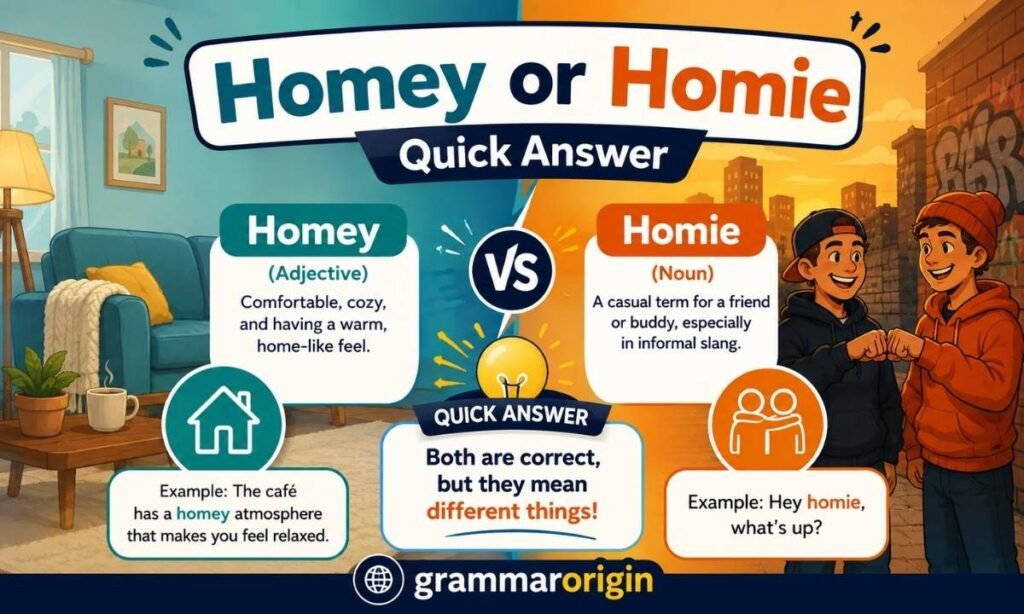
Use homey when you’re talking about comfort, warmth, or a welcoming space. Use homie when you mean a close friend.
| Word | Part of Speech | Meaning | Example |
| Homey | Adjective | Cozy, warm, comfortable | “This kitchen feels homey.” |
| Homie | Noun | Close friend, buddy | “He’s my homie from work.” |
A quick mental test works every time: are you describing a feeling, or are you naming a person? Feelings get homey; people get homie.
Is it homie or homey
Both spellings exist, but they aren’t really interchangeable in modern writing. Homie is the noun for a friend, while homey is the adjective for something comfortable.
A handful of dictionaries do list homey as an alternate noun spelling for “friend,” a leftover from older slang. Still, if you want your sentence to read clearly on the first pass, homie is the safer pick whenever you mean a person.
What Does Homey Mean?
Homey means cozy, comfortable, and welcoming — it almost always describes a place, object, or atmosphere rather than a person. Think small apartments, warm lighting, or a kitchen that smells like something’s baking. This is the “place” half of the homey or homie pair, and it’s the meaning most style guides treat as standard, everyday vocabulary.
The word builds off “home” plus the suffix “-y,” the same pattern you see in words like “sunny” or “chilly.” It’s been part of everyday English for well over a hundred years, long before slang usage entered the picture.
You’ll spot homey constantly in:
- Real estate listings and Airbnb descriptions
- Restaurant and café reviews
- Interior design and home décor writing
- Everyday conversation about a room, a meal, or a mood
Sample sentences:
- The bookstore has a homey corner with worn armchairs.
- Her new apartment already feels homey after just one weekend.
- The hotel skipped the marble lobby and went for something homier instead.
The comparative and superlative forms are homier and homiest, following the standard rule where a final “y” changes to “i” before adding an ending.
What Does Homie Mean?
Homie is informal slang for a close friend, trusted companion, buddy, or someone from your neighborhood. It’s a noun, and it almost exclusively refers to people — the “person” half of the homey or homie pair.
The word grew out of hip-hop and urban culture, though it’s now common well beyond those roots — you’ll hear it in gaming chats, sports commentary, and everyday texting between friends of any background.
Sample sentences:
- My homie picked me up from the airport at 6 a.m.
- I’m meeting a couple of homies for lunch downtown.
- Thanks for covering my shift, homie.
Because it’s slang, homie doesn’t belong in résumés, legal documents, or client-facing emails. Save it for texts, casual chats, and social captions where the tone is already relaxed.
The Origin of Homey or Homie
Homey traces back to a plain English root — “home” plus “-y” — and has functioned as a descriptive adjective since at least the 1800s. There’s nothing slangy about its origin at all.
Homie, on the other hand, comes from “homeboy,” a term that once simply meant someone from your hometown or neighborhood. Through the 1980s and 90s, hip-hop culture shortened it to homie and expanded its meaning to cover any close friend, regardless of where they grew up.
Interestingly, some older song lyrics and 90s slang did spell the friendship term as homey rather than homie. That overlap is part of why the two words still get mixed up today — the split into two distinct spellings happened gradually, not overnight.
British English vs American English Usage
Region changes how the homey or homie pair gets used. Homey works in both British and American English without raising eyebrows. Homie, by contrast, is strongly tied to American slang and shows up far less often in British writing or conversation.
| Word | British English | American English | Meaning |
| Homey | Common | Common | Cozy, comfortable |
| Homie | Rare | Very common | Close friend (slang) |
If you’re writing for an international audience — a travel blog, a global product description, anything read outside the US — homey is the word that translates cleanly everywhere. Homie risks sounding unfamiliar or out of place to readers unfamiliar with American slang.
Pronunciation of Homey and Homie
This is one reason the homey or homie mix-up is so common: both words are pronounced exactly the same way, HOH-mee, rhyming with “foamy” or “roam-y.”
That shared pronunciation is precisely why spelling mix-ups happen so often. When someone hears the word out loud, there’s no audio clue telling them which spelling — or which meaning — is intended. Only the sentence around it, and the context of what’s being described, gives that away.
Which One Should You Use?
Deciding between homey or homie comes down to one question: am I describing a place or feeling, or am I talking about a person? That single question settles almost every case.
- Talking about a room, café, or atmosphere → homey
- Talking about a friend or companion → homie
- Writing something formal, academic, or professional → homey is acceptable, homie generally isn’t
- Texting a friend or posting on social media → either works, depending on what you mean
When you’re genuinely unsure which word fits, picture the sentence without the word in it. If a noun slot is empty (“He’s my ___”), you need homie. If an adjective slot is empty (“This place feels ___”), you need homey.
Common Mistakes with Homey or Homie
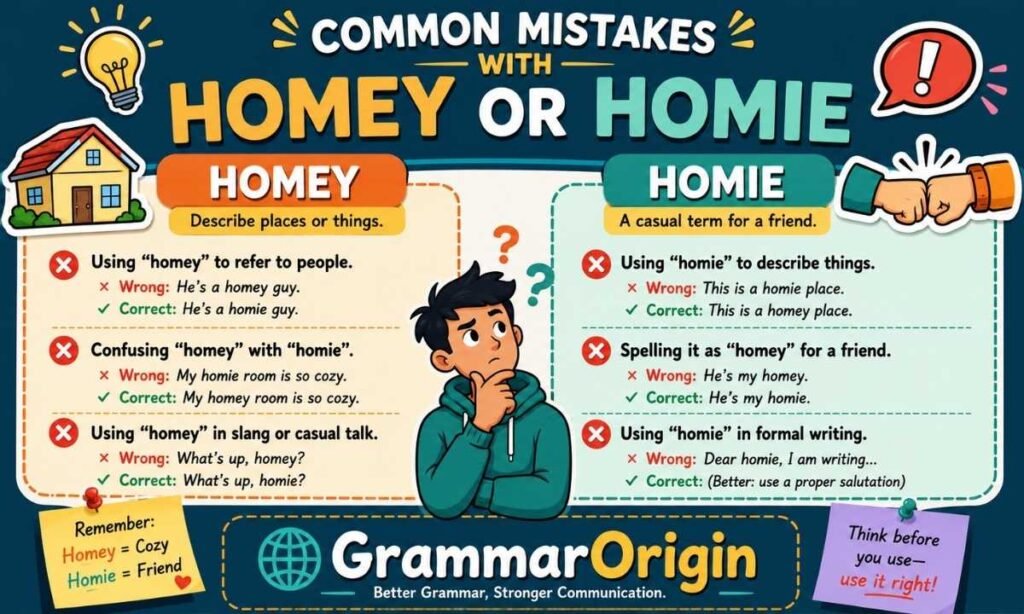
- ❌ “This apartment feels so homie.” → ✅ “This apartment feels so homey.”
- ❌ “She’s my closest homey.” → ✅ “She’s my closest homie.”
- ❌ “I went out with my homie’s.” → ✅ “I went out with my homies.”
- ❌ Using homie in a formal email or client message
- ❌ Confusing homey with homely, which means something different in American English (more on that below)
Most homey or homie mistakes happen fast, in texts and captions, where nobody stops to double-check. Autocorrect makes this worse because it sometimes “fixes” one spelling into the other without warning. Reading your sentence back before hitting send catches most of these errors.
Homey or Homie in Everyday Examples
Seeing homey or homie used correctly across different settings makes the rule stick faster than any definition.
In texts and social captions: “Hanging with the homies tonight” reads naturally and casually, exactly how the word is meant to be used.
In restaurant or hotel reviews: “The lobby has a surprisingly homey feel for a chain hotel” works well in travel and hospitality writing.
In professional writing: “The design team aimed for a homey, approachable feel in the new office” is fine — homey stays acceptable even in business contexts. Swapping in “homie” here would sound completely wrong.
In casual conversation: “What’s up, homie?” is a familiar, friendly greeting between people who already know each other.
Homey or Homie – Google Trends & Usage Data
Search interest for both words tends to move with different audiences and different seasons. Homey sees steady, year-round interest tied to home décor, real estate, and hospitality content — it spikes slightly around moving season and holiday decorating months.
Homie shows more volatile interest, often spiking alongside viral slang moments, music releases, or trending memes. Younger audiences drive most of that search volume, largely through platforms like TikTok and Instagram rather than traditional search.
| Search Pattern | Homey | Homie |
| Typical searchers | Home decorators, renters, travel writers | Younger users, slang learners, ESL speakers |
| Seasonal spikes | Moving season, holidays | Viral trends, new music releases |
| Common platforms | Blogs, real estate sites | Social media, texting |
| Search stability | Consistent | Spiky, trend-driven |
Neither word shows real confusion about spelling in the data — the confusion is almost entirely about meaning and correct usage, which lines up with everything covered above.
Also Read This Quizes or Quizzes?
Comparison Table: Homey vs Homie
The table below lines up every major difference in the homey or homie debate side by side.
| Feature | Homey | Homie |
| Part of speech | Adjective | Noun |
| Meaning | Cozy, warm, comfortable | Close friend, buddy |
| Describes | Places, food, atmosphere | People |
| Formality | Informal but widely accepted | Very informal, slang |
| Plural form | Not applicable | Homies |
| Region | British & American English | Mostly American English |
| Comparative form | Homier, homiest | None |
Homey vs Homely vs Homie
A third word often gets thrown into the homey or homie mix: homely. It looks related, but its meaning shifts depending on which side of the Atlantic you’re on.
| Word | Meaning in US English | Meaning in UK English |
| Homey | Cozy, comfortable | Cozy, comfortable |
| Homely | Plain or unattractive | Cozy, comfortable |
| Homie | Close friend | Close friend |
Calling someone’s house “homely” in the US can sound like a backhanded insult, while the exact same word in the UK is a compliment. When you mean “cozy,” homey avoids that risk entirely, no matter where your reader is from.
Is it spelled homie or homey?
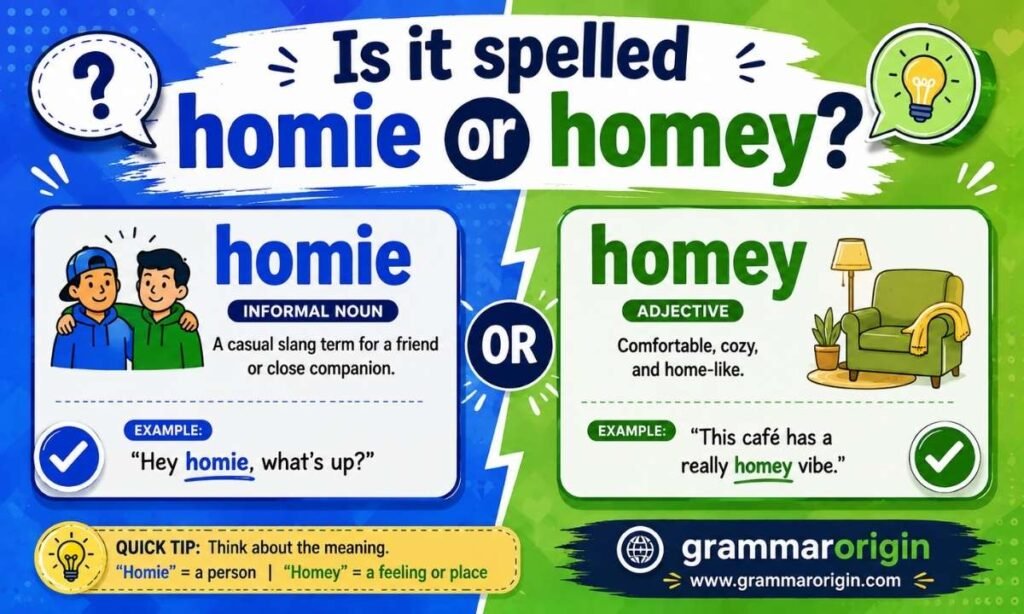
It depends entirely on what you’re describing, not on regional spelling preference. Homie is the noun for a friend; homey is the adjective for comfort.
There’s no single “correct” universal spelling here the way there is with, say, “definitely” vs. “definately.” Both spellings are valid English words — they just do different jobs in a sentence.
What is homey slang for?
Within the homey or homie pair, homey isn’t really slang in its main sense — it’s a standard adjective that’s been part of English for over a century. Some older slang did use it as a friendship term, but that usage has mostly faded in favor of homie.
If you’re searching for the slang meaning of “friend,” homie is the spelling you’re more likely looking for.
Can I say homie to a girl?
Yes — in the homey or homie pair, homie works for any gender. It’s not tied to male friendships specifically, despite its roots in “homeboy” and “homegirl.”
Plenty of people use “homie” interchangeably for close friends of any gender, especially in casual texting and social media. That said, tone still matters — using it with someone you don’t know well can feel presumptuous regardless of gender.
Is it hommies or homies?
Homies is correct. “Hommies,” with the double “m,” is a common misspelling that doesn’t appear in any standard dictionary.
The plural simply adds “-s” to “homie” — no doubled consonant, no apostrophe unless you’re showing possession (as in “my homie’s car”).
Homey or homie meaning
At the core, both words share the same root idea — “home” — but they’ve branched into completely separate meanings. Homey carries the emotional sense of comfort and familiarity, while homie carries the social sense of friendship and trust.
Once you know the root they share, the split actually makes the words easier to remember rather than harder.
Homies meaning family
In the wider homey or homie conversation, homies doesn’t literally mean “family,” but it’s often used to describe people who feel like family — a tight circle of trusted friends. The word implies loyalty and closeness that goes beyond a casual acquaintance.
Someone might say “my homies are basically my family” specifically because the word already carries that emotional weight, even without using the word “family” directly.
Homie meaning in love
This is where the homey or homie distinction gets a little blurry: homie isn’t a romantic term on its own, but it does sometimes show up in relationships with a platonic, teasing tone — calling a partner “homie” can signal comfort and familiarity rather than romance. It’s more common among younger couples who blend friendship language into their relationship.
Context does all the work here. “My homie” said about a partner usually means the relationship feels easy and friend-like, not that romance is absent.
Is homies offensive
Generally, no. Within the broader homey or homie conversation, homies is a friendly, affectionate term used constantly across music, social media, and everyday speech without causing offense. Its tone depends heavily on who’s using it and how.
Because the word has roots in African American and hip-hop culture, some people are thoughtful about using it outside contexts where it feels natural to them. Used respectfully among friends, it rarely raises concerns.
Homey person
“Homey person” is one of the more common homey or homie phrases people search for, and it usually refers to someone with a warm, welcoming personality — the kind of person who makes any room feel more comfortable just by being there. This is the adjective homey applied to a personality trait rather than a place.
It’s a legitimate, natural use of the word. If you mean “a friend” specifically, though, homie or “homeboy” is the more accurate term for a person.
Is homie racist
No, homie itself is not a racist term. In the homey or homie family of words, it’s simply slang for “close friend,” used affectionately across many communities and cultures today.
The word does have specific cultural origins in African American and hip-hop communities, and that history is worth knowing and respecting. Understanding where a word comes from — rather than ignoring it — is generally the more thoughtful approach to using slang borrowed from a specific culture.
Also Read This Quizes or Quizzes?
Homie plural
Grammar around the homey or homie pair is easiest with plurals: the plural of homie is homies, formed the regular way by adding “-s.” There’s no irregular plural form and no apostrophe needed unless you’re showing possession.
- Correct plural: “My homies are coming over.”
- Correct possessive: “That’s my homie’s jacket.”
- Incorrect: “My homie’s are coming over.”
Homies in friendship
Within friendship, and within the wider homey or homie conversation, homies signals a tier above a regular acquaintance — someone you trust, someone you’d call first, someone whose company feels effortless. It’s less formal than “best friend” but carries similar emotional weight.
The word works well precisely because it avoids sounding overly sentimental while still communicating real closeness.
Frequently Asked Questions
Is homey a real word?
Yes. Homey has been a standard English adjective for over a century, describing something cozy, comfortable, or reminiscent of home.
Can homey ever describe a person?
Occasionally, yes — usually to describe someone with a warm, welcoming personality, not as a direct synonym for “friend.” For that meaning, homie is clearer.
Is homey the same as homely?
No. In American English, homey means cozy while homely usually means plain or unattractive. In British English, the two words are closer in meaning.
What’s the difference between homie and homeboy?
Homeboy is the older, longer form that homie developed from. Both mean a close friend, though homie is more common in modern casual speech.
Should I avoid homie in professional writing?
Generally, yes. Homie is slang and fits casual conversation, texts, and social posts better than formal emails, reports, or business communication.
Does autocorrect confuse homey and homie?
It can. Because the words are spelled so similarly, autocorrect on some devices occasionally swaps one for the other, so it’s worth double-checking before you send a message.
Is there a comparative form of homie?
No. Homie is a noun referring to a specific person, so it doesn’t have comparative or superlative forms the way an adjective like homey does.
Conclusion
The homey or homie confusion comes down to one simple distinction: homey describes comfort, and homie describes a person. Keep that separation in mind, and the right word becomes obvious almost every time.
Whether you’re writing a cozy real estate listing or texting a close friend, choosing the correct spelling makes your writing clearer and more natural. Bookmark this guide, and you’ll never have to second-guess homey or homie again.

Muhammad Waqas is an English language teacher and grammar expert with over 8 years of experience helping students and professionals improve their writing skills. He specializes in English grammar, vocabulary, communication, and practical language learning. Through GrammarOrigin, Waqas shares clear, easy-to-understand content that helps readers write and speak English with confidence.