
You typed “inportant” and then your cursor just sat there, blinking. That hesitation happens to almost everyone at some point, usually mid-email or mid-assignment when the word won’t quite settle on the page.
Here’s the short version: only one of these spellings is real. This guide covers the correct spelling of important, why this common spelling mistake keeps happening, and how to lock the right form into memory for good.
Inportant or Important – Quick Answer
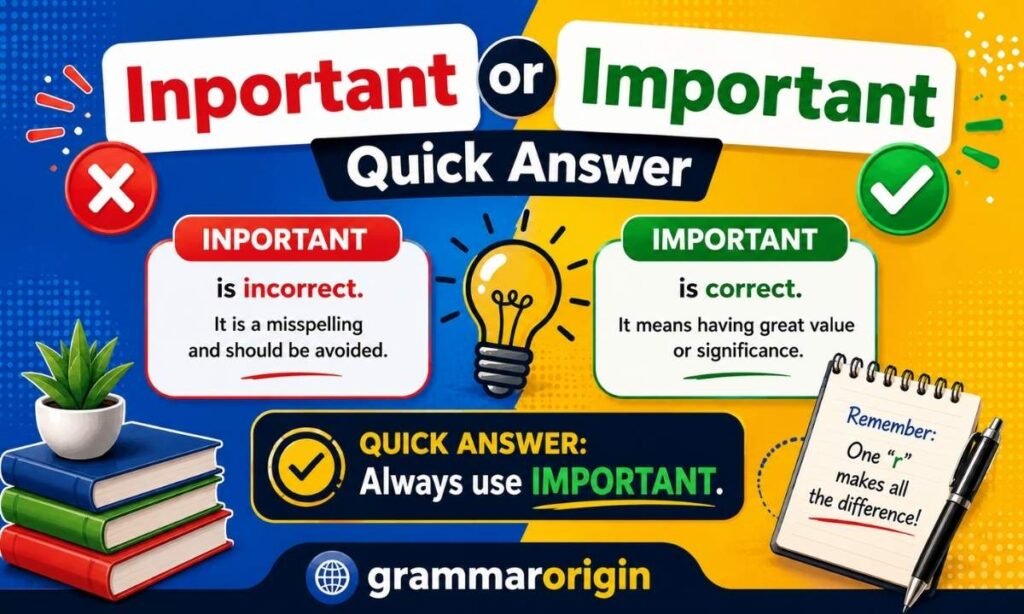
Important is correct. Inportant isn’t a word in any English dictionary.
- ✅ This deadline is important.
- ❌ This deadline is inportant.
No dictionary, style guide, or grammar checker treats “inportant” as valid. It’s a spelling slip, not an alternate form, and it belongs on the same list as other commonly confused words in English.
What Does “Important” Mean?
Important is an adjective that describes something carrying real weight, value, or influence. It applies to people, decisions, documents, and even small daily habits.
Say a client meeting gets moved to Monday — that’s important because it changes your whole schedule. A doctor’s warning about medication timing? Also important, because ignoring it has consequences.
The word shows up constantly because so much of life genuinely deserves attention. That’s exactly why spelling accuracy matters here — it’s one of the most-used adjectives in the English vocabulary.
Why Do People Write “Inportant”?
The confusion comes from how the word sounds, not from any grammar rule. Say “important” out loud quickly, and the “m” can blur into something closer to “n.”
A few things fuel this:
- The letters M and N sit right next to each other on a standard keyboard
- Fast speech blends the sound before “portant”
- Learners sometimes memorize words by ear instead of by spelling
- Autocorrect on phones doesn’t always catch it during swipe-typing
None of this makes “inportant” a legitimate spelling — it just explains why this particular typo is so persistent, even among confident writers who rarely misspell anything else.
The Origin of Important
Important traces back to the Latin verb importare, meaning “to carry in” or “to matter.” It moved into English through French, and the “m” has stayed put through every stage of that journey.
There was never a version of this word built from “in-” plus something else. The “m” isn’t a modern addition — it’s baked into the root, which is exactly why the inportant or important debate has no historical basis at all.
British English vs American English
Plenty of words split between British and American spelling — think “colour” versus “color.” Important isn’t one of them.
| Region | Correct Spelling |
| British English | Important |
| American English | Important |
| Australian English | Important |
Every major English-speaking region agrees on this one. There’s no regional variant to fall back on, so “inportant” doesn’t get a pass anywhere in the world.
Which Spelling Should You Use?
Use important, full stop. It works the same way whether you’re writing for a US audience, a UK reader, or an international mix of both.
School essays, business reports, casual texts, social captions — the spelling doesn’t shift based on tone or formality. Whenever the inportant or important question pops up mid-sentence, a two-second pause to double-check beats sending something with the wrong spelling baked in.
Inportant or important meaning
Only “important” carries an actual definition — “inportant” has none, because it isn’t recognized as a word. The real meaning centers on significance: something that matters, affects an outcome, or deserves attention.
It can describe a person (“an important mentor”), a moment (“an important milestone”), or a piece of information (“important details about your flight”). The common thread is always weight or consequence — something that would change things if it were missing.
Inportant or important synonym
Since “inportant” holds no meaning, every synonym here belongs to “important” alone. Swapping in a synonym occasionally also keeps writing from sounding repetitive.
- Significant
- Essential
- Crucial
- Vital
- Necessary
- Key
- Meaningful
- Critical
Each one leans slightly differently — “vital” suits health and survival, while “key” fits a main point in an argument. Pick based on context rather than treating them as interchangeable.
Inportant or important in a sentence
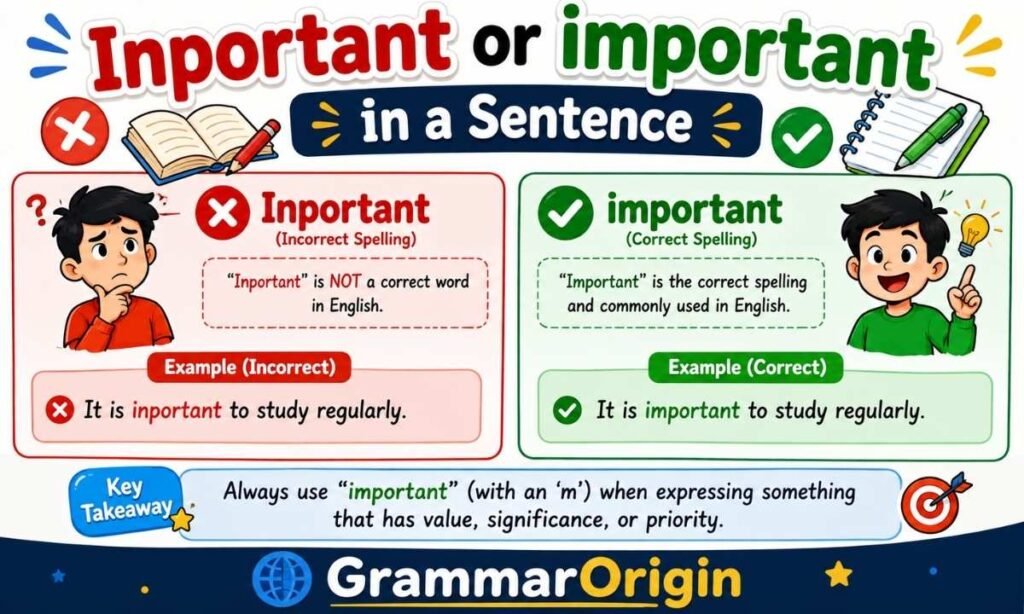
Seeing the word inside real sentences makes the correct spelling stick faster than any rule ever could.
- Sleep is important for focus and mood.
- This report contains important figures for the board meeting.
- It’s important to double-check flight times before booking.
- Her feedback was important to the final decision.
- Please read the important notice before Friday.
Every one of those examples uses “important” naturally — no sentence in standard English calls for “inportant” instead.
Inportant or important grammar
Grammatically, important functions only as an adjective, which means it modifies nouns rather than standing alone as a subject or verb. It follows normal adjective placement rules — either right before a noun (“an important call”) or after a linking verb (“this call is important”).
It also takes standard comparative and superlative forms: more important and most important, rather than “importanter” or “importantest.” The related noun is importance, and the adverb form is importantly — both keep the same “m,” following the same pattern as the base word.
“Inportant” has no grammatical role at all since it isn’t recognized as a word in any variety of English.
Also Read This Homey or Homie
Inportant or important examples
Placing incorrect and correct versions side by side usually settles any remaining doubt.
| Incorrect | Correct |
| This is an inportant email. | This is an important email. |
| Please share inportant updates. | Please share important updates. |
| Water is inportant for health. | Water is important for health. |
| That was an inportant lesson. | That was an important lesson. |
The pattern repeats every time across the inportant or important debate: swap the “n” for an “m,” and the sentence becomes correct instantly.
Most important meaning in English
“Most important” is the superlative form, used when comparing several things and picking out the one that matters more than the rest. It signals priority, not just general significance.
For example: “Honesty is the most important trait in a friendship” ranks honesty above other qualities rather than just calling it valuable. Newsrooms use the same structure when they lead with “the most important story of the day,” pointing to a single standout item among many.
This phrase shows up often in writing that ranks, prioritizes, or narrows down a list — reports, rankings, and opinion pieces especially.
Common Mistakes with Inportant or Important
Most spelling errors here follow the same handful of habits, regardless of how experienced the writer is or how strong their written communication normally is.
Writing what you hear
Spoken English blurs sounds together more than people realize. Since “m” softens in fast speech, “inportant” can feel like a reasonable guess even to careful writers.
Trusting sound over spelling
English spelling doesn’t always track pronunciation closely. Leaning purely on how a word sounds is a common source of typos across dozens of English words, not just this one.
Ignoring spellcheck warnings
Most spellcheck tools flag “inportant” immediately since it isn’t a recognized word. The mistake usually slips through when someone types fast, works on mobile, or skips past the red underline without a second look.
Inportant or Important in Everyday Use
The inportant or important question comes up constantly across very different kinds of everyday writing and professional communication.
Emails
A misspelled subject line — “Inportant: Meeting Moved” — can make a message look rushed before it’s even opened. Getting it right protects first impressions.
School & Education
Teachers routinely mark spelling slips on assignments, even strong ones. Getting “important” right helps students avoid losing easy points.
Work & Business
Reports, proposals, and internal memos lean on this word constantly. One typo like “inportant” can quietly chip away at how polished a document looks.
News & Media
Journalists use “important” to flag developments worth attention. Editorial standards make spelling slips here especially visible to readers who expect precision.
Social Media
Captions are more forgiving overall, but “inportant” still stands out — especially in posts meant to look professional or informative.
Also Read This Homey or Homie
Inportant or Important – Search & Usage Insight
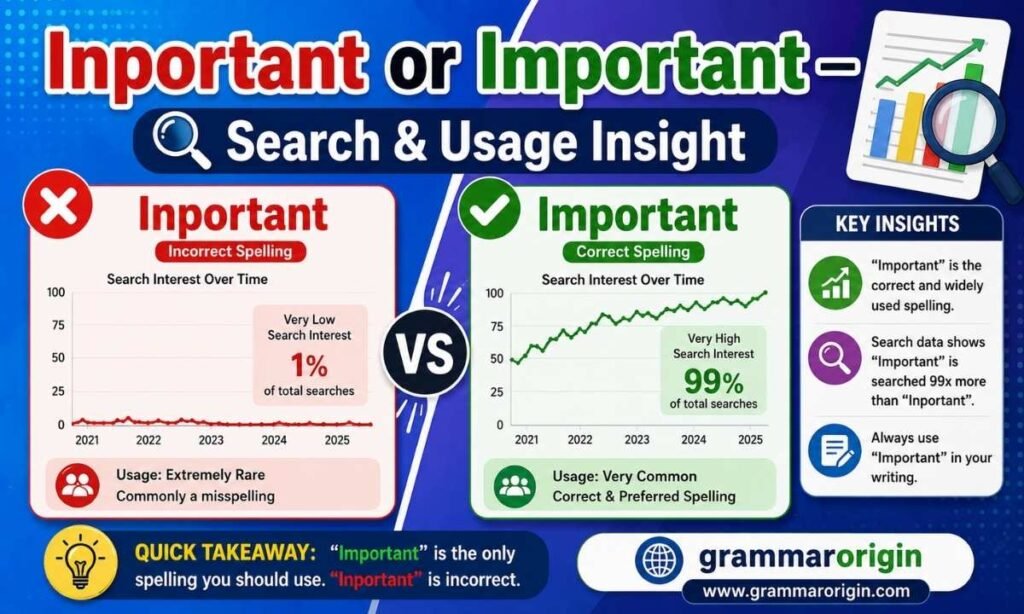
People searching “inportant or important” are almost never confused about what the word means — they’re double-checking a spelling they typed too fast to trust. That distinction shows up in how the query is phrased, direct and specific rather than open-ended.
This search pattern is common among students, English language learners, content writers, and professionals proofreading before hitting send. The confusion is nearly always about the letter, never about the word’s actual meaning or grammar.
Comparison Table: Inportant vs Important
| Feature | Inportant | Important |
| Correct spelling | No | Yes |
| Found in dictionaries | No | Yes |
| Used in British English | No | Yes |
| Used in American English | No | Yes |
| Grammatically valid | No | Yes |
| Common cause | Typing or pronunciation slip | Standard English spelling |
Frequently Asked Questions
Is it inportant or important?
In the inportant or important debate, important is correct. Inportant is a spelling mistake and doesn’t appear in any English dictionary.
Why do people spell it “inportant”?
Mostly because “m” and “n” sound alike in fast speech, and the two letters sit next to each other on a keyboard.
Does the spelling change in British English?
No. British, American, and Australian English all use the exact same spelling — important.
What part of speech is important?
It’s an adjective. It describes nouns like decisions, people, or events rather than naming an action.
What’s the superlative form of important?
Most important. Important follows standard comparative rules — more important, most important — rather than adding “-er” or “-est.”
Can spellcheck catch “inportant”?
Yes, in almost every modern app or browser. It’s flagged because it isn’t a recognized English word.
What are good synonyms for important?
Significant, essential, crucial, vital, and necessary all work well depending on context.
Final Thoughts
Between inportant or important, only one spelling has ever been correct. Important keeps its “m” straight from its Latin root, stays consistent across every English-speaking region, and never shifts based on formality or audience.
The mix-up is a typing and pronunciation habit, not a genuine grammar rule or regional variation. Once the “m” registers, this common spelling mistake tends to disappear from your writing for good.

Muhammad Waqas is an English language teacher and grammar expert with over 8 years of experience helping students and professionals improve their writing skills. He specializes in English grammar, vocabulary, communication, and practical language learning. Through GrammarOrigin, Waqas shares clear, easy-to-understand content that helps readers write and speak English with confidence.