
Only one of these two words exists in real English. If you’ve typed “absense” in an email and then paused, wondering if it looked right, you’re far from the only one — it’s one of the more commonly misspelled words in everyday writing. The word you actually want is absence, and the confusion usually comes down to how the word sounds, not how it’s built.
This guide walks through where the word comes from, why the mistake keeps happening, and how to use absence correctly across grammar, spelling, and everyday writing. By the end, you won’t need to second-guess it again.
Absence or Absense – Quick Answer
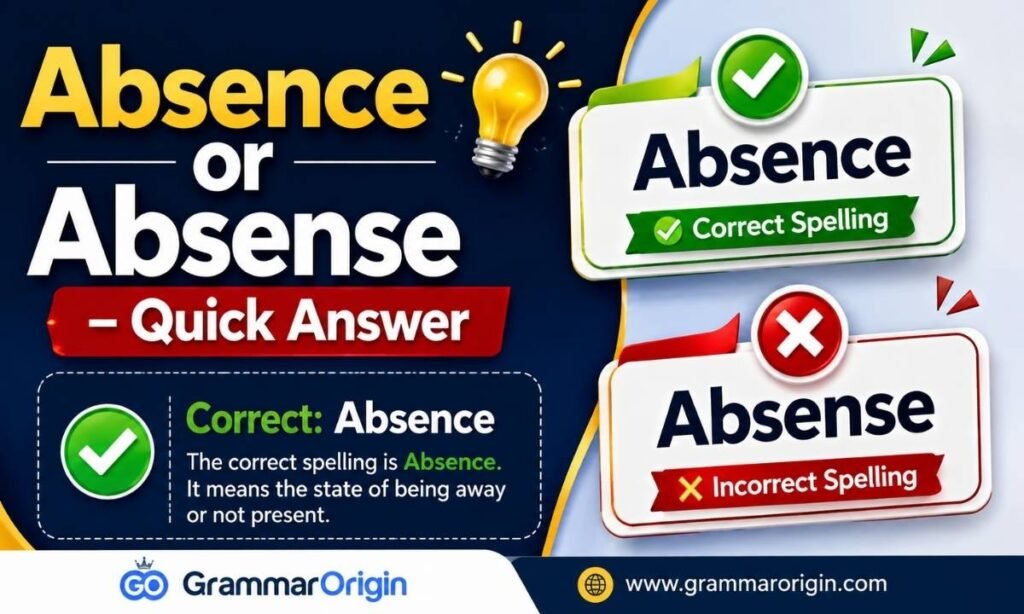
Absence is correct. Absense is not a real word — it’s a spelling slip, not an alternate form.
- ✅ Absence — Her absence from the office went unnoticed until Friday.
- ❌ Absense — this spelling doesn’t appear in any standard English dictionary.
The word ends in -ence, not -ense, and that single letter is where almost every mistake starts. Once you lock in the ending, the rest of the word takes care of itself.
The Origin of Absence or Absense
Absence traces back to the Latin word absentia, built from ab- (away) and esse (to be) — literally, “being away.” Absense has no such history; it was never a word in any stage of English.
The term moved into English through Old French in the medieval period, keeping its Latin-rooted -ence ending along the way. That’s the same pattern behind words like presence, silence, and patience — all of them Latin borrowings that kept the -entia root spelled as -ence.
Absense, by contrast, isn’t a variant spelling or a regional form. It simply doesn’t connect to any Latin, French, or Old English source — which is a strong sign it’s an error rather than a legitimate alternative.
British English vs American English Spelling
There’s no British-versus-American split here — both varieties of English write it the same way. Unlike colour/color or centre/center, absence doesn’t change across regions.
| Region | Correct Form |
| British English | absence |
| American English | absence |
| Either region | absense is wrong |
So if you’ve ever assumed absense might be a British spelling, that idea doesn’t hold up. Dictionaries on both sides of the Atlantic — Oxford, Cambridge, and Merriam-Webster alike — list only absence.
Which Spelling Should You Use?
Use absence in every situation — there’s no context where absense becomes acceptable. This holds true whether you’re writing a school note, a business email, or a text to a friend.
- Academic essays and reports: absence
- Workplace emails and HR documents: absence
- Casual messages and social posts: absence
- UK, US, or any English-speaking audience: absence
The rule doesn’t shift based on formality or audience. If you’re unsure, default to absence every single time.
Also Read This Inportant or Important
Why Is This Mistake So Common?
The mistake happens because absence sounds a lot like it should end in -sense when spoken aloud. Since the “c” in the middle is silent, your ear picks up on a sound pattern that doesn’t match the actual spelling.
English has plenty of common words ending in -sense — nonsense, sense, common sense — and that familiarity nudges writers toward the wrong pattern. Meanwhile, words that genuinely share absence‘s ending, like presence and existence, are less front-of-mind when you’re typing quickly.
Autocorrect doesn’t always catch it either, since “absense” can slip past spell-checkers that are tuned for more obvious typos. Add in rushed typing or texting, and the error keeps circulating.
Common Mistakes with absense vs absence
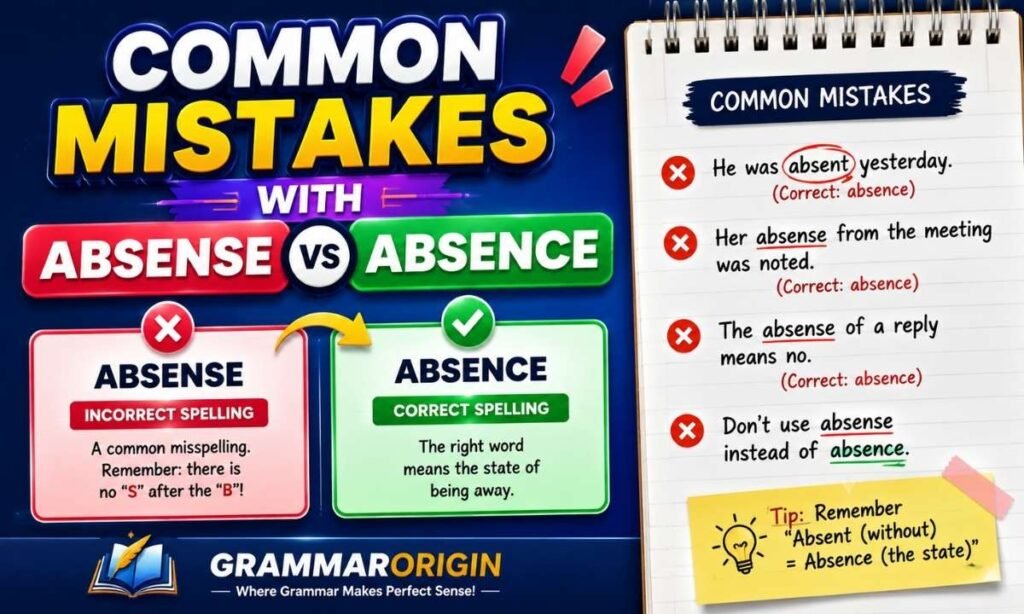
The core spelling mistake is swapping the final c for an s, but a few related errors show up just as often. Here’s what to watch for:
- ❌ Absense → ✅ Absence (wrong ending entirely)
- ❌ Abscence → ✅ Absence (an extra “c” gets inserted)
- ❌ Absance → ✅ Absence (the “e” is swapped for an “a”)
- ❌ Abcense → ✅ Absence (letters get transposed)
A simple way to catch yourself: pair absence mentally with presence. If you’d never write “presense,” there’s no reason to write “absense” either.
Absence or Absense in Everyday Examples
Absence shows up constantly in daily writing — from short texts to formal reports — and it’s always spelled the same way regardless of tone. Here’s how it looks in real, common contexts:
- Text message: “Missed you at lunch, your absence didn’t go unnoticed.”
- Workplace email: “Please log any planned absence with your manager in advance.”
- News report: “Analysts pointed to the absence of clear guidance as the reason for market uncertainty.”
- School note: “Please excuse my daughter’s absence due to a dental appointment.”
- Everyday conversation: “The absence of traffic this morning made the commute painless.”
Across every one of these, swapping in absense would be flagged as an error by any editor, teacher, or spell-checker worth trusting.
Absence or Absense – Google Trends & Usage Data
Search interest for both terms reveals a clear pattern: people typing “absense” are almost always checking whether it’s correct, not using it confidently. Queries like “is absense a word” or “how to spell absence correctly” are common ways this confusion surfaces in search behavior, since spell-check tools don’t always flag it.
Absence itself is one of the more frequently used abstract nouns in English, appearing regularly in workplace, education, and news content. Absense, meanwhile, shows up almost exclusively inside comparison searches — a sign that writers are pausing mid-sentence to double-check themselves rather than trusting the spelling outright.
That hesitation is actually useful. It means most people already sense something is off about absense — they just need the confirmation that absence is the word they’re after.
Absence vs Absense: Comparison Table
| Feature | Absence | Absense |
| Correct spelling | Yes | No |
| Found in dictionaries | Yes | No |
| Part of speech | Noun | N/A |
| Pronunciation | /ˈæb.səns/ | Same sound, wrong spelling |
| Word origin | Latin absentia | None |
| Acceptable in formal writing | Yes | No |
| Acceptable in casual writing | Yes | No |
This table makes the comparison simple: every category favors absence, and absense doesn’t qualify as a legitimate entry anywhere.
Absence or absense meaning
Absence means the state of being away, missing, or not present — and that’s the only meaning either spelling carries, since absense isn’t a word at all. It applies to people, objects, qualities, or even conditions that are expected but not there.
You’ll see it used for a person missing from a room (“his absence at the meeting”), a missing quality (“an absence of enthusiasm”), or something that simply isn’t happening (“an absence of rain this summer”). As a noun, it always points to something lacking or not there, never to an action.
Absence or absense grammar
Grammatically, absence is a countable noun, which means it can take a plural form — absences — when referring to multiple instances. “Absense” fails at the grammar level too, since a word that doesn’t exist can’t follow any grammatical rule.
A few structural notes worth knowing:
- Absence pairs naturally with prepositions: “in the absence of,” “absence from,” “due to absence.”
- Its related adjective is absent (“she was absent”), and its adverb is absently (“he stared absently out the window”).
- The plural, absences, is used when counting occurrences: “Three absences this month triggered a review.”
Recognizing that absence belongs to the same noun family as presence, existence, and patience makes the grammar — and the spelling — far easier to remember together.
Also Read This Inportant or Important
Absence or absense uk
In UK English, the spelling is identical to American English: absence, with no regional variation at all. Unlike words such as colour or organise, this isn’t one of the spelling pairs that splits by country.
British dictionaries, including Oxford and Cambridge, list only absence as correct, and absense doesn’t appear as a recognized British variant either. If you’re writing for a UK audience, you can use absence with full confidence — no adjustment needed.
Absence or absent from school
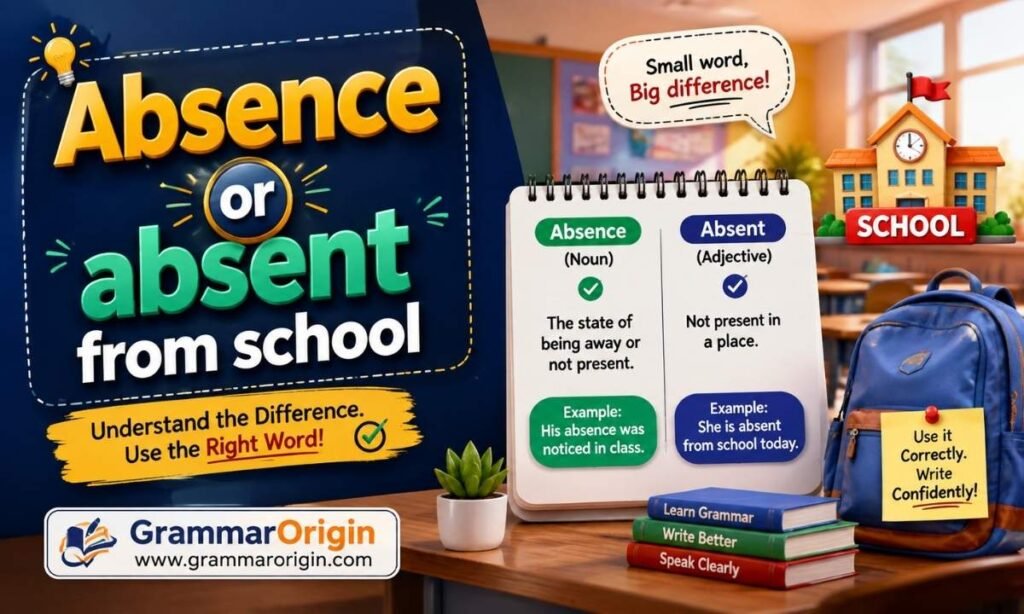
When it comes to school contexts, the confusion often isn’t just about spelling — it’s about choosing between absence and absent, which serve different grammatical roles. Absence is the noun (“her absence from school was excused”), while absent is the adjective describing a person (“she was absent from school”).
A quick way to tell them apart: if the word follows “was” or describes a person directly, you likely need absent. If it’s the subject of the sentence or follows “due to,” “because of,” or “in the,” you need absence.
- ✅ “He was absent yesterday.” (adjective, describes the student)
- ✅ “His absence was noted in the register.” (noun, names the state of being away)
- ❌ “He was absense yesterday.” (absense is never correct in either role)
Absence synonym
Common synonyms for absence include nonattendance, unavailability, absenteeism, and lack, depending on the context you’re writing in. For a person missing from a place, nonattendance or absenteeism fits best; for something conceptually missing, lack or deficiency works better.
- Formal/workplace: absenteeism, nonattendance, leave of absence
- General/abstract: lack, absence of, want of
- Availability-focused: unavailability, non-appearance
The opposite of absence is presence — a useful pairing to remember, since both words share the same -ence ending and the same silent letter pattern that trips writers up.
Frequently Asked Questions
Is it “absence” or “absense”?
It’s absence. “Absense” isn’t recognized in any English dictionary and is considered a spelling error.
Why do people misspell absence as absense?
Because the word’s silent “c” makes it sound like it should end in -sense, similar to words like nonsense or sense. The pronunciation misleads the spelling.
Is “absense” ever correct in British English?
No. Both British and American English use only absence — there’s no regional exception for “absense” anywhere.
What part of speech is absence?
Absence is a countable noun. Its plural form is absences, and its related adjective is absent.
What is a simple trick to remember the spelling?
Pair it with presence in your mind — both words end in -ence, and if you wouldn’t misspell “presence” as “presense,” the same logic protects “absence.”
Does absence have a plural form?
Yes. Absences is used when referring to more than one instance, such as “several absences were recorded this term.”
What’s the difference between absence and absent?
Absence is the noun form (a state of being away), while absent is the adjective form used to describe a person or thing that’s missing.
Final Thoughts
Choosing between absence and absense isn’t really a close call — absence is the only correct spelling, backed by its Latin origin, consistent use across British and American English, and every major dictionary. Absense is simply a mishearing turned into a typo, not a recognized alternative.
Once you connect absence to its word family — presence, existence, patience — the spelling becomes far easier to trust without a second thought. Use absence consistently, and it’ll stop being something you need to double-check.

Muhammad Waqas is an English language teacher and grammar expert with over 8 years of experience helping students and professionals improve their writing skills. He specializes in English grammar, vocabulary, communication, and practical language learning. Through GrammarOrigin, Waqas shares clear, easy-to-understand content that helps readers write and speak English with confidence.