
Someone sleeping on a park bench gets called a vagrant. Someone else riding a freight train gets called a hobo. Most people use the two words like they’re the same thing, and that’s exactly where the confusion starts.
This guide untangles vagrant vs hobo properly — the legal weight one word carries, the working-class history behind the other, and where terms like tramp, bum, and vagabond fit into the same family.
Quick Answer
A vagrant is someone without a fixed home or steady income, and historically, the word came with legal consequences attached. A hobo is a migratory worker — someone who travels specifically to find temporary jobs, most associated with America’s railroad era.
The short version: hobos moved with a purpose, vagrants (at least by the old legal definition) didn’t. That single distinction explains almost everything else about how these words split.
What Is a Vagrant?
A vagrant is a person with no permanent home, no steady job, and no fixed address to speak of. The word doesn’t describe why someone ended up that way — just the condition itself, close to what older writing called a transient or drifter.
What sets “vagrant” apart from casual slang is its legal history. Courts in England were already using the term in statutes back in the 1300s, and American cities kept “vagrancy laws” on the books well into the 20th century, treating homelessness itself as something arrestable.
That legal baggage still colors the word today. Calling someone a vagrant in modern writing tends to sound clinical, even a little harsh, compared to softer alternatives like “unhoused” or “person experiencing homelessness.”
What Is a Hobo?
A hobo is a traveling worker — someone who moves from place to place specifically to find temporary employment. Picture a farmhand hopping a freight train to reach the next harvest; that’s the classic image.
The word is tied tightly to a specific slice of American history, roughly the 1870s through the 1940s, when riding freight boxcars between seasonal jobs during the Great Depression was a real and fairly common way for an itinerant worker to survive hard economic times.
Unlike “vagrant,” hobo never carried formal legal weight. It grew instead into folklore — hobo songs, a loosely shared code of conduct among rail travelers, and a kind of scrappy dignity that later got romanticized in film and music.
Vagrant vs Hobo (Key Differences Explained)
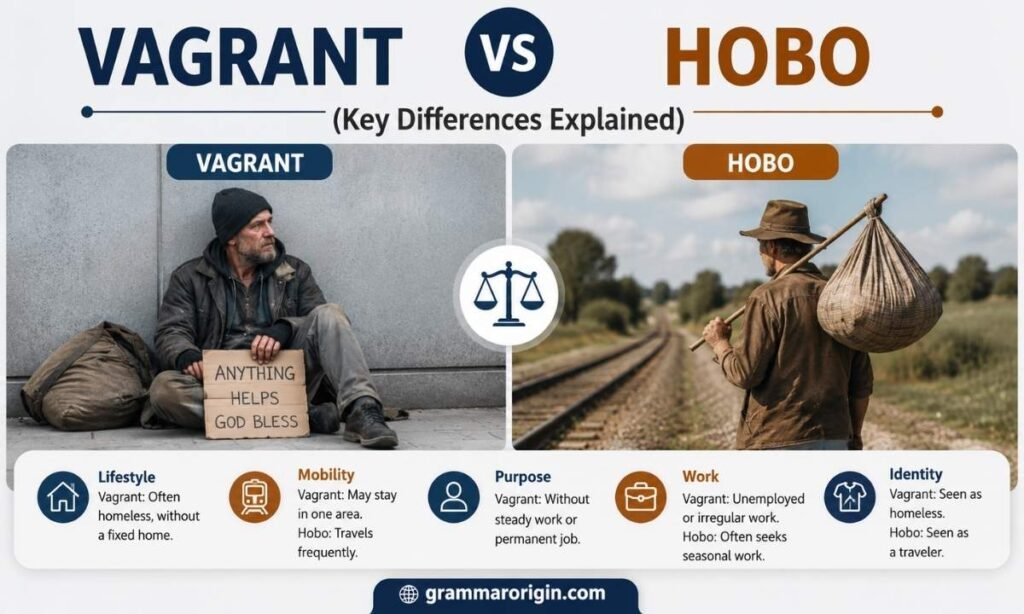
The real split between these words isn’t homelessness itself — both describe people without stable housing. It’s intent and motion.
A vagrant’s situation is treated as static: no home, no job, no particular direction. A hobo’s situation implies constant movement toward something — usually the next town, the next harvest, the next paying job.
Legally, only one of these words ever got someone arrested just for existing in public. Vagrancy statutes did exactly that for centuries; nothing comparable ever applied to the word “hobo.”
Comparison Table: Vagrant vs Hobo
| Feature | Vagrant | Hobo |
| Core meaning | No fixed home or income | Traveling worker seeking jobs |
| Movement | Often stationary, aimless | Constant, purposeful travel |
| Employment | Usually none | Actively works, temporary jobs |
| Legal history | Criminalized for centuries | No formal legal category |
| Era of common use | 1300s to present | 1870s to roughly 1940s |
| Tone today | Clinical, sometimes harsh | Nostalgic, historical |
The table oversimplifies a little — plenty of real people crossed both categories depending on the season or the year — but it captures the core split searchers are usually looking for.
Historical Background You Should Know
Vagrant is the older word by a wide margin. English courts were using it in legal statutes as early as the 1300s, borrowed from Old French “wagrant,” itself rooted in the Latin “vagari” — to wander.
Hobo’s origins are much murkier and much more recent. Word historians point to a few competing theories: a shortened “hoe boy,” describing a farm laborer who carried his own hoe, or a railroad greeting like “Ho, boy!” shouted between workers. Nobody has ever settled it for certain.
What’s clear is the economic backdrop. Post-Civil War America needed mobile labor for railroads, farms, and mines, and thousands of workers answered that need by riding freight cars between jobs — which is exactly how “hobo” entered everyday speech.
The History of Vagrancy Laws (and Why They Were Struck Down)

Vagrancy laws once let police arrest someone simply for appearing homeless or unemployed in public — no actual crime required, just the status itself. That’s a detail most modern readers find genuinely surprising.
These laws stayed on the books in many US cities well into the 20th century, targeting anyone without shelter or steady employment, and they were disproportionately used against the poor, immigrants, and formerly enslaved people during Reconstruction and after.
The turning point came in 1972, when the Supreme Court’s ruling in Papachristou v. City of Jacksonville struck down a Florida vagrancy law for being unconstitutionally vague. That decision triggered a wave of similar laws getting dismantled across the country.
Modern Usage of Vagrant and Hobo Today
Neither word gets much use in current, respectful writing — “homeless” and “unhoused” have largely taken their place in journalism, policy, and everyday conversation.
Vagrant still shows up occasionally in legal or municipal contexts — city ordinances, court documents, that sort of formal language — where its older, technical meaning still applies.
Hobo, on the other hand, survives mostly as a nostalgic or joking term. Someone might call themselves a “hobo” over a scruffy outfit or a broke month, but using it to describe an actual homeless person today reads as oddly dated.
Vagrant vs Homeless vs Hobo (Common Confusion)
These three words get lumped together constantly, but they’re not interchangeable. “Homeless” is the broad, modern, respectful umbrella term — it says nothing about travel or work.
Vagrant narrows that down with a legal and historical edge, implying a fixed, often stigmatized status. Hobo narrows it a completely different direction, implying active movement in search of work rather than a static condition.
Picture three circles: homeless is the largest, containing both vagrant and hobo as older, more specific — and now mostly outdated — subsets of the same general idea.
Also Read This Trash vs Garbage
Common Misconceptions About Hobo and Vagrant
A lot of people assume hobo just means “homeless person from the past,” full stop. That misses the defining trait — travel for work — which separates a hobo from someone who simply lacked housing.
Another common mistake is treating vagrant as automatically criminal. The word describes a lack of stable home or income; it doesn’t imply lawbreaking, even though vagrancy statutes once treated it that way.
People also assume both words are equally outdated. In practice, “vagrant” survives in formal legal writing far more than “hobo” does — the gap in how current each term feels is bigger than most assume.
Real-Life Examples of Usage
Seeing both words in context clears things up faster than any definition can.
- “The old vagrancy ordinance let police arrest anyone found sleeping in the square.” — legal, historical context.
- “My grandfather rode freight trains as a hobo during the Depression, picking up farm work along the way.” — travel-for-work context.
- “City council debated new rules targeting vagrant encampments downtown.” — modern legal/municipal usage.
- “He joked that three days without a shower made him look like a total hobo.” — casual, joking modern slang.
- “Historians still study hobo culture as a genuine working-class subculture, not just a symbol of poverty.” — cultural/historical framing.
Vagrant vs Hobo vs Vagabond
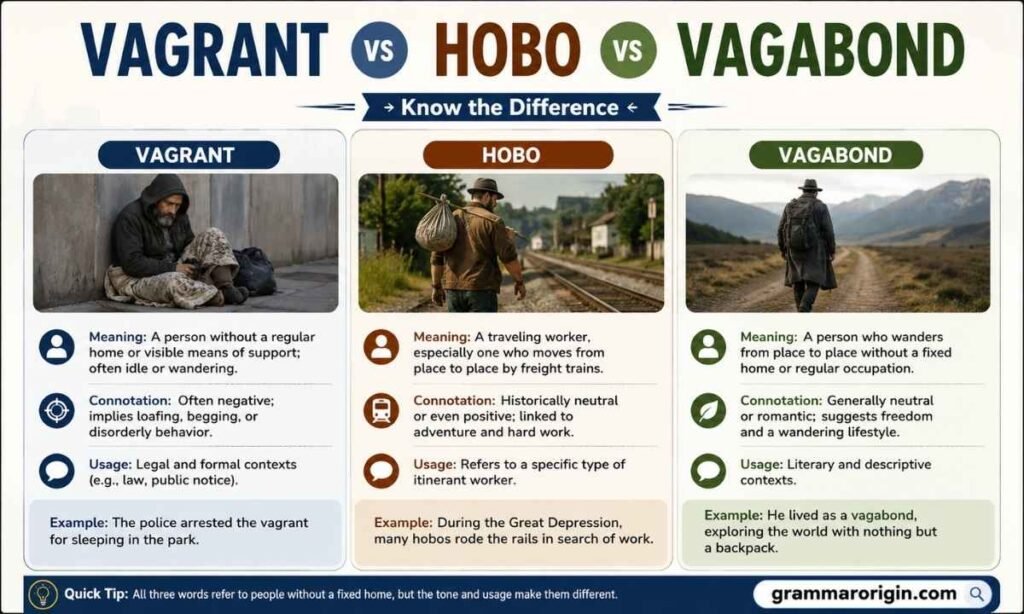
Vagabond sits close to both words but leans lighter — it can describe someone who simply enjoys a wandering lifestyle, with or without money, rather than someone forced into it by circumstance.
Where vagrant carries legal weight and hobo implies a work ethic, vagabond often carries a touch of romance — think of a free-spirited traveler rather than someone struggling to survive.
In short: a vagabond might wander by choice, a hobo wanders for work, and a vagrant’s wandering (by the old definition) has neither a clear reason nor a clear destination.
Hobo vs Vagrant vs Bum vs Tramp
This four-way split actually has a rough internal logic to it, rooted in old rail-travel slang: does the person travel, and does the person work?
| Term | Travels? | Works? |
| Hobo | Yes | Yes |
| Tramp | Yes | Avoids it when possible |
| Bum | No | No |
| Vagrant | Sometimes | Rarely, by the legal definition |
That hierarchy isn’t strict modern usage — it’s closer to the pecking order rail travelers themselves once used to describe each other. Most people today just use whichever word comes to mind, without the old distinctions in play.
Vagrant vs Hobo on Reddit — How People Actually Use These Words Today
Online, both words drift pretty far from their historical meanings — Reddit threads use “hobo” constantly as a self-deprecating joke about being broke, messy, or living cheaply, with zero connection to actual homelessness.
“Vagrant” shows up less often in casual online speech, and when it does, it’s usually in a historical, legal, or gaming/fiction context rather than describing a real person.
That gap says something useful: hobo has drifted into harmless internet slang, while vagrant has mostly stayed formal, which lines up exactly with the legal-versus-cultural split covered earlier in this guide.
Also Read This Trash vs Garbage
Vagrant vs Docker — A Completely Different Meaning (Clearing the Confusion)
If a search for “vagrant vs docker” landed you here, this isn’t the topic — but here’s the quick answer anyway. Vagrant, in software development, is a tool by HashiCorp for building and managing lightweight, portable virtual development environments.
Docker, by contrast, is a containerization platform that packages applications with their dependencies into isolated containers, which run faster and lighter than full virtual machines.
| Tool | What It Does |
| Vagrant (software) | Manages full virtual machines for consistent dev environments |
| Docker | Runs lightweight containers sharing the host OS kernel |
The two share a name with the linguistic term purely by coincidence — there’s no actual connection between HashiCorp’s Vagrant and the word discussed throughout the rest of this article.
Is “Vagrant” or “Hobo” Offensive Today?
Neither term counts as neutral or fully respectful in current usage — both can land as dismissive depending on tone and audience, even when no offense is intended.
Vagrant carries the sharper edge of the two, mostly because of its criminal-law history and its long use as a tool against the poor, immigrants, and marginalized communities.
Hobo feels gentler by comparison, largely thanks to its folk-culture associations, but calling an actual unhoused person a “hobo” today still risks sounding careless. “Person experiencing homelessness” remains the safer, current standard in journalism and policy writing.
Frequently Asked Questions
What is the main difference between vagrant and hobo?
A vagrant has no fixed home or income and historically faced legal consequences for it. A hobo specifically travels to find temporary work, most associated with America’s railroad era.
Is “hobo” an offensive word?
It can come across as dated or dismissive when used to describe a real person today, even though it carries a lighter, more nostalgic tone than “vagrant.”
Are vagrants and hobos the same as homeless people?
Not exactly. “Homeless” is the broad modern term; vagrant and hobo are older, narrower words tied to specific legal or cultural histories within that broader category.
What’s the difference between a hobo and a tramp?
A hobo travels and works; a tramp travels but avoids steady work whenever possible — a distinction that comes from old rail-travel slang rather than formal definitions.
Why don’t vagrancy laws exist anymore in most places?
Courts ruled many of them unconstitutionally vague, since they criminalized a person’s status rather than any actual act — most notably in the 1972 Papachristou v. City of Jacksonville decision.
Does “vagrant” have anything to do with the software tool of the same name?
No. HashiCorp’s Vagrant is a virtual development environment tool, completely unrelated to the linguistic meaning of the word covered in this guide.
Can “vagrant” be used as a verb?
No, vagrant only functions as a noun or adjective in standard English — there’s no verb form in common or correct usage.
Final Thoughts
Vagrant and hobo both describe people without permanent homes, but they come from genuinely different histories — one a centuries-old legal label, the other a working-class travel culture from a specific slice of American history.
Neither word fits comfortably in respectful modern writing about homelessness, and that’s worth keeping in mind regardless of which one seems to fit better in a given sentence.

Muhammad Waqas is an English language teacher and grammar expert with over 8 years of experience helping students and professionals improve their writing skills. He specializes in English grammar, vocabulary, communication, and practical language learning. Through GrammarOrigin, Waqas shares clear, easy-to-understand content that helps readers write and speak English with confidence.