
Type “modeling” into a British document and it looks off. Type “modelling” into an American one and the same thing happens. Neither spelling is wrong — they just belong to different sides of the English-speaking world.
This guide settles modelling or modeling for good: which one fits American writing, which one fits British writing, and how the split actually started. You’ll also find niche breakdowns for fashion, engineering, data science, and CAD, so the right spelling never depends on guesswork again.
Quick Answer
Modeling is the American English spelling. Modelling is the British English spelling — used across the UK, Australia, and most Commonwealth countries.
Both words mean exactly the same thing. Pick based on your audience: American readers expect one L, British readers expect two.
What Does Modeling or Modelling Mean?
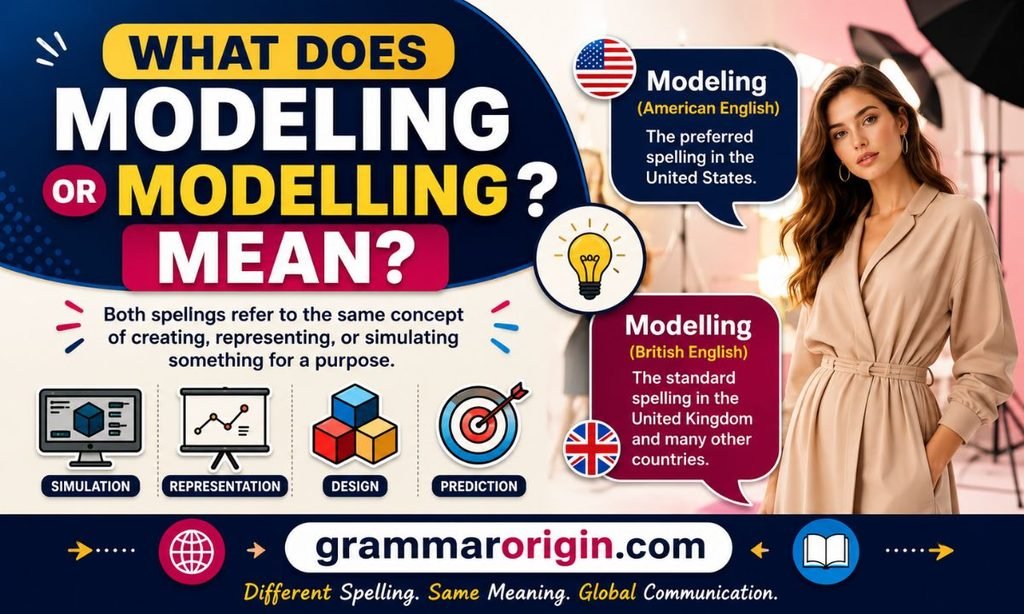
Both spellings describe the same activity — creating a representation of something, posing as a model, or demonstrating a process others can follow. The meaning never changes; only the letter count and regional spelling convention do.
You’ll run into this word across wildly different fields, from runway fashion to climate research.
Common uses include:
- Fashion modeling
- Mathematical modeling
- Business and financial modeling
- Data modeling
- 3D and CAD modeling
- Role modeling
- Scientific modeling
Why Are There Two Different Spellings?
The split traces back to a deliberate spelling reform, not an accident. American lexicographer Noah Webster simplified dozens of English words in the early 1800s, dropping what he considered unnecessary doubled letters as part of a broader push toward American orthography.
Webster’s changes turned “travelling” into “traveling,” “labelled” into “labeled,” and “modelling” into “modeling.” British English kept the original doubled-consonant pattern, and that historical fork is exactly why both spellings still exist today.
The rule in practice:
- American English: don’t double the final consonant before “-ing”
- British English: double the final consonant before “-ing”
Modelling vs Modeling Comparison Table
| Feature | Modeling | Modelling |
| English Variety | American English | British English |
| Meaning | Same | Same |
| Standard In | United States | UK, Australia, most Commonwealth nations |
| Origin | Webster’s 19th-century reform | Original English spelling pattern |
| Formal Writing | Accepted | Accepted |
When to Use “Modeling”
Reach for “modeling” whenever you’re writing for a US audience, an American publication, or any style guide built on American English conventions.
It shows up naturally in sentences like:
- The team relied on data modeling to forecast quarterly sales.
- She’s been modeling for three major brands this year.
- Financial modeling gave the startup a clearer runway estimate.
Most American universities, newsrooms, and corporations default to this single-L spelling without exception.
Also Read This Its Called vs It Called
When to Use “Modelling”
Choose “modelling” for UK readers, Australian and New Zealand audiences, and most international organizations that follow British spelling conventions.
Typical examples:
- The engineering firm specialises in computer modelling.
- She’s modelling for a London-based fashion house.
- Climate modelling shaped the report’s core predictions.
British newspapers, academic journals, and government publications treat the double-L spelling as the default.
Examples of Modelling vs Modeling in Different Contexts
Fashion
American: She started modeling for a swimwear brand last spring. British: She started modelling for a swimwear brand last spring.
Business
American: Financial modeling drives most investment decisions at the firm. British: Financial modelling drives most investment decisions at the firm.
Technology
American: The startup built its product around 3D modeling tools. British: The startup built its product around 3D modelling tools.
Science
American: Researchers used modeling software to track storm patterns. British: Researchers used modelling software to track storm patterns.
Modelling vs Modeling Common Mistakes People Make
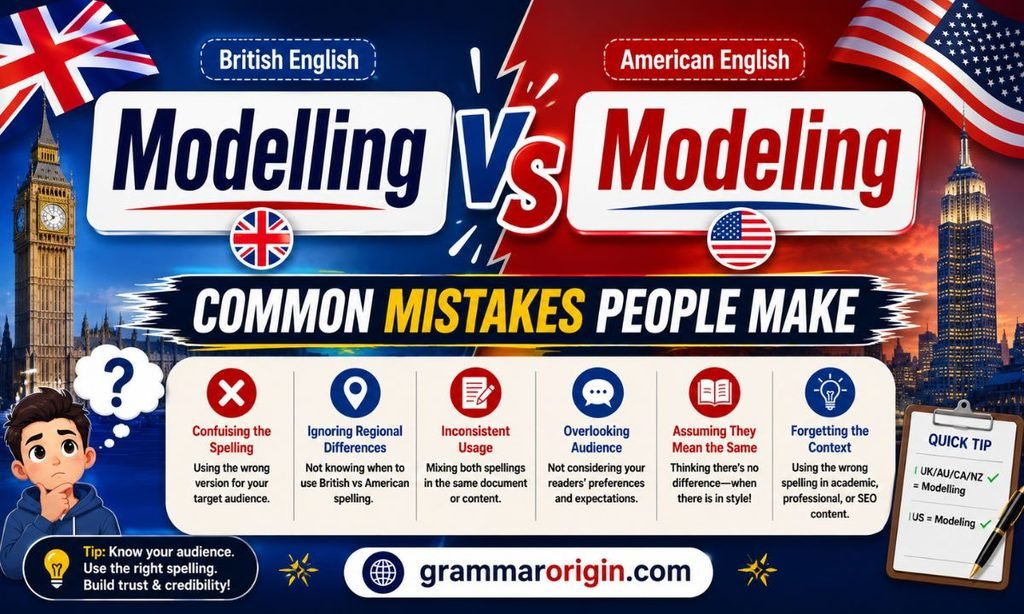
Mistake #1: Mixing Styles
❌ The agency handles financial modelling and data modeling for clients. ✅ The agency handles financial modeling and data modeling for clients. (pick one style and stay consistent)
Mixing single-L and double-L spellings inside one document is the single most common slip writers make.
Mistake #2: Assuming One Is Wrong
Some writers assume “modelling” is a typo, or that “modeling” looks incomplete. Neither is true — both spellings are fully correct within their respective English varieties.
Mistake #3: Ignoring Audience Location
Writing “modeling” for a British audience, or “modelling” for an American one, can read as careless even though the word itself isn’t wrong. Matching your audience’s expected spelling matters more than personal preference.
How to Choose the Right Spelling
Who Is Your Audience?
American readers expect “modeling.” British, Australian, and most Commonwealth readers expect “modelling.” Start there before anything else.
What Style Guide Are You Following?
Publications, universities, and companies often specify a spelling convention in their internal style guide — check it before you draft, not after.
Are You Writing for SEO?
If your target keyword is “modelling vs modeling,” it’s fine to mention both spellings naturally throughout the piece. For the rest of your body copy, stick to one consistent style so the article doesn’t read as sloppy.
Related Words and Spelling Differences
The modelling vs modeling pattern isn’t unique — it repeats across a whole family of English words that follow the same consonant-doubling rule and regional spelling convention.
| American English | British English |
| Traveling | Travelling |
| Counseling | Counselling |
| Labeled | Labelled |
| Fueled | Fuelled |
| Modeling | Modelling |
Once you recognize this pattern, switching between American and British spelling gets a lot easier across the board.
Is Modeling More Common Online?
Yes, “modeling” appears more often across the internet overall, largely because American English dominates global web content and search volume.
That said, “modelling” stays firmly standard across UK news sites, Australian publications, academic journals, and organizations that follow British style guides. Search engines treat both spellings as closely related, so neither version gets penalized in results.
Modelling or Modeling Mathematical
In mathematics, both spellings describe building an equation-based representation of a real-world system. American papers write “mathematical modeling”; British and Commonwealth papers write “mathematical modelling.”
Example: Mathematical modeling helped the team predict traffic flow across the new intersection.
3D Modeling or Modelling
3D work follows the same regional split as every other context — American software documentation says “3D modeling,” while UK-based studios and publications say “3D modelling.”
Example: The design team used 3D modeling software to prototype the product casing.
Modelling or Modeling in Engineering
Engineering reports lean on whichever spelling matches the country of publication. US engineering firms write “modeling”; UK and Commonwealth firms write “modelling.”
Example: The bridge project relied on structural modelling to test load-bearing capacity.
Financial Modelling or Modeling
Finance teams build spreadsheets and forecasts under either spelling — the practice is identical, only the letter count shifts by region.
Example: Financial modeling gave investors a clearer picture of five-year revenue growth.
Data Modelling or Modeling
Data professionals design database structures and schemas under both spellings, depending on where the company or publication is based.
Example: Data modelling shaped how the engineering team structured the customer database.
Modelling or Modeling Science
Scientific research papers follow the journal’s house style — American journals default to “modeling,” while British and international journals often default to “modelling.”
Example: Climate scientists rely on modeling to project long-term temperature trends.
CAD Modeling or Modelling
Computer-aided design follows the same rule as every other technical field — American CAD documentation uses “modeling,” British CAD documentation uses “modelling.”
Example: The architect used CAD modeling to finalize the building’s structural layout.
Also Read This Its Called vs It Called
Modeller vs Modeler
The noun form follows the identical pattern: “modeller” is British English, “modeler” is American English, and both describe someone who builds models or works as one.
Example: The 3D modeller spent weeks refining the character’s textures. / The 3D modeler spent weeks refining the character’s textures.
Frequently Asked Questions
Is “modelling” correct?
Yes. “Modelling” is the standard British English spelling and is used throughout the UK, Australia, and most Commonwealth countries.
Is “modeling” correct?
Yes. “Modeling” is the standard American English spelling and is used throughout the United States.
Which spelling is used more often?
When people search “modelling or modeling,” global data leans toward “modeling” simply because American English dominates much of the internet, though “modelling” remains standard across British-English regions.
Do modelling and modeling mean different things?
No. Both words share the exact same meaning — only the spelling differs based on regional English conventions.
Which spelling should Canadian writers use?
Canada mixes both conventions. Many Canadian publications lean toward British spelling, but American influence means “modeling” also appears frequently.
Why does British English double the L and American English doesn’t?
The difference comes from Noah Webster’s 19th-century American spelling reforms, which dropped doubled consonants that British English had traditionally kept.
Should I use both spellings in the same article?
Only if you’re specifically comparing modelling or modeling, as this guide does. Otherwise, pick one spelling convention and use it consistently throughout your writing.
Final Thoughts
Modelling or modeling isn’t a question of right versus wrong — it’s a question of American English versus British English. Modeling fits US audiences; modelling fits UK, Australian, and most Commonwealth audiences.
Once you know who you’re writing for, the correct spelling picks itself. Stay consistent within a single document, and your writing will read as polished no matter which side of the Atlantic your reader is on.

Muhammad Waqas is an English language teacher and grammar expert with over 8 years of experience helping students and professionals improve their writing skills. He specializes in English grammar, vocabulary, communication, and practical language learning. Through GrammarOrigin, Waqas shares clear, easy-to-understand content that helps readers write and speak English with confidence.