
If you’ve searched for “Messege or Message” and paused, wondering which spelling is correct, you’re far from the only one. It’s a common spelling question in English, and the answer is simple: message is correct, while messege is incorrect.
This guide explains the meaning of message, why so many people confuse its spelling, and how to remember the correct version. You’ll also find a comparison table, real sentence examples, and a helpful look at message vs. massage, two words that are often confused.
Quick Answer
Message is the only correct spelling. Messege is a misspelling and doesn’t appear in any English dictionary.
Whether you’re writing a text, an email, or a formal report, message is the form to use every time — there’s no context where messege becomes acceptable.
Meaning of “Message”
A message is any piece of information passed from one person to another, whether it’s spoken, written, or sent digitally.
It covers a wide range of everyday communication:
- A text or chat notification
- A voicemail or spoken note
- A written letter or email
- An idea or lesson conveyed indirectly, like the message of a film or speech
For example: “She left a message before her flight” or “The speech carried a message about resilience.” Both uses rely on the same spelling — message, never messege.
Why People Write “Messege” Instead of “Message”
Most people write messege because of how the word sounds, not because they don’t know English. The soft “-ij” sound at the end doesn’t hint at the correct “age” spelling, so the brain guesses.
A few other reasons show up again and again:
- Fast typing on phones, where fingers slip on similar-looking keys
- A habit of spelling words phonetically instead of visually
- Autocorrect on some devices not flagging it, since it still resembles a real word
None of these explain it away, though — message keeps its “age” ending regardless of how quickly or casually you’re typing.
Messege vs Message Comparison Table
| Word | Correct? | Meaning | Use It? |
| Messege | Incorrect | No meaning — not a real word | Never |
| Message | Correct | A piece of communication or information | Always |
The rule is simple: if you spot “messege” anywhere — in your own writing or someone else’s — swap it for “message” immediately.
Messege or Message or Massage
This is where a lot of confusion piles up, because three similar-looking words get mixed together in casual typing. Only two of them — message and massage — are real English words; messege isn’t one of them at all.
| Word | Real Word? | Meaning | Example |
| Messege | No | Not a word | — |
| Message | Yes | Written or spoken communication | “I got your message.” |
| Massage | Yes | Physical therapy on muscles | “She booked a massage.” |
A message is something you send or receive; a massage is something you get done to your body at a spa or clinic. They don’t overlap in meaning at all — only in how they sound when said quickly.
Message vs Massage: Pronunciation Difference
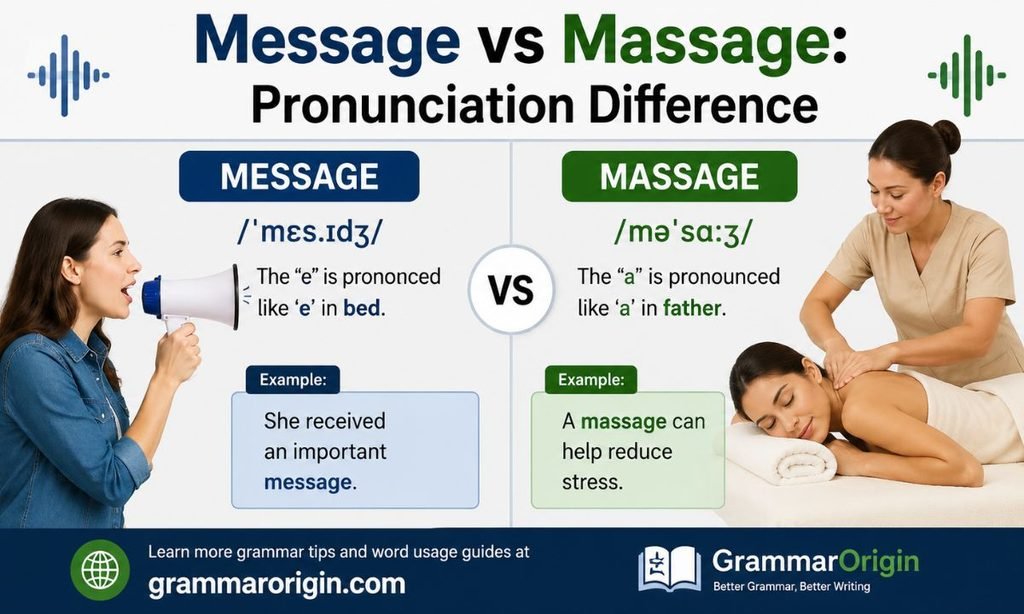
Message is pronounced “MES-ij,” with the stress on the first syllable and a soft ending. Massage is pronounced “muh-SAHZH,” with the stress landing on the second syllable and a “zh” sound borrowed from French.
That “zh” sound in massage — like the “s” in “measure” — is the biggest giveaway. If you hear that softer, buzzing ending, you’re dealing with massage, not message.
It helps to lock down the massage meaning too: it’s the act of rubbing or kneading muscles for relief, nothing to do with sending information. So if someone asks how to spell message like “rub” or “knead,” they’re really asking about massage, not message at all.
Correct Usage of “Message” in Sentences
Seeing the word in different settings helps the spelling stick in memory better than rules alone.
Everyday conversation:
- Did you check my message yet?
- He left a voice message this morning.
Formal writing:
- Please leave a message after the beep.
- The director’s message to staff was clear and direct.
Digital communication:
- Your message was delivered at 9:42 AM.
- I saw your message on WhatsApp last night.
Across every one of these, the spelling doesn’t shift — it’s message in casual chats and formal memos alike.
Also Read This Modelling or Modeling?
Message as a Verb (To Message Someone)
Message also works as a verb, meaning to send someone a message. “I’ll message you when I land” is just as correct as using it as a noun.
This verb form follows the same spelling rules as the noun — no double letters change, and no “messege” version exists here either. Related verb forms include messaged (past tense) and messaging (the ongoing act of sending messages), both keeping the same root spelling intact.
Common Mistakes Related to “Message”
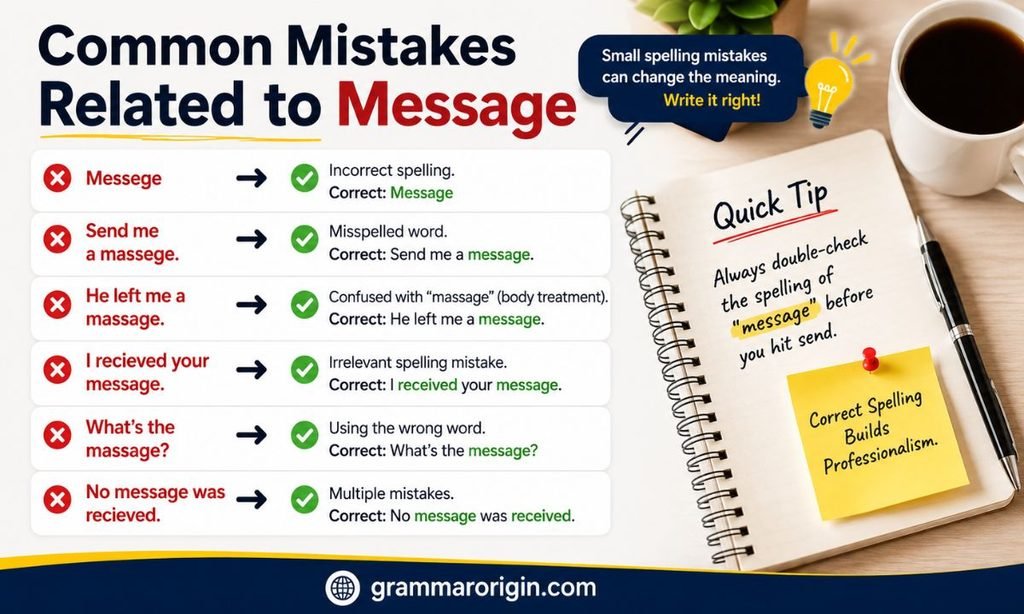
A handful of misspellings show up again and again, usually from rushed typing rather than genuine confusion about the word.
Incorrect → Correct:
- messege → message
- mesage → message
- messsage → message
- messegeing → messaging
A quick way to catch yourself: message always has a double “s” in the middle and ends in “age,” never “ege.”
Spelling Rule Behind “Message”
Message traces back to the Latin missus, meaning “sent,” which passed into Old French as message before English adopted it with the same spelling. That history is exactly why the word doesn’t follow modern phonetic logic.
Because of this origin, message keeps two features that trip people up:
- A double “s” in the middle
- An “-age” ending rather than “-ege”
Other English words share that same “-age” pattern — package, village, damage, courage, passage. None of them end in “-ege,” and message is no exception.
American vs British English Differences
There’s no spelling difference between American and British English here — both use message, and neither recognizes messege as valid.
Where the two do differ slightly is in tone of use: American English leans on message heavily in texting and social apps, while British English tends to favor it in more formal letters and workplace notes. The spelling itself, though, never changes across either variety.
Also Read This Modelling or Modeling?
Related Words and Variations
A handful of words share message’s root and its spelling pattern, which makes them useful for reinforcing the correct form.
- Messages — the plural form (if you’re wondering how to spell messages, it’s the same root plus an “s,” nothing more)
- Messaging — the ongoing act of sending messages
- Messaged — the past tense
- Messenger — a person, app, or service that delivers messages
Every one of these keeps the same “ss” and “age” pattern found in the original word — none of them ever slip into a “messege” spelling.
Easy Memory Tricks
If the spelling still doesn’t stick, a few small tricks tend to work better than repetition alone.
- Split it visually: mes + sage — both halves look like real, familiar chunks of English.
- Use a rhyme: “A message has an age,” a quick nudge toward the “-age” ending.
- Type it slowly once: M-E-S-S-A-G-E, noticing the double “s” lands right before the “a.”
When “Messege” Might Appear
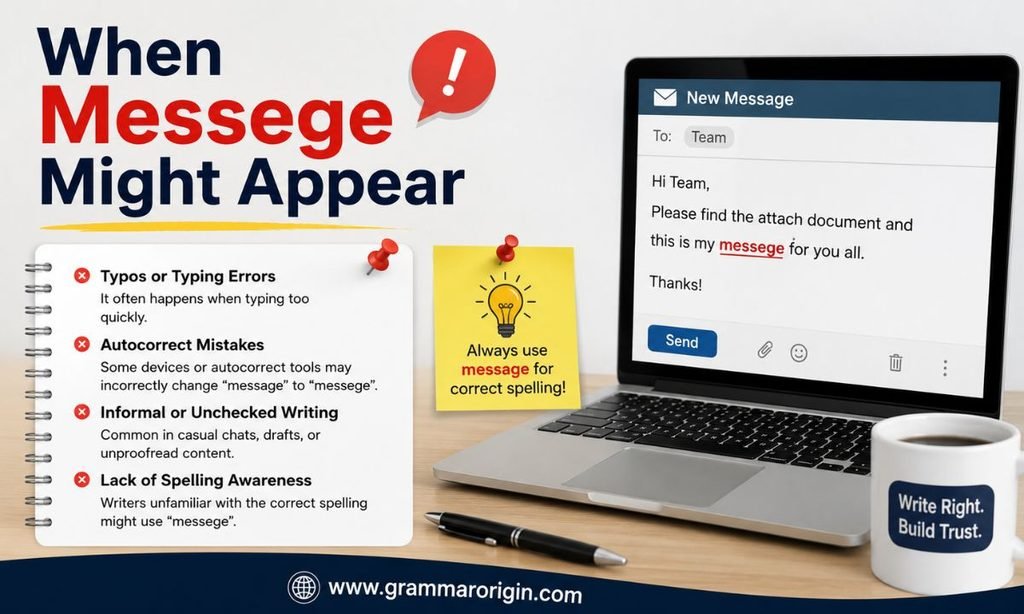
You’ll still spot messege scattered across casual writing — social media comments, quick chats, or typing mistakes made in a hurry.
Seeing it often doesn’t make it valid, though. Every major dictionary, grammar checker, and style guide agrees: messege isn’t a recognized English word, no matter how common the typo is online.
Why Correct Spelling Matters
Spelling message correctly does more than avoid a red squiggly line — it shapes how readers judge your writing at a glance.
- It signals attention to detail
- It keeps writing easy to read without double-checking meaning
- It protects credibility in emails, applications, and reports
- It avoids the small but real risk of misunderstanding
In job applications or professional emails, a mistake like messege can leave a negative impression even when the actual content is strong.
Frequently Asked Questions
Is messege ever correct?
No. Messege is always a misspelling — message is the only correct form in any context.
What’s the difference between a message and a massage?
A message is written or spoken communication, like a text or email. A massage is a physical therapy technique that relieves muscle tension — the two share no meaning overlap.
How do you spell message as in text?
It’s spelled the same way in every context — message, with a double “s” and an “-age” ending, whether you mean a text, email, or spoken note.
Why do people confuse messege and message?
Because the pronunciation doesn’t clearly show the spelling, and English spelling doesn’t always follow how a word sounds.
Is message spelled differently in British English?
No. American and British English both use message — there’s no regional spelling variation for this word.
How can I remember the correct spelling?
Picture the rule: double “s” plus an “-age” ending equals message. Words like village and package follow the same pattern.
What part of speech is “message”?
It’s mainly a noun, but it also works as a verb, as in “I’ll message you later.”
Summary
Between messege and message, only one is real: message, with its double “s” and “-age” ending traced back through Old French and Latin. Messege shows up from fast typing and phonetic guessing, but it has no place in dictionaries or formal writing.
Keep the pattern in mind — double “s,” ends in “age” — and the correct spelling stops being something you have to second-guess with every text, email, or report you send.

Muhammad Waqas is an English language teacher and grammar expert with over 8 years of experience helping students and professionals improve their writing skills. He specializes in English grammar, vocabulary, communication, and practical language learning. Through GrammarOrigin, Waqas shares clear, easy-to-understand content that helps readers write and speak English with confidence.