
Wondering whether to say on the list or in the list? Both phrases are grammatically fine, but they’re not interchangeable — one signals inclusion, the other signals location inside a collection.
Once you see the pattern, picking the right preposition stops feeling like guesswork. This guide breaks down the meaning, real examples, common slip-ups, and the exact moments each phrase actually fits.
Quick Answer
Use on the list when someone or something has been included, accepted, or added. Use in the list when you’re pointing to where an entry sits within the contents of that list.
- Your name is on the list. (You’ve been included.)
- Your name appears in the list below. (You’re looking at where it sits.)
A short way to hold onto this: included means on, located means in.
What Does “On the List” Mean?
On the list means a person, item, or task has been accepted as part of one — the focus is on belonging, not on physical position. It’s the phrase native speakers reach for almost automatically.
Guest lists, waiting lists, shopping lists, to-do lists, and priority lists all lean on “on” because each one works like a record that things get added to.
On the List Examples
- My name’s on the list for tomorrow’s interview.
- Are you on the guest list for the wedding?
- Bread and eggs are on the shopping list.
- Finishing this report is on my to-do list today.
- She’s been on the waiting list for months.
Each sentence carries the same idea — the person or item has already been accepted.
What Does “In the List” Mean?
In the list points to something existing within a collection’s contents, treating it as a document rather than a surface you’re added to.
You’ll run into this phrasing most often with databases, spreadsheets, search results, and anything digital where entries are being scanned or searched.
In the List Examples
- Your username shows up in the list of registered accounts.
- Check the answer in the list below.
- This item is fourth in the list of results.
- His name isn’t in the list of references anymore.
- The system flags any duplicate in the list.
Here, the focus shifts to where something sits, not whether it was accepted in the first place.
Why Do We Say “On the List” Instead of “In the List”?
English treats a list like a surface — a sheet of paper, a schedule, a menu — where names and items get written on top, not tucked inside.
That’s the same logic behind on the schedule, on the agenda, on the menu, and on the roster. Lists behave the same way in the language’s mental model.
So you’ll hear:
- Your name is on the attendance list. ✅
- Your name is in the attendance list. ❌ (sounds off)
The first version works because the name was added as an entry, not buried inside a container.
On the List vs In the List: Key Difference
| Phrase | Core Meaning | Typical Use | Example |
| On the list | Included, accepted, added | Everyday speech, official records | Your name is on the list. |
| In the list | Located within the contents | Documents, databases, digital records | Your name appears in the list below. |
Remember
On the list = you belong there. In the list = you’re being found there.
Real-Life Situations: When to Use Each Phrase
Grammar sticks better when you can picture the actual moment you’d use it.
Event Registration
When you sign up for an event, you’re added to an official record.
Correct: Your name is on the event list. Meaning: You’ve been registered and confirmed.
Restaurant Reservation
A restaurant keeps track of who’s booked a table.
Correct: Your reservation is on the list. Meaning: The staff already has your booking noted down.
Shopping
Whatever you jot down before heading to the store follows the same rule.
Correct: Milk is on the shopping list. Meaning: It’s been added to what you need to buy.
Website or Database
Anything digital tends to flip toward “in,” since developers and systems treat a list as a stored collection.
Correct: The article appears in the list of search results. A common example from coding: a program might check whether a username exists in the list of registered accounts before letting someone log in — that’s checking location within a dataset, not membership in a social sense.
School or Workplace
Attendance and staff records use the same inclusion logic as guest lists.
Correct: Her name is on the class list. Meaning: She’s officially enrolled or present.
Also Read This Messege or Message?
Common English Grammar Mistakes
These four mix-ups show up constantly, even among fluent speakers who just haven’t thought about why “on” wins here.
Mistake 1: Using “In the Guest List”
Incorrect: My name is in the guest list. Correct: My name is on the guest list.
“On the guest list” is the standard, expected phrase in almost every context.
Mistake 2: Using “In the Waiting List”
Incorrect: I am in the waiting list. Correct: I am on the waiting list.
You’re included as someone waiting, not tucked inside a container.
Mistake 3: Using “In the Shopping List”
Incorrect: Apples are in the shopping list. Correct: Apples are on the shopping list.
Items get added onto a shopping list, not placed inside it.
Mistake 4: Using “On the List” for Location
Incorrect: Find the word on the list below. Better: Find the word in the list below.
Here you’re searching through contents, so “in” fits the meaning better.
Included on the List vs Included in the List
Both phrases show up often, and the difference tracks the same on/in logic from earlier.
Included on the List
Included on the list signals that someone or something was accepted as a member of the group.
- Her name was included on the list of finalists.
- This hotel is included on the list of recommended stays.
Included in the List
Included in the list leans toward the contents or details of a document or record.
- The updated prices are included in the list below.
- Several notes are included in the list of instructions.
Most of the time, “included on the list” reads more naturally when membership or acceptance is the point.
When Should You Use “In the List”?
“In the list” earns its place in three fairly specific situations.
1. Finding Information
Example: Your order number is in the list of confirmed purchases. You’re scanning for a specific entry, not asking whether it was accepted.
2. Discussing Order or Position
Example: This name appears first in the list. The sentence is about ranking or sequence, not membership.
3. Talking About Digital Collections
Example: The script checks every entry in the list before saving. Databases, arrays, and spreadsheets get treated as containers, which naturally pulls “in” into place.
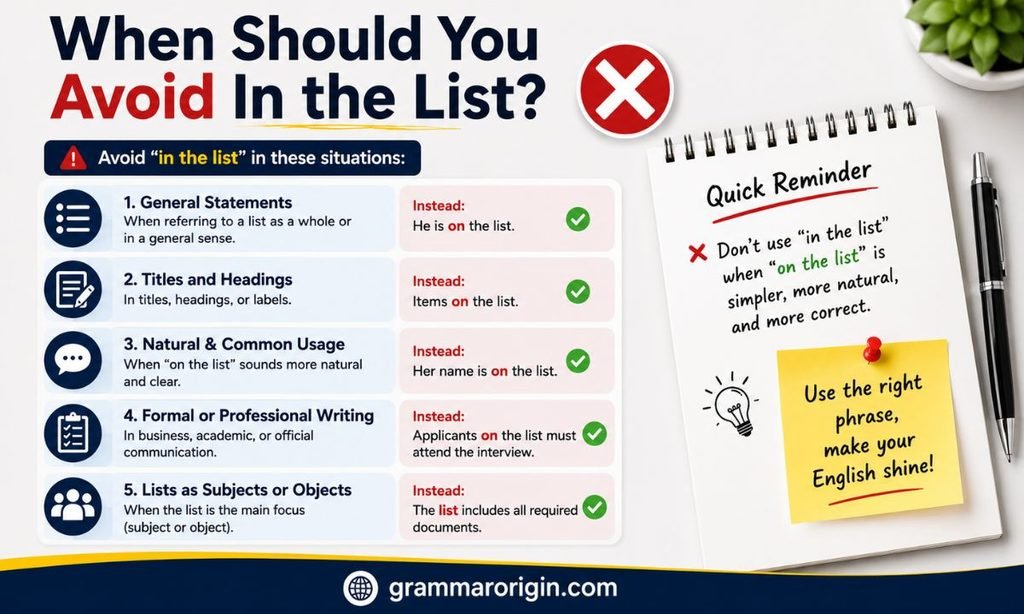
When Should You Avoid “In the List”?
A few sentences sound logical on paper but land oddly to a native ear.
Incorrect: I am in the guest list. Better: I am on the guest list.
Incorrect: She is in the waiting list. Better: She is on the waiting list.
Incorrect: His name is in the attendance list. Better: His name is on the attendance list.
Each of these describes belonging, not physical placement — so “on” is the natural fit.
Also Read This Messege or Message?
American vs British English Prepositions
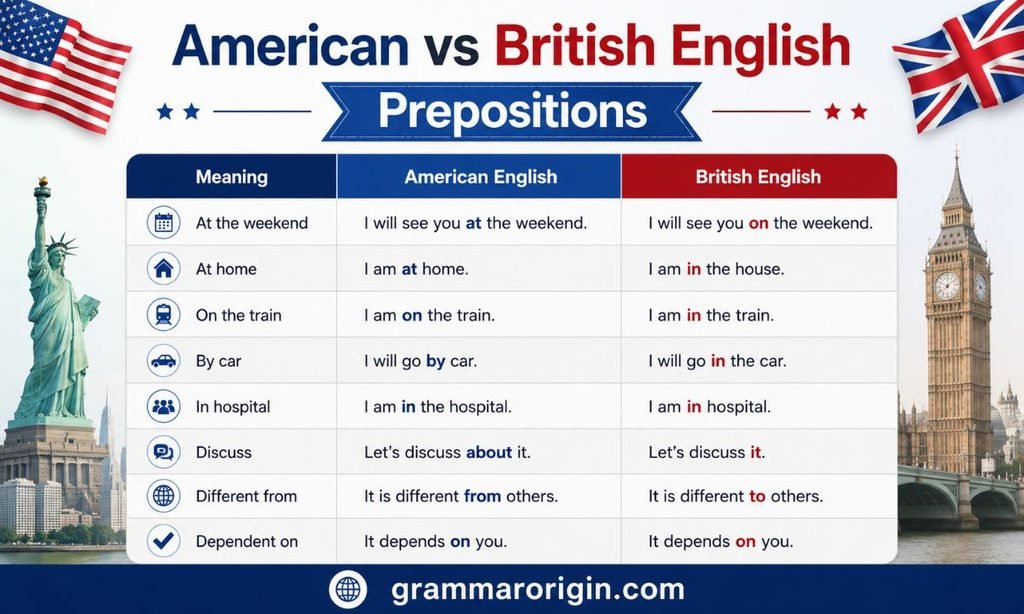
There’s no real split between American and British English here — both sides land on the same choices.
- On the list handles inclusion in both varieties.
- In the list covers location or contents in both varieties.
A quick note on data: corpus research on everyday English (the kind found in tools like COCA and Google Ngrams) consistently shows “on the list” appearing far more often across spoken and written English, regardless of region. Reference sources like the Britannica Dictionary back this up too, noting that “on the list” is the customary choice in nearly every situation. So whether you’re writing for a US or UK reader, the same rule holds.
Related Expressions You Should Know
Recognizing the pattern in related phrases makes the on/in choice almost automatic.
Expressions Using “On”
- on the list
- on the menu
- on the schedule
- on the agenda
- on the roster
- on the register
- on the waiting list
- on the guest list
Expressions Using “In”
- in the list
- in the database
- in the directory
- in the spreadsheet
- in the report
- in the catalog
- in the index
Notice that “on” phrases describe things added or recorded, while “in” phrases describe things stored or contained.
Final Thoughts
On the list and in the list aren’t really competing phrases — they answer two different questions. One tells you whether something’s been accepted; the other tells you where it sits inside a collection.
Once that distinction clicks, choosing between them stops being a guessing game. Stick with on the list for belonging, and in the list for locating, and the right preposition will start coming out naturally.
Frequently Asked Questions
Name Is Not on the List or In the List?
Say “not on the list” when someone hasn’t been included or approved. “Your name isn’t on the list” means you weren’t added as a member, the way a bouncer might tell someone they can’t enter an event.
That’s different from a document search coming up empty. If a spreadsheet or directory simply doesn’t contain an entry, “not in the list” fits better, since the concern is missing content rather than rejected membership.
Not Included on the List or In the List?
“Not included on the list” is the natural phrasing for something left out of membership or approval, such as a candidate who didn’t make a shortlist. “Not included in the list” works when a detail or entry is missing from a document’s contents instead.
Picture a report that’s supposed to cover ten products but only mentions eight — the two left out are “not included in the list,” since the issue is about what the document contains, not who got accepted.
My Name Is in the List or On the List?
Go with “on the list” when you mean you’ve been accepted or registered for something, which covers the vast majority of everyday situations. Use “in the list” only if you’re describing where your name physically or digitally appears within a set of entries, like a search result or a spreadsheet column.
A quick test: if someone could check you off at a door, say “on.” If someone’s scanning a file for your name, say “in.”
In Your List or On Your List?
“On your list” is standard for personal lists — reading lists, wish lists, to-do lists — since these track things you’ve chosen to add. “In your list” only fits when you’re pointing to something’s position inside a longer document or file, like a specific line in a saved spreadsheet.
Most everyday conversations about personal goals or plans will use “on,” so that’s the safer default when in doubt.
Not in the List Meaning?
“Not in the list” usually means an item or name can’t be found within a specific set of entries, like a database or spreadsheet — it’s about absence from content, not rejection. A programmer running a search might say a value is “not in the list” simply because it doesn’t match any stored entry.
This phrasing carries no judgment either way; it just states that the search came back empty.
On My List Meaning?
“On my list” means something has been added to your personal set of plans, goals, or items — as in “trying that restaurant is on my list” or “learning Spanish is on my bucket list.” It’s an informal way of saying you intend to get to something eventually.
The phrase works for both short-term tasks and longer-term ambitions, which is part of why it’s so common in casual speech.
On the List Meaning?
“On the list” broadly means someone or something has been accepted, registered, or added as part of a recognized group, whether that’s a guest list, a shortlist, or a shopping list. The exact context changes the stakes — a shopping list is low-pressure, while a shortlist for a job might carry real weight — but the underlying grammar stays identical.
That consistency is exactly why the phrase works so smoothly across such different settings.

Muhammad Waqas is an English language teacher and grammar expert with over 8 years of experience helping students and professionals improve their writing skills. He specializes in English grammar, vocabulary, communication, and practical language learning. Through GrammarOrigin, Waqas shares clear, easy-to-understand content that helps readers write and speak English with confidence.