
Convertor or converter? Most people type this into Google every week, and both spellings show up online, in apps, and even in old textbooks. That’s exactly why the confusion never really goes away.
Here’s the short version: converter is the correct and standard spelling. Convertor is an old form that still appears in a few technical fields. This guide walks you through the meaning, the history, and real examples, so you can use the right word every single time.
Convertor
Convertor is an older spelling of the same word. It still shows up in some technical manuals, engineering documents, and a few product names.
Most dictionaries list it as an alternate form, not the main entry. In daily writing, it’s best to skip it unless you’re quoting an old technical source.
Converter
Converter is the word you should use in almost every situation. By definition, a converter is a person, tool, or device that changes something from one form into another.
You’ll see it in software, electronics, cars, and daily conversation. It’s the spelling that dictionaries, teachers, and professional writers all recommend.
Convertor or Converter: Quick Answer
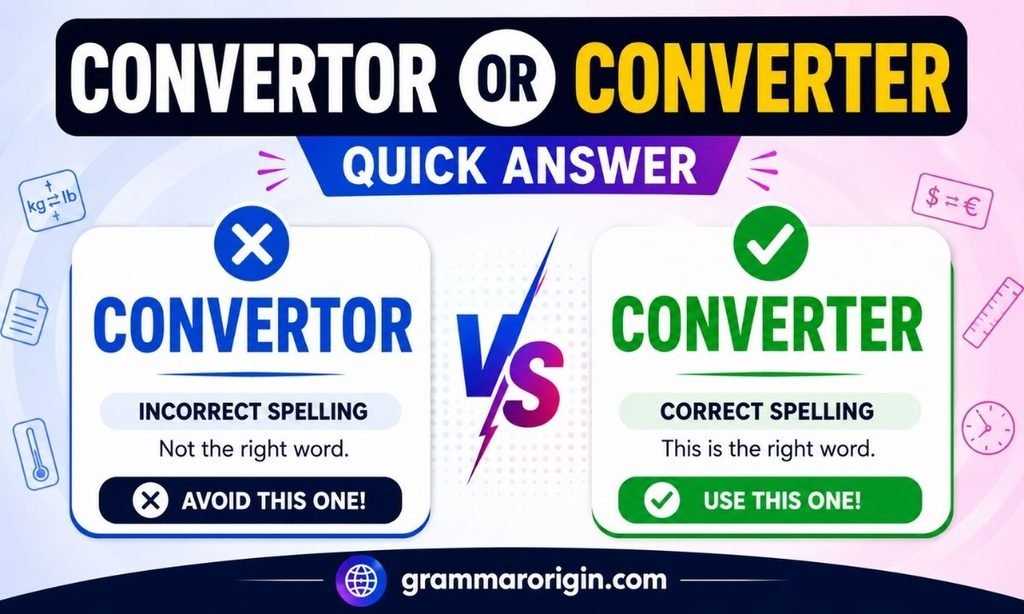
Converter is correct. Convertor is an old form that rarely appears in modern writing.
Main Difference
Converter follows the normal English rule for words that describe a tool or device: verb plus “-er”. Convertor uses an older “-or” ending that mostly survives in technical fields.
- Converter: standard, modern, widely accepted
- Convertor: rare, old-fashioned, limited to a few technical contexts
Examples
- Correct: I bought a new phone charger with a plug converter.
- Correct: The office printer needs a paper tray converter.
- Rare, not wrong: Some old manuals still spell it convertor.
Definitions with Examples
Converter and convertor share the same root meaning, but only one is common today. Here’s a clear breakdown of both, along with the plain converter definition each dictionary gives.
Converter (Definition)
A converter is a device, tool, or piece of software that changes something from one form into another. It’s the standard spelling used by Merriam-Webster, Oxford, Cambridge, and Collins dictionaries.
Examples
- This tool works as a file converter for PDF and Word documents.
- The car’s catalytic converter cuts down harmful exhaust gases.
- I need a currency converter before my trip to Japan.
- Her laptop uses a small power converter for charging.
Convertor (Definition)
Convertor means the exact same thing as converter, but it’s used far less often. Dictionaries usually list it as an alternate spelling, mostly tied to older electrical equipment.
Examples
- The 1960s power plant used a rotary convertor. (historical context)
- Some European patents still name the part a convertor.
- Old textbooks sometimes spell it convertor, but newer editions changed it to converter.
Simple Meaning
Think of it this way: converter is the word people use today, and convertor is the word people used to use. Same meaning, different age.
Also Read This Refer or Reffer: Which One Is Correct and How to Use It
The Origin of Converter
Converter comes from the Latin word convertere, which means “to turn around” or “to change.” The word traveled through French before landing in English as “convert.”
Formation Rule
This is a simple case of English word formation. English often builds nouns for tools or people by adding “-er” to a verb. Think of teacher, driver, or printer. Convert follows the same pattern:
convert + er = converter
Meaning
A converter, by this formation rule, is simply “a thing that converts.” It’s a clean, logical pattern that most English speakers already know without thinking about it.
British English vs American English Spelling
This isn’t a British vs American spelling split, unlike words such as “colour” and “color.” Both regions use converter.
Key Point
Whether you’re writing for a UK audience, a US audience, or anywhere else, converter is the word to use. There’s no regional form of this one.
Comparison Table
| Region | Preferred Spelling | Rare Form |
| United States | Converter | Convertor |
| United Kingdom | Converter | Convertor |
| Canada | Converter | Convertor |
| Australia | Converter | Convertor |
| Pakistan | Converter | Convertor |
| India | Converter | Convertor |
Convertor vs Converter: Key Difference Explained
The real difference isn’t about meaning. It’s about how often each spelling gets used, and where.
Comparison Table
| Feature | Converter | Convertor |
| Spelling type | Standard | Old form |
| Everyday use | Very common | Rare |
| Dictionary status | Main entry | Alternate entry |
| Best for | General and digital writing | Old technical documents |
Example
- Correct: Download this free video converter app.
- Confusing: “Video convertor” would puzzle most readers and look outdated.
Which Spelling Should You Use?
Use converter almost every time you write. It’s the safe, modern, and widely accepted choice.
Always Prefer
Converter, for blogs, emails, apps, resumes, school work, and business writing. It matches what readers expect and what search engines recognize.
When You May See Convertor
- Quoting an old engineering manual
- Reading a historical document
- Looking at a specific old product name
In Exams
Stick with converter. Teachers and examiners mark it as the correct spelling in almost every English test.
Easy Tip
If you’re ever unsure, just remember: “-er” like teacher, not “-or” like actor. That small memory trick works almost every time.
Usage Tip (Very Important)
Use converter in all everyday and professional writing. Save convertor only for direct quotes from older technical sources.
Examples
- Correct: The app includes a built-in unit converter.
- Correct: This adapter works as a plug converter for travel.
- Confusing: “Plug convertor” would look like a spelling mistake to most readers today.
Common Mistakes with Convertor or Converter
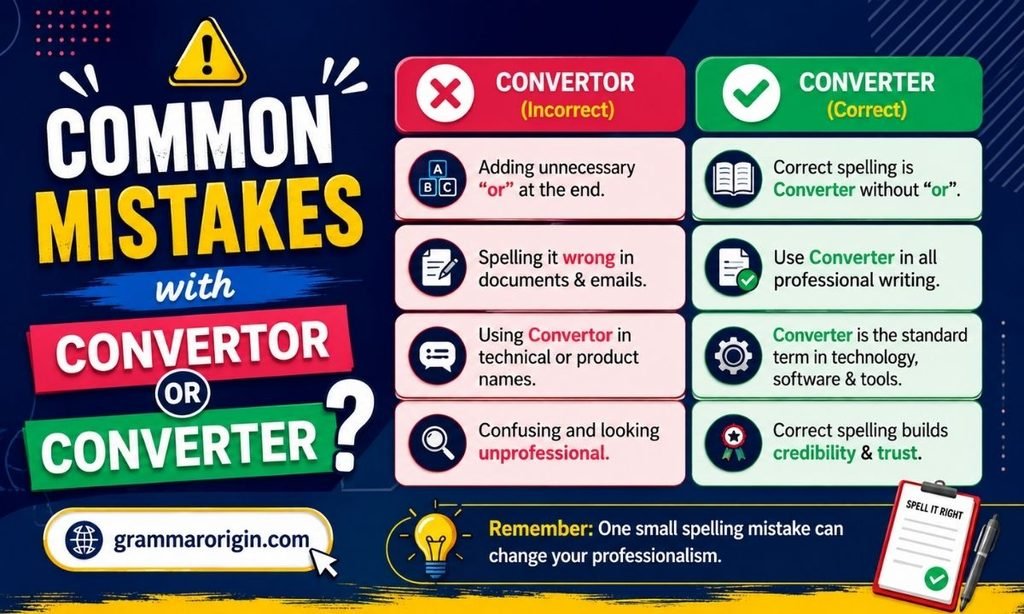
A few small habits keep this confusion alive. Here are the most common ones people fall into.
1. Using Convertor Everywhere
Writers sometimes assume convertor is just a casual short form. It isn’t. It’s simply the older spelling, and it looks out of place in modern text.
2. Thinking Both Are Equal
Both words carry the same meaning, but they aren’t equally accepted. Converter wins in nearly every context, from casual chats to technical manuals.
3. Copying Old Text
Some websites and PDFs still use convertor because they were written years ago. Copying that old wording into new content carries the mistake forward.
4. Spelling Confusion
Autocorrect and quick typing sometimes swap the letters without anyone noticing. A quick proofread catches this every time.
Converter in Everyday Examples
Converter shows up more often than most people realize. Here’s how it looks across different parts of daily life.
Technology
- I converted my old cassette tapes using an audio converter.
- This website offers a free image converter for JPG and PNG files.
Vehicles
- The mechanic checked the car’s catalytic converter during the service.
- A torque converter helps automatic cars shift gears smoothly.
Apps
- My phone has a built-in currency converter app for travel.
- The photo editor includes a quick file-size converter tool.
Work
- Please send the document through the PDF converter before the meeting.
- Our team uses a time zone converter for international calls.
Daily Use
- I keep a plug converter in my travel bag for other countries.
- The recipe app has a measurement converter for cups and grams.
Converter: Google Trends and Usage Data
Search behavior tells a clear story here. People search for converter far more often than convertor, across nearly every English-speaking country.
Trends
Converter shows up in searches for tools, apps, and devices almost every day. Convertor, on the other hand, mostly appears in searches checking spelling or reading old technical pages.
Region Table
| Region | Common Search Term |
| United States | Converter |
| United Kingdom | Converter |
| Pakistan | Converter |
| India | Converter |
| Philippines | Converter |
| Nigeria | Converter |
Top 10 Searches
- convertor or converter which is correct
- converter meaning
- currency converter
- video converter
- file converter
- unit converter
- power converter
- converter vs convertor
- pdf converter
- convertor spelling
Comparison Table
Here’s a short summary table that puts everything from this guide in one place, so you can check it at a glance.
| Feature | Converter | Convertor |
| Correct today | Yes | Rarely |
| Meaning | Same | Same |
| Common use | Everyday and digital | Old technical texts |
| Recommended for writing | Yes | No |
Converter Calculator
A converter calculator is simply a tool that changes one type of value into another using math built into an app or website. You’ve probably used one without even naming it that way.
These calculators cover units, currency, temperature, and more. Type in a number, pick your unit, and the converter calculator gives you an instant, accurate result with no manual math needed.
Also Read This Refer or Reffer: Which One Is Correct and How to Use It
Convertor or Converter (Length and Unit Conversion)
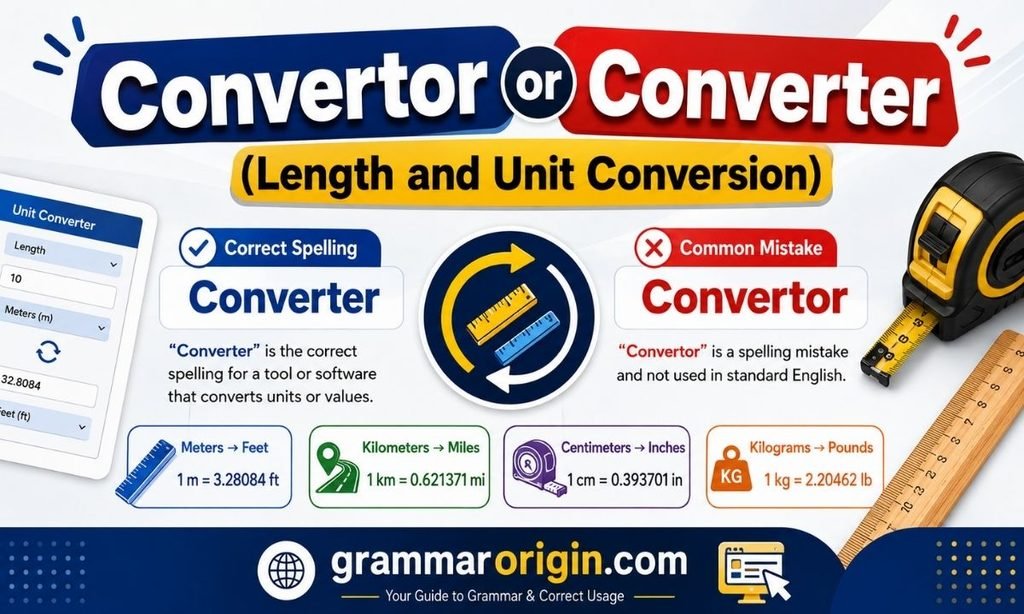
For length and unit conversion, converter is the spelling to use, as in “length converter” or “unit converter.” Convertor doesn’t appear in this context in any common tool or app name.
A length converter changes measurements like meters to feet, or kilometers to miles. It’s one of the most searched converter tools online, especially for travel, school work, and construction projects.
Currency Converter
A currency converter shows you how much one country’s money is worth in another currency, based on the current exchange rate. Travelers, shoppers, and businesses use it every single day.
Type in an amount, choose the two currencies, and the converter updates the value instantly. Rates change often, so a good currency converter always pulls fresh data rather than old numbers.
What Is Converter in Electrical?
In electrical terms, a converter is a device that changes electrical energy from one form to another, for example from AC to DC or from one voltage level to another. It’s a core part in phone chargers, power supplies, and industrial machines.
A voltage converter and a signal converter are two common types you’ll see in electrical work. Both keep devices safe by matching the exact power or signal they need, so a device built for low voltage doesn’t get damaged by a stronger power source.
Converter and Inverter: What’s the Difference?
A converter changes electrical current from one type to another, most often AC to DC. An inverter does the reverse job. It turns DC back into AC.
Think of a laptop charger: it converts wall power (AC) into the DC power your battery needs. A solar power system, on the other hand, uses an inverter to turn stored DC battery power back into AC for home use.
Converter in Power Electronics
In power electronics, a converter is a circuit or device built to control and change electric power between different voltage levels or current types. Engineers rely on these converters in everything from phone chargers to electric vehicles.
Common types include AC-to-DC converters, DC-to-DC converters, and analog-to-digital converters, along with buck or boost converters. Each one handles a slightly different power conversion job, but they all follow the same basic idea: changing power safely from one form to another.
A Quick Decision Rule
Here’s an easy way to decide which word fits your writing, without overthinking it.
- Writing a blog post, email, app description, or school paper? Use converter.
- Quoting an old engineering manual or historical document word-for-word? Convertor may appear, and that’s fine to keep as-is.
- Not sure at all? Converter is almost always the safe choice.
Final Thoughts
Convertor or converter comes down to one simple rule: converter is correct, modern, and safe to use almost everywhere. Convertor still exists, but only in a handful of old technical or historical contexts.
Whether you’re writing about a currency converter, a power converter, or a converter used in electronics, stick with the standard spelling. It keeps your writing clear, professional, and easy for anyone to understand.
Frequently Asked Questions
Is convertor a real word?
Yes, convertor is a real word. It’s just an older, less common spelling of converter, and modern dictionaries list it as an alternate form.
Which spelling is correct: convertor or converter?
Converter is the correct and standard spelling in modern English. Convertor is accepted but rarely used today.
Do British and American English spell it differently?
No, both British and American English prefer converter. This isn’t a regional spelling difference like “colour” versus “color.”
Can I still use convertor in technical writing?
You can, but only if you’re quoting an older source or a specific old product name. For new writing, converter is the safer choice.
What is the difference between a converter and an inverter?
A converter changes AC power into DC power, while an inverter does the opposite and turns DC power into AC. Both are common in electronics and power systems.
Why do some old texts use convertor instead of converter?
Older English writing sometimes followed a Latin-style “-or” ending for certain words. Convertor was more common decades ago, before converter became the standard modern spelling.
Is convertor wrong to use in exams?
Most teachers and exam boards count converter as the correct spelling. Using convertor may get marked as an error, so it’s best avoided in test writing.

Muhammad Waqas is an English language teacher and grammar expert with over 8 years of experience helping students and professionals improve their writing skills. He specializes in English grammar, vocabulary, communication, and practical language learning. Through GrammarOrigin, Waqas shares clear, easy-to-understand content that helps readers write and speak English with confidence.