
Timeframe or time frame? Both spellings show up everywhere, in emails, news articles, and school papers, and most people never stop to check which one is right.
Here’s the short answer: both are correct. Time frame (two words) is the traditional form, and timeframe (one word) is the modern version used often in business writing. This guide breaks down the meaning, the history, and real examples, so you can pick the right one with confidence.
Timeframe
Timeframe is the one-word spelling of the same term. It’s common in business emails, tech writing, and everyday online content.
Most dictionaries list it as an accepted variant rather than the main entry. Software dashboards and app menus often use this closed form because a single word fits neatly into small labels and buttons. It works well in casual and modern writing.
Time
The word time refers to the ongoing passage of moments, measured in seconds, days, months, or years. On its own, it’s one of the most basic words in English.
When paired with “frame,” it forms a phrase that points to a specific stretch of time set aside for something, not time in general.
Timeframe or Time Frame: Quick Answer

Both timeframe and time frame are correct. Time frame is the older, more formal spelling, while timeframe is the newer, closed form.
Main Difference
Time frame is written as two separate words and feels more traditional. Timeframe joins the words together and feels more modern and compact.
- Time frame: traditional, formal, common in academic writing
- Timeframe: modern, common in business and digital content
Examples
- Correct: We need a time frame for the project.
- Correct: We need a timeframe for the project.
- Correct: The time frame is two weeks.
Definitions with Examples
Time frame and timeframe share the exact same meaning. The only real difference is spelling style.
Time Frame (Definition)
A time frame is a period of time in which something happens, is planned, or must be completed. It’s the version most dictionaries list as the main entry.
Examples
- The time frame for the exam is two hours.
- We will decide the time frame tomorrow.
- The project has a short time frame.
Timeframe (Definition)
Timeframe means the exact same thing as time frame, just written as one word. It’s the spelling you’ll spot often in software menus and business reports.
Examples
- The project has a tight timeframe.
- We need a clear timeframe for delivery.
- This timeframe is too short.
Simple Meaning
Time frame and timeframe both point to the same idea: a set period during which something is expected to happen. One is just written with a space, and the other without.
Also Read this Convertor or Converter: Which One Is Correct? (Full 2026 Guide)
The Origin of Time Frame
Time frame comes from joining two separate words: time, meaning duration, and frame, meaning a structure or limit. Together, they describe a bounded period.
This is a normal case of word formation in English, where two separate words are used side by side so often that they eventually get treated as one unit, sometimes staying open like time frame and sometimes closing up like timeframe.
Meaning Together
Picture a frame placed around a stretch of time. That image captures exactly what the phrase means: a structured, defined period.
Example
We need a time frame for completion before the client signs off.
British English vs American English Spelling
Both British and American English accept time frame and timeframe. The preference just leans slightly different ways in each region.
Key Point
British writing tends to favor time frame as the safer, more formal choice. American business writing uses timeframe more often, especially in reports and digital content.
Comparison Table
| Region | Preferred Form | Accepted Form |
| United Kingdom | Time frame | Timeframe |
| United States | Timeframe | Time frame |
| Pakistan | Both | Both |
| India | Both | Both |
Timeframe vs Time Frame: Key Difference Explained
The real difference between these two comes down to style, not meaning. Both describe the exact same period of time.
Comparison Table
| Feature | Time Frame | Timeframe |
| Spelling | Two words | One word |
| Style | Formal, traditional | Modern, business |
| Common setting | Academic writing | Work and reports |
| Meaning | Same | Same |
Example
- Correct: We need a time frame for delivery.
- Correct: We need a timeframe for delivery.
Which One Should You Use?
Pick time frame for formal or academic writing, and timeframe for business or casual writing. Neither choice is wrong.
Use Time Frame When
- Writing formal essays or reports
- Answering academic or exam questions
- Following a traditional grammar style guide
Use Timeframe When
- Writing business emails or memos
- Creating digital content or app copy
- Following a modern, casual writing style
Easy Tip
Two words feels formal. One word feels modern. That’s the whole rule in a single line.
One more small point worth knowing: avoid the hyphenated form “time-frame” in most writing, since it’s the least common of the three. The plural also follows normal rules: time frames for the two-word form, and timeframes for the one-word form.
Usage Tip (Very Important)
Both spellings are correct, so the real decision comes down to tone and consistency. Pick one style and stick with it through the whole document.
Examples
- The time frame is short. (formal tone)
- The timeframe is short. (modern tone)
- We need a clear time frame before signing the contract.
Common Mistakes with Timeframe or Time Frame
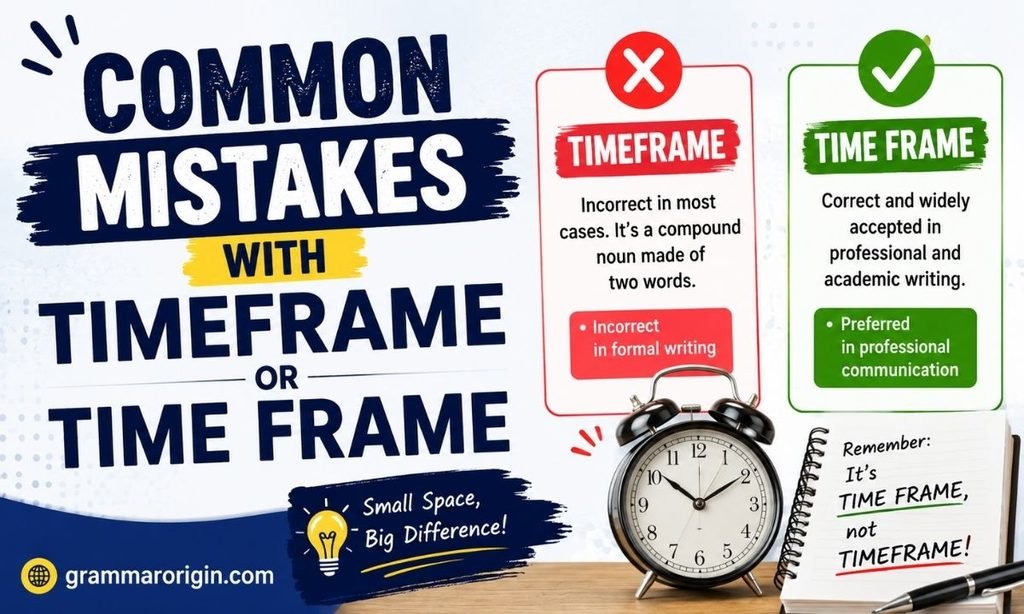
A few small habits keep this confusion going. Here are the ones people run into most often.
1. Thinking One Is Wrong
Some writers assume only one spelling is correct. That’s not true. Dictionaries recognize both time frame and timeframe.
2. Mixing Styles in One Document
Switching between time frame and timeframe in the same document looks careless. Readers notice the inconsistency right away.
3. Using Wrong Context
Using timeframe in a strict academic paper can feel out of place. Using time frame in casual chat can feel stiff. Match the spelling to the setting.
4. Spelling Confusion
Autocorrect sometimes joins or splits the words without anyone noticing. A quick read-through before publishing catches this every time.
Time Frame in Everyday Examples
Time frame and timeframe show up across nearly every part of daily writing. Here’s how they look in different settings.
Daily Life
- I have a short time frame before my flight.
- What’s the time frame for finishing this book?
Work
- Please confirm the time frame for the meeting.
- The project timeframe is one month.
School
- The exam time frame is three hours.
- Our teacher gave us a strict timeframe for the essay.
Business
- We agreed on a delivery timeframe with the supplier.
- The company set a six-month time frame for the launch.
Timeframe: Google Trends and Usage Data
Search data shows a clear pattern here. Timeframe gets searched heavily in business and tech contexts, while time frame stays strong in general and academic searches.
Trends
Timeframe is common in project management tools, dashboards, and business writing. Time frame shows up more in academic papers, news writing, and formal documents.
Long-term usage data, like the kind tracked in Google’s Ngram book database, shows time frame has stayed the more frequently printed form for decades, while timeframe has climbed steadily since the rise of digital and business writing.
Also Read this Convertor or Converter: Which One Is Correct? (Full 2026 Guide)
Region Table
| Region | Common Search Term |
| United States | Timeframe |
| United Kingdom | Time frame |
| Pakistan | Both |
| India | Both |
| Australia | Both |
| Canada | Both |
Top 10 Searches
- timeframe or time frame which is correct
- is timeframe one word
- time frame meaning
- timeframe vs time frame
- correct spelling of timeframe
- time frame synonym
- timeframe merriam webster
- time frame examples
- timeframe or time frame uk
- timeframe or time frame us
Comparison Table
Here’s a quick summary that pulls everything from this guide into one place.
| Feature | Time Frame | Timeframe |
| Correct | Yes | Yes |
| Style | Formal | Modern |
| Common use | Academic, formal | Business, digital |
| Meaning | Same | Same |
Timeframe or Time Frame in the UK
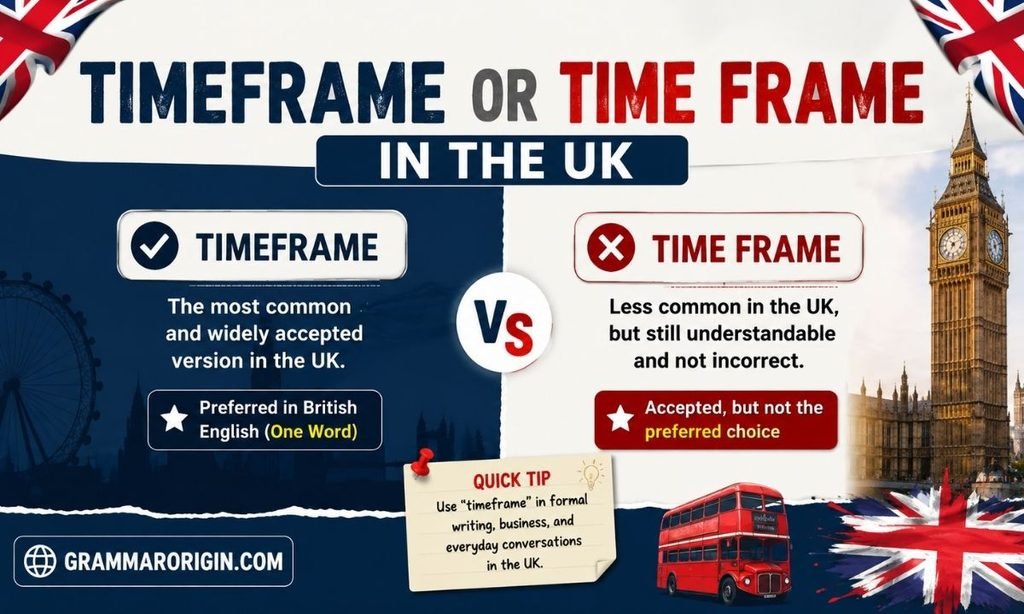
In the UK, time frame is the more traditional and widely accepted form. Timeframe still appears, especially in business and tech writing, but it’s less common than in the US.
British style guides and academic institutions generally lean toward the two-word spelling. If you’re writing for a UK audience and unsure which to pick, time frame is the safer choice.
Timeframe or Time Frame in the US
In the US, timeframe has grown popular, especially in business reports, software interfaces, and everyday writing. Time frame still holds strong in academic and formal contexts.
Merriam-Webster notes that time frame remains the more common spelling in American English today, even though timeframe is fully accepted. Either form works well depending on your audience.
Timeframe or Time Frame in Australia
Australian English follows patterns closer to British usage, so time frame tends to appear more often in formal writing. Timeframe still shows up regularly in business and casual contexts.
Since Australian style guides don’t strictly reject either form, writers usually just need to stay consistent throughout a single document.
Timeframe or Time Frame in Canada
Canadian English sits somewhere between British and American habits, so both time frame and timeframe are common. Government and academic writing often prefers the two-word form.
Business and tech writing in Canada leans toward timeframe, similar to trends seen in the US. Since Canada follows a mixed style, checking your company’s own style guide is the quickest way to settle on one spelling.
What Does Merriam-Webster Say?
Merriam-Webster lists time frame as the main entry and treats timeframe as a less common variant. Both are recognized as correct, with the same meaning.
The dictionary also notes that compound words often shift from two words into one word over time, which explains why timeframe keeps gaining ground in modern writing, even though time frame remains the more traditional and currently more common form. Cambridge Dictionary takes a similar approach, listing time frame as the main spelling while noting timeframe and time-frame as accepted variants. Oxford follows the same pattern, treating the two-word form as standard.
Timeframe Synonyms
Common synonyms for time frame include period, duration, window, schedule, and timeline. Each one carries a slightly different shade of meaning.
Period is the most general option, simply meaning a stretch of time. Duration points to how long something lasts, while deadline marks a fixed end point rather than an open stretch. Timeline often shows a sequence of events rather than just one period, and timescale describes the length of time over which something develops. Timespan is close in meaning too, though it usually points to the length between two specific points rather than a set period for a task.
A Quick Decision Rule
Here’s a simple way to choose, without overthinking it.
- Writing a formal report, essay, or academic paper? Use time frame.
- Writing a business email, app description, or casual note? Timeframe works fine.
- Not sure at all? Time frame is the safer, more widely recognized default.
Frequently Asked Questions
Is timeframe one word or two words?
Timeframe is written as one word, while time frame is written as two words. Both spellings are accepted in modern English.
Which is correct, timeframe or time frame?
Both are correct and carry the same meaning. Time frame is the more traditional and formal choice, while timeframe is the modern, closed form.
Does Merriam-Webster prefer time frame or timeframe?
Merriam-Webster lists time frame as the main entry and timeframe as a less common but accepted variant. Both mean the same thing.
Is timeframe used differently in the UK versus the US?
Not really in meaning, but in preference. The UK leans toward time frame, while the US uses timeframe more often in business and digital writing.
What is a synonym for time frame?
Common synonyms include period, duration, window, schedule, and timeline. Each fits slightly different situations.
Can I use timeframe in formal writing?
Yes, though time frame is generally the safer pick for strict academic or formal documents. Timeframe fits well in business and casual contexts.
Is time frame or timeframe correct in Australia and Canada?
Both are accepted in Australia and Canada. Formal and academic writing tends to favor time frame, while business writing often uses timeframe.
Conclusion
Timeframe or time frame comes down to style, not correctness. Both spellings mean the same thing: a set period during which something happens or must be completed.
Choose time frame for formal, academic, or traditional writing, and timeframe for business, digital, or casual content. Whichever you pick, staying consistent throughout your writing is what matters most.

Muhammad Waqas is an English language teacher and grammar expert with over 8 years of experience helping students and professionals improve their writing skills. He specializes in English grammar, vocabulary, communication, and practical language learning. Through GrammarOrigin, Waqas shares clear, easy-to-understand content that helps readers write and speak English with confidence.