
Fairing or faring? Which one do you actually need? These two words sound exactly alike, yet they live in completely different worlds of meaning.
This guide walks you through the real fairing or faring difference, shows you when to use each word, and gives you tricks that stick. By the end, you’ll never second-guess yourself again.
Quick Answer: Fairing or Faring?
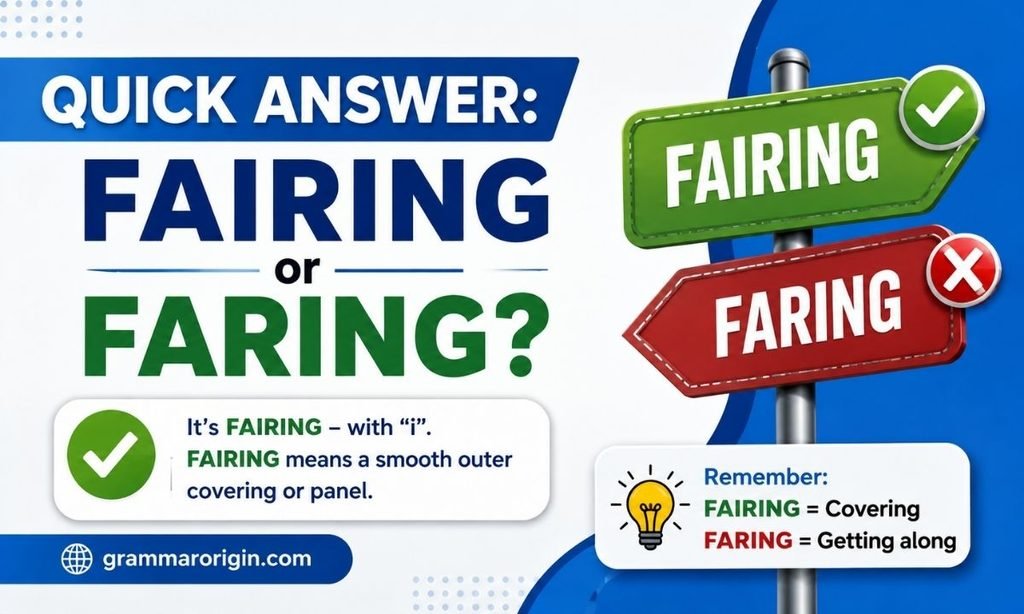
Faring means getting along, doing well, or managing through a situation. Fairing means a smooth outer covering used on vehicles or aircraft.
So if you’re asking about someone’s wellbeing, health, or progress, you want faring. If you’re talking about a motorcycle panel, aircraft nose cover, or aerodynamic shell, you want fairing.
Here’s the fast version:
- Faring: a verb form, used for people, teams, or situations
- Fairing: a noun, used for physical objects and vehicle parts
One quick test: swap the word for “doing” or “cover.” If “doing” fits, write faring. If “cover” fits, write fairing.
Meaning of “Fairing”
Fairing is a noun that names a smooth, shaped covering built to cut down drag or protect internal parts. Engineers and designers use this word constantly.
You’ll spot it most often in:
- Motorcycle design
- Aircraft and rocket components
- Bicycle frames
- Boat hulls
- Industrial product casings
A few real examples:
- The racing bike’s fairing snapped off after the crash.
- Engineers reshaped the rocket’s nose fairing to cut wind resistance.
- The new scooter model ships with a color-matched fairing.
Related terms you’ll see nearby include shell, casing, cowl, and aerodynamic panel. All of these point to the same idea: a protective outer shape.
Meaning of “Faring”
Faring comes from the verb “fare,” and it describes how someone or something is progressing, coping, or performing. It shows up constantly in everyday check-ins.
Common examples include:
- How’s your brother faring after the surgery?
- The startup is faring well despite a tough market.
- She’s faring better than anyone expected this semester.
The faring well meaning here is simple: things are going smoothly, and progress looks positive. Swap “well” for “badly” or “poorly,” and the same structure works for tougher situations too.
You’ll see faring most in emails, interviews, journalism, and casual conversation. Basically anywhere someone checks on progress or condition, faring is the word doing the work.
Also Read This Timeframe or Time Frame: Which One Is Correct?
Key Differences Between Fairing and Faring
Once you line the fairing or faring difference up side by side, the choice becomes much easier to spot.
| Word | Part of Speech | Core Meaning | Typical Setting | Sample Sentence |
| Fairing | Noun | A shaped covering that reduces drag | Engineering, vehicles, aviation | The plane’s nose fairing was replaced after the bird strike. |
| Faring | Verb (present participle) | Getting along or progressing | Conversation, writing, reports | The team is faring well this quarter. |
Notice the one-letter difference is the entire trap. Drop the extra “i,” and the meaning flips from a physical object to a human condition.
Common Mistakes People Make
Most fairing or faring mistakes happen from typing habit, not from real confusion about meaning. The biggest slip-up happens when people ask about someone’s condition but accidentally reach for the wrong spelling.
Mistake 1: Writing “How are you fairing?” instead of “How are you faring?” This one shows up constantly in texts and emails, and it’s almost always a typo rather than a real misunderstanding of meaning.
Mistake 2: Writing “The bike’s faring cracked” instead of “The bike’s fairing cracked.” Here the writer means the physical panel but types the verb form by habit.
Mistake 3: Trusting spell-check to catch it. Spell-check won’t flag either word, since both are spelled correctly on their own. Only the context tells you which one is right.
Memory Tricks to Never Confuse Them Again
These fairing or faring tricks work because they tie each word to something you already remember. Try linking each word to something familiar:
- Fairing shares its root with “fair” (smooth), so think: fairing keeps things smooth for machines.
- Faring shares its root with “fare,” the same root behind “farewell” and “welfare.” Both are about a person’s journey or condition.
A quick shortcut: Fairing = machine part. Faring = human condition. Say it out loud a few times and it locks in fast.
American vs British English Differences
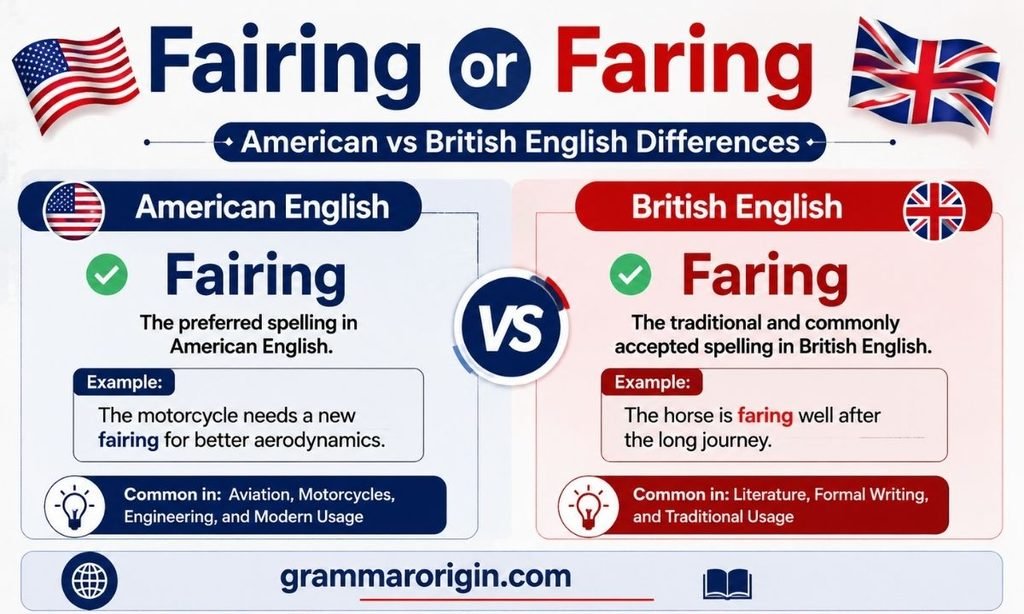
There’s genuinely no spelling split here. American and British English use both words in exactly the same way, and neither region changes the letters or the grammar.
The only difference is tone. British writing leans slightly more toward “How are you faring?” in formal contexts, while American writing often prefers the simpler “How are you doing?” Both choices are completely correct.
When to Use Fairing in Technical Writing
Fairing belongs in manuals, spec sheets, and any writing tied to vehicle or aircraft design. It signals precision, which matters in technical documents.
Examples that fit this setting:
- The carbon-fiber fairing shaved two seconds off the lap time.
- Technicians inspected the tail fairing before clearing the aircraft for takeoff.
- The redesigned fairing lowered drag by 12 percent in wind-tunnel tests.
Using this word correctly in technical content builds trust with readers who know the industry. Getting it wrong is an easy way to lose that trust fast.
When to Use Faring in Conversation or Writing
Faring fits naturally into everyday check-ins, business updates, and storytelling. It’s the word you reach for when discussing progress, not parts.
A few natural examples:
- Are you faring well after the move to the new city?
- Sales are faring better this month than last quarter.
- How is she faring since starting the new treatment plan?
Faring often pairs with adverbs like well, poorly, badly, or better. That pairing is a strong sign you’re dealing with the verb, not the noun.
Also Read This Timeframe or Time Frame: Which One Is Correct?
Why These Words Get Confused So Often

Three things drive this mix-up, and understanding them makes the fix permanent.
First, both words are true homophones. They’re pronounced exactly the same way, with no difference in sound at all, so your ear gives you no clue.
Second, the spelling gap is tiny. One extra letter separates a machine part from a human condition, which is an easy typo to miss.
Third, most people simply talk about wellbeing far more often than aerodynamics. That daily familiarity with “faring” makes writers default to it even when a physical object is the actual subject.
A quick root-word comparison makes the split clearer:
| Root Word | Meaning | Modern Word |
| Fair (smooth, even) | Describes something streamlined | Fairing |
| Fare (to journey, get along) | Describes progress or condition | Faring |
Quick Practice Quiz
Test yourself with these five quick lines. Answers and reasoning are right below.
- How is your cousin ___ after the accident?
- The motorcycle’s front ___ needs replacing.
- The company is ___ better than analysts predicted.
- The rocket’s nose ___ separated on schedule.
- Are you ___ well in your new apartment?
Answers:
- Faring. You’re asking about a person’s condition.
- Fairing. You’re naming a physical vehicle part.
- Faring. This describes business progress.
- Fairing. This names an aircraft component.
- Faring. This checks on someone’s wellbeing.
Frequently Asked Questions
Is “faring” a word?
Yes, faring is a real word. It’s the present participle of the verb “fare,” and it means to get along or progress. You’ll find it in every major dictionary.
Is it “how are you faring” or “how are you fairing”?
The correct version is “How are you faring?” Since you’re asking about someone’s condition, not a vehicle part, “fairing” doesn’t apply here at all.
What does “faring well” mean?
Faring well means someone or something is doing fine, progressing smoothly, or handling a situation successfully. It’s a slightly formal but very natural way to describe positive progress.
What’s a good answer to “How are you faring?”
A simple, honest response works best, such as “I’m faring well, thanks for asking” or “It’s been tough, but I’m managing.” Either answer directly addresses the question about your condition.
Is “fairing or faring well” ever a correct phrase together?
No, you’d choose one or the other depending on meaning. “Faring well” is the correct phrase for describing progress, while “fairing” would only apply if you were separately talking about a vehicle part.
How should you respond if someone asks “Are you faring well?”
Answer with how you’re actually managing, like “Yes, things are going smoothly” or “Not great, but I’m getting through it.” The question is about your overall condition, not a yes-or-no fact.
What does “How is she faring?” mean?
It’s a way of asking how a woman is coping, progressing, or getting along in a specific situation, such as recovery, a new job, or a personal challenge.
Final Thoughts
The whole decision comes down to one question: are you talking about a person’s progress, or a physical object? Progress always points to faring, while any vehicle or aircraft covering points to fairing.
Once that single difference clicks, you’ll never hesitate over fairing or faring again. The right word will simply feel automatic.

Muhammad Waqas is an English language teacher and grammar expert with over 8 years of experience helping students and professionals improve their writing skills. He specializes in English grammar, vocabulary, communication, and practical language learning. Through GrammarOrigin, Waqas shares clear, easy-to-understand content that helps readers write and speak English with confidence.