
If you’ve ever paused mid-sentence wondering whether to write judgement or judgment, you’re not alone. Both spellings exist in modern English, and spellcheckers often disagree with each other.
The real answer depends on where you live, what you’re writing, and which style guide you follow. This guide breaks it down clearly, with examples for the US, UK, Canada, and Australia.
Quick Answer
The short form is standard in American English, while the version with the extra “e” is standard in British and Commonwealth English.
- American English and legal writing worldwide use the shorter spelling
- British, Australian, Canadian, and general international writing use the longer spelling
- Both versions mean exactly the same thing
Example: An American editor writes “Use your best judgment,” while a British writer keeps the traditional spelling with the extra letter in the same phrase. Neither version is wrong.
Simple Background
The word traces back to the Old French term “jugement,” which itself came from the verb “jugier,” meaning “to judge.” English borrowed it during the medieval period.
Over the following centuries, two spelling habits split off from the same root: one kept the middle “e,” and one dropped it. Dictionaries on each side of the Atlantic later locked in different preferences.
Example: Old legal English texts from the 1600s show both versions used almost interchangeably, long before any fixed rule existed.
Judgement or Judgment Clear Explanation of the Difference
What is “Judgment”?
This is the spelling preferred in American English, and it’s also the dominant form in legal writing across most English-speaking countries, including the UK.
- Standard in the United States for every context
- Used in legal rulings even by British and Canadian courts
- Shorter form favored by style guides like AP and Chicago
Example: “The judge delivered his ruling early Monday morning.”
What is “Judgement”?
This is the everyday spelling used in British, Australian, and Canadian English outside of formal legal documents.
- Common in UK newspapers, books, and casual writing
- Preferred in general, non-legal Commonwealth writing
- Matches the Oxford English Dictionary’s traditional entry
Example: “Her decision about the deal turned out to be spot on.”
Where Did the Word Come From? (Origin & History)
The spelling split isn’t random. It goes back to two influential dictionary makers who shaped English on opposite sides of the ocean.
Samuel Johnson’s 18th-century dictionary kept the “e,” cementing the longer form as the British norm. Decades later, Noah Webster simplified American spelling and dropped the “e,” giving the US its shorter version. Merriam-Webster, Webster’s modern successor, still lists the shorter spelling first today.
Example: This is the same historical split that gave American English “color” instead of the British “colour.”
Comparison Table
| Spelling | Region | Common Context | Sample Usage |
| Judgment | American English | All contexts | “Trust your instincts and reasoning.” |
| Judgement | British English | General, non-legal writing | “He showed poor decision-making.” |
| Judgment | UK, Canada, Australia | Legal rulings | “The court issued its ruling.” |
| Judgement | Canada, Australia | Everyday, non-legal writing | “That was a fair, well-reasoned call.” |
Which One to Use and When
Use the shorter spelling when:
- You’re writing for an American audience
- You’re drafting anything legal, no matter the country
- You’re following AP Style or the Chicago Manual of Style
Use the longer spelling when:
- You’re writing for a British, Australian, or Canadian audience
- The content is general, not a formal legal document
- You’re following Oxford style outside legal contexts
Example: A US blog post says “Use good judgment,” while a UK news article keeps the extra letter in the same phrase. Both versions are correct in their own market.
Simple Tip to Remember
- The American version is shorter
- The British version is longer, with the extra “e”
Think of it this way: America dropped a letter, just like it dropped the “u” in colour. Fewer letters means American spelling.
Also Read This Let Past Tense Explained: Rules, Forms & Examples
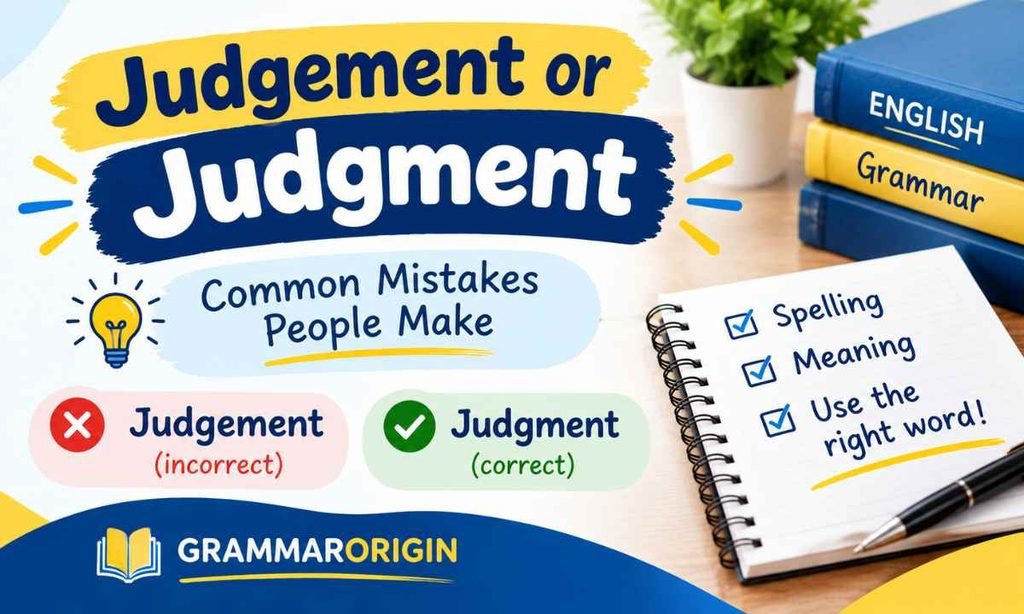
Judgement or Judgment Common Mistakes People Make
1. Thinking one is wrong
Neither version is incorrect. The mistake is assuming there’s only one universal answer instead of checking your audience or region first.
Example: A student loses marks for “wrong spelling” when really their teacher just prefers a different regional style.
2. Mixing both spellings
Switching between the two forms within the same document looks careless, even though each one is individually correct.
Example: A report that uses the shorter spelling in paragraph one and the longer spelling in paragraph three reads as inconsistent, not flexible.
3. Using the wrong form in exams
Exam boards usually follow one fixed style, and ignoring it can cost marks even though the word itself isn’t technically wrong.
Example: A Cambridge English exam typically expects the British form, while a US-based TOEFL answer expects the American one.
Judgement or Judgment Everyday Real Life Examples
Regional spelling habits show up everywhere in daily writing, from work emails to casual posts online.
In Emails
- American: “Please use your judgment on this.”
- British: keeps the same line but adds the extra “e” at the end
In News
Legal and news reporting tends to lean on the shorter spelling, even in British outlets, because most reporting follows official court language.
Example: “The Supreme Court’s ruling was released this morning,” using the shorter legal spelling.
On Social Media
Casual posts show both spellings depending on the writer’s country, and neither draws criticism online.
Example: “Trust your judgment!” is a common American post, while a British user simply adds the extra letter and posts the same thought.
In Daily Life
Everyday conversation and writing simply follow whatever spelling a person grew up learning at school.
- “Good judgment is important in business.”
- A British manager would write the same line with the extra “e” added
Short Learning Section for Students
Step 1: Learn the rule
The American form drops the “e.” The British, Australian, and Canadian form keeps it, outside legal writing.
Step 2: Practice
Write both versions of a sentence until the pattern feels natural: “Use your judgment” and the same line with the extra letter added.
Step 3: Use memory trick
Remember: the US spelling is shorter, just like American English trims other British letters, as in color, favor, and honor.
Step 4: Be consistent
Pick the spelling that matches your audience or assignment, then use it throughout the entire piece without switching.
Judgement or Judgment Oxford Dictionary
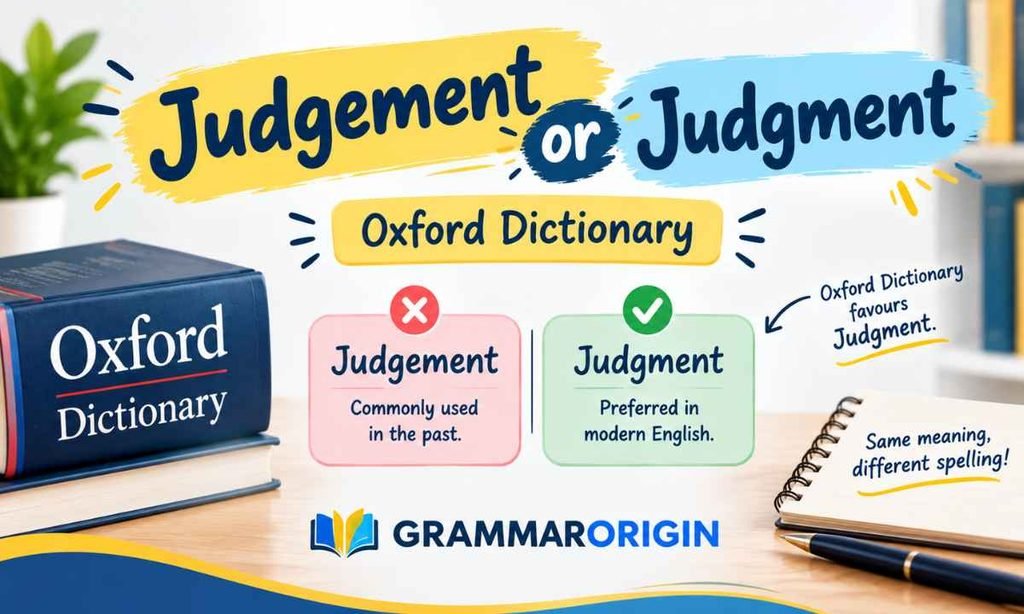
The Oxford English Dictionary lists the longer spelling as its primary British entry, though it also fully recognizes the shorter form as an accepted variant, especially in legal use.
Example: Oxford’s own style guides recommend the shorter spelling specifically when writing about court rulings, even for a British audience.
Judgement or Judgment Canada
Canadian English generally follows the British pattern, using the longer spelling in everyday writing while switching to the shorter one for legal and court documents.
Example: A Canadian court order will read “judgment,” but a Canadian magazine article will usually add the extra letter for the same word.
Judgement or Judgment Which Is Correct
Both are correct. There is no single “right” spelling worldwide. The correct choice depends entirely on your country, your audience, and whether the writing is legal or general.
Example: An American resume should say “sound judgment,” while a UK cover letter should keep the traditional spelling in the same phrase.
Also Read This Let Past Tense Explained: Rules, Forms & Examples
Judgement or Judgment Australia
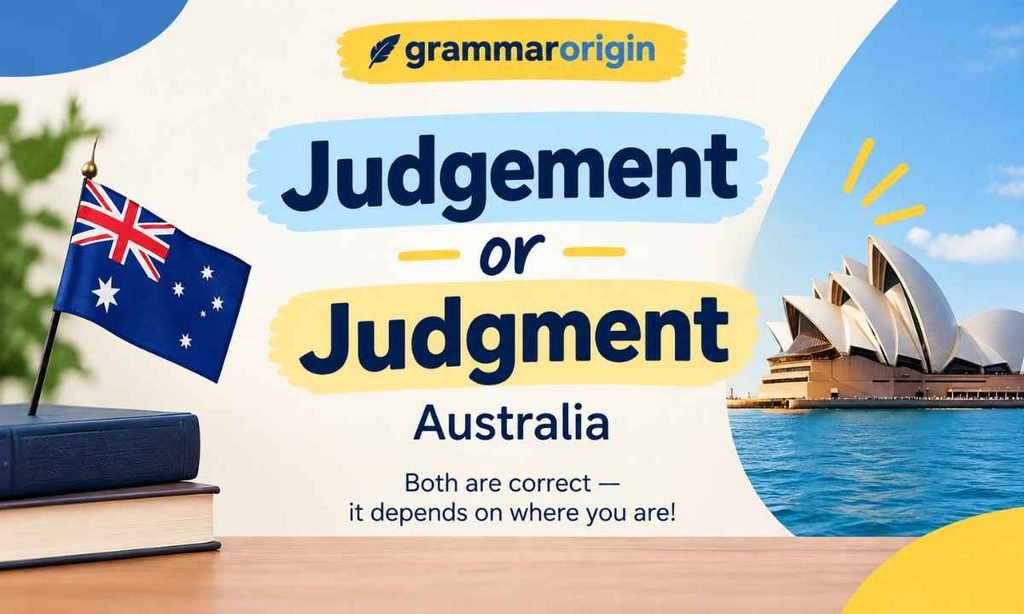
Australian English mirrors British conventions, favoring the longer spelling in general writing but shifting to the shorter one for formal legal rulings and court paperwork.
Example: An Australian newspaper reviewing a court case will often use the shorter legal spelling in the headline, despite using the longer spelling elsewhere in the same article.
Frequently Asked Questions
Is “judgement” wrong?
No. It’s the standard spelling in British, Australian, and Canadian English outside legal writing.
Which spelling is more common globally?
The shorter form is more common overall, mainly because it’s used in American English and in legal writing across nearly every English-speaking country.
Which one should I use in exams?
Follow your exam board’s style guide. Cambridge and most UK-based exams expect the British form, while US-based tests expect the American one.
Is there a difference in meaning?
No. Both words carry the exact same meaning; only the spelling changes by region.
Why do two spellings exist for the same word?
Because Samuel Johnson’s British dictionary kept the “e,” while Noah Webster’s American dictionary later dropped it, splitting the tradition permanently.
Is “judgment” used in legal writing?
Yes. It’s the preferred legal spelling almost everywhere, including the UK, Canada, and Australia, even when those countries use the longer form elsewhere.
How can I remember which spelling to use?
Match the spelling to your audience: the shorter form for American or legal writing, the longer form for British, Canadian, or Australian general writing.
Final Thoughts
Both judgement and judgment are correct, and the difference comes down to region and context rather than right or wrong. American English keeps the shorter form, while British, Canadian, and Australian English generally use the longer one outside legal writing.
If you remember one rule, remember this: match your spelling to your audience, stay consistent throughout your writing, and switch to the shorter form whenever you’re dealing with a legal ruling, no matter where you live.

Muhammad Waqas is an English language teacher and grammar expert with over 8 years of experience helping students and professionals improve their writing skills. He specializes in English grammar, vocabulary, communication, and practical language learning. Through GrammarOrigin, Waqas shares clear, easy-to-understand content that helps readers write and speak English with confidence.