
You type a sentence, then pause halfway through. Should it be “she didn’t call” or “she doesn’t call”? This didn’t or doesn’t mix-up trips up even confident English speakers, and it usually comes down to one thing: timing.
This guide breaks the confusion down in plain terms, with side-by-side examples, a comparison table, common slip-ups, and a short quiz at the end so you can check what stuck.
Quick Answer
Didn’t means “did not” and points to the past. Doesn’t means “does not” and points to the present, but only with he, she, it, or a singular noun.
- Past action, already finished: use didn’t
- Present habit or current fact: use doesn’t
Example: “He didn’t call last night” describes something already over, while “He doesn’t call very often” describes a pattern happening now.
Simple Rule
Here’s the whole didn’t or doesn’t rule in one line: if “did” fits the sentence, use didn’t; if “does” fits, use doesn’t.
Try swapping the word mentally. “Did she go?” sounds right for the past. “Does she go?” sounds right for the present. Whichever question form matches your sentence gives you the answer.
Simple Background
Both words are negative contractions built from the auxiliary verb “do.” Didn’t joins “did” and “not,” while doesn’t joins “does” and “not.” These short forms exist mainly for spoken and informal written English, since the full versions, “did not” and “does not,” sound more formal.
In casual writing, emails, and conversation, the contracted forms are standard. In formal or academic writing, some style guides still prefer the full “did not” or “does not,” so it helps to know both forms even if you default to the shorter one day to day.
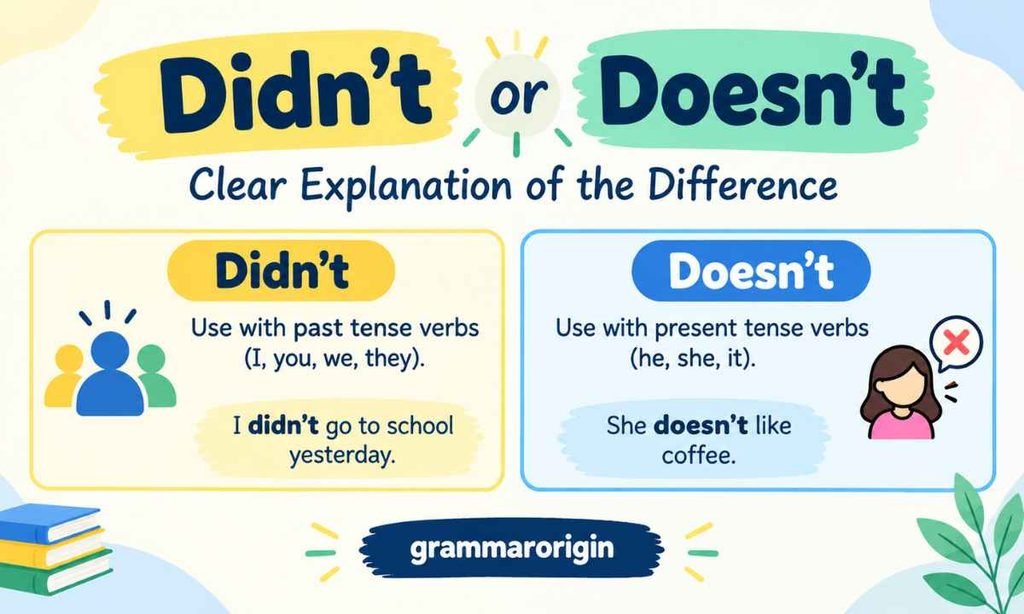
Didn’t or Doesn’t Clear Explanation of the Difference
What is “Didn’t”?
Didn’t is the short form of “did not,” and it always signals the past tense, no matter which subject is doing the action.
Example: “I didn’t finish the report before the deadline.” The event is already over; there’s nothing to debate about timing.
It works with every subject: I, you, he, she, it, we, they. That makes it more flexible than doesn’t in one specific way. It never changes based on who is speaking.
What is “Doesn’t”?
Doesn’t is the short form of “does not,” reserved for he, she, it, or a singular noun, and it describes something happening now or repeating as a habit.
Example: “My laptop doesn’t charge unless the cable is pushed in firmly.” That’s a current, ongoing problem, not a one-time past event.
Change the subject to “I” or “they,” and doesn’t no longer applies. That job belongs to “don’t” instead.
Also Read this Judgement or Judgment? The Correct Spelling (2026)
What About “Don’t”?
Don’t is the plural and first- or second-person counterpart of doesn’t, short for “do not,” and it pairs with I, you, we, and they.
Example: “We don’t usually eat out on weekdays.” Same present-tense job as doesn’t, just a different set of subjects.
Seeing all three as one family, split by tense (didn’t) and by subject (doesn’t versus don’t), is easier than memorizing three separate rules.
Comparison Table
| Word | Full Form | Tense | Works With | Example |
| Didn’t | Did not | Past | Any subject | “They didn’t wait.” |
| Doesn’t | Does not | Present | He, she, it, singular nouns | “She doesn’t wait.” |
| Don’t | Do not | Present | I, you, we, they | “I don’t wait.” |
Scan this table before writing anything tense-sensitive, and the right word almost picks itself.
Which One to Use and When
Use didn’t for anything already over: yesterday, last month, or any finished event with a clear endpoint. Use doesn’t or don’t for anything true right now, habitual, or factual in the present.
Example: “He didn’t attend the meeting” describes something that happened once, in the past, while “He doesn’t attend meetings on Fridays” describes a standing pattern.
When to Use Didn’t and Don’t
Didn’t covers every past-tense negative regardless of subject, while don’t handles present-tense negatives specifically for I, you, we, and they.
Example: “We didn’t submit the form yesterday” is past and finished, while “We don’t submit forms without a signature” is present and ongoing practice.
More Examples
Seeing similar sentence shapes side by side makes the pattern click faster than any rule alone.
Doesn’t and Don’t Examples
Doesn’t: “This app doesn’t save drafts automatically.” Don’t: “We don’t save drafts automatically either.”
Both describe an ongoing present limitation. Only the subject changes which word fits.
Doesn’t and Didn’t Examples
Doesn’t: “The printer doesn’t work on Mondays,” a recurring issue that’s still true. Didn’t: “The printer didn’t work this morning,” a one-time past breakdown.
Same machine, same complaint, but the timing decides the word.
Simple Tip to Remember
Picture “did” and “does” as time markers. Did means past, done and closed. Does means present, still open. Didn’t and doesn’t simply add “not” behind whichever time frame applies.
Example: Ask yourself, “Did this happen already, or does it happen now?” Whichever question fits naturally gives you your word.
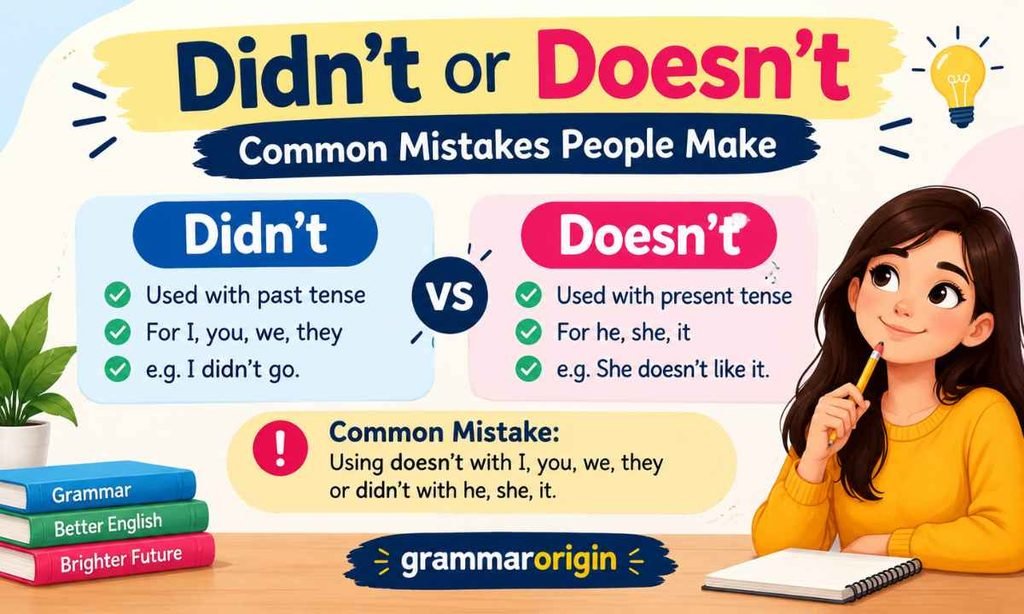
Didn’t or Doesn’t Common Mistakes People Make
1. Using “Doesn’t” for Past Events
Incorrect: “She doesn’t finish yesterday.” Correct: “She didn’t finish yesterday.”
Fix: whenever a time word like yesterday, last week, or ago appears, doesn’t gets swapped out for didn’t automatically.
2. Using “Didn’t” for Present Situations
Incorrect: “He didn’t like spicy food” (when describing his current taste). Correct: “He doesn’t like spicy food.”
Fix: if you’re describing an ongoing preference rather than a single past incident, doesn’t is the correct choice.
3. Adding a Past Tense Verb After “Didn’t”
Incorrect: “I didn’t went to the gym.” Correct: “I didn’t go to the gym.”
Fix: didn’t already carries the past tense by itself, so the verb right after it stays in its plain, base form: go, not went; see, not saw; eat, not ate. This is the same reason irregular verbs like “go” and “see” don’t get their past-tense spelling after didn’t.
Also Read this Judgement or Judgment? The Correct Spelling (2026)
Didn’t or Doesn’t Everyday Real Life Examples
In School
- “I didn’t submit my assignment on time.”
- “She doesn’t understand the homework instructions.”
In Daily Life
- “We didn’t clean the kitchen last night.”
- “He doesn’t cook on weekends.”
In Emails
- “I didn’t receive the attached invoice.”
- “The link doesn’t open on my end.”
On Social Media
- “I didn’t expect that plot twist!”
- “This filter doesn’t work on older phones.”
Short Learning Section for Students
Step 1: Remember the Time
Ask whether the action is finished (past) or still true (present) before choosing a word.
Example: “Did I already eat?” points to didn’t. “Do I eat breakfast daily?” points to doesn’t.
Step 2: Practice
Write five sentences about your own day: three in the past using didn’t, two in the present using doesn’t.
Example starter: “I didn’t wake up early. My alarm doesn’t ring loud enough.”
Step 3: Learn the Pattern
After didn’t, the verb always stays in its base form, with no -ed ending and no irregular past spelling.
Example: didn’t go, didn’t eat, didn’t see, never didn’t went, didn’t ate, didn’t saw.
Step 4: Read and Speak
Read dialogue-heavy books or watch shows with subtitles, and pause on every didn’t, doesn’t, or don’t you hear.
Example: notice how a character says “She doesn’t know” in one scene and “She didn’t know” in the next. The story’s timing explains the switch.
Frequently Asked Questions
What is the difference between didn’t and doesn’t?
Didn’t refers to the past for any subject, while doesn’t refers to the present for he, she, it, or a singular noun. That single timing difference is the whole didn’t or doesn’t rule.
Is “didn’t” used for all subjects?
Yes. Didn’t works the same way with I, you, he, she, it, we, and they, since past tense doesn’t change by subject in English.
Can I use “doesn’t” with “I”?
No. Use “don’t” with I instead: “I don’t know,” not “I doesn’t know.”
Why do we say “didn’t go” instead of “didn’t went”?
Because didn’t already shows the past tense, so the verb after it drops back to its base form.
Is “doesn’t” only for present tense?
Yes, doesn’t always refers to a present action, habit, or fact, never something already finished.
How can I quickly tell which word to use?
Ask whether “did” or “does” fits the sentence naturally. Did signals didn’t, and does signals doesn’t.
Is “don’t” the same as “doesn’t”?
Not exactly. Both are present tense, but don’t pairs with I, you, we, and they, while doesn’t pairs only with he, she, it, or singular nouns.
Final Thoughts
The whole didn’t or doesn’t puzzle comes down to timing. Didn’t looks backward, while doesn’t and don’t stay in the present. Once you spot the time clue in a sentence, the right word follows almost on its own.
Keep the base-verb rule in mind after didn’t, and check whether your subject is singular or plural before choosing between doesn’t and don’t. With those two checks, the mistake mostly disappears.

Muhammad Waqas is an English language teacher and grammar expert with over 8 years of experience helping students and professionals improve their writing skills. He specializes in English grammar, vocabulary, communication, and practical language learning. Through GrammarOrigin, Waqas shares clear, easy-to-understand content that helps readers write and speak English with confidence.