
Amount or Ammount You’ve typed “ammount” before, maybe more than once, and paused wondering if that extra letter belonged there. It doesn’t.
Amount is the correct spelling, and it only ever takes one “m.” Once you see why the double letter feels tempting, the mistake stops happening on its own.
What Does “Amount” Mean?
Amount refers to a quantity, total, or measurable sum of something. It works for money, time, effort, or anything you can measure rather than count one by one.
Correct Spelling
- Amount (correct)
- Ammount (incorrect)
The correct English spelling uses only one “m.”
Simple Definition
Amount can mean:
- The total quantity of something
- A sum or measurement
- A level or degree
Examples of “Amount” in Sentences
- The amount of sugar in this recipe seems way too high.
- She donated a large amount of money to the shelter.
- We only had a small amount of time to finish the report.
Pronunciation and Etymology of “Amount”
Amount is pronounced /əˈmaʊnt/, stressed on the second syllable, and it traces back to Latin roots.
The word grew out of the Old French amonter, meaning “to ascend” or “to add up,” which itself came from the Latin ad (to) plus montem (mountain). Picture a pile growing higher, and the connection to “total” makes sense.
Example: “Historians trace the word amount all the way back to a phrase that literally meant climbing toward a peak.”
Why Do People Spell It as “Ammount”?
People write “ammount” because English has plenty of words with doubled consonants, and the pattern feels like it should apply here too. It doesn’t.
Common Reasons Behind the Mistake
Pronunciation plays a role first. Said quickly, “amount” can sound like it carries a heavier middle sound than it actually does.
Similar-looking words add to the confusion, since terms like common, hammer, summer, and comment all double their middle consonant.
Fast typing is another factor. On a phone keyboard, an extra tap of “m” slips in easily and often goes unnoticed until it’s already published.
Example: “She typed ammount three times in one email before her assistant caught it.”
Amount vs Ammount: Quick Comparison Table
| Feature | Amount | Ammount |
| Correct English Spelling | Yes | No |
| Found in Dictionaries | Yes | No |
| Accepted in Formal Writing | Yes | No |
| Used in Schools and Exams | Yes | No |
| Safe for Professional Content | Yes | No |
Synonyms of “Amount”
Several words work as close substitutes for “amount,” depending on what’s being measured.
- Quantity
- Total
- Sum
- Volume
- Measure
Example: “The total owed on the invoice matched exactly what we’d budgeted for.”
How to Remember the Correct Spelling of “Amount”
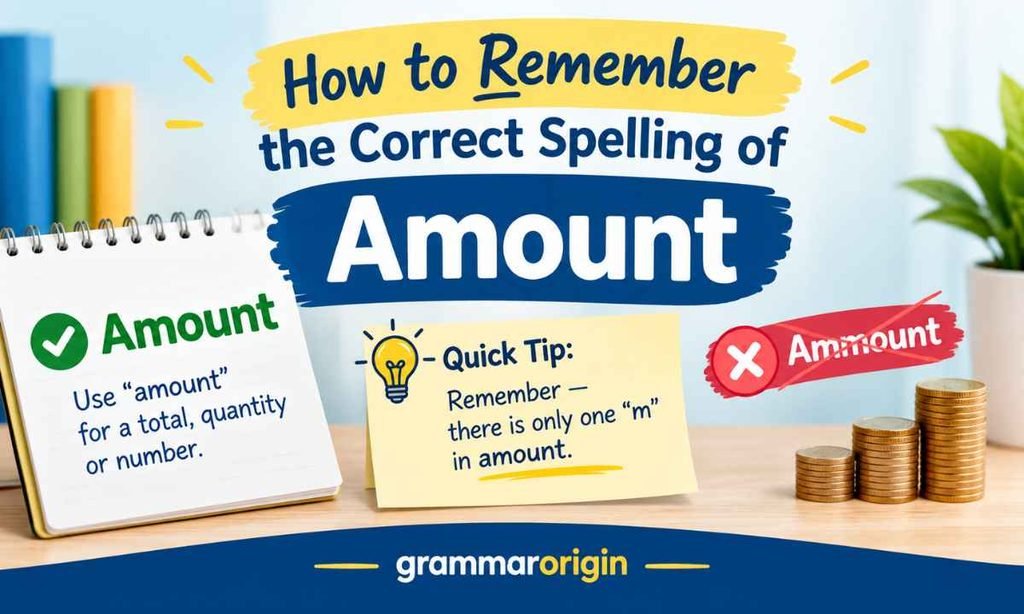
A couple of simple tricks make this spelling stick without much effort.
Use the “One M Rule”
Try repeating: “A large amount needs only one m.” It’s a small phrase, but it tends to stay in memory longer than a spelling rule alone.
Break the Word Into Sounds
Split the word as a + mount. The second half looks just like “mount,” a word that only ever has one “m.”
Example: “Think of climbing a mountain when you spell amount, and the single m becomes obvious.”
Read More English Content
Regular reading exposes you to the correct spelling often enough that it eventually feels automatic.
Is “Ammount” Ever Correct in English?
No. “Ammount” doesn’t appear in any standard English dictionary, in any context, formal or casual.
Trusted Dictionary References
Merriam-Webster and Oxford Learner’s Dictionaries both list only “amount,” with no alternate spelling noted anywhere in their entries.
Example: “A quick search on Merriam-Webster’s site returns zero results for ‘ammount,’ confirming it isn’t a recognized word.”
Also Read This You Too or You To? Here’s the Correct Phrase to Use
Real-Life Example: How One Small Spelling Error Hurt Website Credibility
A freelance writer working on finance content for a small business kept spelling “amount” as “ammount” across several published articles in 2025. Nobody caught it before the posts went live.
Readers noticed first, leaving comments questioning whether the site could be trusted for financial advice. The business owner later admitted the mistake had gone unnoticed during proofreading.
After the spelling was corrected sitewide, engagement slowly recovered, though it took a few months. A single repeated typo had done more damage to trust than anyone expected.
2025–2026 Language and Search Trends About Spelling Errors
Spelling confusion around commonly misspelled words remains one of the most searched grammar topics online.
Grammarly’s usage data shows that doubled-consonant errors, including “ammount,” are among the more frequent corrections flagged in everyday writing. A 2025 HubSpot report on content quality also found that spelling mistakes quietly reduce a reader’s trust in a website’s expertise, even when the information itself is accurate.
Google’s own quality guidelines continue to reward content that reads as accurate and carefully edited, which makes correct spelling more than just a grammar preference.
Key Statistics
- Doubled-consonant misspellings are among the most common typing errors reported by grammar tools.
- Readers associate spelling accuracy with a site’s overall trustworthiness.
- Search engines typically treat “ammount” as a typo variant with far less consistent traffic than “amount.”
Common Situations Where “Amount” Is Used
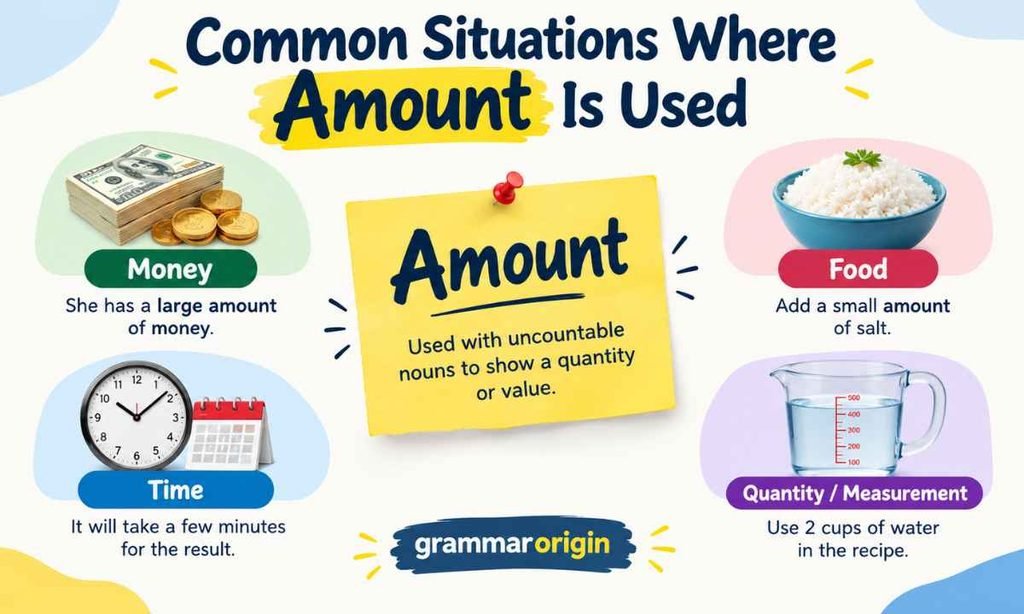
Seeing “amount” across different fields makes the correct spelling easier to remember in context.
In Finance
Example: “The total amount due was listed clearly at the bottom of the invoice.”
In Education
Example: “Teachers reduced the amount of homework assigned over the holidays.”
In Health and Science
Example: “Doctors recommend tracking your daily amount of water intake.”
In Business Writing
Example: “The proposed budget amount was approved during Thursday’s meeting.”
Grammar Tips for Using “Amount” Correctly
“Amount” pairs with uncountable nouns, not countable ones, and mixing that up is a separate mistake from the spelling issue.
Use “Amount” With Uncountable Nouns
Example: “A large amount of patience got her through that meeting.”
Avoid Using It With Countable Nouns
Countable items need “number” instead, as in “a number of apples,” not “amount of apples.”
Example: “The number of students in the class grew by ten this semester.”
Quick Rule
Use “amount” for things you measure, and “number” for things you count.
Using “Amount” as a Verb (“Amount To”)
“Amount” isn’t only a noun. As a verb, “amount to” means to add up to or become equal to something.
Example: “His excuses didn’t amount to much once the deadline actually passed.”
This verb form follows the exact same spelling rule: one “m,” never two.
Common Misspellings Similar to “Ammount”
People who misspell “amount” often stumble over similar words built the same way.
| Incorrect | Correct |
| Writting | Writing |
| Bussiness | Business |
| Enviroment | Environment |
| Recieve | Receive |
| Definately | Definitely |
Best Ways to Avoid Spelling Mistakes Online
A few consistent habits prevent errors like “ammount” from ever reaching a published page, especially in professional writing where credibility matters.
Use Grammar Tools
Grammarly, Microsoft Editor, and Google Docs’ built-in spellcheck all catch this error instantly.
Example: “Google Docs underlined ammount in red the moment it was typed.”
Proofread Before Publishing
Rereading blog posts, emails, and captions before hitting publish catches mistakes a first draft usually misses.
Read Aloud
Reading a sentence out loud slows down the eye enough to spot errors that skimming glosses over.
Learn Frequently Confused Words
Keeping a running list of words you personally misspell builds long-term accuracy faster than one-off corrections.
Amount or Ammount Grammar
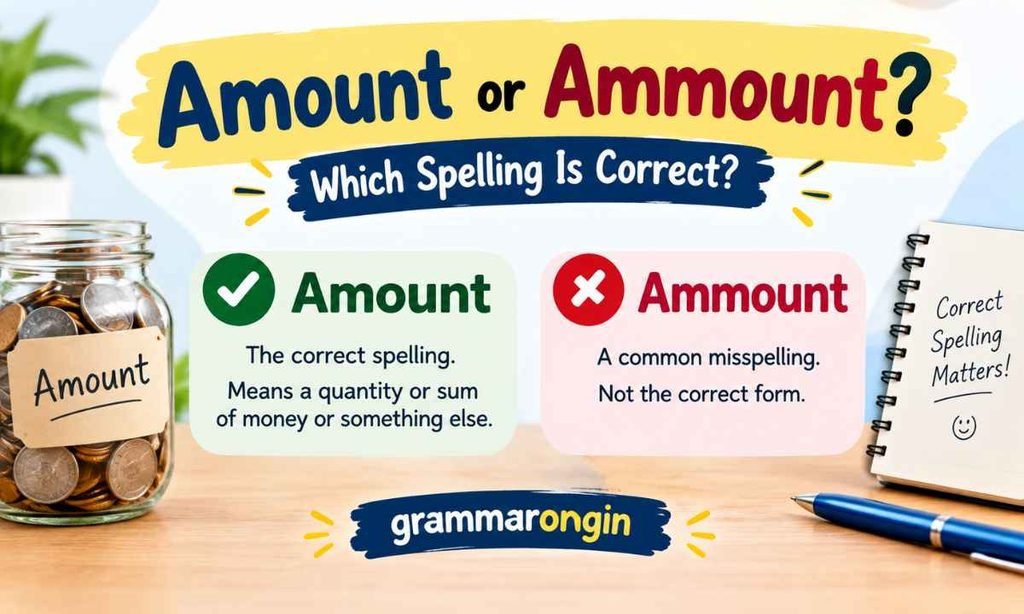
Grammatically, “amount” behaves as both a noun and a verb, while “ammount” has no grammatical role at all since it isn’t a real word.
Example: “Grammar checkers flag ammount immediately because it doesn’t exist in any recognized part of speech.”
Amount or Ammount in English
In standard English, across British and American usage alike, only “amount” is accepted.
Example: “Whether you’re writing for a US audience or a UK one, amount is the spelling that works everywhere.”
Also Read This You Too or You To? Here’s the Correct Phrase to Use
Mini Quiz: Amount or Ammount
1. Which spelling is correct?
a) Ammount b) Amount Answer: b) Amount
2. Fill in the blank:
“The total ______ was printed on the bill.” a) amount b) ammount Answer: a) amount
3. Which one is a spelling mistake?
a) Amount b) Ammount Answer: b) Ammount
4. “Amount” is mainly used for:
a) Quantity or total b) Animal names Answer: a) Quantity or total
5. Choose the correct sentence:
a) The ammount is too high. b) The amount is too high. Answer: b) The amount is too high.
6. True or False:
“Ammount” is accepted in English dictionaries. Answer: False
7. Quick Memory Trick!
How many “m” letters are in “amount”? a) One b) Two Answer: a) One
Frequently Asked Questions
Is “ammount” a real word?
No. “Ammount” doesn’t appear in any standard English dictionary, including Merriam-Webster or Oxford.
Which spelling is correct: amount or ammount?
“Amount” is correct, spelled with a single “m.”
Why do people write “ammount”?
Mostly pronunciation habits and similarity to other double-consonant words like “common” or “hammer.”
Is “ammount” acceptable in informal writing?
No. It’s incorrect in every context, casual or formal.
How can I remember the correct spelling of amount?
Try the “one m rule,” or picture the word “mount” hiding inside “amount.”
Does a spelling mistake like this affect SEO?
Yes. Repeated spelling errors can lower reader trust and engagement, both of which search engines factor into content quality.
Can spellcheck automatically catch “ammount”?
Most modern spellcheck tools flag it instantly and suggest “amount” as the correction.
Summary
Amount is the only correct spelling, and “ammount” never earns a place in standard English, formal or otherwise.
Remembering the single “m,” or picturing “mount” inside the word, keeps this mistake from creeping back into your writing.

Muhammad Waqas is an English language teacher and grammar expert with over 8 years of experience helping students and professionals improve their writing skills. He specializes in English grammar, vocabulary, communication, and practical language learning. Through GrammarOrigin, Waqas shares clear, easy-to-understand content that helps readers write and speak English with confidence.