
Shiney or shiny: only one of these actually exists in the dictionary, and it’s shiny. Shiney is a spelling slip that sneaks in because it looks like a natural extension of “shine.”
This guide gives you the quick answer first, then walks through why the mistake happens, what the word really means, and a simple pattern that makes the correct spelling automatic from now on.
Shiney or Shiny: Quick Answer
The correct spelling is shiny, not shiney. Every major dictionary lists shiny, and none of them recognize shiney as a valid word.
The Correct Spelling
Shiny is the only accepted form in English writing, whether it’s a school essay or a product label.
Example: The new phone looked shiny in the store lights. (Not: The new phone looked shiney in the store lights.)
Is “Shiney” Ever Correct?
No. Shiney shows up online constantly, but it has never been accepted as standard spelling in any English-speaking country.
Example: A caption that reads “so shiney today” is technically wrong, even though thousands of similar posts exist.
Why So Many People Search “Shiney or Shiny”
The confusion comes from how the brain processes the root word “shine.” Adding “y” feels like it should keep the “e,” so shiney feels logical even though it isn’t correct.
Example: Someone who just wrote “the shine on his shoes” will often carry that “e” straight into the next word without noticing.
What Does Shiny Mean?

Shiny describes something that reflects light, looks polished, or appears bright and new.
Simple Dictionary Definition
At its core, shiny means bright, glossy, or smooth enough to reflect light clearly.
Example: A freshly waxed car and a clean glass window are both shiny for the same basic reason: light bounces off them easily.
Emotional and Visual Meaning of Shiny
Beyond the literal definition, shiny carries a feeling of newness, cleanliness, and even luxury in everyday speech.
Example: Calling a gadget “shiny and new” sells the idea of quality just as much as the object itself.
Common Objects People Describe as Shiny
Jewelry, cars, shoes, coins, hair, and glass surfaces are the most common things people call shiny in daily conversation.
Example: “Her earrings were so shiny they caught the light from across the room.”
Shiny in Everyday Conversation
Native speakers use shiny casually, often without thinking twice about the spelling.
Example: “Your hair looks really shiny today” is a completely natural, everyday compliment.
Why “Shiney” Is a Common Spelling Mistake
Several habits combine to make shiney one of the more persistent typos in English.
The Influence of the Word “Shine”
Writers see “shine” and assume adding “y” simply extends the word without dropping anything. Shine itself traces back to the Old English word “scīnan,” which already carried the meaning of giving off light centuries before “shiny” ever existed.
Example: The logic “shine + y = shiney” feels correct on paper, even though English spelling doesn’t work that way here.
How English Pronunciation Creates Confusion
Shiny and shiney sound identical when spoken aloud, so the ear gives no clue about which spelling is right.
Example: Say both versions out loud. Neither one sounds more “correct” than the other, which is exactly the problem.
Why Autocorrect Sometimes Misses the Error
Autocorrect tools rely on how often a word appears in real writing, and shiney appears often enough in casual text that some systems hesitate to flag it.
Example: A quick text message like “omg so shiney” may pass through unflagged on certain keyboards, reinforcing the habit.
Also Read This Sentence or Sentance: Which Spelling Is Correct?
The Role of Phonetic Spelling
People who spell by sound rather than by rule are more likely to add letters that match pronunciation, even when it’s wrong.
Example: The same phonetic habit causes errors like “recieve” instead of “receive,” where sound and spelling simply don’t line up.
Editor’s Tip: If a word ends in a silent “e” and you’re adding “y,” try dropping the “e” first as a default habit. It works for shine, ice, and noise, and it will save you from most of these mix-ups.
The Real Grammar Rule Behind Shiny
English adjectives that end in “y” follow a specific, learnable pattern, and shiny fits it exactly.
How Adjectives Form in English
Many descriptive adjectives are built by adding “y” to a root noun or verb, turning it into a quality or characteristic.
Example: Sun becomes sunny, dust becomes dusty, and shine becomes shiny.
Why “Shiny” Drops the Extra “E”
When a root word ends in a silent “e,” English typically removes that “e” before adding “y.”
Example: Ice drops its “e” to become icy, and shine drops its “e” to become shiny, following the exact same rule.
Similar Word Patterns You Already Know
Once you notice this pattern in one word, you start seeing it everywhere in English.
Example: Stone becomes stony, taste becomes tasty, and smoke becomes smoky.
Exceptions That Confuse Writers
English isn’t perfectly consistent, and a few words break this pattern in ways that trip people up.
Example: True becomes truly, not truey, which shows why memorizing a handful of exceptions still matters.
Shiney vs Shiny: Side-by-Side Comparison
Placed next to each other, the difference between the two versions becomes obvious.
Meaning Comparison
| Word | Status | Meaning |
| Shiny | Correct | Bright, glossy, reflective |
| Shiney | Incorrect | Common misspelling of shiny |
Grammar Comparison
Shiny functions as a standard English adjective, while shiney has no grammatical standing at all since it isn’t a recognized word.
Example: You can say “shinier” or “shiniest” as comparative forms of shiny, but shiney has no accepted forms of its own.
Pronunciation Comparison
Both words are pronounced the same way, which is the entire reason this mistake keeps happening.
Example: /ˈʃaɪ.ni/ is how shiny is pronounced, and shiney would sound identical if it were a real word.
Usage Comparison
Shiny appears in books, ads, and everyday speech. Shiney appears almost exclusively in casual, unedited writing.
Example: Search any published article for “shiney,” and you’ll mostly find typos rather than intentional use.
Why “Shiny” Is the Standard English Spelling
Multiple layers of authority, from dictionaries to search engines, agree on shiny as the only correct form, settling the shiney or shiny question for good.
Dictionary Recognition
Merriam-Webster, Cambridge, Oxford, and Collins all list shiny, and none of them include shiney as an alternate spelling.
Example: Typing “shiney” into most dictionary search bars redirects you straight to the shiny entry.
Academic and Professional Usage
Teachers, editors, and employers expect the standard spelling in any formal or graded writing.
Example: A student who writes “shiney” in an essay risks losing marks for a spelling error that’s easy to avoid.
Publishing and Editorial Standards
Newsrooms, magazines, and book publishers correct shiney to shiny automatically during editing, without exception.
Example: No major published novel or news article uses shiney intentionally as a stylistic choice.
Search Engine and SEO Preference
Search engines strongly favor the correctly spelled version, since that’s what dictionaries, articles, and product listings consistently use.
Example: A product description using “shiny finish” will rank and read better than one using “shiney finish.”
Real-Life Examples of Shiny in Sentences

Seeing the word used across different situations helps the correct spelling stick.
Casual Everyday Examples
Example: “The puppy’s coat looked shiny after its bath.”
School and Academic Examples
Example: “The lab report described the mineral’s shiny, reflective surface.”
Workplace Communication Examples
Example: “The design team asked for a shiny finish on the packaging mockup.”
Marketing and Advertising Examples
Example: “Shiny leather boots, now available in three colors” reads far more polished than the misspelled version ever could.
Social Media Caption Examples
Example: “New shiny sneakers, feeling good today” works as a short, visual caption that fits the platform’s casual tone.
Also Read This Sentence or Sentance: Which Spelling Is Correct?
Common Mistakes People Make With Shiny
A few recurring errors show up again and again around the shiney or shiny mix-up.
Writing “Shiney” in Emails
Professional messages lose polish the moment a simple word like this is spelled wrong.
Example: Incorrect: “The client requested a shiney finish.” Correct: “The client requested a shiny finish.”
Mixing Verb and Adjective Forms
Writers sometimes swap shine and shiny in places where only one of them actually fits grammatically.
Example: Incorrect: “The shoes shiny brightly.” Correct: “The shoes shine brightly.”
Confusing Shiny With Glossy or Sparkly
These words overlap in meaning but aren’t interchangeable in every context.
Example: A polished floor is shiny, a magazine cover is glossy, and a diamond ring is sparkly, each word carrying its own shade of meaning.
Overusing “Shiny” in Descriptive Writing
Repeating the same adjective too often can make writing feel flat and repetitive.
Example: Swapping in gleaming, polished, or lustrous every so often keeps a paragraph from sounding repetitive.
Shiny in Different Types of Writing
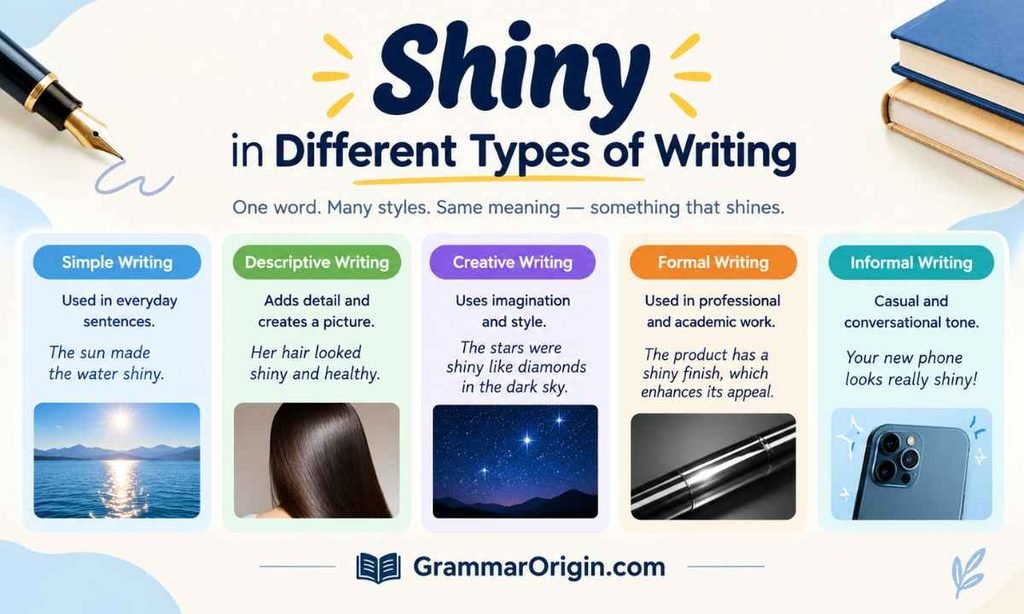
The word adapts easily across formal and informal contexts alike.
Formal Writing
Example: “The specimen displayed a shiny, metallic surface under laboratory lighting.”
Informal Writing
Example: “Your shoes look super shiny today.”
Creative Writing
Example: In fiction, a shiny object often symbolizes temptation, wealth, or hidden danger lurking behind something attractive.
Product Descriptions
Example: “Finished in a shiny chrome coating that resists fingerprints” is the kind of line that sells a product on sight.
Children’s Writing and ESL Learning
Example: Early readers often meet the word through simple phrases like “the shiny apple” or “the shiny star,” since it’s easy to picture.
The Difference Between Shine and Shiny
Shine and shiny share a root, but they play very different grammatical roles.
Shine as a Verb
Example: “The stars shine brightly on clear nights.”
Shine as a Noun
Example: “Her shoes had a bright shine after polishing.”
Shiny as an Adjective
Example: “The car looked shiny after the wash.”
Quick Comparison Table
| Word | Part of Speech | Example |
| Shine | Verb or Noun | The stars shine at night. |
| Shiny | Adjective | The stars look shiny tonight. |
English Spelling Patterns That Explain Shiny
Once you see the underlying pattern, shiny stops feeling like an exception and starts feeling like a rule.
Words That Change Before Adding “Y”
English regularly drops a silent “e” before attaching “y” to a root word.
Example: Ice becomes icy, juice becomes juicy, and shine becomes shiny.
Similar Examples Like Tiny and Sunny
The “y” ending is one of the most common ways English forms adjectives from shorter root words.
Example: Sun becomes sunny, mud becomes muddy, and rain becomes rainy.
Why English Doesn’t Use “Shiney”
Usage over centuries settled on shiny because it matches this broader spelling pattern, and dictionaries simply followed common practice.
Example: If “shiney” had become standard, words like icy and juicy would likely have gained an extra “e” too, and they never did.
Memory Pattern That Actually Works
A short, personal rule beats memorizing formal grammar terms.
Example: Remind yourself: “shine loses its e before y,” and apply that same logic to ice, noise, and smoke.
Pronunciation Guide: Shiny vs Shiney
Both words sound the same, which is exactly why the shiney or shiny spelling debate causes so much trouble in the first place.
How Native Speakers Pronounce “Shiny”
Shiny is pronounced /ˈʃaɪ.ni/, with the stress landing on the first syllable and a soft “ee” sound closing it out.
Example: Say “shy” followed by a quick “nee,” and you’ve got the correct pronunciation of shiny.
Why “Shiney” Sounds Acceptable but Looks Wrong
English is full of words where spelling and pronunciation don’t match up cleanly, and this is one more example of that gap. Linguists call this mismatch between sound and spelling a quirk of English orthography, the writing system that doesn’t always follow how a word is actually said.
Example: Words like “knife” and “queue” show just how disconnected English spelling can be from how a word actually sounds.
Common Pronunciation Mistakes Among ESL Learners
Learners sometimes stress the wrong syllable or shorten the ending vowel sound.
Example: Saying “shin-ee” instead of “shy-nee” is a common early mistake that usually fades with more listening practice.
British English vs American English Usage
Unlike many words that split by region, shiny stays exactly the same everywhere.
Is “Shiny” Different in UK and US English?
No. Both British and American English use shiny, with no alternate regional spelling at all.
Example: Unlike color and colour, there’s no “shiney” version accepted anywhere in the English-speaking world.
Why Both English Variants Use the Same Spelling
Regional spelling splits usually come from older historical influences, and shiny simply never developed one.
Example: Words like organize and organise diverged over centuries, but shine-based words never followed that same path.
Regional Writing Habits and Online Errors
Casual internet writing spreads misspellings quickly, regardless of country or region.
Example: “Shiney” shows up just as often in US social media posts as it does in UK ones, since the mistake isn’t tied to any dialect.
Synonyms for Shiny to Improve Your Vocabulary
Swapping in a synonym now and then keeps descriptive writing fresh.
Formal Synonyms
Example: “The lustrous wooden floor reflected the chandelier’s light.”
Informal Alternatives
Example: “Her new bag looked so sparkly under the store lights.”
Synonyms Based on Texture and Appearance
Example: Jewelry often gets described as glittering, hair as glossy, and water as shimmering, each word suited to its own context.
Idioms and Expressions Related to Shiny
The word shows up in a handful of familiar English expressions.
“All That Glitters Is Not Gold”
This saying warns that something shiny on the surface may not hold real value underneath.
Example: “The deal looked great at first, but all that glitters is not gold.”
“Bright and Shiny”
This phrase usually describes something brand new and appealing.
Example: “He drove home in a bright and shiny new car.”
Pop Culture Use of “Shiny”
Movies, games, and advertising lean on “shiny” because reflective objects naturally catch human attention.
Example: In gaming culture, rare “shiny” item variants are prized specifically because they stand out visually from the ordinary version.
Why Shiny Often Symbolizes Newness
Across marketing and storytelling, shine is shorthand for quality, freshness, and value.
Example: A “shiny new start” is a common phrase used to describe a fresh beginning, even when nothing literal is shining at all.
Why Correct Spelling Matters in Professional Writing
Small spelling errors like the shiney or shiny mix-up carry a bigger cost than most people expect in professional settings.
First Impressions in Emails and Resumes
Hiring managers and clients often judge attention to detail based on small writing errors.
Example: A single “shiney” in a cover letter can quietly undercut an otherwise strong application.
Credibility in Academic Writing
Teachers and professors read spelling as a signal of overall writing care, even in short assignments.
Example: A well-written essay with one obvious misspelling still loses some of its polish in a grader’s eyes.
SEO and Search Visibility Benefits
Correctly spelled content ranks and performs better because it matches what people actually search for and what dictionaries confirm as standard.
Example: A blog post titled with the correct spelling naturally reaches more readers than one built around a common typo.
Brand Trust and Marketing Impact
Brands that get basic spelling wrong risk looking careless, especially in industries built around quality and polish.
Example: A luxury watch ad describing a “shiney finish” would undercut the very premium image it’s trying to sell.
Real Examples of “Shiny” From Different Industries
Every industry that sells appearance leans heavily on this word.
Technology and Gadgets
Example: “The new smartphone features a shiny glass back panel.”
Fashion and Jewelry
Example: “The bracelet’s shiny gold finish caught every eye in the room.”
Automotive Industry
Example: “The showroom floor was lined with shiny, freshly waxed cars.”
Beauty and Cosmetics
Example: “The serum promises shiny, healthy-looking hair within weeks.”
Gaming and Entertainment
Example: “Collectors chase shiny in-game items because of how rare they are.”
Shiney or shiny Pokemon
In gaming communities, the shiney or shiny debate shows up constantly, and the answer follows standard English rules here too.
The official, correct term is Shiny Pokémon, referring to rare, alternately colored versions of a creature that players enjoy collecting. “Shiney Pokemon” is a common misspelling among fans, especially non-native English speakers, but it has never been the official or correct term.
Example: A player posting “just caught a shiney Charizard” is using the popular gaming term with the same spelling mistake found everywhere else online.
Shiney Ahuja
This heading refers to a real person rather than the spelling debate covered above, and it’s worth a brief, factual note.
Shiney Ahuja is an Indian film actor best known for his role in the 2006 Bollywood film Gangster. In 2011, a trial court convicted him in a criminal case involving his domestic worker, and in 2016, the Bombay High Court acquitted him after reviewing the evidence on appeal.
Example: Searches for “Shiney Ahuja” are about this actor’s name and legal case, not the spelling of the adjective shiny, since a proper noun follows its own unique spelling regardless of general English rules.
Final Thoughts
The correct spelling is shiny, and shiney is simply a common typo shaped by pronunciation and the pull of the word “shine.” Once you remember that the silent “e” drops before adding “y,” the correct form becomes second nature.
Whether you’re describing a polished car, a gaming collectible, or a well-edited resume, getting this small detail right adds a layer of polish to your own writing.
Frequently Asked Questions
Is “shiney” ever correct in any form of English?
No. Neither British nor American English recognizes shiney as a valid spelling in any context.
Why do so many people write shiney instead of shiny?
The word “shine” tricks the brain into keeping its silent “e” when adding “y,” even though the correct rule drops it.
What is the easiest way to remember the correct spelling of shiny?
Remember that shine loses its “e” before adding “y,” the same pattern used in ice becoming icy and smoke becoming smoky.
Is “Shiny Pokemon” the correct spelling in gaming?
Yes. The official gaming term is Shiny Pokémon, and “Shiney Pokemon” is simply a widespread misspelling among fans.
Does shiny mean the same thing as glossy or sparkly?
Not exactly. Shiny describes reflecting light in general, while glossy leans toward smooth polish and sparkly suggests small flashes of light.
Is Shiney Ahuja’s name related to the word shiny?
No. Shiney Ahuja is a proper noun, an actor’s given name, and it follows its own spelling independent of the adjective shiny.
Does correct spelling of shiny really matter in professional writing?
Yes. Small, avoidable errors like shiney can quietly affect first impressions in resumes, emails, and marketing copy.

Muhammad Waqas is an English language teacher and grammar expert with over 8 years of experience helping students and professionals improve their writing skills. He specializes in English grammar, vocabulary, communication, and practical language learning. Through GrammarOrigin, Waqas shares clear, easy-to-understand content that helps readers write and speak English with confidence.