
In the unfazed vs. unphased debate, unfazed is the only correct spelling. It means calm and unbothered when something stressful happens, like harsh criticism, bad news, or a sudden change of plans. Unphased is a mix-up that keeps sneaking into emails, captions, and even news copy.
So why does the mistake happen? Because “fazed” and “phased” sound exactly alike, and “phased” is a real word that spellcheck won’t flag. This guide covers the meaning, the origin of faze, quick memory tricks, and plenty of examples, so the right word comes to you without a second thought.
Unfazed Meaning: What It Actually Means (And How to Use It Correctly)
Unfazed means calm and unbothered by something that would normally rattle a person. It’s an adjective built from the verb faze, which means to disturb or throw someone off balance.
You’ll usually meet faze in the negative: “Nothing fazes her,” or “It didn’t faze him.” Add the prefix un- to fazed, the past participle of faze, and you get unfazed. It’s a word for someone who took the hit and stayed steady.
Example: The new intern stayed unfazed when the client rewrote the brief an hour before the meeting.
Simple Examples You’ll Recognize
Simple examples show the pattern fast: someone faces pressure, and they don’t crack. Read these out loud and the word starts to feel natural.
- The goalkeeper looked unfazed as the crowd roared during the penalty shootout.
- My sister stayed unfazed when the oven died halfway through the dinner party.
- The author was unfazed by criticism of her first draft.
- The speaker was unfazed by the heckler in the third row.
- He seemed unfazed after the team lost its biggest client.
Notice what every sentence has in common. There’s always some kind of pressure, surprise, or challenge, and the person’s reaction is the point.
Example: The pilot sounded unfazed as she announced the turbulence.
When to Use “Unfazed”
Use unfazed when you’re describing how someone reacts to stress, surprise, or pressure. If the sentence is about nerves or emotions, this is your word.
It fits neatly in these situations:
- Criticism, feedback, or rude comments
- Bad news or sudden setbacks
- Emergencies and high-stakes moments
- Big audiences, tough opponents, or tense negotiations
Example: She walked into the negotiation unfazed by the size of the other team.
Unfazed By or Unfazed At?
“Unfazed by” is the safest pairing. It’s the one you’ll see most often in dictionary examples, and it reads naturally after linking verbs like be, seem, appear, and remain.
You might spot “unfazed at” now and then, but it sounds less natural to most readers. Plenty of writers skip the preposition entirely and just say someone “stayed unfazed.”
Example: The cat seemed completely unfazed by the vacuum cleaner.
Synonyms That Reinforce the Meaning
Words like composed, unruffled, and unshaken all point to the same idea: staying steady when things get tense. Learning a few of them helps the meaning of unfazed stick.
- Composed (in control of your reactions)
- Unruffled (not visibly disturbed)
- Unshaken (confidence still intact)
- Collected (calm and organized under stress)
- Cool-headed (thinking clearly when others panic)
Example: The nurse stayed composed while the ward filled up.
Why People Confuse Unfazed vs. Unphased
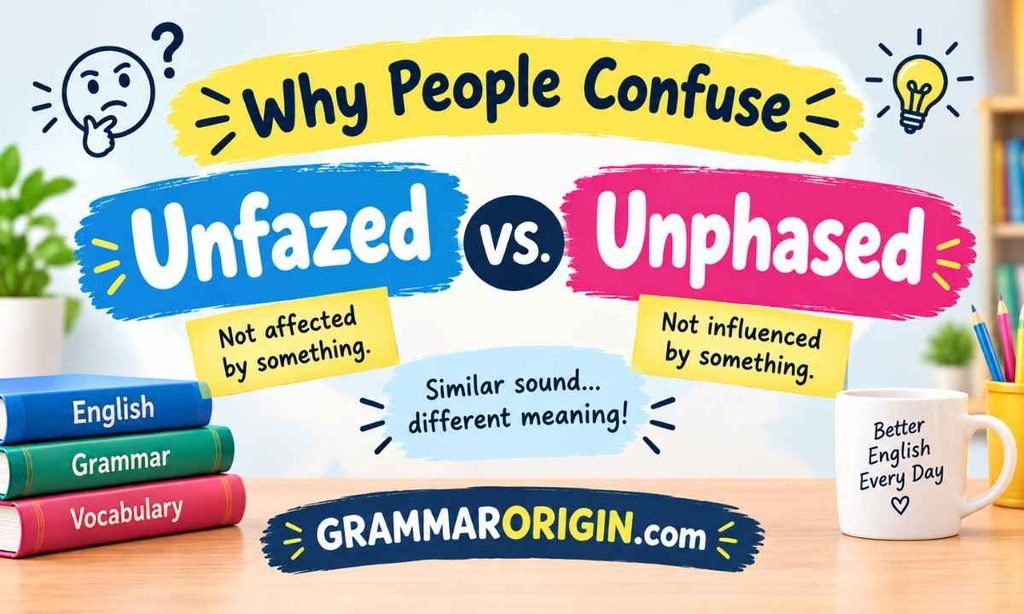
People mix these words up because they sound identical and look almost the same on the page. Add a spellchecker that stays quiet, and the wrong version slips right through.
This pair sits on the long list of commonly confused words, right next to affect and effect. If you’ve ever typed “unphased or unfazed” into a search bar, you’re in good company, because the mistake starts in the ear, not the brain.
Example: A tired writer types “unphased” at midnight, reads it back, and sees nothing odd because it sounds right.
Also Read This Cosy or Cozy: Which Spelling Is Correct? (UK vs US)
The Phonetic Trap
Fazed and phased are homophones, so in the unfazed vs. unphased puzzle your ear can’t tell you which spelling to use. Both are pronounced the same way, with the stress on the second syllable: un-FAYZD.
English also gives you two ways to write the “f” sound. Think of “phone” and “fun.” So the spelling has to be memorized, because sound gives no clues.
Example: Say “unfazed” and “unphased” out loud. You’ll hear no difference at all.
Spellcheck Doesn’t Always Save You
Spellcheck often misses the error because “phased” is a legitimate word. The tool sees a valid spelling, so it has no reason to complain.
Some grammar checkers may catch it, but you can’t count on that. A quick manual check saves you from sending the wrong word to a client or a hiring manager.
Example: “The manager was unphased by the complaint” passes many basic checks. “The manager was unfazed by the complaint” is what you actually mean.
Mental Association with “Phase”
Most people see “phase” all the time, so the brain grabs the familiar spelling. Think of the phases of the moon, phase one of a project, or the phase a teenager goes through.
That familiarity creates a pull. When you hear the sound “fayzd,” the more common written word wins by default, even though it has nothing to do with staying calm.
Example: The town moved into the second phase of its road repairs.
Fazed vs Phased: Verb Forms
The faze vs phase split is simple: they’re two separate verbs with two separate meanings. Faze means to disturb or daunt. Phase means to do or introduce something in stages, usually in the phrases “phase in” and “phase out.”
| Base verb | Other forms | Meaning | Example |
| Faze | fazes, fazed, fazing | To disturb or daunt | Bad reviews never fazed her. |
| Phase | phases, phased, phasing | To do in stages | The school phased out paper forms. |
Put un- in front of “fazed” and you get unfazed, the calm adjective. Put un- in front of “phased” and you get a word that only makes sense if something wasn’t done in stages.
Example: The store phased in the new checkout system over two months.
What “Unphased” Means (Technically Speaking)
Is unphased a word? Not really. In the unfazed vs. unphased pair, it isn’t a standard dictionary word, and the rare unphased meaning is “not carried out in stages.”
Break it down and the logic is simple: un- means not, and phased points to phase as a stage. Most major dictionaries don’t list it, and Dictionary.com calls it a misspelling of unfazed.
Example: The launch was unphased, so every branch switched systems on the same day.
Where This Might Appear (Rarely)
You might see it in planning or technical talk about rollouts, schedules, and system upgrades. Even there, it’s uncommon.
Careful writers usually pick clearer wording like “all at once” or “in a single step.” That way nobody wonders whether a typo slipped in.
Example: The city ran an unphased launch, opening every new bus route on the same morning.
Why It Doesn’t Work in Everyday Writing
When you’re describing a feeling or reaction, unphased says something else entirely, and readers will either stumble or assume you made a typo. The word you want is unfazed.
Even a writer who wants the technical sense risks confusion, because so many people misspell unfazed this way. Clear wording beats a clever word every time.
Example: “She was unphased by the news” makes readers wonder about stages. “She was unfazed by the news” says what you mean.
Unfazed vs. Unphased: Side-by-Side Comparison
Unfazed is the standard word for staying calm under pressure. Unphased is a common misspelling in most writing, and a rare technical term at best.
| Feature | Unfazed | Unphased |
| Meaning | Not disturbed or worried | Not done in stages (rare) |
| Part of speech | Adjective | Adjective |
| Built from | un- + fazed (from faze) | un- + phased (from phase) |
| Listed in major dictionaries | Yes | Generally no |
| Typical use | Reactions to stress or surprise | Rollouts and schedules, if used at all |
| Safe in formal writing | Yes | No |
| Example | She stayed unfazed by the delay. | The rollout was unphased. |
Quick Rule You Can Trust
In the unfazed vs. unphased choice, a sentence about how someone feels or reacts always gets unfazed. There are almost no exceptions in everyday English.
Here’s a fast check: swap in “not bothered.” If the sentence still makes sense, unfazed is the right word.
Example: “He was not bothered by the noise” becomes “He was unfazed by the noise.”
A Memory Trick That Actually Works
The easiest trick for unfazed vs. unphased is to connect the F in fazed with the F in feelings. Once that link is in your head, the wrong spelling starts to look odd.
You don’t need grammar jargon for this. A couple of small mental hooks are enough to lock it in for good.
Example: Feelings stay steady, so you’re unfazed.
The “F = Feelings” Trick
Faze and feelings both start with F, and unfazed is all about feelings staying steady. Phase starts with PH, like the word “physical,” so think of it as a real step in a plan.
So ask yourself one question: is this sentence about a feeling or a step? A feeling gets the F. A step gets the PH.
Example: Her feelings didn’t change, so she was unfazed.
Another Way to Remember
Try the “aze family.” Daze, amaze, and faze all describe something happening in the mind. They share the same -aze ending, and none of them takes a PH.
Phase belongs with the moon, with projects, and with life stages. You can also turn the phrase around: “Nothing fazes me” becomes “I’m unfazed.”
Example: “Nothing fazes him” becomes “He’s unfazed.”
Also Read This Cosy or Cozy: Which Spelling Is Correct? (UK vs US)
Common Mistakes (And How to Fix Them Instantly)
Most unfazed vs. unphased errors come from one habit: writing the word by sound. The fix is simple. Whenever the sentence describes a reaction, replace unphased with unfazed.
You don’t need to memorize a long list. A short habit of pausing on this word is enough to catch nearly every slip.
Example: “The coach stayed unphased” becomes “The coach stayed unfazed.”
Wrong vs. Right Examples
Seeing the wrong and right versions side by side makes the fix obvious.
- Wrong: The candidate looked unphased by the tough questions. Right: The candidate looked unfazed by the tough questions.
- Wrong: We stayed unphased through the storm. Right: We stayed unfazed through the storm.
- Wrong: I’m not phased by rude comments. Right: I’m not fazed by rude comments.
- Wrong: The referee seemed unphased by the protests. Right: The referee seemed unfazed by the protests.
Example: Even a short caption like “Totally unfazed” should get a second look before you post.
Spot the Pattern
The wrong version pops up in the same kinds of sentences again and again. Watch for these signals:
- Emotion words like calm, nervous, worried, or stressed nearby
- Reaction verbs such as seemed, stayed, looked, or remained
- The word “by” right after it, pointing to what caused the pressure
When you see two or more of these signals, the word you need is unfazed.
Example: “She remained calm and unfazed by the noise” hits all three signals.
Why This Small Mistake Hurts Your Credibility

It’s a one-letter slip, but readers tend to notice it, especially in polished writing like resumes, cover letters, and client emails. Mixing up unfazed vs. unphased won’t ruin a career, but it can make a good message look rushed.
Think of it as a small polish issue. Fixing it costs you a few seconds, and it keeps your writing looking sharp.
Example: A cover letter that says “I stayed unfazed under deadline pressure” reads stronger than one with a spelling slip in the same line.
First Impressions Stick
In professional writing, small errors stand out because readers are scanning quickly. A misspelled word near the top of a message can color how the rest is read.
That’s fair or not, depending on your view, but it’s how people read. A clean first paragraph earns you more patience for everything that follows.
Example: An email opening with “I was unfazed by the tight timeline” sounds calm and capable.
It’s a Quiet Red Flag
Most readers won’t point out the mistake. They’ll just quietly file it under “careless,” and you’ll never know.
Editors, recruiters, and clients often spot this kind of thing fast because they read a lot of text. The damage is silent, which makes it easy to overlook.
Example: A reviewer might think, “Nice portfolio, but the caption says unphased.”
Easy Fix, Big Payoff
The fix takes almost no effort: learn the rule once and use it forever. Your writing looks more careful, and your message lands with more confidence.
A tiny habit like this adds up across every email, post, and document you write in a year.
Example: Change one word, and “unfazed under pressure” stops being a risk and becomes a strength.
Case Study: How One Word Changed Perception
A single word from the unfazed vs. unphased pair can change how a message feels. This is an illustrative scenario, not a real client story, but it shows how the mistake plays out in practice.
Imagine a freelance designer sending a proposal to a new client. The pitch is strong, and one sentence in the middle carries the whole personality of the message.
Example: The sentence that shapes the reader’s opinion is the one describing how the designer handles pressure, and its key word is unfazed.
Before
Here’s the line as first written: “Even after the client rejected my first draft, I stayed unphased and sent a stronger version by morning.”
The story is good, but the reader pauses on “unphased.” A few people quietly wonder whether the designer proofreads carefully, and the strong point loses some of its punch.
Example: “I stayed unphased and sent a stronger version” sounds confident but reads as a typo.
After (Corrected Version)
Now the corrected line: “Even after the client rejected my first draft, I stayed unfazed and sent a stronger version by morning.”
Nothing else changed, yet the sentence now reads as calm, capable, and polished. The reader keeps moving instead of stopping to question the wording.
Example: “I stayed unfazed and sent a stronger version” sounds exactly like what the designer wants to say.
Deep Dive: The Origin of “Faze”
Faze is an American English verb that first appeared in the 1830s. It’s thought to be a variant of “feeze,” an older word meaning to frighten.
The story behind it also explains why the unfazed vs. unphased mix-up lasts, and why “phase” keeps creeping in. The two words come from completely different roots, and they only look related because the spellings overlap.
Example: People used to say someone was in a “feeze” when they were worked up, and faze grew out of that.
Where “Faze” Comes From
The Online Etymology Dictionary traces faze to “feeze,” a word from Kentish dialect in the mid-1400s that meant to frighten or alarm. Feeze goes back to an Old English word meaning “to drive away.” Faze grew out of it in American English, and “unfazed” was recorded in 1933.
Merriam-Webster lists four spellings that have been used over time: faze, phase, feaze, and feeze. Today, writing “phase” for this meaning is treated as an error. The modern spelling “faze” was standard by around 1900.
Phase, on the other hand, came into English in the 17th century from Greek, and it originally described the phases of the moon. Two different words, two different families.
Example: The verb faze and the noun phase have no shared root, even though they sound the same.
What It Implies
To faze someone is to shake their composure, so the word carries a sense of disturbance. That’s why it shows up so often in the negative: “It didn’t faze her.”
Unfazed flips that idea. The pressure arrived, and the person stayed grounded. That quiet strength is exactly what the word is meant to capture.
Example: A sudden fire alarm didn’t faze the seasoned teacher, so she stayed unfazed.
Real-Life Situations Where “Unfazed” Fits Perfectly
Once you’ve settled unfazed vs. unphased, you’ll see the right word in offices, families, sports reports, and everyday chat. It fits anywhere a person stays calm when others might panic.
Here are a few areas where it shows up most naturally.
Example: A quiet commuter stays unfazed when the train is delayed for the third time.
Workplace Examples
At work, unfazed describes people who handle pressure without drama. It’s a compliment you’ll see in reviews and recommendation letters.
- The team lead stayed unfazed when the server crashed before the demo.
- She was unfazed by the sudden budget cut and simply reworked the plan.
- New hires learn fast when a manager is unfazed by mistakes.
Example: He remained unfazed when the presentation software froze on stage.
Personal Life
In daily life, unfazed captures the calm that lets people shrug off small disasters. It’s especially handy for parenting, travel, and family stories.
- Our toddler was unfazed by the thunderstorm and slept right through it.
- I stayed unfazed when my flight was rescheduled at the last minute.
- She’s unfazed by online negativity and never replies to it.
Example: My grandmother was unfazed by the power cut and lit candles like it was routine.
Pop Culture and Media
Sports writers and film reviewers love this word. It describes the athlete who doesn’t blink at a big moment or the character who strolls away from a disaster.
Even news outlets have gotten it wrong. NPR once ran a short correction after a piece called a radar technician “unphased” by isolation and pace of work. A reader pointed out that unfazed was the right word.
Example: The lead actor’s character stays unfazed as the city collapses behind him.
Quick Self-Test (Lock It In)
Try these three quick checks on unfazed vs. unphased and its verb cousins. Pick the right word for each blank before you scroll to the answers.
- Despite the heavy criticism, the chef remained completely ______. (unfazed / unphased)
- Nothing seems to ______ her, not even a last-minute change. (faze / phase)
- The school plans to ______ out the old textbooks over two years. (faze / phase)
Example: Read each sentence out loud, and decide if it’s about a feeling or a step.
Answer
Here are the answers, with the reason for each.
- Unfazed. The sentence is about a reaction to criticism.
- Faze. It means “nothing seems to disturb her.”
- Phase. “Phase out” means to remove gradually, in stages.
If you got all three, you’ve got the difference down. If you missed one, reread the “Fazed vs Phased: Verb Forms” section and try again.
Example: “Nothing seems to faze her” and “We’ll phase out the old system” use two different verbs.
Unfazed antonyms
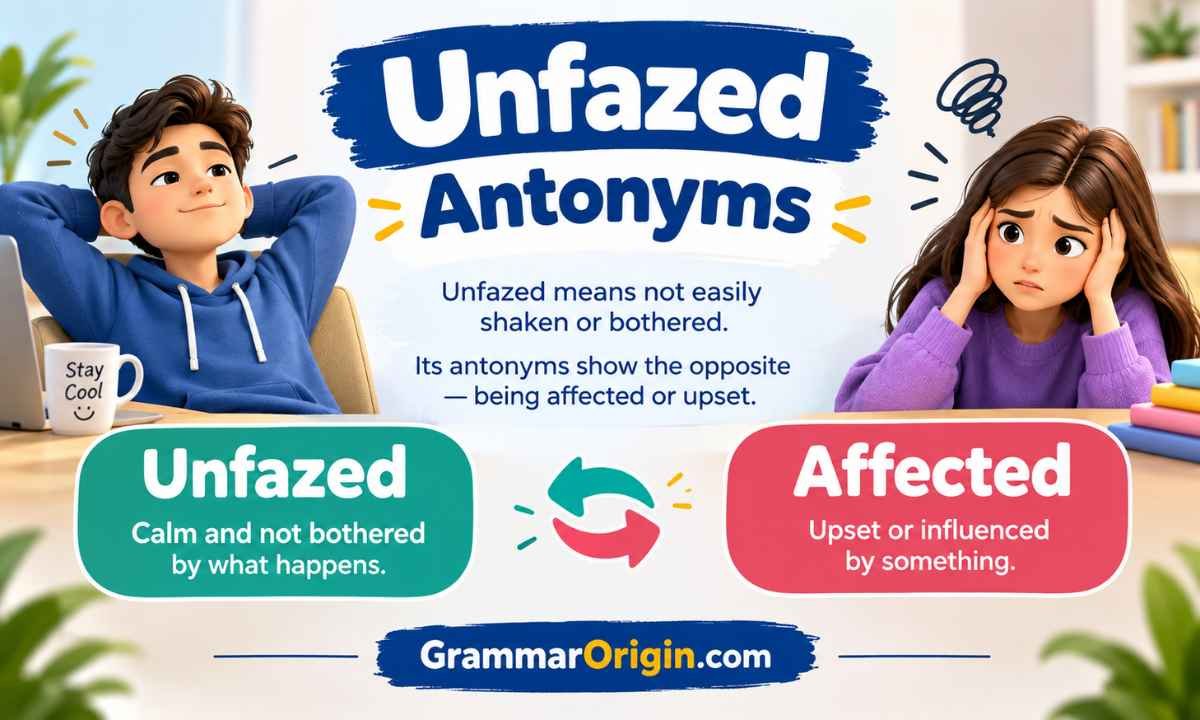
The main opposites of unfazed are fazed, rattled, and flustered. Each one describes someone who does react to pressure, just in slightly different ways.
- Fazed (disturbed or thrown off)
- Rattled (shaken, often suddenly)
- Flustered (confused and nervous)
- Unnerved (made anxious or uneasy)
- Disconcerted (thrown off balance)
- Perturbed (troubled or worried)
Example: The tough question left the candidate visibly rattled, while his rival stayed unfazed.
Unfazed synonym
Good synonyms for unfazed include composed, unruffled, unflappable, and imperturbable. They all point to someone who stays calm, though each has a slightly different flavor.
| Synonym | Shade of meaning | Example |
| Composed | Calm and in control | She stayed composed during the interview. |
| Unruffled | Not visibly disturbed | He looked unruffled despite the noise. |
| Unflappable | Calm as a lasting trait | Our unflappable manager never raises her voice. |
| Imperturbable | Very hard to disturb | An imperturbable pilot guided the plane down. |
| Undaunted | Facing a challenge boldly | The team was undaunted by the deadline. |
| Unbothered | Casually not affected | He seemed unbothered by the teasing. |
Unflappable often describes a lasting personality trait, while unfazed usually describes a reaction in one specific moment. That small difference helps you pick the best word.
Example: A person can be unfazed by one bad day without being unflappable in general.
Final Thoughts
The unfazed vs. unphased question has a clear winner: unfazed is the correct spelling for staying calm, and unphased is just a look-alike that doesn’t belong in everyday writing. Fazed and phased sound identical, which is exactly why the mix-up survives.
Keep the “not bothered” swap and the F for feelings close by, and the right word will show up on its own. A quick check on this one word keeps your writing clean and your message clear.
Frequently Asked Questions
What does “I’m not phased” mean?
“I’m not phased” is a common misspelling of “I’m not fazed,” which means “this doesn’t bother me.” The correct version is “I’m not fazed.”
Strictly speaking, “phased” would relate to doing something in stages, which isn’t what the speaker means. In the unfazed vs. unphased mix-up, this is the same error in verb form.
Example: “Rude comments don’t get to me. I’m not fazed.”
Is “unfazed” a word?
Yes, unfazed is a standard English adjective, and major dictionaries such as Merriam-Webster and Dictionary.com list it. It means not disturbed or worried by something.
Unphased, by comparison, is generally treated as a misspelling in ordinary writing.
Example: The sailor was unfazed by the choppy water.
What is the opposite of unphased?
If someone uses unphased to mean unfazed, the opposite is fazed, or words like rattled and flustered. In the rare technical sense of “not done in stages,” the opposite is phased.
Because the word is so often a misspelling, it’s usually clearer to use unfazed and its antonym fazed.
Example: The referee stayed unfazed, while the coach looked fazed by the protest.
What does it mean to be unfazed?
To be unfazed means to stay calm and unbothered in a situation that might upset or worry other people. It usually describes a reaction to pressure, criticism, surprise, or bad news.
Think of it as steady nerves. The event happens, and the person doesn’t lose their composure.
Example: She sat unfazed as the audience whispered during her speech.
Is it “unfazed by” or “unfazed at”?
“Unfazed by” is the standard and most natural choice. It’s the pairing most often shown in dictionary examples, so it’s the safe pick for any type of writing.
You may occasionally see “unfazed at,” but it reads less naturally to many readers. You can also drop the preposition and just write “stayed unfazed.”
Example: The team was unfazed by the rain delay.
Is “unphased” acceptable in British English?
No, unphased is generally treated as a misspelling in both British and American English. Unfazed is the standard spelling in both, so there’s no regional split to worry about.
Whenever you’re choosing between unfazed vs. unphased in British or American writing, go with unfazed.
Example: The London commuter stayed unfazed by the signal failure.

Muhammad Waqas is an English language teacher and grammar expert with over 8 years of experience helping students and professionals improve their writing skills. He specializes in English grammar, vocabulary, communication, and practical language learning. Through GrammarOrigin, Waqas shares clear, easy-to-understand content that helps readers write and speak English with confidence.