
Genius vs Genious? The correct spelling is genius, with an -ius ending. Genious is a common misspelling, and it isn’t a word in standard English.
This guide explains what genius means, where the word comes from, and why Genius vs Genious trips up so many writers. You’ll also get memory tricks and the grammar details that trip writers up.
Is It Genius or Genious?
It’s genius. The spelling genious is a mistake, and you won’t find it as an entry in Collins, Merriam-Webster, or Dictionary.com.
American and British English both use genius, so there’s no regional exception to learn. When the question is Genius vs Genious, the answer is the same everywhere.
Example: She’s a chess genius, and everyone in the club knows it.
What Does Genius Mean?
Genius means exceptional intellectual or creative ability, or a person who has it. Dictionaries also keep an older meaning that comes from Roman religion.
To judge Genius vs Genious properly, it helps to see how the word is used. It shows up in three everyday ways: as great intelligence, as rare talent, and as a clever idea.
Genius as Exceptional Intelligence
Genius can describe a person with extraordinary mental power. It can also name the power itself, as in “her genius as a designer.”
Used that way, the word is uncountable, so you don’t add an s or a before it.
Example: Albert Einstein is often called a genius for his work on relativity.
Genius as Extraordinary Talent
Genius can mean a rare natural gift, especially in music, art, or craft. Here the focus is on creative power more than on test-style smarts.
Example: Mozart’s musical genius is still studied by composers today.
Genius as a Brilliant Idea
People also use genius for a clever idea or move, as in “a stroke of genius.” This sense is informal and a little playful.
Example: Hiding the spare key inside a fake rock was a genius move.
Historical Meaning of Genius
Genius began as a Roman religious idea: a guardian spirit tied to a person, a family, or a place. Merriam-Webster traces it to the Latin gignere, meaning “to beget,” and says it entered English in the 14th century with the “attendant spirit” meaning.
Over time the word stretched to cover a person’s natural ability, and later great intelligence itself. Dictionary.com dates the English word to between 1350 and 1400. That Latin spelling stuck, and it’s the reason Genius vs Genious has a clear answer today.
Example: In ancient Rome, a man’s genius was a guardian spirit, not a test score.
Genius Loci: The Spirit of a Place
Genius loci is a Latin phrase for the protective spirit of a place. Today it usually describes a location’s special atmosphere.
Example: The old harbor town has a strong genius loci, with its narrow lanes and salt air.
Why People Misspell Genius as Genious
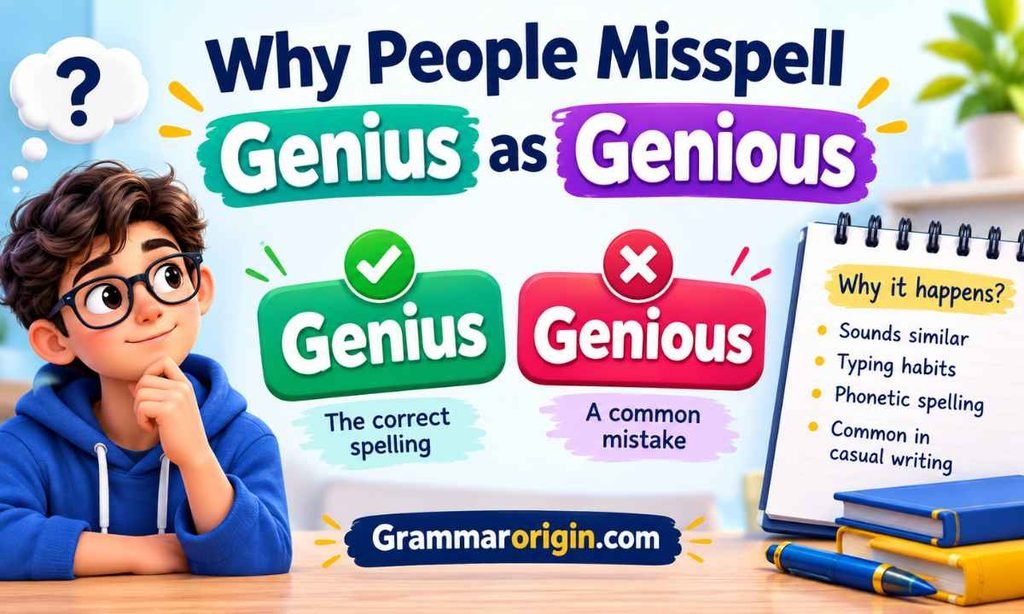
People misspell genius as genious for three reasons: a familiar -ious ending, the way the word sounds, and fast typing. Each one pushes an extra o into the middle of the word.
Seeing why the Genius vs Genious mix-up happens makes it much easier to stop.
Example: Typed in a hurry, “He’s a genius” can slip into “He’s a genious.”
Also Read This Nosey or Nosy: Which Spelling Is Correct? Meaning & Examples
The -ious Pattern Trap
English is full of common -ious words, such as curious, serious, glorious, various, and obvious. Your brain spots a familiar ending and fills it in, even though genius doesn’t follow that pattern. That habit is the biggest reason the Genius vs Genious mix-up exists.
Example: Curious, serious, and glorious all take -ious, but genius doesn’t.
Pronunciation Confusion
Genius is usually said JEEN-yus, and sometimes JEE-nee-us. That “ee-us” sound is the same one you hear in curious, so your ear suggests an o that isn’t there. Sound is the second reason Genius vs Genious trips people up.
For the record, Collins’s American entry gives /ˈdʒinjəs/ and also /ˈdʒiniəs/. Neither one has an “oh” sound anywhere.
Example: Say “JEEN-yus” out loud, and genius has no o to spell.
Typing and Search Errors
Fast fingers and search habits spread the typo. On a QWERTY keyboard, the o key sits right next to the i key, so a stray o is easy to hit.
Once a typo lands in a search bar, it can look familiar the next time you see it. That’s how a wrong spelling starts to feel right, and it keeps Genius vs Genious alive.
Example: A quick search for “genious meaning” is a typical slip, and the word you wanted was genius.
Genius vs Genious: Side-by-Side Comparison
Genius is the only accepted spelling, and genious is an error. The table shows the full picture at a glance.
| Feature | Genius | Genious |
| Spelling status | Correct | Incorrect |
| Dictionary entry | Listed in Collins, Merriam-Webster, Dictionary.com | Not listed |
| Meaning | Exceptional ability, or a person with it | None, it’s a misspelling of genius |
| Part of speech | Noun, plus an informal adjective | Not applicable |
| Plural | Geniuses (genii for spirits) | Not applicable |
| Ending | -ius | -ious (wrong) |
| Essays, emails, and exams | Always safe | Never accepted |
| American and British English | Same in both | Wrong in both |
Every row of the Genius vs Genious comparison points the same way, so there’s nothing to weigh.
Example: The genius behind the plan took no credit for it.
How to Use Genius Correctly in Sentences
Use genius as a noun for a person or a quality, and as an informal adjective in casual talk. In formal writing, the adjective you want is usually ingenious.
Getting Genius vs Genious right is only half of it, because the word has a few usage rules of its own.
Example: He’s a genius, and his idea was ingenious.
As a Noun
As a noun, genius names a person with rare ability, or the ability itself. Use “a genius” for the person and plain “genius” for the quality.
Example: The team hired a genius to fix the code. / It took real genius to solve it.
As an Informal Adjective
Genius also works as an adjective in casual speech, as in “a genius idea.” Many dictionaries mark this use as informal.
In a report or essay, swap it for ingenious, clever, or inventive.
Example: That was a genius idea for the party.
Common Mistakes to Avoid
Most errors with this word fall into the same few buckets:
- Writing genious instead of genius.
- Writing “an genius” instead of “a genius.”
- Writing “geniouses” instead of “geniuses.”
- Using genius as a formal adjective where ingenious fits better.
- Mixing up genius and ingenious in the same sentence.
Example: Instead of “two geniouses,” write “two geniuses.”
Is Genious Ever a Real Word?
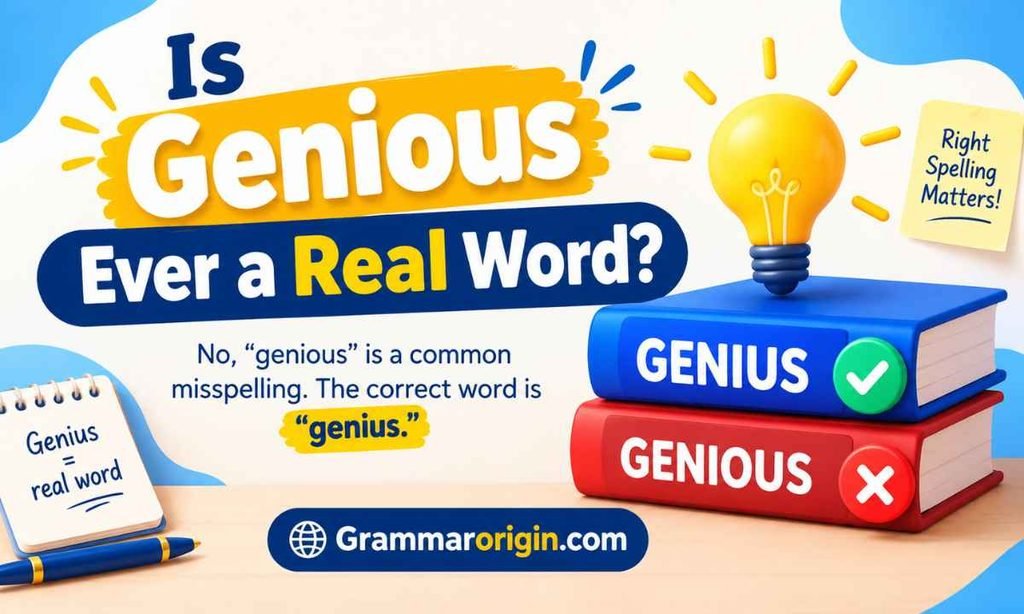
No. Genious isn’t a real English word, and no major dictionary lists it. It isn’t a British spelling, an American spelling, or a technical term.
A brand or username can spell it any way it likes, but that doesn’t turn it into a word. In normal writing, the Genius vs Genious debate has just one valid side.
Example: A username might say “genious,” but a sentence should say genius.
Why Genius Ends in -ius Instead of -ious
In Genius vs Genious, the ending is the whole story. Genius ends in -ius because English borrowed the word straight from Latin and kept the Latin spelling. Many -ious words, like curious and glorious, came from a different Latin ending, -iosus.
Ingenious makes a neat contrast. It comes from the Latin ingeniosus, so it takes -ious, while genius comes from the Latin genius, so it doesn’t.
Example: Latin genius became English genius, but Latin ingeniosus became ingenious.
Memory Tricks to Remember Genius Is Correct
Three quick tricks make the right spelling stick: the genie link, the -ious adjective rule, and pattern grouping. Pick the one that sounds most natural to you.
Any of them settles Genius vs Genious in a couple of seconds.
Example: Remember the trick, then write genius with confidence.
Think “Genie” Inside Genius
Genie and genius are close relatives, and Merriam-Webster lists genii as a plural for both. Both start with g-e-n-i, which gives you the first four letters for free.
After that, genie takes an e and genius takes us. Be careful with “genie plus us,” because that spells genieus. Keep the four letters, then add us.
Example: Gen-i-us: the genie’s first letters, with “us” on the end.
Remember This Rule
The ending -ious usually marks an adjective, and genius is a noun. That one idea explains why curious, serious, and ingenious have an o and genius doesn’t, and it settles Genius vs Genious on its own.
Example: A genius is often curious: the noun has no o, and the adjective does.
Use Pattern Grouping
Sort the words by ending and the picture gets clear. The -ius group is small, and the -ious group is large.
- -ius: genius, radius, Celsius
- -ious: curious, serious, glorious, ingenious
Example: Radius, genius, and Celsius all end in -ius.
Genius Synonyms and Related Words
Common synonyms include mastermind, prodigy, virtuoso, and polymath, and each one leans in a slightly different direction. Once Genius vs Genious is settled, choose by nuance, not just by sound.
Example: Calling her a mastermind says more about planning than about talent.
For Exceptional Intelligence
These words stress mental power or breadth of knowledge. A mastermind plans cleverly, a polymath knows a lot about many fields, and brainiac is the casual, playful one.
Example: She’s a polymath: part scientist, part poet.
For Creative Brilliance
These words fit artists, performers, and inventors. A virtuoso has top-level skill, a visionary sees what’s next, and a prodigy is a young person with rare talent.
Example: The young pianist was a true prodigy.
Related But Weaker Than Genius
These words praise ability without the rare, once-in-a-generation weight of genius. Gifted, talented, bright, clever, and sharp all sit a step lower.
Example: He’s talented, but nobody would call him a genius yet.
When “Genius” Is Overused
Genius is overused when it labels everyday things, like a snack hack or a shortcut. The more often it’s used for small stuff, the less it means for real achievement.
Spelling it right matters, and so does using it sparingly, even after Genius vs Genious is settled. Save it for rare skill. For ordinary cleverness, words like smart, inventive, or handy do the job better.
Example: A clever shortcut is fine; calling it genius waters the word down.
Case Study: Why This Misspelling Happens So Often
The misspelling happens because three small forces line up: sound, pattern, and speed. This is an illustrative walk-through, not survey data.
Picture someone writing a caption about a friend. They say “JEE-nee-us” in their head, think of curious and serious, and the keyboard puts the o right where a finger lands.
Even if a spellchecker underlines the word, a quick click-through can leave it in. Once it’s written down wrong a few times, it starts to look right.
That’s why Genius vs Genious is a habit problem more than a knowledge problem.
Example: The writer meant genius, but the sound, the pattern, and the keyboard all pushed toward genious.
Genius in Modern Pop Culture
Pop culture loves the genius as a character, and the Genius vs Genious answer doesn’t change there either, because titles and scripts use genius. The type is the brilliant outsider: the brilliant outsider who sees what everyone else misses. Will Hunting in Good Will Hunting and Sheldon Cooper in The Big Bang Theory are two well-known examples.
National Geographic also made an anthology series called Genius, which profiled figures such as Albert Einstein and Pablo Picasso. Brands borrow the word too, from the Genius lyrics site to Apple’s Genius Bar.
Example: Will Hunting is a math genius who works as a janitor.
Famous People Often Called Geniuses
People often link the word with names like Albert Einstein, Leonardo da Vinci, Marie Curie, Wolfgang Amadeus Mozart, Isaac Newton, and Nikola Tesla. They span physics, art, chemistry, music, and engineering.
There’s no scientifically precise definition of genius, so the label is always a judgment call. Psychologist Howard Gardner’s theory of multiple intelligences describes at least eight kinds, which helps explain why brilliance shows up in so many fields.
Example: Marie Curie, a scientific genius, won Nobel Prizes in both physics and chemistry.
Also Read This Nosey or Nosy: Which Spelling Is Correct? Meaning & Examples
Words Commonly Misspelled Like Genius
Several words invite the same sound-alike slip. Ingenious, mischievous, grievous, and radius are the usual suspects.
| Correct | Common slip | What goes wrong |
| ingenious | ingenius | The o gets dropped |
| mischievous | mischievious | An extra i sneaks in |
| grievous | grievious | An extra i sneaks in |
| radius | radious | An o gets added, like genious |
Notice that the Genius vs Genious error is one member of a bigger family of sound-alike slips.
Example: She gave a mischievous smile, with no extra i.
How to Avoid Spelling Errors Like Genious
Slow down, check anything that looks familiar, and doubt the patterns that feel too easy. A few small habits catch almost every slip.
These four habits also settle Genius vs Genious for good.
Example: One extra look at the page turns genious back into genius.
Proofread Backward
Read your text from the last word to the first. That breaks the flow, so your eyes land on spelling instead of meaning, which is how Genius vs Genious slips get caught.
Example: Reading backward, the odd word “genious” jumps out, and you fix it to genius.
Verify Uncertain Words
If a word looks slightly off, look it up. For Genius vs Genious, a dictionary like Collins or Merriam-Webster settles it in seconds, and memory alone isn’t a reliable check.
Example: A quick lookup confirms the spelling is genius.
Watch False Patterns
Be suspicious when a word seems to match a big family of words. The -ious family is huge, and genius isn’t part of it.
Example: Genius looks like curious, but its ending is different.
Do Not Trust Autocorrect Blindly
Autocorrect and spellcheck are helpful, but they aren’t careful readers. A typo can be swapped for a different real word, like ingenious or ingenuous, and no red line appears.
Read the finished sentence once more before you send it, because a Genius vs Genious slip can hide in an otherwise clean line.
Example: If autocorrect offers ingenious, check whether you meant genius instead.
Genius vs Intelligent vs Brilliant
Getting Genius vs Genious right is step one, and choosing among genius, intelligent, and brilliant is step two. Genius is a noun for rare ability or the person who has it, while intelligent and brilliant are adjectives. A person can be intelligent or brilliant, but only a few are called a genius.
| Word | Part of speech | What it means | Example |
| Genius | Noun, informal adjective | Rare, exceptional ability, or a person with it | She’s a genius at math. |
| Intelligent | Adjective | Good at learning and understanding | He’s an intelligent student. |
| Brilliant | Adjective | Very clever or impressive, also very bright | That was a brilliant answer. |
Brilliant also describes bright light, which intelligent never does.
Is Genius Capitalized?
No, genius is lowercase in normal sentences, and after Genius vs Genious, capitalization is the next thing to check. Capitalize it only at the start of a sentence, in a title, or when it’s part of a name.
Example: My sister is a genius, and Genius is also the name of a lyrics site.
Grammar Note: “A Genius” or “An Genius”?
It’s “a genius.” The rule follows sound, not spelling, and genius starts with the J sound, which is a consonant sound.
That’s why you say “a genius” but “an hour,” where the h is silent. It’s a small rule that goes hand in hand with Genius vs Genious.
Example: He’s a genius, and she’s an honest one.
Plural and Possessive of Genius
Once Genius vs Genious is behind you, the plural is the next detail. The usual plural is geniuses, and genii is the older Latin-style plural, and Dictionary.com says it’s used mainly for the spirit meanings.
For the possessive, genius’s is the common singular form and geniuses’ is the plural. Some style guides allow genius’ too, so follow whichever guide you’re using.
Example: A genius’s notebook is full of sketches, and the geniuses’ labs are down the hall.
Quick Diagram: How the Error Happens
Here’s the error as a short chain. Follow it from top to bottom and you can see exactly where the extra o appears.
Step 1: You hear “JEEN-yus” or “JEE-nee-us”
|
Step 2: Your brain looks for a familiar ending
|
Step 3: It finds curious, serious, glorious (-ious)
|
Step 4: A stray o gets typed: “genious”
|
Step 5: Check the dictionary: g-e-n-i-u-s
Break the chain at step 5 and the Genius vs Genious mistake never reaches the page.
Example: Stop at step 5, and the word on the page stays genius.
Expert Quote on Spelling Patterns
Dictionary.com’s usage note on ingenious flags the same sound-alike trap, just in reverse. It warns that ingenious matches genius in sound, but “it’s not spelled ingenius.”
So the problem runs both ways. Writers add an o to genius, and they drop the o from ingenious. In both cases, the sound is leading the spelling.
Example: Add the o to ingenious, and leave it out of genius.
Genius vs genious synonyms
Genious has no synonyms because it isn’t a word. The synonyms people usually want belong to genius: mastermind, prodigy, virtuoso, polymath, and visionary.
If you searched for Genius vs genious synonyms, the right move is to fix the spelling first, then pick the synonym. Other slips like “genuis,” with swapped letters, get the same fix.
Example: Write mastermind, not “genious,” when you want a stronger word.
Genius vs ingenious
Genius is a noun for a person or a quality, while ingenious is an adjective for something clever and inventive. They come from related Latin roots, which is why they sound alike.
Ingenious describes things like ideas, plans, and devices. Genius names the person behind them.
Example: The genius built an ingenious machine.
Genius vs Ingenuous
Ingenuous means open, honest, and a little naive, which is very different from ingenious. Dictionary.com notes that the two words share a Latin root and once overlapped in meaning, but they’ve split apart.
Example: Her ingenuous smile made everyone trust her.
The “Ingenius” Misspelling
Ingenius isn’t a word. The adjective is ingenious, and it needs the -ous ending.
Example: It was an ingenious plan, not an “ingenius” one.
Summary
Genius vs Genious has one answer: genius, with an -ius ending. It works as a noun for a person or a quality, and as an informal adjective in casual speech.
Genious is a typo caused by sound, pattern, and speed. Keep in mind that -ious usually marks an adjective, while genius is a noun, and ingenious is the adjective that takes the o. With that, Genius vs Genious stops being a problem.
Example: A genius can be ingenious, but nobody is a genious.
Frequently Asked Questions
Genius vs Genious: which spelling is correct?
Genius is correct, and genious is a misspelling. The word ends in -ius, not -ious, in both American and British English.
Is genious a word?
No. Genious isn’t a word in standard English, and major dictionaries such as Collins, Merriam-Webster, and Dictionary.com don’t list it.
How do you spell genius?
Spell it g-e-n-i-u-s. The ending is -ius, and there’s no o anywhere in the word.
What is the plural of genius?
The usual plural is geniuses. Genii is an older plural, used mainly for the spirit meanings of the word.
Is it “a genius” or “an genius”?
It’s “a genius.” The word starts with a J sound, which is a consonant sound, so it takes “a.”
What is the difference between genius and ingenious?
Genius is a noun for a person with rare ability, or the ability itself. Ingenious is an adjective meaning clever and inventive, as in an ingenious plan.

Muhammad Waqas is an English language teacher and grammar expert with over 8 years of experience helping students and professionals improve their writing skills. He specializes in English grammar, vocabulary, communication, and practical language learning. Through GrammarOrigin, Waqas shares clear, easy-to-understand content that helps readers write and speak English with confidence.