
Surprise is the correct spelling, and “suprise” is a typo that drops the first r. The word has two r’s and two s’s, and that missing letter is what trips people up.
This guide settles the surprise or suprise question with real examples, dictionary facts, pronunciation help, and a few memory tricks that stick. Think of it as a quick fix before you hit send on that party invite.
Quick Answer
Surprise is the only correct spelling. “Suprise” is not an English word, just a common misspelling of it.
Example: Correct: “The surprise party starts at seven.” Incorrect: “The suprise party starts at seven.”
When the surprise or suprise doubt creeps in, count the r’s. Surprise has two: one after the u and one after the p. Spell checkers flag the short version right away, and so do editors.
- Correct: surprise (8 letters, double r)
- Wrong: suprise (7 letters, one r)
- Why it happens: the first r is quiet in fast speech
Meaning and Definition of Each Word
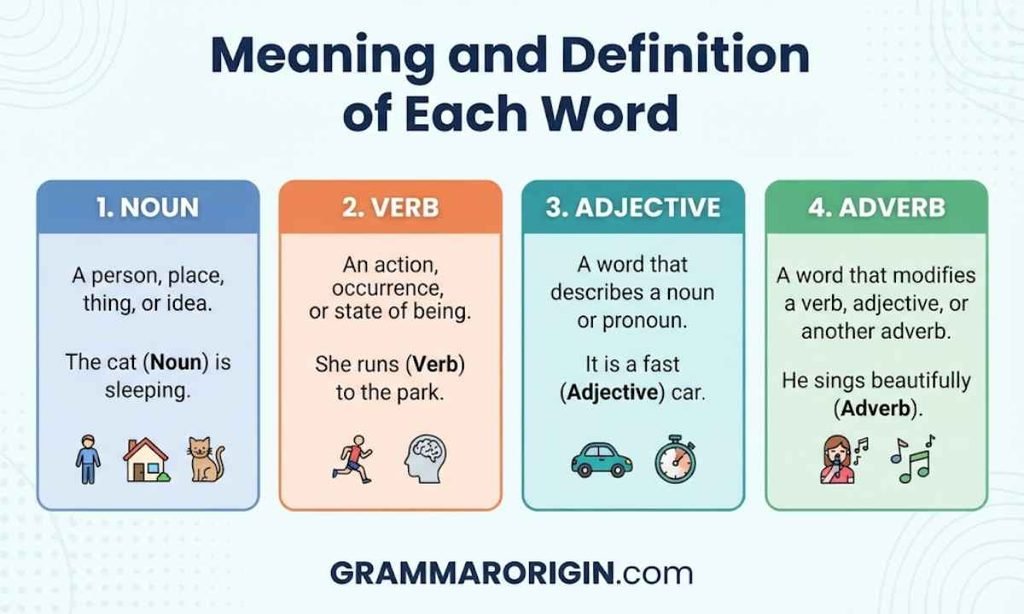
Surprise is a real word for something unexpected, or for the feeling that something unexpected causes. Suprise has no meaning because it only exists as a spelling slip.
The two entries below show how far apart the words in the surprise or suprise pair really are. One is a dictionary word. The other is a typo.
Example: “Her visit was a surprise” uses the real word. “Her visit was a suprise” uses a typo.
1. Surprise
Surprise works as both a noun and a verb, and both uses are about the unexpected.
Example: “The news surprised everyone in the office” (verb). “The result came as a surprise” (noun).
As a noun, it can be an event or a piece of news you did not see coming. It can also be the feeling that follows, like the look on someone’s face when the lights flip on at a party.
As a verb, it means to catch someone off guard, to amaze them, or to give them something they did not expect. Older uses are harsher. Armies have long used the word for a sudden attack.
2. Suprise
Suprise is not an English word. It is surprise with the first r missing.
You will mostly spot it in rushed texts, social captions, and last-minute drafts, where the fingers skip a letter the brain barely heard.
Dictionaries do not list it as a variant or a regional spelling, so a surprise or suprise search in any dictionary lands you on surprise.
Example: “I got a suprise gift” should read “I got a surprise gift.”
Key Differences Between the Words
The real difference is simple: surprise is a word and suprise is not. Meaning, grammar, and pronunciation all belong to surprise alone.
Example: “That plot twist was a total surprise” is the spelling every reader expects.
Three things separate them in practice:
- Spelling: surprise has eight letters and two r’s. Suprise has seven letters and one r.
- Status: surprise appears in every standard dictionary. Suprise is an error.
- Use: you can write surprise anywhere. You would write suprise only when pointing out the mistake.
The surprise or suprise mix-up is a spelling problem, not a meaning problem. People who type suprise almost always mean surprise.
Comparison Table
This table shows the surprise or suprise gap at a glance. Only surprise passes every test.
| Feature | Surprise | Suprise |
| Correct spelling | Yes | No |
| Number of letters | 8 | 7 |
| Number of r’s | 2 | 1 |
| Listed in dictionaries | Yes | No |
| Part of speech | Noun, verb | None (it is an error) |
| Safe for formal writing | Yes | No |
| When spoken | suh-PRIZE | Sounds the same |
| Same in UK and US English | Yes | Not applicable |
Example: Look at the “Number of r’s” row. S-U-R-P-R-I-S-E has two, and anything with one is wrong.
Examples in Sentences
Real sentences settle the surprise or suprise debate faster than any rule. Here is one for each way the word is used.
Example: “The surprise visit from her old teacher made her whole week.”
- Noun (an event): “The announcement was a surprise to everyone on the team.”
- Noun (a feeling): “She looked at him in surprise.”
- Verb: “He wanted to surprise his mother with a homemade cake.”
- Past form: “I was surprised by how fast the line moved.”
- Before another noun: “They threw a surprise party on Friday.”
- Shout: “Surprise! We have been planning this for weeks.”
Correct Usage of “Surprise”
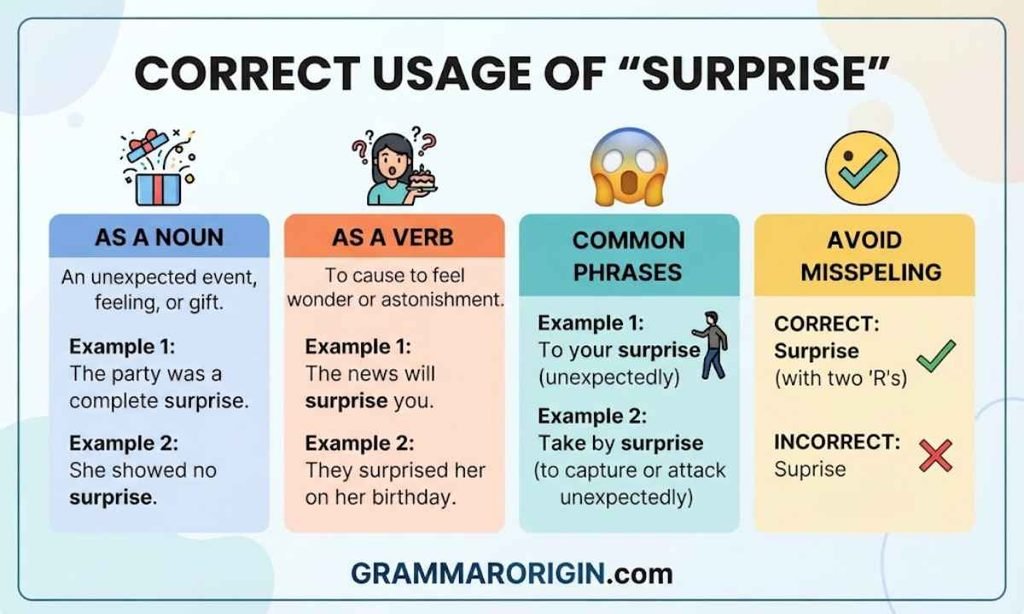
Use surprise whenever you mean something unexpected or the act of catching someone off guard. It works as a noun, a verb, and a shout, and the spelling never changes. In any surprise or suprise showdown, the first word wins.
These patterns come up all the time:
- A surprise: “The gift was a surprise.”
- To my surprise: “To my surprise, the train was early.”
- By surprise: “The question caught me by surprise.”
- Surprise + noun: surprise party, surprise guest, surprise attack.
- Surprise someone: “You surprised me.”
- No surprise: “It is no surprise she won.”
Example: “To everyone’s surprise, the quiet new kid won the spelling bee.”
Also Read This Recurring vs. Reoccurring: Difference Examples & Usage
Incorrect Usage of “Suprise”
Suprise is wrong in every sentence, whatever job it is doing. Swap in surprise and the sentence is fixed.
Example: Incorrect: “The suprise inspection was suprising.” Correct: “The surprise inspection was surprising.”
Each surprise or suprise pair below shows the one-letter repair.
- Incorrect: “What a nice suprise!” Correct: “What a nice surprise!”
- Incorrect: “Don’t tell her, it’s a suprise.” Correct: “Don’t tell her, it’s a surprise.”
- Incorrect: “I want to suprise you.” Correct: “I want to surprise you.”
- Incorrect: “He was suprised by the gift.” Correct: “He was surprised by the gift.”
The same missing r breaks the related words too: suprised, suprising, and suprisingly. The fix is the same for all of them.
Common Mistakes
The most common surprise or suprise mistake is dropping the first r, but it is far from the only one. A few others show up again and again.
- Writing suprise: skipping the first r.
- Writing surprize: using an old-fashioned spelling with a z.
- Using the noun instead of the adjective: “I was surprise” instead of “I was surprised.”
- Breaking related words: suprised, suprising, suprisingly.
- Mixing up surprised and surprising: one describes the person, the other describes the cause.
- Trusting autocorrect too much: it often catches suprise, but it cannot catch a correctly spelled word used in the wrong form.
Example: Incorrect: “I was surprise to see you.” Correct: “I was surprised to see you.”
Why Do People Write “Suprise”?
People write suprise because the first r is easy to miss when the word is spoken. In many accents, the first syllable is just “suh.”
Example: Say “suh-PRIZE” aloud and listen for the first r. Type exactly what you hear and you end up with “suprise.”
Standard British pronunciation is written /səˈpraɪz/, which has no r sound in that first syllable at all. American speakers often keep a light r, but it is soft enough to vanish in quick speech.
Add fast typing and a habit of phonetic spelling (writing what you hear), and the extra r disappears. That is why the surprise or suprise slip is an ear problem more than a knowledge problem. Careful proofreading catches it every time.
Tips to Remember the Difference
The easiest fix for the surprise or suprise problem is to spell the word in two chunks: sur + prise. Say the first chunk, then add the second.
A few more mnemonics help it stick:
- Spot the sandwich: the p sits between two r’s. S-U-R-P-R-I-S-E.
- Think “over”: the prefix sur- means “over,” as in surpass, surplus, and surcharge. Surprise began as a word for being “taken over.”
- Match the -prise family: comprise, enterprise, apprise, and reprise all end the same way.
- Slow down once: type the word letter by letter a single time, and your fingers tend to remember.
Example: Say it in chunks: sur, then prise. Now write it: S-U-R, then P-R-I-S-E.
When to Use Each Word
Use surprise every time. Suprise has no correct use, except when you are quoting or teaching the mistake.
Example: In a client email: “The visit was a surprise.” In a spelling lesson: “Many students write suprise when they mean surprise.”
The surprise or suprise rule does not change with your audience. American, British, Canadian, and Australian English all spell it the same way. It is also the same in emails, essays, job applications, and captions.
If you are writing a spelling lesson, put “suprise” in quotation marks and label it as incorrect so nobody copies it.
Grammar Rules
Surprise works as a noun and as a verb, and its forms follow simple spelling patterns. Grammar settles the surprise or suprise question too, since only surprise has noun and verb forms at all.
- Noun: you can count it (“a surprise,” “two surprises”). When it means the feeling, it has no plural (“to her surprise”).
- Verb: surprise, surprises, surprised, surprising. You surprise someone.
- Passive voice: “I was surprised by the news” or “surprised at the result.”
- Before a noun: surprise party, surprise visit.
- Ending changes: drop the final e before -ing (surprising) and add just d for the past (surprised).
- Fixed phrases: to my surprise, by surprise, in surprise, no surprise.
Example: “She was surprised by the gift, and the surprising part was that he had made it himself.”
Word Forms: Surprised vs Surprising vs Surprisingly
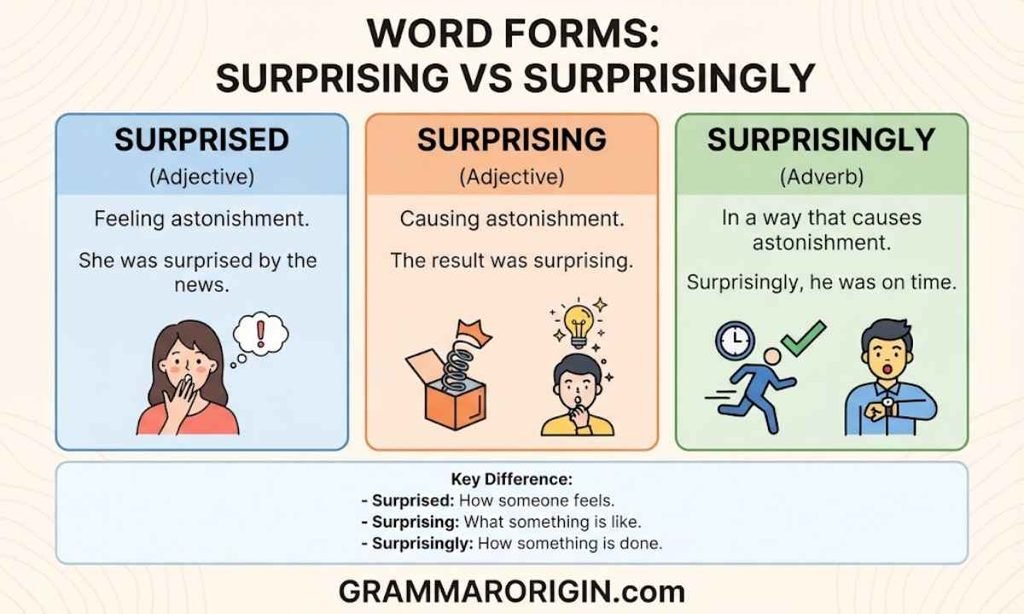
Surprised describes how a person feels, and surprising describes whatever causes that feeling. Surprisingly is the adverb that comments on a whole sentence or adds to an adjective.
Example: “The score was surprising, and Maya looked surprised. Surprisingly, the quiet team won.”
Think of it as cause and effect. The surprising thing happens, and the surprised person reacts. Mixing them up changes the meaning.
The surprise or suprise rule carries over to every related form, and each one keeps both r’s: surprised, surprising, surprisingly. The missing-r versions (suprised, suprising, suprisingly) are just as wrong.
Synonyms or Related Words
Good synonyms for the noun include astonishment, amazement, shock, wonder, and bombshell. For the verb, try astonish, amaze, startle, stun, or take aback.
They are not all the same. Shock usually feels negative, startle is a quick jolt, and bombshell means big news that lands hard.
Related phrases: out of the blue, caught off guard, unexpected, unforeseen, and sudden. None of these has a one-r twin, which is what makes the surprise or suprise trap so specific to this one word.
Example: “The merger was a bombshell, but the bonus was a pleasant surprise.”
Origin of “Surprise”
Surprise comes from Old French and first meant being overtaken or seized. The sur- part means “over,” and the rest comes from prendre, “to take.”
Example: In older writing, “the camp was surprised at dawn” meant it was attacked without warning.
Knowing those two parts also explains the surprise or suprise problem: the word is built from sur + prise, so both r’s belong.
Prendre goes back to the Latin word prendere, a short form of prehendere, “to grasp.” In Old French, the noun surprise meant something “taken unawares.” That is why the ending is -prise (taken) and not the -ize you see in words like organize.
The Online Etymology Dictionary dates the English noun to the late 1300s, the Middle English period, meaning an unexpected attack or capture. The Oxford English Dictionary’s earliest evidence for the verb is from 1474, in a translation by the printer William Caxton.
The “something unexpected” meaning we use today settled in by the 1590s.
Surprise vs Surprize (Archaic Spelling)
Surprise with an s is correct. Surprize with a z is an old-fashioned spelling that has fallen out of use.
The Online Etymology Dictionary notes the word was once spelled surprize, and Grammarly calls the z version outdated. It is not a US spelling, either. Words like organize and organise differ between American and British English, but surprise does not, because its ending is not the -ize ending.
That turns the surprise or suprise confusion into a three-way tangle, and only one spelling wins. If you see the z version today, it is either very old text or a mistake.
Example: Incorrect: “What a lovely surprize!” Correct: “What a lovely surprise!”
Surprise or suprise pronunciation
Both spellings are said the same way: suh-PRIZE, with the stress on the second syllable. Since suprise is not a real word, there is only one pronunciation to learn.
Example: Say “suh-PRIZE” for the word, then spell it out loud: S-U-R-P-R-I-S-E.
The Oxford English Dictionary gives /səˈprʌɪz/ for British English and /sə(r)ˈpraɪz/ for US English, using IPA symbols. Oxford Learner’s Dictionaries lists /səˈpraɪz/ for the UK and /sərˈpraɪz/ for the US.
The ending rhymes with size, prize, and wise, even though it is spelled -ise. That z sound is another reason people get tangled. Spoken aloud, surprise or suprise sounds like a tie, and only the page shows the winner.
Also Read This Recurring vs. Reoccurring: Difference Examples & Usage
Surprise or suprise oxford dictionary
Oxford lists the word only as surprise. Suprise does not appear as a variant spelling in its entries.
The Oxford English Dictionary records 15 meanings for the verb, and nine of them are no longer used. Oxford Learner’s Dictionaries explains the noun in two ways: an unexpected event or piece of news, and the feeling caused by something sudden.
It also covers the idiom “take somebody by surprise.” Collins Dictionary and Merriam-Webster use the same spelling. Between them, the surprise or suprise question has a very clear answer.
Example: “The early snowfall took the hikers by surprise.”
Summary
Surprise is the spelling to use, and suprise is a slip born from fast speech and fast typing. The surprise or suprise question comes down to one habit: two r’s, one on each side of the p.
Keep the sur + prise trick handy, and you will catch the mistake before anyone else does.
Frequently Asked Questions
Is it surprise or suprise?
It is surprise. Suprise is a misspelling that leaves out the first r.
Is “suprise” a real word?
No. Suprise is not a word in standard English, and no major dictionary lists it as a variant.
It is simply surprise typed or spelled with one r missing.
Why does the surprise or suprise mix-up happen so often?
The first r is soft in everyday speech, so people spell what they hear. Fast typing makes the slip even easier.
In many accents the first syllable sounds like just “suh,” which nudges writers to skip the r.
Is surprise spelled differently in British and American English?
No. British, American, Canadian, and Australian English all spell it surprise.
Only the pronunciation changes slightly. UK speakers often drop the r in the first syllable, and US speakers usually keep a light one.
How do you pronounce surprise?
It is suh-PRIZE, with the stress on the second syllable. The final -ise sounds like “size.”
British English is usually written /səˈpraɪz/, and American English /sərˈpraɪz/.
Is “surprize” correct?
No. Surprize is an old-fashioned spelling that is no longer used.
Stick with surprise, with an s, in all modern writing.

Muhammad Waqas is an English language teacher and grammar expert with over 8 years of experience helping students and professionals improve their writing skills. He specializes in English grammar, vocabulary, communication, and practical language learning. Through GrammarOrigin, Waqas shares clear, easy-to-understand content that helps readers write and speak English with confidence.