
Isle or aisle? An isle is a small island, and an aisle is the walkway between rows of seats, shelves, or pews. They sound identical, and since both are real words, your spell-checker won’t flag a mix-up.
Below you’ll find where each word came from, how to say them, the phrases they live in, and a short quiz to make the difference stick.
Quick Answer
An isle is a small island. An aisle is a passage between rows of seats, shelves, or pews. Because the two sound the same, the isle or aisle choice only shows up when you write.
Example: After the ferry reached the isle, we shuffled down the aisle to get off.
Here’s a rule that settles most isle or aisle cases. If water surrounds it, spell it isle. If people walk through it, spell it aisle.
Meaning and Definition of Each Word
Isle means a small island, and aisle means a lane of open space between two rows of something. Neither word borrows its meaning from the other.
Both are nouns, and both are said the same way, which is why the isle or aisle question trips up so many writers. Everything else about them, from origin to everyday habitat, is separate.
Example: The tiny isle had one chapel, and the chapel had one narrow aisle.
What Does “Isle” Mean?
Isle is a small piece of land surrounded by water. Dictionaries such as Merriam-Webster define it as an island, especially a small one.
In everyday speech, most people say island. Isle survives mainly in proper names, like the Isle of Wight off England’s south coast and the Isle of Skye in Scotland, and in nicknames like the Emerald Isle for Ireland.
It also shows up in poems and adventure stories, where it sounds a little more romantic. That’s why isle or aisle rarely feels like a close call when you’re naming a real place.
Example: Smugglers once stashed their cargo on a rocky isle off the Cornish coast.
What Does “Aisle” Mean?
Aisle is a walkway that runs between rows of seats, shelves, or other fixtures. You’ll find one on every plane, in every supermarket, and down the middle of most theaters and churches.
Example: I always book the aisle seat so I can stand up without climbing over strangers.
Church architecture adds a small wrinkle. Strictly speaking, an aisle is the side section of a church that runs alongside the main hall, called the nave. In daily speech, though, everyone calls the central path the aisle.
That’s the sense you’ll meet at a wedding, so isle or aisle is never a debate inside a church. The word has a figurative life in politics too, which we’ll get to shortly. Merriam-Webster’s entry for aisle lists the full set of senses.
Etymology: Origin of Isle and Aisle
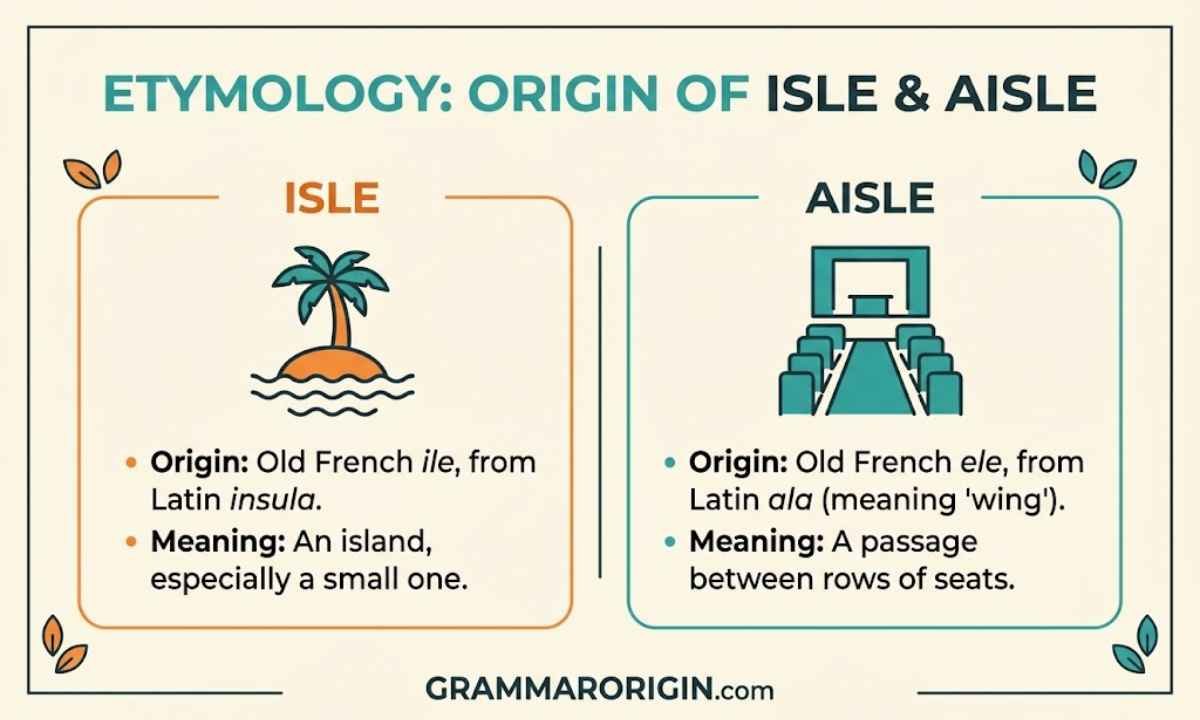
Isle comes from Latin insula, meaning island, while aisle traces back to Latin ala, meaning wing. They aren’t relatives. They just ended up looking alike.
According to Etymonline, aisle entered English in the late 1300s as ele, the side division of a church, by way of Old French. Around 1700 it picked up a silent s, copying isle, and by 1750 it had gained its leading a from the French aile.
A mix-up with the word alley may also have nudged it toward the meaning of a passage between pews, which appeared in 1731. So the isle or aisle tangle is more than 300 years old.
Isle took its own detour. It arrived in English as ile in the late 1200s, and the s was restored in the late 1500s to match the Latin original.
Here’s a twist most guides skip: island didn’t come from isle. It has a separate Old English root, and its s crept in later through confusion with isle (Etymonline’s island entry tells the story).
So the “s” you can’t hear in either word is a spelling leftover, not a clue.
Example: In a medieval church, the aisle named a wing of the building, while the isle named land out at sea. Two unrelated ideas that eventually shared a sound.
Key Differences Between the Words
The core difference between isle or aisle is meaning: isle is land surrounded by water, and aisle is a path between rows. Everything else follows from that split.
- Meaning: isle is a small island; aisle is a passage between seats, shelves, or pews.
- Origin: isle comes from Latin insula; aisle comes from Latin ala.
- Where you’ll see it: isle lives in place names, poetry, and fiction; aisle lives in stores, planes, theaters, churches, and politics.
- Figurative use: isle has almost none; aisle has plenty, like “across the aisle.”
- Length: isle has four letters for a small island; aisle has five for a longer walk.
Example: The senator spent her holiday on the Isle of Wight, then came home ready to work across the aisle.
Also Read This Recieved or Received: Which Spelling Is Correct? Meaning
Comparison Table
Here’s the whole isle or aisle difference at a glance, with every feature side by side.
| Feature | Isle | Aisle |
| Meaning | A small island | A walkway between rows |
| Part of speech | Noun (rare verb use) | Noun |
| Pronunciation | /aɪl/ | /aɪl/ |
| Latin root | insula (island) | ala (wing) |
| Typical settings | Place names, poems, travel writing | Planes, stores, theaters, churches |
| Famous phrases | Isle of Man, Emerald Isle | Walk down the aisle, across the aisle |
| Plural | isles | aisles |
| Quick cue | Water around it | People walking through it |
Example: A sentence with water clues points to the left column, and a sentence with seats or shelves points to the right. “The cargo reached the isle” goes left; “The cart rolled down the aisle” goes right.
Examples in Sentences
Seeing isle or aisle in action is the quickest way to lock the difference in. The sentences below are split by word, so you can scan whichever one you need.
Example: The isle was calm all morning, but the aisle on the ferry was a traffic jam.
The Examples of “Isle”
Each sentence here uses isle for a small island or a named island.
- The lighthouse keeper rowed out to the isle every morning.
- Ireland earned the nickname Emerald Isle for its green hills.
- You can reach the Isle of Man by ferry or by plane.
- Nobody had lived on the isle since the great storm.
- Her novel is set on a fog-wrapped isle in the North Sea.
- The Isles of Scilly sit off the tip of Cornwall.
Notice the capital letter whenever isle is part of a name. That’s a proper noun, so it gets the same treatment as any other place.
Examples of “Aisle”
Aisle always points to a path between rows, whether those rows hold seats, shelves, or wedding guests.
- Please keep the aisle clear until the seatbelt sign goes off.
- The cereal is in aisle nine, just past the frozen peas.
- She walked down the aisle on her father’s arm.
- Ushers handed out programs along the center aisle.
- I picked an aisle seat because I’m tall.
- The comedian had the whole crowd rolling in the aisles.
Common Phrases and Idioms
Aisle appears in far more everyday phrases than isle, and isle mostly lives inside place names. When isle or aisle appears inside one of the phrases below, the phrase makes the decision for you.
- Walk down the aisle: to get married.
- Across the aisle / both sides of the aisle: between opposing political parties.
- Aisle seat: a seat on the edge of a row, next to the walkway.
- Rolling in the aisles: laughing uncontrollably.
- Aisle runner: the strip of cloth or paper laid down at a ceremony.
- Isle of Man, Isle of Wight, Isle of Skye: named islands, always with a capital I.
- Emerald Isle: a nickname for Ireland.
The political phrase makes sense once you picture a legislature. In chambers like the US Congress, the two parties traditionally sit on opposite sides of a central walkway, so reaching across the aisle means cooperating with the other side.
Example: The bill passed because members from both sides of the aisle backed it.
Also Read This Recieved or Received: Which Spelling Is Correct? Meaning
Common Mistakes
The most frequent isle or aisle slip is writing isle when you mean a walkway, especially in “walk down the isle.” The reverse error, aisle for an island, is rarer but just as wrong.
Incorrect vs Correct Usage
Each pair below shows the error first, then the fix.
❌ We walked down the isle looking for pasta. ✅ We walked down the aisle looking for pasta.
❌ She dreams of walking down the isle in June. ✅ She dreams of walking down the aisle in June.
❌ The pirates buried their gold on a tiny aisle. ✅ The pirates buried their gold on a tiny isle.
❌ Both parties must reach across the isle. ✅ Both parties must reach across the aisle.
❌ We’re honeymooning on the Aisle of Wight. ✅ We’re honeymooning on the Isle of Wight.
❌ Please take an isle seat near the exit. ✅ Please take an aisle seat near the exit.
Why do these slip through? Autocorrect treats both spellings as valid words, so nothing gets underlined. A quick read for meaning is the only real safety net, and the isle or aisle test in the next section makes that read take about two seconds.
Tips to Remember the Difference
Every good isle or aisle memory trick links isle to island through spelling and aisle to a place you’d walk. Pick the cue that sticks and let it do the work.
1. Think of “Island”
Isle opens with the same two letters as island, and both describe land with water around it. This is a spelling trick, not a sound trick, since island is said /ˈaɪlənd/ and isle is just /aɪl/.
Try a swap test for isle or aisle. If you can replace the word with island and the sentence still works, isle is your answer. If the swap sounds silly, you probably need aisle.
Example: “They sailed to a small isle” survives the swap (“a small island”), while “They sailed down the aisle” does not.
2. “Aisle” Has an “A” for Area
The extra A in aisle can stand for area, the open space you walk through. Think of aisle as isle with an A added for room to move.
Another A-word works just as well: airplane, which is where most people meet their first aisle seat.
Example: Book the aisle seat, the one with the extra A for extra area.
3. Visual Memory Trick
Visual thinkers can turn isle or aisle into a picture: a dot of land ringed by blue for isle, and two rows of shelves with a lane between them for aisle.
Example: Sketch a dot with waves around it and label it isle, then sketch two shelves with a gap and label that aisle.
Length helps too. Aisle is the longer word, and an aisle is the longer, narrower stretch. Isle is the shorter word for a small patch of land.
4. Wedding Clue
Of all the isle or aisle shortcuts, this one is the easiest: if someone is walking toward a wedding ceremony, the word is aisle, never isle. The only time an isle belongs near a wedding is when the couple flies off to one afterward.
Example: They’ll walk down the aisle on Saturday and land on a quiet isle by Monday.
When to Use Each Word
Use isle for small islands, island names, and poetic writing. Use aisle for walkways between rows and for the political phrase “across the aisle.”
Example: Ask yourself one question before you type isle or aisle: is there water or is there a walkway? The answer picks the spelling for you, as in “a ferry to the isle” versus “a cart in the aisle.”
Use “Isle” When:
Reach for isle when you name or describe a small island, especially in a formal or literary voice.
- You’re writing a place name, like the Isle of Man or the British Isles.
- You’re using a nickname, like the Emerald Isle.
- You want a poetic or storybook tone for a small island.
- You’re describing a group of islands in the plural, as in “the Scottish isles.”
Example: The isles off Scotland’s west coast draw walkers all summer.
Use “Aisle” When:
Choose aisle any time a path runs between rows or sides, and the isle or aisle decision is done.
- You’re describing a store, supermarket, or warehouse.
- You’re talking about seats on a plane, bus, train, theater, or stadium.
- You’re writing about a ceremony or wedding.
- You’re describing politics with “across the aisle.”
Example: Our pew sat halfway down the aisle, three rows from the front.
Grammar Rules (If Applicable)
Isle and aisle follow ordinary noun rules. The only real grammar challenge is choosing between isle or aisle, a classic homophone trap.
Example: One isle, two isles; one aisle, two aisles. The plurals are regular, and the plural spellings sound identical too.
1. They Are Homophones
Homophones are words that sound alike but differ in spelling and meaning, and isle, aisle, and I’ll all qualify. Because a spell-checker only tests whether a word exists, it won’t catch a homophone mix-up.
The fix for any isle or aisle slip is proofreading by meaning rather than by spelling. Ask what the word is doing in the sentence.
Example: “Meet me in the aisle with the bread” and “Meet me on the isle with the bread” sound the same, but only one fits a supermarket.
2. Context Is Key
Nearby words settle the isle or aisle choice. Water, ferry, coast, and sail signal isle, while shelves, seats, bride, and usher signal aisle.
Example: “The ferry stopped at the isle” is full of water clues, and “The usher stood in the aisle” is full of seating clues.
3. Part of Speech
Both words are nouns. Isle also has a rare verb use, meaning to place on or turn into an island, which some dictionaries list. Aisle never works as a verb.
Capitalize Isle when it’s part of a proper name, since it then behaves like any other place name.
Example: In “the Isle of Skye,” Isle is part of a proper noun, so it takes a capital I.
Isle, Aisle, or I’ll?
Isle, aisle, and I’ll are triple homophones: three spellings, one sound, /aɪl/. I’ll is the contraction of “I will” or “I shall.” That turns the usual isle or aisle puzzle into a three-way puzzle.
The apostrophe usually keeps I’ll safe, but voice typing and fast texting can slip it in the wrong place. Dictation tools hear the sound and guess the spelling.
Example: I’ll take the aisle seat, and by Friday we’ll be relaxing on a quiet isle.
Synonyms or Related Words
Island and islet sit closest to isle, while passage and walkway sit closest to aisle. None is a perfect swap, so check the nuance before you replace anything. Synonyms can’t settle isle or aisle for you, because the two words share no meaning.
Example: “Please keep the aisle clear” becomes “Please keep the walkway clear,” but swapping in “corridor” would picture a hallway between rooms instead.
For “Isle”
- Island: the everyday word for land surrounded by water.
- Islet: a very small island.
- Cay or key: a low, sandy island, as in the Florida Keys.
- Ait or eyot: a small island in a river, used mainly in British English.
- Archipelago: a group of islands, related rather than a synonym.
Atoll doesn’t belong on a synonym list. It’s a ring of coral around a lagoon, which makes it a specific kind of island rather than another word for isle.
For “Aisle”
- Passage: a general word for a way through.
- Walkway: a path built for walking.
- Gangway: a British word for the passage between rows of seats.
- Pathway: a path, often outdoors.
- Corridor: close, but it connects rooms rather than separating rows.
Isle or aisle pronunciation
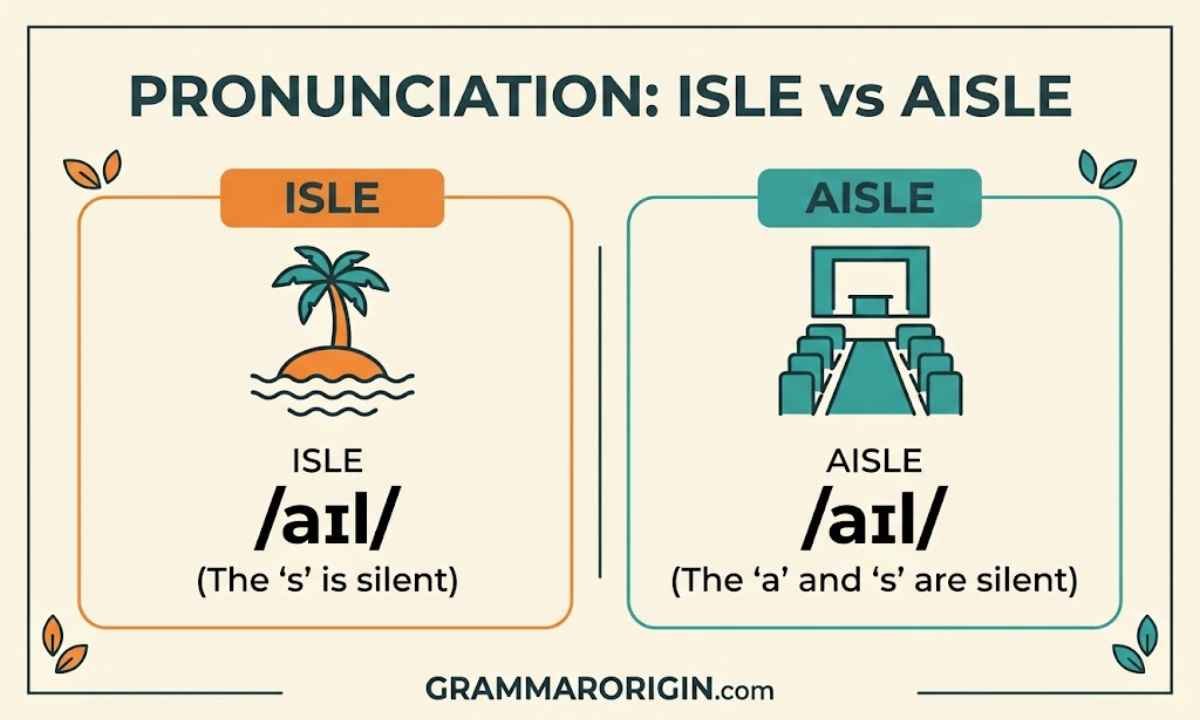
Both words are pronounced /aɪl/, rhyming with mile, smile, and style, so the sound can’t help you choose. The s is silent in both.
American and British English say them the same way. The plurals, isles and aisles, are also identical at /aɪlz/.
Island is the odd one out at /ˈaɪlənd/, with the extra “and” sound at the end.
Example: Say it out loud: “We found the isle” and “We found the aisle” sound exactly alike, which is why context has to do the work in isle or aisle questions.
Isle or aisle wedding
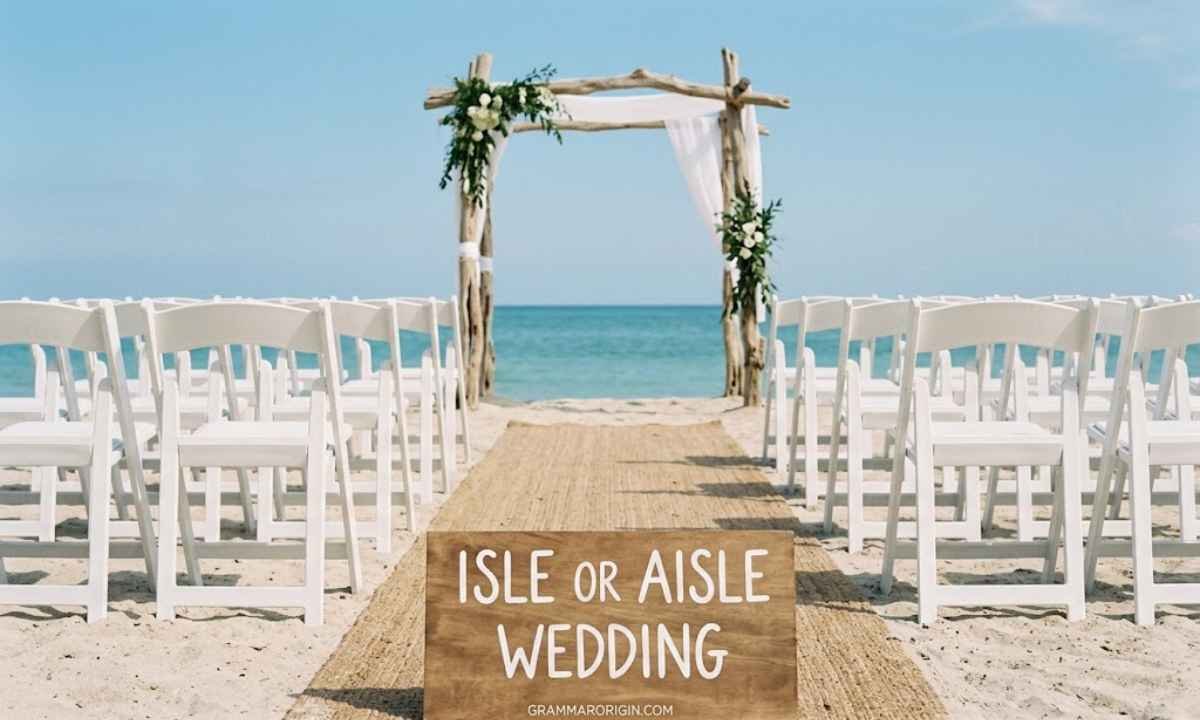
At a wedding, the word is always aisle. The bride, the groom, the parents, and the flower girl all walk down the aisle.
Example: The ceremony starts when the flower girl scatters petals down the aisle, and the honeymoon starts when the plane lands on an isle.
“Walk down the aisle” has become a stand-in for getting married, so you’ll see it in headlines and conversation alike. The wedding aisle also gives us aisle runner, aisle decorations, and aisle markers, and all of them take the five-letter spelling.
So where does isle fit into the isle or aisle wedding question? Only in destination weddings, where the ceremony itself happens on a small island. Even then, the guests still walk down the aisle to get there.
Mini Quiz
Test your isle or aisle instincts with six fill-in-the-blank sentences. Answers are listed right below.
Worked example: “The cereal is in ____ nine.” Shelves are involved, so the answer is aisle.
- The bride paused at the end of the ____.
- Ferries run daily to the ____ of Wight.
- Please keep the ____ clear during boarding.
- A tiny ____ off the coast was home only to seabirds.
- Lawmakers from both sides of the ____ backed the bill.
- ____ meet you at the gate after landing.
Answers: 1. aisle, 2. Isle, 3. aisle, 4. isle, 5. aisle, 6. I’ll.
Summary
The isle or aisle puzzle comes down to one check: is it land in water, or a path between rows? Water means isle. Seats, shelves, or a wedding mean aisle.
Keep the island swap test and the A-for-area cue handy, and isle or aisle slips will be easy to catch on a quick read-through. Now you can stroll down the aisle at the supermarket and still plan your trip to a quiet isle.
Frequently Asked Questions
What is the difference between isle or aisle?
An isle is a small island, and an aisle is a walkway between rows of seats, shelves, or pews. They sound alike, but their meanings, origins, and everyday settings are completely different.
Is it “walk down the aisle” or “walk down the isle”?
It’s “walk down the aisle,” always, and isle or aisle isn’t a toss-up here. The phrase means to get married, and it refers to the path between the guests’ seats at a ceremony.
How do you pronounce isle and aisle?
Both are pronounced /aɪl/, like “mile,” so isle or aisle can’t be told apart by ear. The s is silent in each word.
Is it isle or aisle in “reach across the aisle”?
It’s aisle. The phrase describes working with the opposing political side, and the aisle is the walkway between the parties’ seats in a legislature.
Is isle the same as island?
Almost. Isle usually means a small island and appears mainly in place names and literary writing, while island is the everyday word. They aren’t historically related, since isle comes from Latin insula and island has its own Old English root.
Is “I’ll” a homophone of isle and aisle?
Yes. I’ll is the contraction of “I will,” and it sounds exactly like isle and aisle. The apostrophe is your visual clue.

Muhammad Waqas is an English language teacher and grammar expert with over 8 years of experience helping students and professionals improve their writing skills. He specializes in English grammar, vocabulary, communication, and practical language learning. Through GrammarOrigin, Waqas shares clear, easy-to-understand content that helps readers write and speak English with confidence.