
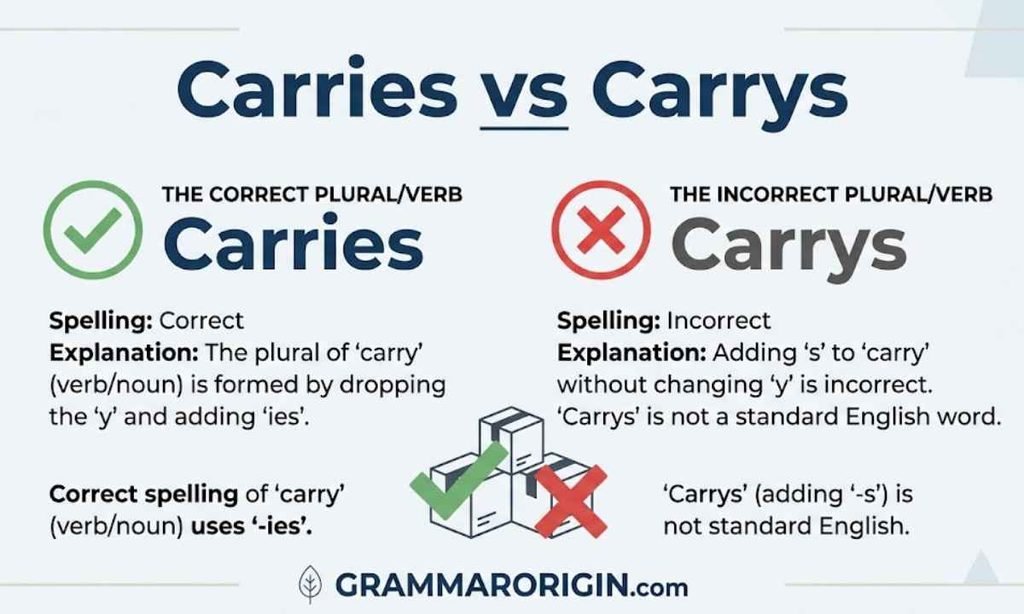
Carries is correct, and carrys is a spelling mistake in standard English. When a verb ends in a consonant plus y, the y becomes i before -es, so carry turns into carries with he, she, and it.
If you’ve ever frozen over a keyboard wondering about carries or carrys, you’re in good company. Plenty of confident writers stall here, so this guide gives you the rule, the meanings, and a few memory tricks that make the choice automatic.
Quick Answer:
Use carries. In the carries or carrys debate, carrys isn’t an accepted spelling of this verb in American or British English.
The logic is simple. A verb that ends in a consonant plus y swaps the y for ies in the third-person singular, which is exactly what happens to cry (cries) and study (studies).
Hira carries her sketchbook everywhere, even to the bus stop.
That covers what most people need. The rest of this guide explains why the rule works, where it stops working, and which nearby traps catch even careful writers.
Carries Meaning
Carries is the simple present form of carry for he, she, it, and any singular subject. It usually means to move, hold, or bear something, though the exact sense shifts with whoever (or whatever) is doing the carrying.
The courier carries every parcel up the back stairs by hand.
Dictionaries like Merriam-Webster and Dictionary.com list a whole cluster of senses, from lifting a bag to passing a signal along. Oxford Learner’s Dictionaries traces the word to Latin carrus, a wheeled vehicle, by way of Anglo-Norman French. That’s why carry and car look like cousins.
Carries Means Holds or Transports
Here, carries means a person keeps something in their hands, on their body, or in a bag while they move. The object travels along with them.
The sense stretches to things you wear or keep on you, too. A man can carry a watch, a cane, or a wallet without ever lifting it, simply because it goes where he goes.
- Hamza carries a spare charger in his jacket pocket.
- The hiker carries two liters of water and little else.
Carries Means Transports
When the subject is a vehicle, pipe, cable, or natural force, carries means it moves something from one place to another. No hands are involved.
A narrow pipe carries rainwater from the roof to the garden drain.
Think of the night train that carries mail to the coast, or the wind that carries the smell of rain across a field. The subject does the moving, and the thing being moved just rides along.
Carries Means Supports Weight
In building and engineering talk, carries means bears a load so it doesn’t sag or collapse. The subject is usually part of a structure.
A load-bearing wall, a steel beam, and a bridge deck all work this way. When a road “crosses” a river on a bridge, writers often say the bridge carries the road, which is a handy bit of engineering phrasing.
This steel beam carries the full weight of the floor above it.
Carries Means Offers or Stocks a Product
Shops, websites, and distributors use carries to say they keep an item available for sale. It describes inventory, not lifting.
That bookshop carries secondhand poetry and a surprisingly good range of maps.
The meaning covers brand lines, sizes, and categories. A pharmacy might carry sugar-free syrups, and an online store might carry only certain makers. If something isn’t in stock, you’d say they don’t carry it.
Carries as a Noun (Plural of Carry)
Carries can also be a plural noun, the plural of carry. Merriam-Webster and Oxford both list the noun, and it follows the same y-to-ies pattern as story and stories.
You’ll meet it mostly in sport and the outdoors. In American football, carries are rushing attempts. In golf, a carry is how far the ball travels through the air before landing. Canoeists use the word for a portage, the stretch where you haul the boat overland.
The running back finished with 21 carries for 96 yards.
Carrys Meaning
Carrys has no standard meaning as a verb. Anyone typing carrys or carries is really choosing between a misspelling and the real word, and the misspelling comes from adding a bare -s where English wants -ies.
Most spellcheckers flag it, but not every tool does, and fast typing hides it easily.
Wrong: Tariq carrys his lunch to the office. Right: Tariq carries his lunch to the office.
Why Does Carrys Look Correct?
It looks right because most English verbs just take an -s, and carrys follows that comfortable pattern. Your eye has seen walks, helps, and runs thousands of times.
That’s the root of the carries or carrys mix-up. There’s a second trap. Plenty of everyday verbs end in -ys: plays, stays, enjoys, says. So the ending doesn’t feel foreign, even though it’s wrong after a consonant.
Put plays next to carrys and they look like twins. Only one of them follows the rule for its own ending.
Why Is It Carries, Not Carrys?
Because English changes a final y to i before an -es ending when a consonant sits right before the y. It’s a spelling convention, not a quirk of this one word.
The ending also tells you how the word sounds. Carries finishes with a z sound, which the -es spelling signals clearly.
The ferry carries forty cars and one very patient goat.
The Consonant + Y Rule
If the letter before the final y is a consonant, drop the y, add ies. For carry, the letter before y is r, a consonant, so you get carries.
Here’s how the same move works on other verbs:
| Base verb | Third-person singular |
| carry | carries |
| study | studies |
| cry | cries |
| fly | flies |
| marry | marries |
| apply | applies |
One detail trips people up. Before -ing, the y stays, which gives carrying (not carriing). The change only happens before -es and -ed.
A kingfisher flies low over the river and carries its catch to a branch.
What Happens With a Vowel + Y?
Keep the y and add a plain -s. That’s the whole rule for verbs where a vowel (a, e, i, o, u) sits before the final y.
The quick test: look one letter back from the y. A vowel means leave it alone. Play becomes plays, stay becomes stays, enjoy becomes enjoys, buy becomes buys, and obey becomes obeys.
Say is regular on paper, even though it’s pronounced “sez.” You still write says, never saies.
My sister plays cricket on Sundays and stays for the whole match.
Other Verbs That Follow the Same Pattern (and the Proper Noun Exception)
Dozens of verbs change like carry does, including marry, bury, vary, deny, reply, and identify. If a consonant comes before the y, expect ies.
The two Marys in my class both study law.
Names are the exception. Proper nouns keep their y when they become plural, so you write the Kennedys, two Marys, and the Carrys if you mean a family named Carry. That’s the only common situation where carrys can appear, and it’s a noun, not a verb.
Carries vs. Carry: Understanding the Verb Forms
Carry is the base form for I, you, we, and they. Carries is the third-person singular form for he, she, it, and any single person or thing.
Ayesha carries the keys, but her brothers carry the bags.
This is subject-verb agreement at work. Grammar books call the changed ending an inflection, and in the simple present, only the third-person singular gets one.
| Subject | Verb form | Sample sentence |
| I / you | carry | You carry the tray. |
| he / she / it | carries | It carries a heavy battery. |
| we / they | carry | They carry the banners. |
| one driver | carries | The driver carries the mail. |
| two drivers | carry | The drivers carry the mail. |
Carried covers both the simple past and the past participle, and carrying is the present participle.
When to Use Carries in a Sentence
Use carries when one third-person subject performs the action of carrying in the present. A quick test: if you can swap the subject for he, she, or it, carries fits.
The night guard carries a flashlight and a thermos of tea.
The meaning changes with the subject, so the patterns below sort the common uses.
Physical Carrying
Use carries when someone lifts, holds, or bears something while moving. Pair a singular person with an object and, often, a place.
The porter carries two suitcases at once without breaking a sweat.
The typical shape is subject, carries, object, and then where or how: She carries a tray into the dining room.
Transportation
Use carries when a vehicle, route, or service moves people or goods. Companies and systems count as singular subjects here.
The airline carries thousands of passengers a day, and a thick cable carries electricity into the building. Both sentences use the same verb because the subject is one thing doing the moving.
The 7:15 bus carries most of the town’s commuters.
Supporting a Load
Use carries when a structure or component holds up weight or traffic.
The central pillar carries the roof, so the builders left it untouched.
You’ll hear it with shelves (a shelf carries a set load), floors, columns, and bridges. It reads as technical but never stiff.
Read More Realated Posts Hola or Ola? The Real Difference, Meaning & Correct Usage
Stocking Products
Use carries when a seller keeps a product line available.
That electronics counter carries only two phone brands.
Customers usually phrase it as a question: Do you carry this in a larger size? Notice the base form after do. The same switch happens with does, which we’ll get to shortly.
Communicating or Containing Something
Use carries when a source holds, broadcasts, or delivers information, or when something brings a consequence with it. This is the most flexible group.
- The morning paper carries a full-page obituary.
- Local radio carries the match live.
- A speeding offense carries a fine.
- Mosquitoes in that region carry the virus. (plural subject, so carry)
- Her voice carries to the back row without a microphone.
The same verb covers news, laws, labels, voices, and sound traveling over water. Once you spot that carries just means “has or delivers,” the range makes sense.
Carries On, Carries Out, Carries Over: Phrasal Verbs and Idioms
Add a small word like on, out, or over and carries takes on a new meaning, but the spelling never changes. These are among the most searched uses of the verb.
- carries on means continues: The shop carries on despite the flood.
- carries out means performs: She carries out every inspection herself.
- carries over means moves into the next period: Unused leave carries over to January.
- carries off means pulls off successfully: He carries off a suit better than most.
A few idioms use the same form. A comment that carries weight has real influence, a strong proposal carries the day by winning the vote, and someone who carries a torch for an old friend still holds romantic feelings. Someone who can’t carry a tune has trouble singing in key.
Her opinion carries weight with the board.
Common Mistakes
The carries or carrys slip is only one of five that show up again and again: writing carrys, dropping the -s after he or she, adding -s to a plural subject, using carries after does, and sneaking in an apostrophe.
| Mistake | Fix | What went wrong |
| Sana carrys the keys. | Sana carries the keys. | The y never changed to i. |
| He carry the box. | He carries the box. | The third-person -s is missing. |
| The students carries books. | The students carry books. | A plural subject takes the base form. |
| Does Sana carries a spare? | Does Sana carry a spare? | Does already marks the third person. |
| The bridge carry’s traffic. | The bridge carries traffic. | A verb doesn’t need an apostrophe. |
Look at the middle rows. Carries isn’t automatically right just because a sentence mentions carrying something. The subject has the final say.
A Simple Case Study
Four small slips can sit inside one short message, and each has its own cause. Here’s a made-up shop notice, written the way many of us type in a hurry.
Hi all, Bilal carrys the delivery list on Mondays, and the drivers carries the parcels to the van. Does Bilal carries a spare key? Our shop carry only branded stock, so check before you promise anything.
And here it is repaired:
Hi all, Bilal carries the delivery list on Mondays, and the drivers carry the parcels to the van. Does Bilal carry a spare key? Our shop carries only branded stock, so check before you promise anything.
- Bilal is singular, but carrys is misspelled.
- Drivers is plural, so it needs the bare form carry.
- Does already did the third-person work, so carry stays plain.
- Shop is singular, so carry became carries.
Carries in Different Tenses
Carries belongs to the simple present with a third-person singular subject. Other tenses use carry, carried, or carrying instead, and carrys appears in none of them.
She carried it yesterday, she carries it today, and she will carry it tomorrow.
| Tense | Example |
| Simple present (he/she/it) | She carries the bag. |
| Simple present (I/you/we/they) | They carry the bag. |
| Simple past | She carried the bag. |
| Present continuous | She is carrying the bag. |
| Present perfect | She has carried the bag. |
| Future | She will carry the bag. |
The y turns into i before -ed (carried) and stays put before -ing (carrying). It’s the same logic you saw earlier, applied to different endings.
Carries or Carrys in Questions and Negative Sentences
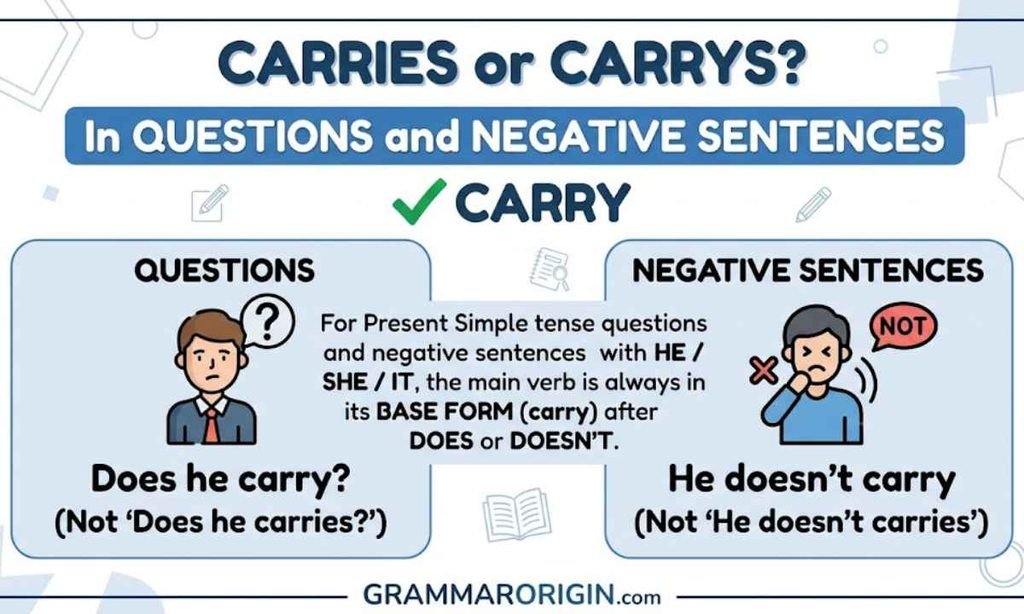
After does or doesn’t, use the base form carry. Whether you were leaning toward carries or carrys, neither belongs there.
The reason is neat. The helping verb does takes the -s for the third person, so the main verb goes back to its plain form.
Does your cousin carry a spare charger?
Negatives work the same way: The shop doesn’t carry that brand. Modal verbs follow suit, since you’d say she can carry it and he will carry it, never she can carries it. Plural subjects get do or don’t with carry too: Do they carry cash?
Carries vs. Carries’ vs. Carry’s
Only carries, with no apostrophe, is the verb form (and the plural noun). Carries’ and carry’s are possessive or contracted forms that need a specific context.
My backpack carries everything I need for the week.
Carries
Carries is the verb for he, she, it, and singular subjects, and it’s also the plural noun in sports and the outdoors. It never needs an apostrophe in either role.
The new handle carries the weight without a creak.
Carry’s
Carry’s is the possessive of the singular noun carry, or of the name Carry. It can also stand for “Carry is” when the name does the acting.
Carry’s laptop is on the desk, and Carry’s coming at noon.
A golfer might also discuss the carry’s distance over a lake, which is the possessive of the noun. For the verb, it’s still carries.
Read More Realated Posts Hola or Ola? The Real Difference, Meaning & Correct Usage
Carries’
Carries’ is the possessive of the plural noun carries. You’ll mostly see it in sports writing.
The carries’ average length was just 3.2 yards.
It reads clumsily, so many editors rephrase to “the average length of his carries.” Both are grammatical, but the rewrite is smoother.
Carries vs. Caries
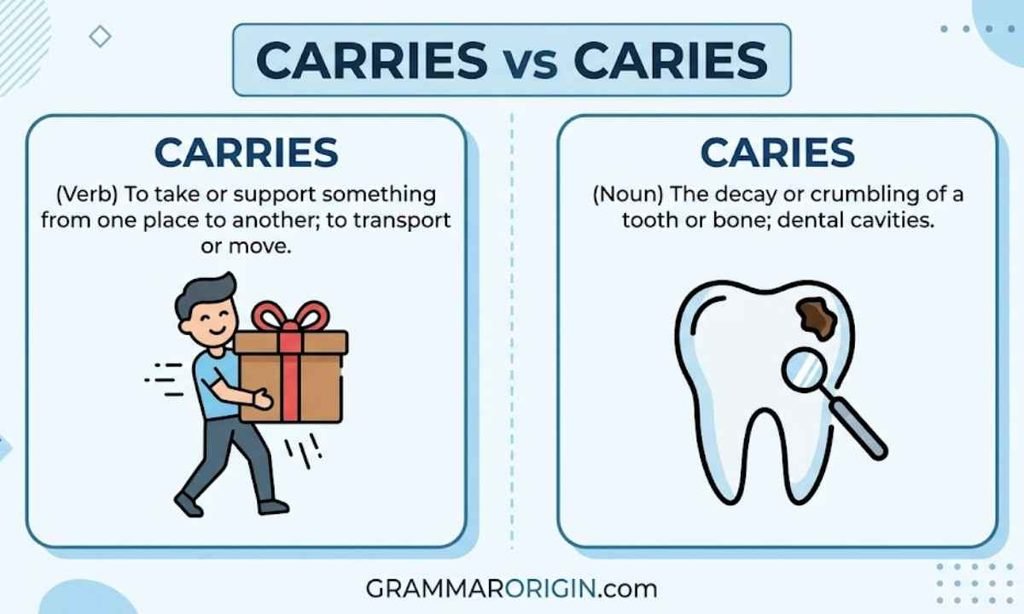
Carries comes from carry, while caries is a dental term for tooth decay. They look almost identical on the page, but they’re different words from different roots.
In some accents the two sound alike, which makes the typo easy. Caries behaves as both singular and plural, a habit it inherits from Latin, and you’ll see it most in the phrase “dental caries.”
The dentist found caries in two molars while the nurse carries the tray over.
A related look-alike is carrier, where the y also becomes i, this time before -er.
How to Remember
Whenever you’re stuck on carries or carrys, look at the letter before the y. A consonant means change to ies, and a vowel means keep the ys.
If that feels abstract, here are three habits that stick:
- Set carries beside plays. Say them aloud and tap the letter before y.
- Group carries with study, try, and marry, then keep the whole family in one mental drawer.
- Listen for the z at the end. If it sounds like “-eez,” the spelling wants -ies.
He carries it, she stays put, and neither one needs an apostrophe.
Quick Comparison:
In the carries or carrys question, carries wins. It’s the correct third-person form, and carrys is incorrect except as the plural of a name. Carry, carried, and carrying are all valid forms of the same verb.
| Form | Correct? | Where it fits |
| carries | Yes | Verb for he, she, it; plural noun |
| carrys | No | Only as the plural of the name Carry |
| carry | Yes | Base form; I, you, we, they; after does |
| carried | Yes | Past tense and past participle |
| carrying | Yes | Present participle |
| carry’s | Limited | Possessive or contraction of “Carry is” |
| carries’ | Limited | Possessive of the plural noun |
| caries | Different word | Tooth decay |
My uncle carries his lunch, but the drivers carry theirs.
Examples
Here are everyday sentences using carries, grouped loosely by meaning, so the carries or carrys choice looks obvious in context. Read them aloud; the z sound at the end helps lock in the spelling.
- The new tablet carries a battery that lasts two days.
- Zainab carries a small umbrella in her bag all year.
- The mountain railway carries skiers up to the first station.
- A single pipe carries water to all six taps.
- That shelf carries more than it looks like it can.
- The supermarket carries its own brand of olive oil.
- The evening bulletin carries a warning about heavy rain.
- A good coat carries you through three winters.
- This label carries a clear allergy notice.
- The echo carries across the empty hall.
- Unpaid tax carries a penalty after the deadline.
- Their old contract carries over into next year.
Carries or carrys in a sentence
Test yourself. Fill each gap with carries or carry (never carrys), then check the answers below.
- The conductor ____ a ticket machine on his belt.
- Does your brother ____ a spare key?
- The cargo ship ____ steel coils to the port.
- Mahnoor and Sana ____ the heavy bags.
- This strap ____ most of the load.
Answers: (1) carries, since conductor is singular. (2) carry, because does has already taken the -s. (3) carries, for a singular ship. (4) carry, because two people make a plural subject. (5) carries, for a single strap. Carrys is never the answer.
Summary
Carries or carrys has one answer, and it’s carries. The y turns into i before -es whenever a consonant sits right before it, which gives you carries, studies, and tries.
Keep carry after does, doesn’t, and plural subjects, and treat carries’ and carry’s as special cases. Check the letter before the y, and the spelling takes care of itself.
Frequently Asked Questions
Is it carries or carrys?
It’s carries. When people ask carries or carrys, the answer for he, she, it, and any singular subject is always carries, because a consonant before y turns the y into i before -es.
Is carrys ever correct?
Not as a verb. The only time carrys is acceptable is as the plural of a proper name, as in “the Carrys,” where names keep their y just like the Kennedys.
What is the plural of carry?
The plural is carries. As a noun, carry follows the standard pattern of story and stories, which is why you read about a running back’s carries or a canoeist’s long carries.
Do I say “does she carry” or “does she carries”?
Say “does she carry.” The helping verb does takes the third-person -s, so the main verb returns to its plain form. The same applies to doesn’t.
Is carries spelled differently in British and American English?
No. The carries or carrys question has the same answer on both sides of the Atlantic, and major dictionaries such as Merriam-Webster and Oxford list carries as the standard form.
What is the past tense of carry?
The past tense is carried. The y changes to i before -ed, and carried also serves as the past participle. The present participle, carrying, keeps the y.

Muhammad Waqas is an English language teacher and grammar expert with over 8 years of experience helping students and professionals improve their writing skills. He specializes in English grammar, vocabulary, communication, and practical language learning. Through GrammarOrigin, Waqas shares clear, easy-to-understand content that helps readers write and speak English with confidence.