
Ever typed “requestor” in an email and then second-guessed yourself? You’re not alone — these two spellings look almost identical, and most people can’t say for sure which one is actually correct.
Here’s the good news: the difference between requester and requestor is simple once you see it clearly, and it depends on where you’re writing — everyday communication, legal documents, or IT systems. This guide breaks down the meaning, correct usage, and real-world examples so you never second-guess it again.
Quick Answer
Requester vs Requestor — the short answer: “Requester” is the correct spelling for everyday, general, and business English. “Requestor” is a valid variant, but it’s mostly limited to legal, government, and technical/IT documentation. Both words mean the same thing — a person or entity making a request — but “requester” is the safer, more widely accepted choice in almost every situation.
Meaning & Definition
A requester (or requestor) is simply someone who asks for something — information, access, approval, or action. The word comes from the verb “request,” and both spellings describe the exact same role.
There’s no difference in meaning between the two. The only real difference is spelling preference and where each version tends to show up. Understanding this early saves you from overthinking a word choice that, in most writing, has one clear right answer.
Requester vs Requestor vs Requestee
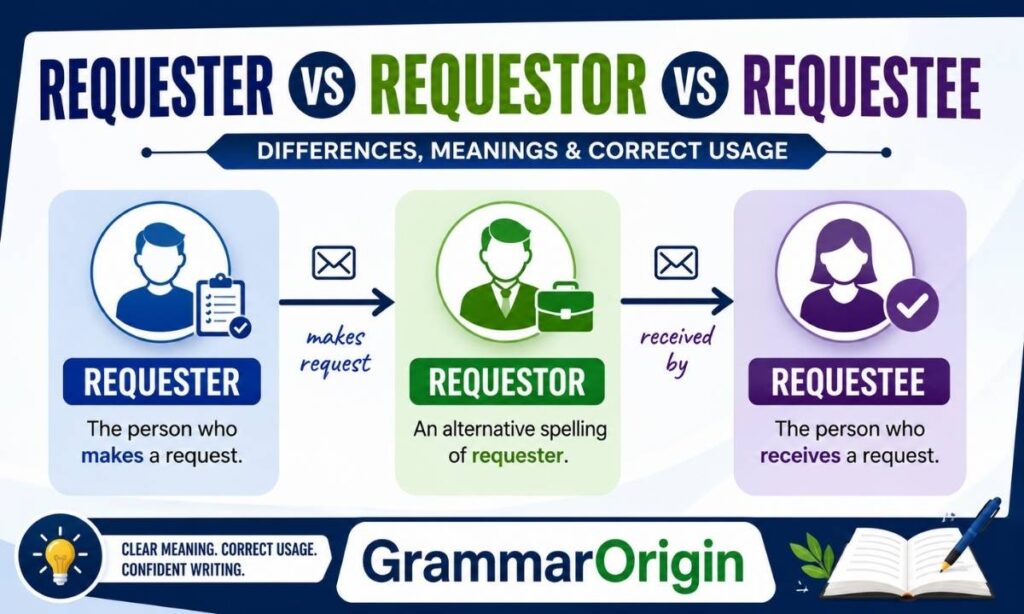
Here’s where a lot of confusion actually starts, because there’s a third word in the mix: requestee.
Requester / Requestor
The person making the request.
Requestee
The person or system receiving the request.
So if someone emails IT asking for software access, they’re the requester. IT, or the system processing that request, is the requestee. This distinction matters most in technical and workflow documentation, where mixing up the requester and the requestee can genuinely cause confusion in a process.
READ MORE RELATED POSTS CLICK ME
Key Difference Table
| Feature | Requester | Requestor |
| Meaning | Person who makes a request | Same meaning |
| Common usage | Everyday English, business, customer service | Legal, government, IT/technical systems |
| Region | Dominant in American English, also common in UK | Occasional in UK legal writing; niche in general use |
| Recommended for general writing | Yes | Not usually |
| Suffix origin | “-er” (native English agent noun) | “-or” (Latin-influenced agent noun) |
Requester in American English (Usage & Prevalence)
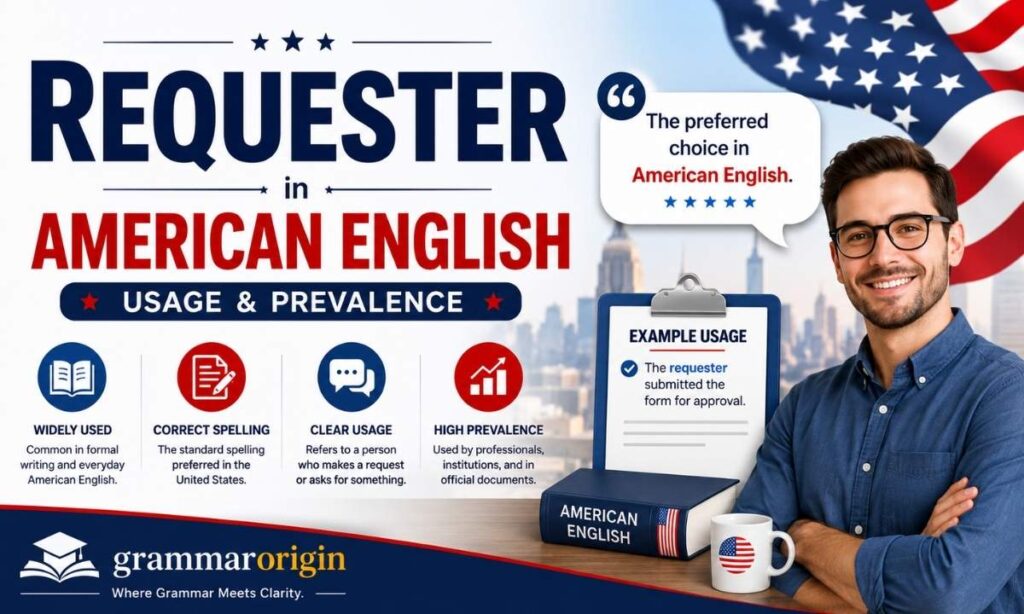
In American English, requester is the default. It follows the same natural pattern as other everyday agent nouns: teach → teacher, write → writer, request → requester.
You’ll see “requester” in:
- Customer support emails
- HR and workplace communication
- Government and public-sector forms
- Everyday business writing
It’s simple, familiar, and instantly readable — which is exactly why it dominates in the US.
Requestor in British English & UK Usage
British English doesn’t have a strict rule favoring “requestor,” but it does show up more often there than in American writing — particularly in older government tenders, procurement documents, and some legal drafting traditions.
Even so, “requester” is gaining ground in the UK too, especially in modern business and digital communication. If you’re writing for a general UK audience, “requester” is still the safer default.
Requestor in Specialized Contexts (Legal, Technical & IT)
This is where “requestor” earns its place. It shows up as a formal or system-defined term in:
- Legal documents — contracts and statutes that use “requestor” as an established defined term
- IT and software systems — field names like “Requestor ID” or “Requestor Role”
- Procurement and government workflows — where legacy terminology has stuck around
The key rule: once a system or document defines “requestor” as a field name, stay consistent with that spelling throughout — don’t switch mid-document.
Requester Synonyms
If you want to vary your language naturally instead of repeating “requester” constantly, here are accurate synonyms depending on context:
- Applicant — for formal requests like access or approval
- Petitioner — common in legal contexts
- Inquirer — for someone asking a general question
- Claimant — specific to claims or entitlement requests
- User — in system/IT contexts where “requester” is a defined role
Not all of these are interchangeable in every context, so match the synonym to the tone of your document.
Oxford Dictionary / Merriam-Webster Verdict
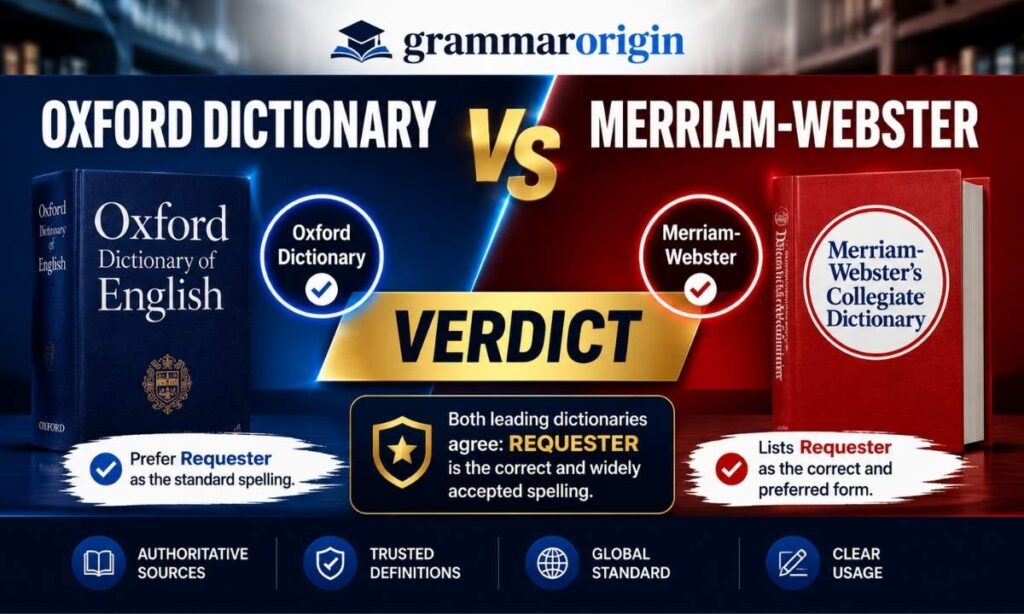
Merriam-Webster lists “requester” as the standard entry, with “requestor” recognized as a valid variant spelling rather than a separate word. Oxford references follow a similar pattern — “requester” as the primary form, “requestor” acknowledged but far less common.
This matters because it settles the debate at the source: there’s no dictionary that treats “requestor” as incorrect, but none of them promote it over “requester” either.
Etymology & Word Origin
The word traces back to the Old French requeste, meaning a petition or formal ask, which entered Middle English and eventually became both the verb and noun “request.”
As English standardized agent-noun endings, “-er” became the default for native-feeling words (teacher, player, writer), which is how “requester” became dominant. “Requestor,” on the other hand, likely persisted through the influence of Latin “-or” endings still common in formal and legal vocabulary — the same pattern behind words like “actor,” “doctor,” and “author.” Neither ending is “more correct” grammatically; it’s really about which tradition a given field followed over time.
Plural Forms — Requesters vs Requestors
The plural rule is simple and follows standard English:
- Requester → Requesters
- Requestor → Requestors
Just add “-s.” No irregular spelling changes apply. Whichever singular form you use, keep the same form consistent when you pluralize it within the same document.
Examples in Sentences
Requester (general/business use)
- The requester will receive a confirmation email once the form is approved.
- Please verify the requester’s identity before releasing any records.
Requestor (legal/technical use)
- The requestor must digitally sign the agreement before access is granted.
- The system logs the requestor ID with every API call.
Notice how the tone shifts: “requester” examples sound conversational, while “requestor” examples sound like they belong in a manual or contract.
Is “Requester” a Real Word? Is “Requestor”?
Yes — both are real, dictionary-recognized words. Neither is slang, and neither is a typo of the other. The confusion usually comes from the fact that they look so similar and mean exactly the same thing, which makes people assume one of them must be “wrong.” It isn’t; it’s a spelling variant issue, not a correctness issue.
Real-World Example (Concrete Named Usage)
A great real example comes from Amazon Web Services. AWS’s S3 storage service has a well-known feature called “Requester Pays,” where the person downloading data — not the bucket owner — covers the cost. Across AWS’s official documentation, the spelling used consistently is “requester” — in headers like x-amz-request-payer, configuration values, and SDK parameters.
This is a useful, concrete case: even in highly technical, code-level documentation, major companies like AWS still default to “requester” rather than “requestor” — reinforcing just how dominant the standard spelling really is, even outside everyday writing.
Common Mistakes to Avoid
- Switching spellings mid-document. Pick one and stay consistent — mixing “requester” and “requestor” in the same piece looks careless.
- Assuming one spelling is wrong. Both are valid; context decides which fits.
- Using “requestor” by default in casual writing. It can come across as overly formal or dated outside legal/technical settings.
- Ignoring system-defined terminology. If a platform or contract already uses “requestor” as a fixed field name, don’t “correct” it to “requester” — that breaks consistency with the system.
- Letting autocorrect decide. Know your context before you accept a suggested spelling.
Frequently Asked Questions
What is the difference between requester and requestor in business documents?
There’s no difference in meaning — only spelling. “Requester” is the standard choice for business documents, emails, and everyday professional writing. “Requestor” appears occasionally in formal or legal-style business paperwork but isn’t the norm.
Which spelling is preferred in professional communication platforms?
“Requester” is preferred across most professional communication platforms, including email, chat tools, and CRM systems. It reads as natural and standard, which is why platforms default to it.
Which term is preferred in standard legal documents?
Legal documents use both, but “requestor” appears more often in formal contracts and statutes as a defined term. Once a document adopts “requestor,” it should stay consistent throughout.
What’s the difference between requester and requestor in technical writing guidelines?
Most technical writing style guides recommend “requester” for general documentation and reserve “requestor” only for cases where a system or API already defines it as a field name.
Do popular project management tools use requester or requestor in their interfaces?
Most popular project management and ticketing tools use “requester” in their interface labels, such as “Requester Name” or “Requester Email.” “Requestor” shows up occasionally in older enterprise or government-built systems.
Can requester and requestor be used interchangeably?
Yes, they mean the same thing and can technically be swapped. The only rule is consistency — don’t switch between the two spellings within the same document.
Is “requestor” grammatically incorrect?
No, “requestor” is not incorrect. It’s a recognized variant spelling, just less common than “requester” outside legal and technical contexts.
Conclusion
Requester and requestor mean exactly the same thing — the only real question is which spelling fits your context. Use “requester” for everyday, business, and general writing, and save “requestor” for legal, technical, or system-defined situations.
Once you know this simple rule, you’ll never have to second-guess your spelling again. Pick one, stay consistent, and your writing will always look polished and correct.

Muhammad Waqas is an English language teacher and grammar expert with over 8 years of experience helping students and professionals improve their writing skills. He specializes in English grammar, vocabulary, communication, and practical language learning. Through GrammarOrigin, Waqas shares clear, easy-to-understand content that helps readers write and speak English with confidence.