
Ever paused mid-sentence, unsure whether to say “friendlier” or “more friendly”? You’re not alone — both forms look correct, and honestly, they usually are. The real challenge isn’t grammar rules; it’s knowing which one fits your sentence.
This guide breaks down the exact rule behind both forms, shows you real examples for casual and formal writing, and gives you a simple test to pick the right one instantly — every time.
Understanding Comparative Adjectives (Grammar Rule)
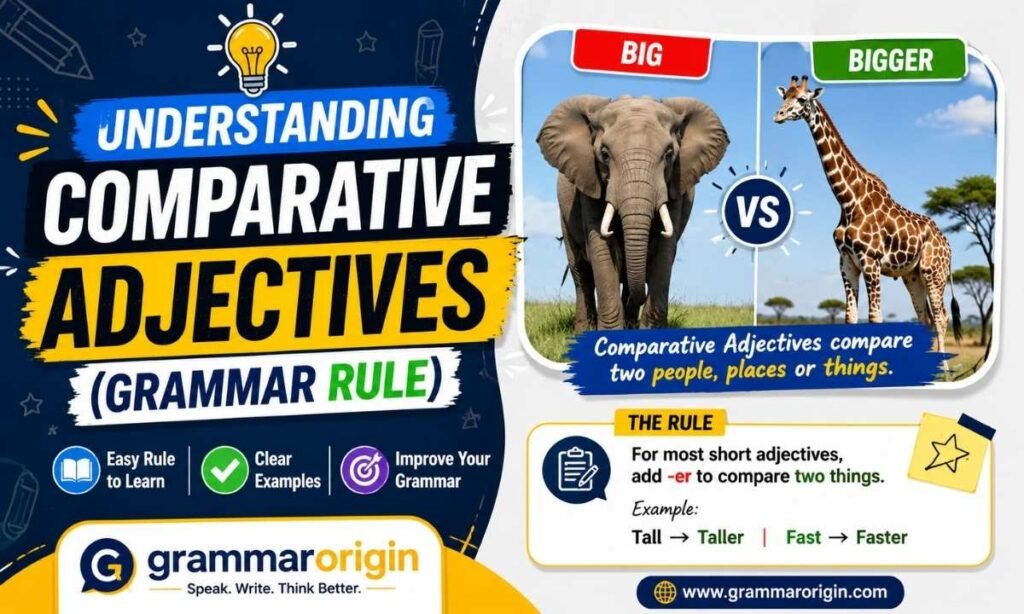
A comparative adjective shows the difference between two things. English forms comparatives in two ways: adding -er to short words, or placing more in front of longer ones.
One-syllable adjectives usually take -er (tall → taller, fast → faster). Adjectives with three or more syllables usually take more (more beautiful, more efficient).
Friendly has two syllables, which puts it in a gray zone. That’s exactly why both friendlier and more friendly exist as valid comparative forms — and why this friendly vs friendlier confusion keeps coming up.
Why “Friendly” Allows Both Forms
Short answer: Friendly allows both forms because it’s a two-syllable adjective ending in -y, a category that has always been flexible in English grammar.
Most -y adjectives (happy, easy, busy) naturally take -ier, so friendlier follows a familiar pattern. But friendly is also built from a noun — friend — plus the suffix -ly, which gives it a slightly different feel.
Because friendly describes something emotional and personal, it comfortably takes the -er ending like a short word. At the same time, its length and structure let it accept more without sounding wrong.
Centuries of everyday use cemented both forms. Neither one is a mistake; they’re two accepted comparative degree of friendly options that native speakers alternate between based on tone.
Comparative & Superlative Degree of Friendly (Full Table)
Short answer: The full comparative and superlative degree of friendly includes four accepted forms — two comparatives and two superlatives.
| Degree | Form 1 | Form 2 |
| Positive | friendly | friendly |
| Comparative | friendlier | more friendly |
| Superlative | friendliest | most friendly |
All four variations are grammatically correct in standard English. The -er/-est forms sound natural in speech, while the more/most forms fit longer or more formal sentences.
Knowing this full chain helps you stay consistent. If you choose friendlier in one sentence, keep using the -er pattern (friendliest) rather than switching mid-paragraph to most friendly.
When to Use “Friendlier”
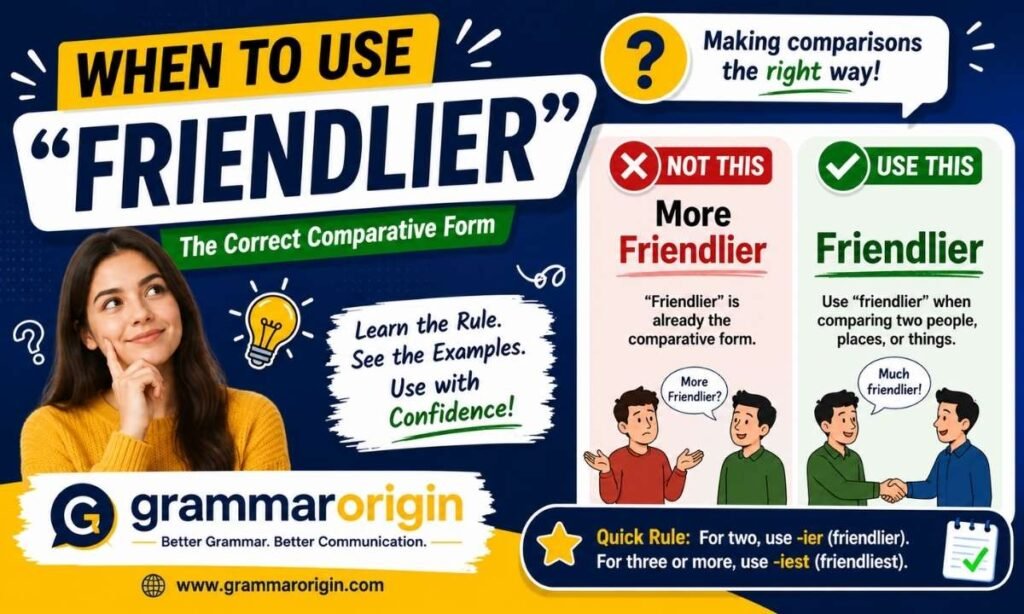
Short answer: Use friendlier for direct, casual comparisons between two people, animals, or places.
Friendlier is short, smooth, and mirrors how people naturally speak. It fits comfortably into everyday conversation, personal writing, and warm, human-focused sentences.
Examples:
- The new manager is friendlier than the last one.
- Dogs are usually friendlier than cats.
- She became friendlier after the training session.
Use friendlier when the sentence is short, the comparison is between two clear subjects, and the tone is relaxed rather than formal.
READ MORE RELATED POSTS CLICK ME
When “More Friendly” Is Better
Short answer: Use more friendly for formal writing, longer sentences, and compound adjectives.
More friendly sounds neutral and measured, which makes it a better fit for reports, technical writing, and situations where you want to avoid an overly warm or emotional tone.
Examples:
- This software update is more friendly to first-time users.
- The revised policy is more friendly toward small businesses.
- Our documentation should feel more friendly and approachable.
It also works better when comparing three or more things, since stacking multiple -er endings in one sentence can sound clumsy.
Compound Adjectives (Eco-Friendly, User-Friendly, etc.)
Short answer: Compound adjectives with friendly almost always use “more,” never “-er.”
Words like eco-friendly, user-friendly, budget-friendly, and family-friendly are hyphenated compounds. Adding -er directly to these phrases breaks the natural rhythm of English.
Correct: more eco-friendly, more user-friendly, more budget-friendly
Incorrect: eco-friendlier, user-friendlier, budget-friendlier
This is one of the clearest, most consistent rules in this entire topic. Whenever friendly is attached to another word with a hyphen, reach for more without hesitation.
Friendliest vs Most Friendly (Superlative)
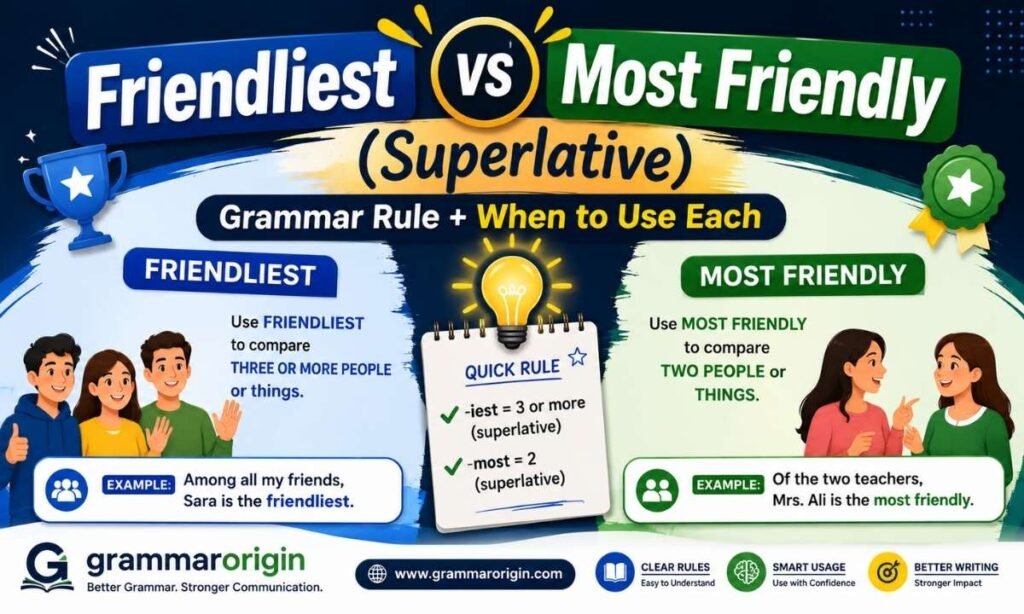
Short answer: Friendliest is the common everyday superlative; most friendly fits formal or compound contexts.
Examples:
- She’s the friendliest person I know. (casual, direct)
- This is the most user-friendly design we’ve released. (compound, formal)
The same logic from the comparative section applies here: standalone friendly leans toward -est, while compound or formal phrasing leans toward most.
Unfriendlier vs More Unfriendly (Negative Form)
Short answer: Both unfriendlier and more unfriendly are used, but more unfriendly is more common in formal writing.
The negative prefix un- makes the word feel heavier, so many writers instinctively reach for the analytical form.
Examples:
- The staff seemed unfriendlier than usual. (casual, still acceptable)
- The new policy feels more unfriendly to remote workers. (formal tone)
In casual speech, unfriendlier is understood without issue. In serious or negative-toned writing, more unfriendly tends to read more naturally.
The “More Friendlier” Mistake (Double Comparative)
Short answer: “More friendlier” is always incorrect — it combines two comparative structures at once.
English never stacks more and -er together. You must choose one system or the other, not both.
Incorrect: She is more friendlier than her sister.
Correct: She is friendlier than her sister. / She is more friendly than her sister.
This double comparative mistake is one of the most common English errors, even among confident writers. If you catch “more” sitting next to any -er word, remove one of them.
Formal vs Casual vs Technical Usage
Short answer: Casual writing favors friendlier; formal, academic, and technical writing favors more friendly.
| Context | Preferred Form | Example |
| Casual conversation | Friendlier | “The staff is friendlier this week.” |
| Professional email | More friendly | “The system is now more friendly to new users.” |
| Technical documentation | More friendly | “The interface is more friendly to screen readers.” |
| Academic writing | More friendly | “The design became more friendly to diverse learners.” |
Technical and scientific writing avoids words that sound too casual or emotional, which is why more friendly appears far more often in manuals and research papers.
Advertising & Branding Usage
Short answer: Marketers choose friendlier for warmth and more friendly for function-driven messaging.
Brand slogans lean on friendlier because it sounds punchy and relatable — think “friendlier skies” rather than “more friendly skies.”
Examples:
- “A friendlier banking experience” — emotional, brand-driven
- “More user-friendly features” — functional, product-driven
If the goal is emotional connection, friendlier wins. If the goal is describing a product feature clearly, more friendly (or a compound form) works better.
What Cambridge & Merriam-Webster Say
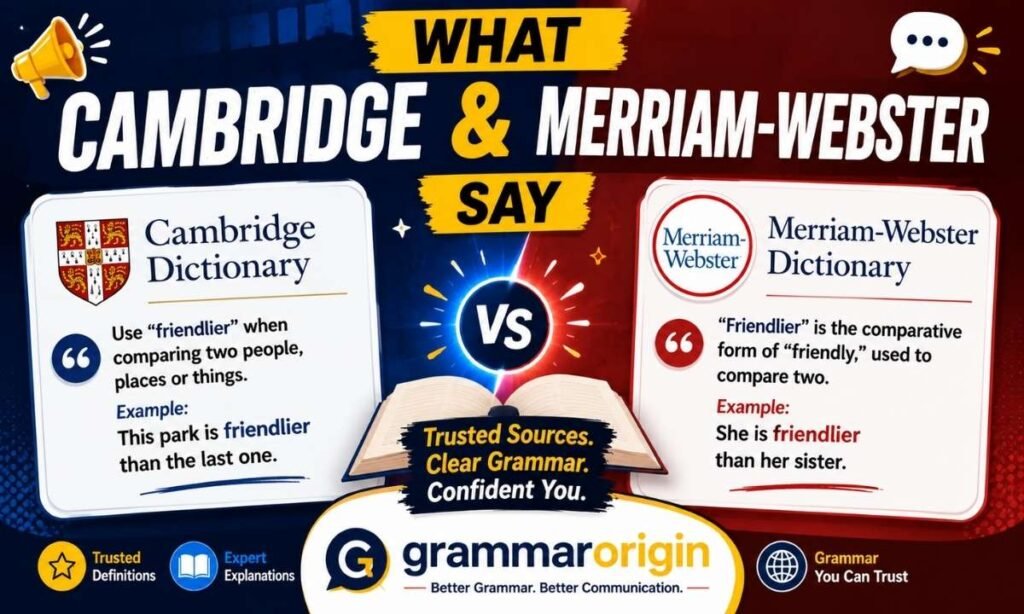
Short answer: Major dictionaries list both friendlier and more friendly as correct, with friendlier marked as the more frequently used form.
Merriam-Webster defines friendly as a two-syllable adjective ending in -y, explaining why it follows the same comparative pattern as happy (happier) and easy (easier).
Cambridge Dictionary also accepts both friendlier and more friendly, noting usage often depends on regional and stylistic preference rather than a strict rule.
Neither dictionary marks more friendly as incorrect. Both forms are standard English — the choice is about tone and context, not correctness.
MORE RELATED POSTS CLICK ME
Side-by-Side Comparison + Real-World Examples
Short answer: Direct comparisons favor friendlier; longer or compound phrases favor more friendly.
| Sentence | Friendlier | More Friendly |
| Casual comparison | “He’s friendlier than his brother.” | Sounds overly formal here |
| Workplace report | Sounds too casual | “Staff have become more friendly this quarter.” |
| Comparing 3+ things | Sounds awkward | “She is more friendly than Anna and Maria.” |
| Compound adjective | Not used | “The app is more user-friendly now.” |
Customer service example: An internal training memo described staff as “noticeably friendlier,” while the same finding appeared as “more friendly toward customers” in the official client-facing report.
Product design example: A UX team called a redesigned interface “friendlier” in a casual team update, but public release notes used “more friendly to new users” to match a professional tone.
Practical Guidelines / Checklist
- Comparing two people or things casually? → Friendlier
- Writing a formal report, email, or academic paper? → More friendly
- Using a compound word (eco-, user-, budget-, family-)? → Always more friendly
- Comparing three or more things? → More friendly
- Want a warm, emotional tone? → Friendlier
- Want a neutral, objective tone? → More friendly
This friendly vs friendlier checklist covers nearly every situation you’ll run into in daily writing.
Quick “Say It Out Loud” Test
Short answer: Read your sentence aloud — if it sounds smooth, use friendlier; if it sounds choppy, use more friendly.
This test works because English naturally favors rhythm. Your ear usually catches an awkward phrase before your brain can explain why it’s wrong.
Try it:
- “The café feels friendlier than before.” (smooth → keep friendlier)
- “The café feels more friendly than before.” (also fine, slightly more formal)
If both options sound equally natural, either is correct — pick the one that matches your tone.
Common Myths
Only one form is correct.
False. Both friendlier and more friendly are accepted by major dictionaries.
Friendlier is informal or unprofessional.
False. Friendlier is casual, not incorrect — it appears in professional writing too.
More friendly is always the formal choice.
Mostly true, but not absolute. Some casual sentences use it comfortably.
Eco-friendlier” is acceptable.
False. Compound adjectives almost always require more, not -er.
American English strictly prefers one form.
False. Usage depends on context and audience, not region alone.
Frequently Asked Questions
Is “friendlier” or “more friendly” grammatically correct?
Both are correct. Friendly is a two-syllable adjective ending in -y, so it accepts both the -er form (friendlier) and the more form (more friendly).
Which is more common — friendlier or more friendly?
Friendlier is more common in everyday speech and casual writing. More friendly appears more often in formal, technical, or compound sentences.
Is “more friendlier” ever correct?
No. “More friendlier” is a double comparative and is always incorrect. Use either friendlier or more friendly, never both together.
What is the superlative form of friendly?
The superlative forms are friendliest and most friendly. Friendliest is used in casual writing, while most friendly fits formal or compound phrases like “most user-friendly.”
Should I say “more eco-friendly” or “eco-friendlier”?
Always say more eco-friendly. Compound adjectives with friendly (eco-friendly, user-friendly, budget-friendly) take more, not the -er ending.
Do British and American English differ on friendlier vs more friendly?
No major difference exists. Both Cambridge Dictionary and Merriam-Webster accept both forms, and usage depends on tone and context rather than region.
Which form should I use in formal writing or business documents?
Use more friendly in formal, academic, or technical writing. It sounds neutral and professional, unlike friendlier, which carries a casual tone.
Conclusion
Both friendlier and more friendly are correct — the difference comes down to tone, not grammar rules. Use friendlier for short, casual comparisons, and more friendly for formal writing or compound phrases like user-friendly.
When in doubt, read your sentence out loud. If it flows smoothly, trust your ear — that’s usually all the friendly vs friendlier guidance you need.

Muhammad Waqas is an English language teacher and grammar expert with over 8 years of experience helping students and professionals improve their writing skills. He specializes in English grammar, vocabulary, communication, and practical language learning. Through GrammarOrigin, Waqas shares clear, easy-to-understand content that helps readers write and speak English with confidence.