
Ever paused mid-sentence, unsure whether to write “upcoming call,” “incoming meeting,” or “oncoming deadline” — and realized none of them sound quite right? You’re not alone. Incoming, upcoming, and oncoming are three of the most commonly confused words in English, even among fluent speakers and experienced writers, because they all hint at something approaching yet mean very different things.
This guide breaks down the exact meaning, real-world usage, and practical examples of each word — covering everyday contexts like calls, events, traffic, and weather — so you can confidently choose the right word every single time, without second-guessing yourself or relying on guesswork.
Incoming vs Upcoming vs Oncoming — Quick Answer
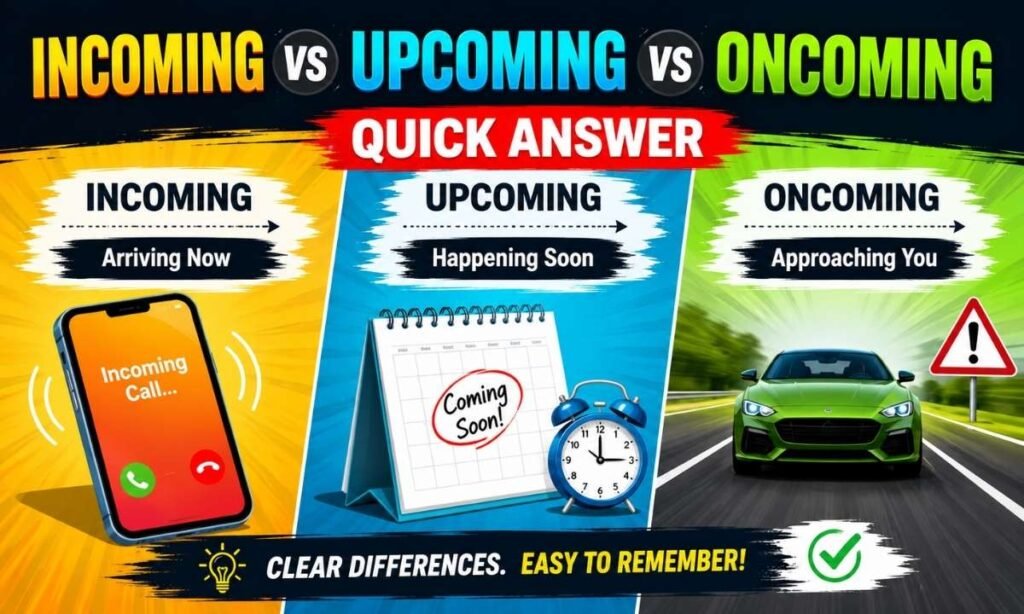
- Incoming = something arriving now, or about to. “An incoming call.”
- Upcoming = something planned for later. “An upcoming meeting.”
- Oncoming = something physically moving toward you. “Oncoming traffic.”
If you only remember one thing from this article, remember that. The rest of this guide fills in the details.
What “Incoming” Means
H3: Definition
Incoming describes something that is on its way to reaching you, your device, or your location — right now or very soon. It’s about arrival, not planning and not necessarily physical motion.
H3: Where It’s Used
- Communication: incoming call, incoming email, incoming message
- Logistics: incoming shipment, incoming order, incoming package
- Education: incoming students, incoming freshman class
- Weather: incoming storm, incoming heatwave
- Emergencies: incoming missile, incoming fire
H3: Examples
- “I missed the incoming call because my phone was on silent.”
- “The warehouse team is clearing space for incoming inventory.”
- “The university welcomed its incoming class this week.”
What “Upcoming” Means
Definition
Upcoming describes something scheduled to happen soon. There’s no motion involved — it’s purely about timing. If it has a date attached to it, “upcoming” almost always fits.
Where It’s Used
- Events: upcoming wedding, upcoming concert
- Work: upcoming meeting, upcoming deadline, upcoming presentation
- Releases: upcoming movie, upcoming product launch
- School: upcoming exam, upcoming semester
Examples
- “Don’t forget the upcoming deadline on Friday.”
- “Fans are already talking about the upcoming sequel.”
- “We’re preparing slides for the upcoming quarterly review.”
What “Oncoming” Means
Definition
Oncoming describes something moving directly toward you through physical space — often fast, and often carrying a sense of danger. Unlike “incoming,” it’s almost never used for digital things like calls or emails.
Where It’s Used
- Traffic: oncoming car, oncoming truck, oncoming headlights
- Weather: oncoming storm, oncoming wave
- Physical danger: oncoming crowd, oncoming train
Examples
- “She pulled over to let the oncoming ambulance pass.”
- “The hikers braced against the oncoming wind.”
- “Watch for oncoming traffic before you cross.”
Side-by-Side Comparison Table
| Word | Core Idea | Involves Movement? | Scheduled? | Typical Use |
| Incoming | Arrival / receiving something | Yes — entering | Not necessarily | Calls, emails, deliveries, students |
| Upcoming | Future timing | No | Yes | Events, meetings, launches, deadlines |
| Oncoming | Physical approach toward you | Yes — toward you | No | Traffic, storms, physical danger |
Best Word Choice by Scenario
| Scenario | Correct Word |
| A text notification on your phone | Incoming |
| A vacation planned for next month | Upcoming |
| A cyclist crossing a busy road | Oncoming |
| A package tracked as “out for delivery” | Incoming |
| A product release once it has an announced date | Upcoming |
| A storm system approaching your city right now | Incoming or Oncoming, depending on emphasis |
The 3-Question Test to Pick the Right Word
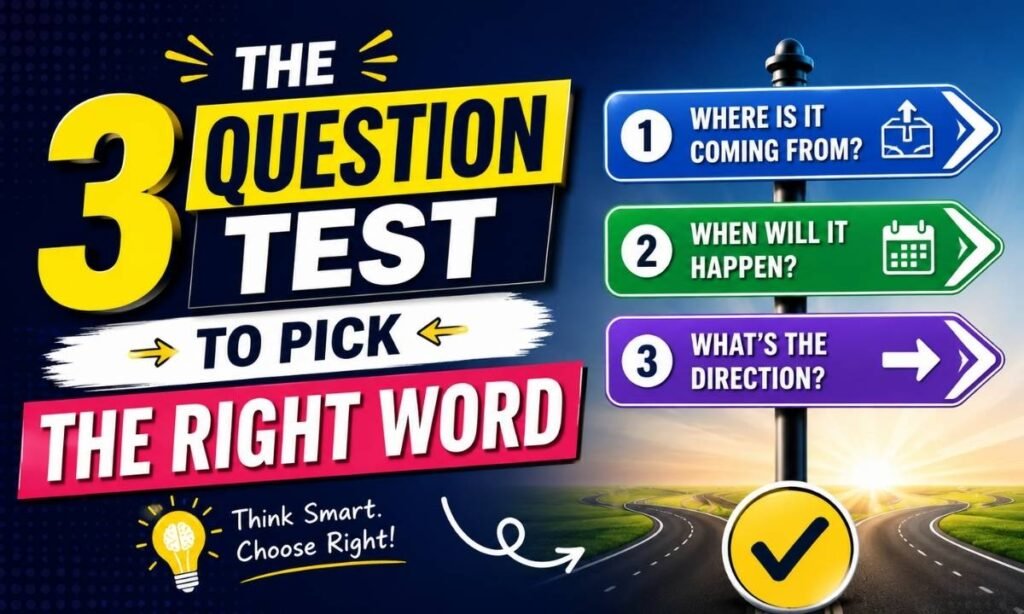
- Is it physically moving toward you right now, often fast? → Use oncoming.
- Is it arriving at your device, inbox, or location, digital or physical? → Use incoming.
- Is it simply sitting on a future date, with nothing moving yet? → Use upcoming.
This order matters because “incoming” and “oncoming” can both describe motion — the test separates them by whether the thing is heading at you (oncoming) or heading into your system or space (incoming).
MORE RELATED POSTS CLICK ME
Incoming vs Upcoming vs Oncoming — Meaning in Urdu
| English Word | Urdu Meaning | Example |
| Incoming | آنے والا (پہنچنے والا) | Incoming call — آنے والی کال |
| Upcoming | آئندہ / آنے والا (وقت کے لحاظ سے) | Upcoming event — آئندہ تقریب |
| Oncoming | سامنے سے آنے والا | Oncoming traffic — سامنے سے آنے والی ٹریفک |
The Urdu translations for “incoming” and “upcoming” often overlap in casual speech, which is exactly why English learners mix them up. The clearest way to separate them: if it has a scheduled date, it’s upcoming (آئندہ); if it’s actively arriving, it’s incoming (آنے والا).
Real-Life Example Conversations
At work:
“We have several incoming invoices to process today.”
“Noted — and don’t forget our upcoming budget review on Monday.”
On the road:
“Slow down, there’s oncoming traffic at the bend.”
“Got it. I’ll also watch for the incoming delivery truck at the gate.”
At school:
“The incoming students arrive for orientation next week.”
“Right, and we still need to finalize the upcoming semester schedule.”
Common Mistakes to Avoid
❌ “The oncoming party starts at 7 PM.” → ✔ “The upcoming party starts at 7 PM.” (A party doesn’t move toward you — it’s scheduled.)
❌ “I have an incoming exam tomorrow.” → ✔ “I have an upcoming exam tomorrow.” (An exam is planned, not arriving.)
❌ “Watch out for the incoming car!” → ✔ “Watch out for the oncoming car!” (A car in motion toward you is oncoming, not incoming.)
❌ “I got an oncoming email.” → ✔ “I got an incoming email.” (Digital arrivals are always incoming, never oncoming.)
Easy Memory Tricks
- Incoming → picture your inbox. Something is coming in to you.
- Upcoming → picture a calendar with a circled date. It’s coming up in time, nothing is moving.
- Oncoming → picture headlights in the opposite lane. It’s coming on toward you through space.
Quick shortcut: if “call” or “package” fits after the word, it’s incoming. If “event” or “deadline” fits, it’s upcoming. If “traffic” or “car” fits, it’s oncoming.
MORE RELATED POSTS CLICK ME
Bonus: Incoming vs Forthcoming vs Impending
Two related words are worth knowing:
- Forthcoming is a more formal cousin of “upcoming” — used for things about to be released or made available, like a forthcoming report or a forthcoming announcement.
- Impending leans toward “oncoming” in tone, but without needing physical direction — it signals something about to happen soon, usually something serious, like impending danger or an impending decision.
Neither replaces “incoming,” “upcoming,” or “oncoming” directly, but knowing them sharpens your sense of how English handles “things that haven’t happened yet.”
Frequently Asked Questions
Is it incoming, oncoming, or upcoming?
It depends on what you mean. Use incoming for something arriving (a call, a package). Use upcoming for something scheduled (an event, a deadline). Use oncoming for something physically moving toward you (traffic, a storm).
What is the difference between incoming and upcoming?
Incoming refers to something that is arriving now or very soon, digital or physical. Upcoming refers to something scheduled for the future with no movement involved. A call is incoming; a meeting is upcoming.
What does “oncoming” mean?
Oncoming means something is moving directly toward you through physical space, often quickly. It’s most commonly used for traffic, storms, or other physical hazards, such as “oncoming traffic.”
Are incoming and oncoming the same?
No. Incoming means something is arriving at you or your location, and it can be digital (a message) or physical (a delivery). Oncoming is only physical and always describes motion directly toward you, like an oncoming car.
Is it “incoming meeting” or “upcoming meeting”?
“Upcoming meeting” is correct. A meeting is scheduled, not something that arrives or moves toward you, so “incoming” doesn’t fit here.
Can “oncoming” be used for events?
No. Events don’t physically move toward you, so “oncoming” doesn’t apply. Use “upcoming” for any scheduled event instead.
What does “upcoming” mean?
Upcoming means something is planned or expected to happen in the near future. It refers purely to timing, with no arrival or physical movement involved.
Conclusion
Incoming, upcoming, and oncoming may look alike, but each one answers a different question: is something arriving, scheduled, or moving toward you. Once you know which question fits, the right word becomes automatic.
Keep the three-question test in mind next time you’re unsure. With a little practice, choosing between incoming, upcoming, and oncoming will feel natural every time.

Muhammad Waqas is an English language teacher and grammar expert with over 8 years of experience helping students and professionals improve their writing skills. He specializes in English grammar, vocabulary, communication, and practical language learning. Through GrammarOrigin, Waqas shares clear, easy-to-understand content that helps readers write and speak English with confidence.