
Ever paused mid-sentence, unsure whether to say “I drove” or “I have driven”? You’re not alone. Drove vs driven is one of the most common mix-ups in English, even among confident speakers.
The good news: the rule is simpler than it looks. In this guide, you’ll learn exactly when to use drove, when to use driven, and how to avoid the mistake for good, with easy, real-life examples.
Drove vs Driven at a Glance
Here’s the short answer before we go deeper.
| Form | Type | Works Alone? | Example |
| Drove | Simple past tense | Yes | I drove to work. |
| Driven | Past participle | No, needs a helper verb | I have driven to work. |
Drove describes a finished action in the past. Driven always needs a helper verb like have, has, had, is, or was. Keep this rule in mind, and the rest of this guide will make perfect sense.
Understanding the Forms of “Drive”
“Drive” is an irregular verb. It doesn’t follow the normal “-ed” pattern that regular verbs use.
Instead, it changes shape depending on the tense:
| Verb Form | Word | Example |
| Base form | drive | I drive to work every day. |
| Simple past | drove | I drove to work yesterday. |
| Past participle | driven | I have driven to work before. |
| Present participle | driving | I am driving to work now. |
Once you know these four forms, choosing between drove and driven becomes much easier.
What Is the Simple Past? (Drove)
Drove is the simple past tense of “drive.” Use it for a completed action that happened at a specific point in the past.
It never needs a helper verb. It stands on its own.
Examples:
- I drove to the airport this morning.
- She drove her kids to school.
- They drove across three states last summer.
- We drove through heavy traffic on the way home.
Notice that each sentence describes a finished action, and none of them use “have,” “has,” or “had.”
What Is the Past Participle? (Driven)
Driven is the past participle of “drive.” Unlike drove, it cannot stand alone. It always needs a helper verb, such as have, has, had, is, was, were, or been.
Examples:
- I have driven this road many times.
- She has driven to work every day this week.
- The car was driven by a professional racer.
- He had driven all night before he finally stopped.
If you remove the helper verb from any of these sentences, the sentence breaks. That’s the clearest sign you need driven, not drove.
Drove vs Driven: What’s the Real Difference?
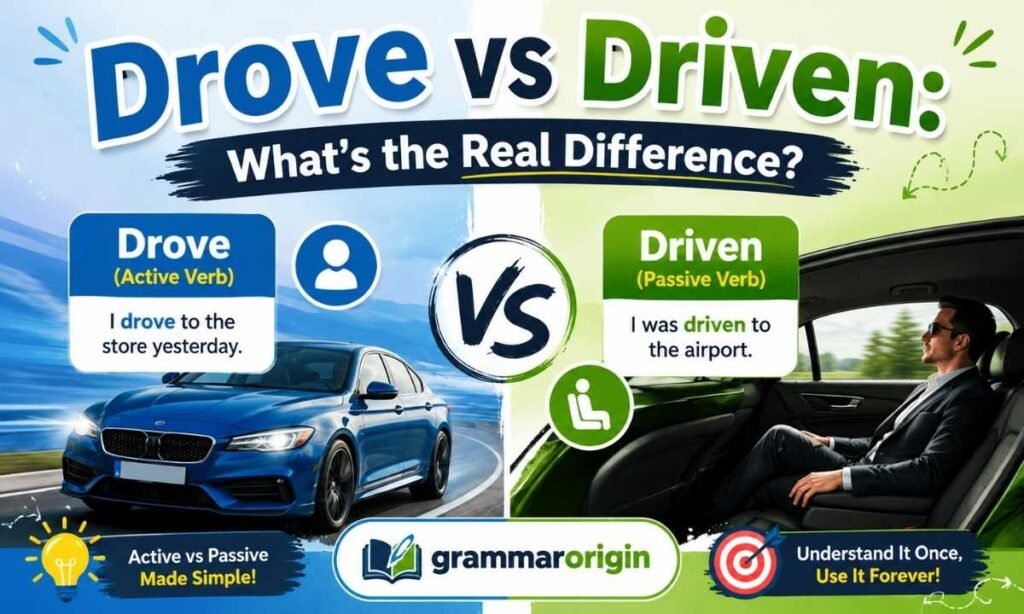
Here’s the core rule in one line:
Drove stands alone. Driven needs a helper.
- Use drove for a simple, finished action with no helper verb.
- Use driven whenever a helper verb like have, has, had, is, or was appears before it.
If a sentence uses driven without any helper verb, it’s incorrect. If a sentence uses drove right after “have,” “has,” or “had,” it’s also incorrect.
Wrong: I have drove this car before. Right: I have driven this car before.
Wrong: She driven to the store yesterday. Right: She drove to the store yesterday.
That one rule solves most drove vs driven mistakes.
READ MORE RELATED POST A MA or An MA?
Perfect Tenses With “Driven” (Present, Past, Future)
Perfect tenses connect a past action to another point in time. All three perfect tenses use driven, never drove.
Present Perfect
Structure: have/has + driven
Use this for experiences or actions with present relevance.
- I have driven a manual car before.
- She has driven this route for years.
Past Perfect
Structure: had + driven
Use this to show one past action happened before another past action.
- He had driven 200 miles before the storm started.
- We had driven for hours before we finally stopped.
Future Perfect
Structure: will have + driven
Use this for an action that will be complete by a specific point in the future.
- By next week, I will have driven across five states.
- She will have driven 10,000 miles by the end of the year.
Using “Driven” in Passive Voice
Passive voice shifts the focus from the person doing the action to the person or thing receiving it. “Driven” is the correct form here, not “drove.”
Structure: is/was/has been + driven
Examples:
- The truck was driven by an experienced driver.
- The car has been driven for only 5,000 miles.
- The delivery van is driven by a new employee.
In each example, the subject isn’t performing the action. It’s receiving it. That’s why driven, not drove, is required.
Context Matters: How Tense Changes the Choice
The same event can sound different depending on whether you use drove or driven.
Example 1:
- Drove: I drove the car yesterday. (A single, finished event.)
- Driven: I have driven the car before. (An experience, with no specific time.)
Example 2:
- Drove: She drove for six hours straight.
- Driven: She had driven for six hours before she stopped for gas.
Drove points to a specific moment. Driven points to experience or a connection between two points in time.
Negative & Question Forms
This is where many learners slip up. In negatives and questions, you use the auxiliary verb “did,” and the main verb goes back to its base form, drive, not drove or driven.
Negative form:
Subject + did not (didn’t) + drive
- I didn’t drive to the office today. (Not: I didn’t drove.)
- She didn’t drive her new car yet. (Not: She didn’t drove.)
Question form:
Did + subject + drive?
- Did you drive to the party last night? (Not: Did you drove?)
- Where did they drive during the trip? (Not: Where did they drove?)
Remember: “did” already carries the past tense. The main verb after it always returns to its base form, drive.
Common Errors to Avoid With “Drove vs Driven”
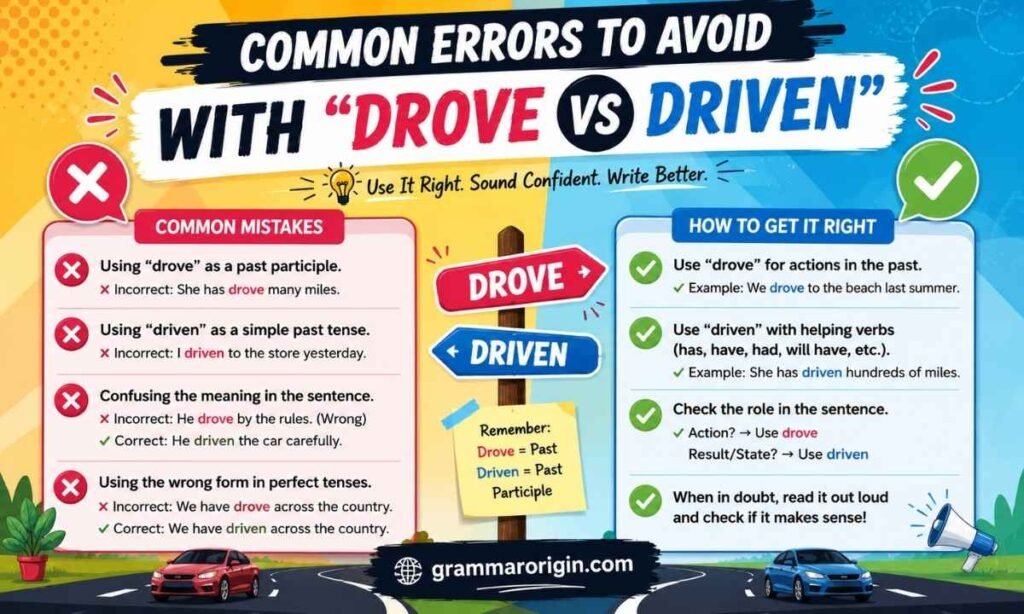
Mistake 1: Using “Drove” With a Helping Verb
Wrong: I have drove this before. Right: I have driven this before.
Helper verbs always require the past participle, never the simple past.
Mistake 2: Using “Driven” Without a Helping Verb
Wrong: I driven to work today. Right: I drove to work today.
Driven can never be the only verb in a sentence.
Mistake 3: Using “Drove” After “Did”
Wrong: Did you drove to school? Right: Did you drive to school?
After “did” or “didn’t,” the verb always returns to its base form.
Quick Decision Guide (Drove vs Driven)
Not sure which one to use? Ask yourself these quick questions.
- Is there a helper verb like have, has, had, is, or was? → Use driven.
- Is the sentence just a simple, finished past action with no helper verb? → Use drove.
- Is the sentence passive (something was done to the subject)? → Use driven.
- Does the sentence start with “did” or “didn’t”? → Use drive, not drove or driven.
One line to remember it all: drove stands alone, driven needs a friend.
READ MORE RELATED POST A MA or An MA?
Is “Driven” Ever an Adjective?
Yes. Besides being a verb form, driven can also work as an adjective. In this case, it describes someone highly motivated or determined.
Examples:
- She is a driven employee who always meets her goals.
- He has a driven personality, always chasing the next challenge.
As an adjective, driven doesn’t need a helper verb. It simply describes a noun, much like “ambitious” or “focused.”
Other Meanings of “Drove” (as a Noun)
Drove isn’t only a verb form. It can also be a noun meaning a group of animals or people being moved together.
Examples:
- The farmer led a drove of cattle to the market.
- Droves of tourists arrived at the beach this weekend.
This usage is less common in daily conversation, but it’s worth knowing so you’re not confused if you come across it in writing.
Frequently Asked Questions
What is the difference between drove and driven?
Drove is the simple past tense, used alone for a completed action. Driven is the past participle, and it always needs a helper verb like have, has, had, is, or was.
Is it correct to say “I have drove”?
No. The correct form is “I have driven.” After “have,” “has,” or “had,” you always use the past participle, driven, not drove.
Have you ever drove or driven a manual car?
The correct version is “Have you ever driven a manual car?” Since the sentence starts with “have,” it needs the past participle, driven.
Can “driven” be used alone in a sentence?
No. Driven always needs a helper verb before it, such as have, has, had, is, or was. Without one, the sentence is incorrect.
When should I use “drove” instead of “driven”?
Use drove for a simple, completed action in the past with no helper verb, such as “I drove to the store yesterday.”
Is “drive” a regular or irregular verb?
Drive is an irregular verb. It doesn’t add “-ed” for the past tense. Instead, it changes to drove and driven.
What is the correct past tense of “drive” in a question?
Use “did” plus the base form, drive, such as “Did you drive to work today?” Never “did you drove.”
Final Thoughts
Choosing between drove vs driven comes down to one simple check: is there a helper verb? If yes, use driven. If not, use drove.
Once you remember this rule, mistakes like “I have drove” disappear for good. With a little practice, the right choice will start to feel automatic.

Muhammad Waqas is an English language teacher and grammar expert with over 8 years of experience helping students and professionals improve their writing skills. He specializes in English grammar, vocabulary, communication, and practical language learning. Through GrammarOrigin, Waqas shares clear, easy-to-understand content that helps readers write and speak English with confidence.