
Typed “ammount” in an email and then paused, wondering if it actually looked right? You’re not the only one — thousands of people search for amount or ammount every month because the word sounds like it could have a double “m,” even though it doesn’t.
Here’s the short answer: amount is correct, and the double-m version is simply a common misspelling. This guide covers the meaning, pronunciation, and the real usage rule most people actually need — when to use amount, number, or quantity.
Amount or Ammount – Quick Answer
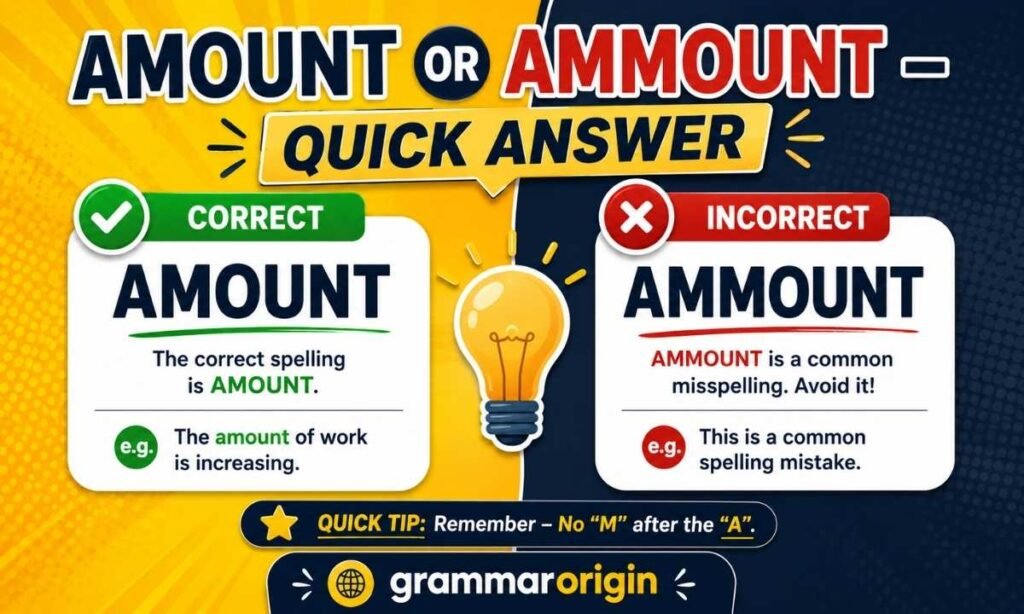
Amount is the correct spelling. Ammount is not a standard English word.
- Amount — a quantity or total of something. Example: The total amount is $500.
- Ammount — a common misspelling with an extra letter. Example: ❌ The total ammount is $500.
There’s no context — formal, casual, academic, or business — where the double-m spelling is correct. Whenever you mean a quantity or total, one word applies.
What Do Dictionaries Say?
Merriam-Webster and Oxford both define this word as a quantity or the total of something. Neither dictionary lists the double-m version as an accepted variant.
Wiktionary goes a step further and directly labels the double-m spelling as a misspelling entry. That’s about as clear a confirmation as you’ll find — one spelling is standard English, and the other simply isn’t recognized.
The Origin of Amount or Ammount
This word traces back to the Old French verb amonter, meaning “to go up” or “to add up.” It entered Middle English as amounten before settling into its modern form.
At no point in this history did the word ever carry a double “m.” The extra letter isn’t a regional variant or an older spelling — it’s purely a modern typing mistake.
Meaning of Amount
As a noun, this word refers to the quantity or total of something — money, time, effort, or anything measured as a whole rather than counted item by item.
It also works as a verb, meaning “to add up to” or “to come to a certain total.” For example: the costs amount to $300.
How to Pronounce Amount (IPA)
The correct pronunciation is /əˈmaʊnt/ — roughly “uh-MOWNT,” with the stress on the second syllable.
Say it out loud and you’ll notice something: there’s no natural pause or emphasis that would suggest a double consonant. The double-m mistake comes from spelling instinct, not from how the word actually sounds.
British English vs American English Spelling
There’s no regional difference here. This word is spelled and used identically in both British and American English.
| Region | Correct Spelling |
| American English | Amount |
| British English | Amount |
Whether you’re writing for a US, UK, or global audience, the same spelling applies everywhere.
Read More Related Post Repore or Rapport
Common Mistakes with Amount or Ammount
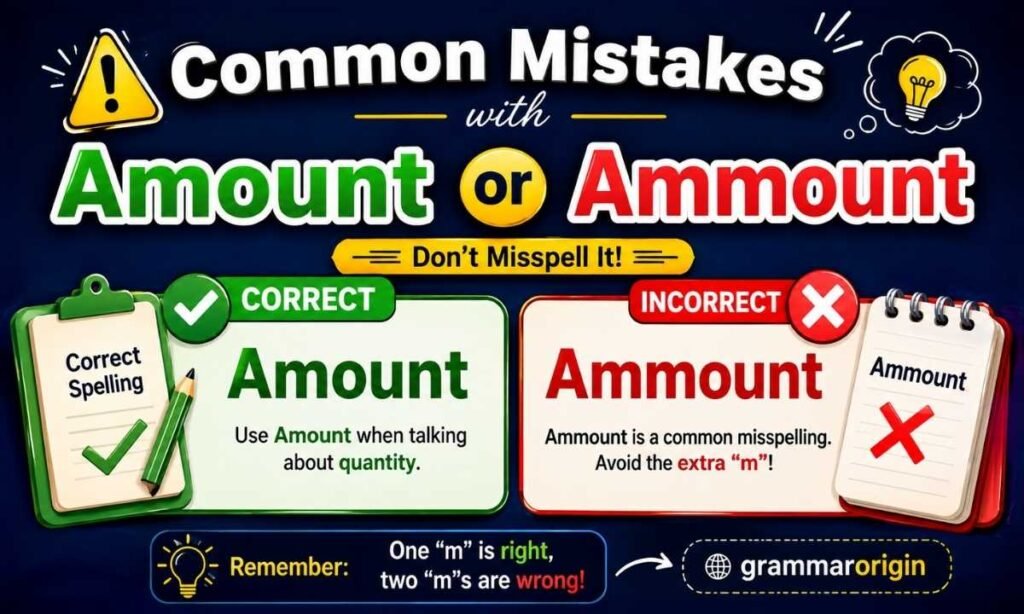
The double-m mistake usually happens because English has plenty of genuine double-consonant words — common, summit, account — and writers assume this word follows the same pattern.
- ❌ The ammount of sugar seems too high.
- ✅ The amount of sugar seems too high.
- ❌ Please confirm the total ammount.
- ✅ Please confirm the total amount.
- ❌ A large ammount of money was spent.
- ✅ A large amount of money was spent.
The fix is always the same: drop the extra “m.”
Amount vs Number vs Quantity
This is where most writers actually go wrong — not with spelling, but with word choice. Cambridge Dictionary’s grammar guide lays out a clear rule for all three:
Use “Amount” for Uncountable Things
Money, time, water, effort, and other things you can’t count individually. A large amount of time was needed.
Use “Number” for Countable Things
People, books, items — anything you could count one by one. A large number of students attended.
Use “Quantity” for Either
Quantity works with both countable and uncountable nouns, and reads slightly more formal. A large quantity of weapons was discovered. A small quantity of cement was used.
A common error is writing “a large amount of people” — since people are countable, “number” is the correct word there instead.
“Amount To” The Idiom Explained
Beyond the noun, this word shows up in a common idiom: “amount to something.” It means to become successful or significant.
She always believed she would amount to something in life. His excuses didn’t amount to much of an explanation.
The verb form works the same way when totaling numbers: the bill amounted to $2,000.
Amount Synonyms
Depending on context, a few words can substitute for this term:
- Total — the combined sum of something
- Sum — often used for money specifically
- Volume — common for liquids or large-scale measurement
- Measure — a more general alternative
- Quantity — the closest formal substitute
These help avoid repeating the same word too often in longer writing.
Amount in Everyday Examples
Emails: Please confirm the total amount due by Friday.
Finance: Enter the payment amount carefully before submitting.
News: A large amount of rainfall caused flooding across the region.
Academic writing: The study measured the amount of stress reported by participants.
Read More Related Post Repore or Rapport
Amount in Business & Finance
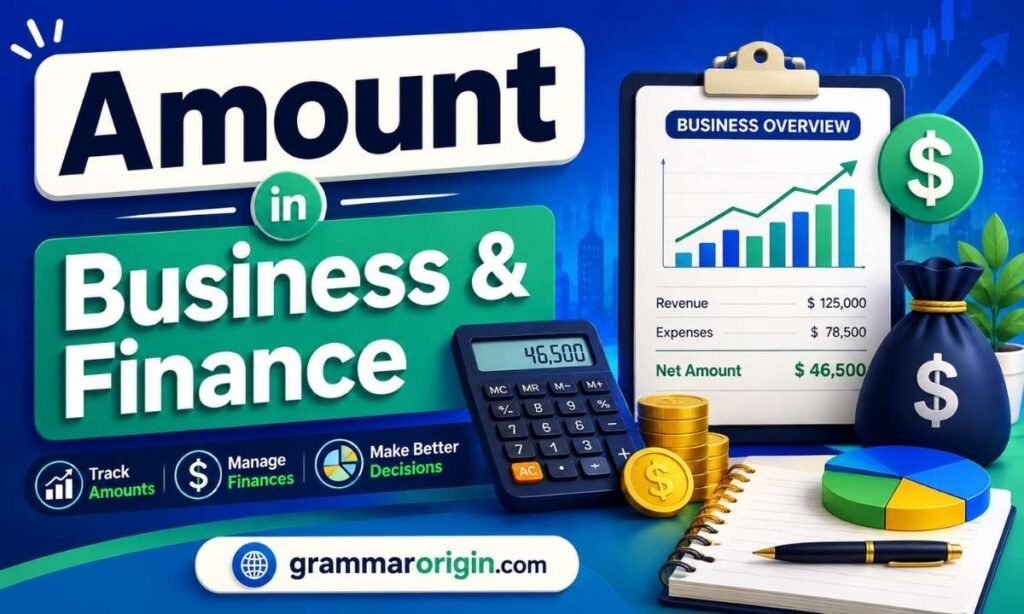
This word appears constantly in financial and business writing, often in specific phrases people search for directly:
- YTD amount — year-to-date total, common in payroll and accounting reports.
- Amount due — the total owed on an invoice or bill.
- Total amount — the final combined sum after all charges or deductions.
Getting the spelling right matters more here than almost anywhere else — a misspelled word on an invoice or financial report can look careless to clients or auditors.
Easy Memory Trick
Here’s a simple way to lock in the correct spelling: think A + MOUNT = AMOUNT.
Since “mount” has only one “m,” the word built from it does too. If you ever type the double-m version, picture climbing a single mountain, not two.
Comparison Table: Keyword Variations
| Search Term | Correct Form | Notes |
| amount or ammount | amount | Most common search variation |
| ammount meaning | amount meaning | Quantity or total of something |
| ytd ammount | YTD amount | Year-to-date total in finance |
| amount of money | amount of money | Correct as written |
| ammounting | amounting | Verb form, one “m” |
Frequently Asked Questions
Is ammount a real word?
No. Wiktionary and every major dictionary list it only as a misspelling. The correct spelling is amount, with a single “m.”
What is the correct spelling of amount?
The correct spelling is A-M-O-U-N-T, with one “m.” There’s no alternative spelling in standard English.
How do you pronounce amount?
It’s pronounced “uh-MOWNT” (/əˈmaʊnt/), with stress on the second syllable.
What does “amunt” mean?
“Amunt” isn’t a standard word either. It’s simply another misspelling of amount, missing letters instead of adding an extra one.
What’s the difference between amount and number?
Use amount for uncountable things like money or time. Use number for things you can count individually, like people or books.
Is amount spelled the same in British and American English?
Yes. There’s no regional spelling difference — it’s identical in both varieties of English.
What is a synonym for amount?
Common alternatives include total, sum, volume, measure, and quantity, depending on the context.
Conclusion
The debate over amount or ammount has one clear answer: amount is correct, spelled with a single “m,” and the double-m version is simply a common typing mistake. Once you remember the word’s French origin and the “A + MOUNT” trick, the confusion disappears for good.
Whether you’re writing an invoice, a report, or a casual email, using amount correctly — and choosing it over number or quantity when appropriate — shows real attention to detail. Keep the one-“m” rule in mind, and you’ll never second-guess it again.

Muhammad Waqas is an English language teacher and grammar expert with over 8 years of experience helping students and professionals improve their writing skills. He specializes in English grammar, vocabulary, communication, and practical language learning. Through GrammarOrigin, Waqas shares clear, easy-to-understand content that helps readers write and speak English with confidence.