
Typed “repore” in an email and then paused, wondering if it actually looked right? You’re not the only one — thousands of people search for repore or rapport every month because the correct word sounds nothing like how it’s spelled.
Here’s the short answer: rapport is correct, and the other spelling is simply a common mistake. This guide covers the meaning, origin, pronunciation, and real-world examples, so you never have to second-guess it again.
Repore or Rapport – Quick Answer
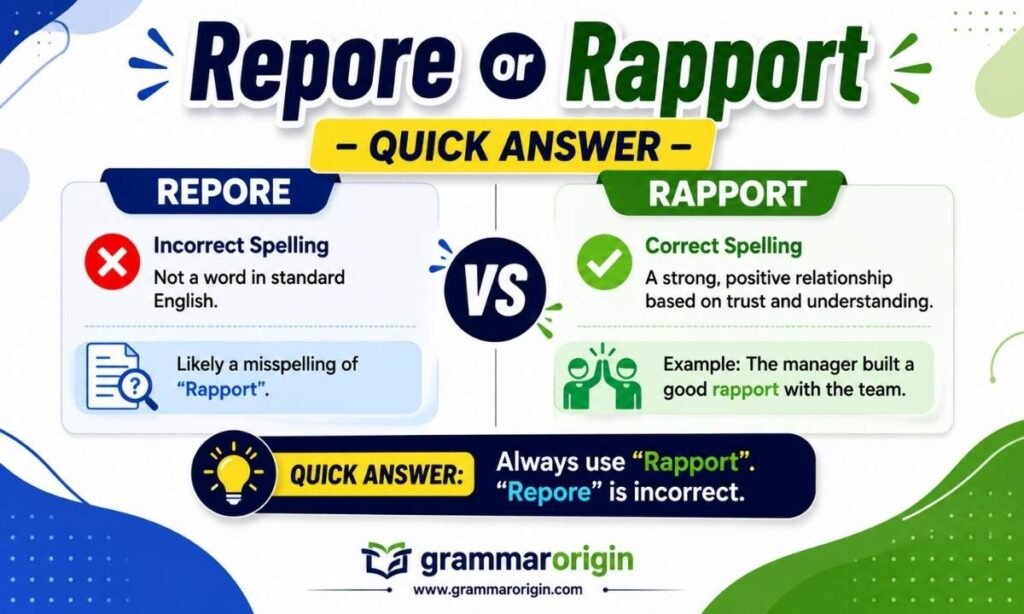
Rapport is the correct spelling. Repore is not a standard English word.
- Rapport — a close, friendly relationship marked by trust and understanding. Example: She quickly built a strong connection with her new team.
- Repore — not found in any English dictionary. Example: ❌ We need to build repore with clients.
There’s no context — formal, casual, academic, or business — where the second spelling is the right choice. Whenever you mean a positive bond between people, one word applies.
What Do Dictionaries Say?
Merriam-Webster defines it as a friendly relationship built on agreement, understanding, or shared feeling. The Oxford and Cambridge dictionaries describe it the same way: a close, harmonious connection between people.
None of these dictionaries list any alternate spelling. That absence is the clearest proof that the phonetic version isn’t a recognized English word — it’s a mistake, not a stylistic choice.
The Origin of Repore or Rapport
The correct term comes from the French verb rapporter, meaning “to bring back” or “to relate.” English borrowed it directly, spelling and all, sometime in the 17th century.
Because French pronunciation often drops the final consonant sound, it’s spoken closer to “ra-pore” than it’s written. That mismatch between sound and spelling is exactly why so many writers guess wrong.
Meaning of Rapport
This word describes a relationship where people communicate easily, trust one another, and feel understood. It shows up constantly in psychology, business, healthcare, and education — anywhere connection matters.
You can share it with a friend, a coworker, a teacher, a stranger you just met, or a client you’re meeting for the first time. It isn’t romantic. It’s about comfort, empathy, and mutual respect.
How to Pronounce Rapport (IPA)
The correct pronunciation is /ræˈpɔːr/ — roughly “ruh-PORE.” The final “t” stays silent, just as it does in several other French loanwords.
This silent letter is the single biggest reason people misspell it. If you remember that it ends in “-port” (not “-pore”), the correct spelling becomes much easier to hold onto.
Is “Repore” Ever a Real Word?
Almost never — but there’s one narrow exception worth knowing. “REPORE” exists as a niche acronym for Report Output Retrieval System, occasionally used in government, military, or legal documentation.
Outside that specific technical context, it has no meaning in standard English. If you’re writing about trust or connection, this acronym doesn’t apply — you need the standard spelling.
Read More Related Post Address or Adress
British English vs American English Spelling
Unlike many English word pairs, there’s no regional difference here. It’s spelled and used identically in both British and American English.
| Region | Correct Spelling |
| American English | Rapport |
| British English | Rapport |
Whether you’re writing for a US audience, a UK audience, or a global one, the same spelling always applies.
Rapport Synonyms
A few words work as substitutes depending on tone:
- Connection — casual, everyday use
- Bond — personal or emotional writing
- Affinity — formal or academic tone
- Chemistry — social or workplace settings
- Understanding — simple, neutral alternative
- Harmony — describing smooth, conflict-free interaction
None are exact matches, but they help vary your writing.
Common Mistakes with Repore or Rapport
The phonetic guess isn’t the only incorrect variant floating around online. Watch for these too:
- Repport — an extra letter in the wrong place
- Repoire — a phonetic guess that adds an unnecessary vowel
- Rapore — missing a “p”
- Rapports — incorrectly pluralized; the word is usually uncountable
All of these should be corrected to the single, standard spelling: rapport.
Is Repore the Same as Report?
No — and this is a mix-up worth clearing up. “Report” is a completely different word, meaning a written or spoken account of something.
The misspelled version isn’t a variant of “report” either. It’s simply a phonetic guess at rapport. The three words look similar on the page, but they mean entirely different things.
Rapport in Real Life
This shows up differently depending on the setting, but the core idea — trust and ease of communication — stays the same everywhere.
In Business
Salespeople build it with clients before pitching a product, and managers use it to strengthen team communication and interpersonal trust.
In Relationships
Friends who “click” instantly usually describe that feeling as being understood without much effort.
In Education
Teachers who build this kind of trust with students tend to see better classroom participation.
In Healthcare
Doctors and therapists rely on it to help patients feel comfortable enough to open up honestly.
Rapport in Psychology
Psychologists treat it as a specific, studied behavior rather than a vague feeling. It’s often broken down into three components: coordination (matching tone and body language), mutual positivity (warmth on both sides), and mutual attention (genuine focus on the other person).
Therapists and counselors are trained to build this early, since patients open up faster once it’s established. This is one reason relationship-building is treated as a real, teachable skill in clinical and counseling training.
Read More Related Post Address or Adress
Repore vs Other French Loanword Spelling Traps
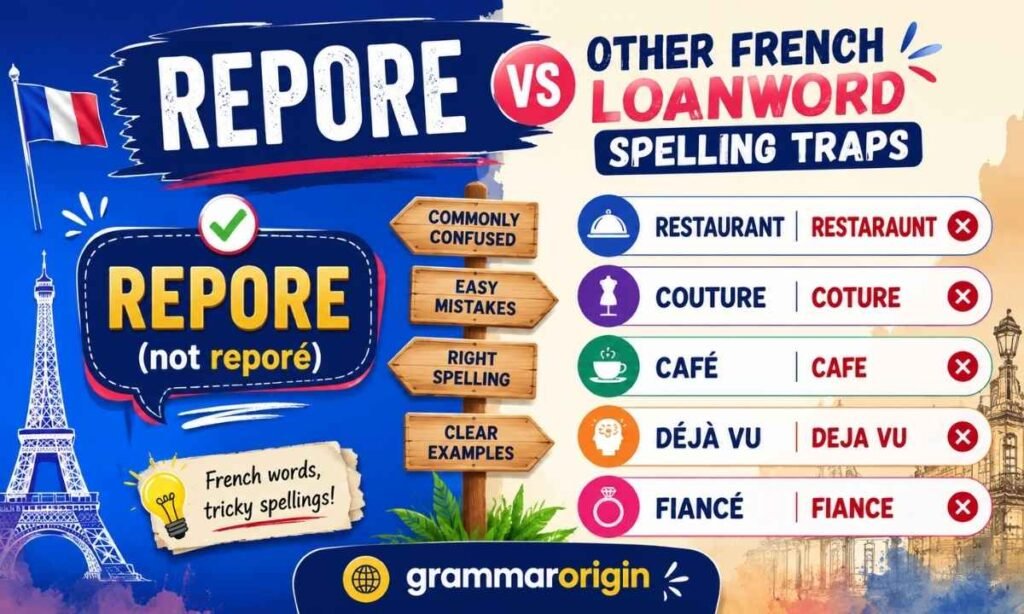
This isn’t the only French-origin word that trips up English writers. Several others share the same “sounds different than it’s spelled” problem:
| Word | Common Misspelling | Why It Happens |
| Rapport | Repore | Silent final “t” |
| Calibre | Caliber (US variant, not a misspelling) | French vs Americanized spelling |
| Ballet | Ballette / Balay | Silent final “t,” unfamiliar ending |
Once you notice this pattern, the mistake starts to make more sense — it’s not carelessness, it’s a predictable side effect of how English absorbs French words.
Easy Memory Trick
Here’s a simple way to lock in the correct spelling: it ends in “-port,” not “-pore.”
Think of it as RAP + PORT = RAPPORT. The double “p” is also worth noting — it’s easy to drop by accident when typing quickly.
Comparison Table: Keyword Variations
| Search Term | Correct Form | Notes |
| repore or rapport | rapport | Most common search variation |
| repor with someone | rapport with someone | Missing letters |
| repoire | rapport | Phonetic misspelling |
| build repore | build rapport | Frequent business-writing error |
| repore meaning | rapport meaning | Friendly, trusting connection |
Frequently Asked Questions
Is repore a real word?
No. It’s not listed in any standard English dictionary. It’s a common misspelling of rapport, with one narrow exception: the technical acronym “Report Output Retrieval System.”
What does rapport mean?
It means a close, friendly relationship built on trust, mutual understanding, and easy communication between people.
How do you pronounce rapport?
It’s pronounced “ruh-PORE” (/ræˈpɔːr/), with a silent final “t.”
What is a repore?
It isn’t a standalone word with its own meaning. In almost every case, it’s simply a misspelling of the correct term.
Is repore the same as report?
No. “Report” means a written or spoken account of something, while the misspelled version is a guess at rapport, meaning a trusting relationship. The three words are unrelated in meaning.
What is a synonym for rapport?
Common alternatives include connection, bond, affinity, chemistry, and understanding, depending on the tone you want.
Is rapport spelled the same in British and American English?
Yes. Unlike many word pairs, it has no regional spelling difference — it’s identical in both British and American English.
Why do people spell rapport as repore?
Because the correct word is pronounced with a silent final “t,” making it sound closer to the incorrect version than it looks on the page. This mismatch between sound and spelling is the main cause of the mistake.
Final Thoughts
The debate over repore or rapport has one clear answer: rapport is correct, and the phonetic version is simply a spelling mistake. Once you understand the silent “t” and the word’s French origin, the confusion mostly disappears.
Whether you’re writing a business email, a resume, or a casual message, using it correctly shows attention to detail. Keep the trick in mind — it ends in “-port,” not “-pore” — and you’ll never have to second-guess it again.

Muhammad Waqas is an English language teacher and grammar expert with over 8 years of experience helping students and professionals improve their writing skills. He specializes in English grammar, vocabulary, communication, and practical language learning. Through GrammarOrigin, Waqas shares clear, easy-to-understand content that helps readers write and speak English with confidence.