
Ask ten people whether it’s leafs or leaves, and you’ll probably get ten confident, mismatched answers. The word looks like it should follow the usual “add an s” rule, yet something about it feels off the moment you type it.
Here’s the short version before we go deeper: leaves is the correct spelling almost every time you’re talking about a plant, and every major style guide agrees on that. Leafs shows up only in a handful of narrow, specific situations tied to verbs and proper names.
Leafs or Leaves – Quick Answer
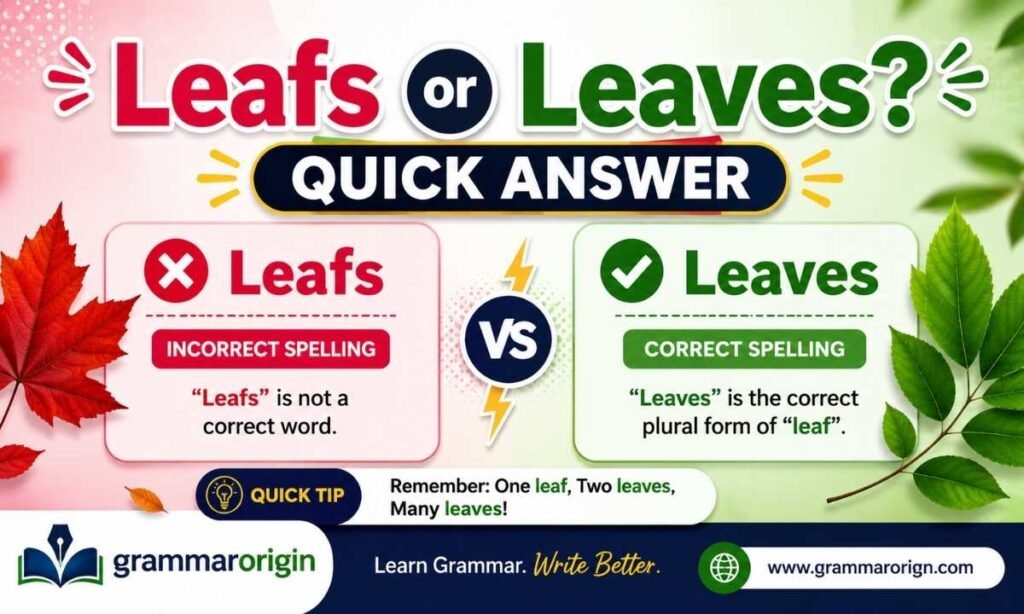
Leaves is correct when you mean more than one leaf from a tree or plant. Leafs only works as a verb form or inside a proper name.
A few quick checks:
- “The garden was covered in wet leaves.” — correct
- “The garden was covered in wet leafs.” — incorrect
- “He leafs through old letters every Sunday.” — correct, because it’s a verb
- “The Toronto Maple Leafs” — correct, because it’s a name, not a grammar choice
If you’re writing about nature, homework, or anything botanical, leaves wins every time.
The Origin of Leafs or Leaves
Leaf comes from Old English, and its plural has always resisted the standard “-s” pattern. Somewhere along the way, English speakers softened the f sound into a v sound before adding the ending.
That’s the same shift you see in knife becoming knives and wolf becoming wolves.
| Singular | Plural |
| leaf | leaves |
| knife | knives |
| wolf | wolves |
| shelf | shelves |
This f-to-v shift is one of English’s most recognizable irregular plural noun patterns, and it’s a big part of why noun pluralization feels inconsistent to new learners. Leafs never fully disappeared, though. It survived as a verb — describing the act of turning pages — and later got locked into place inside proper names, most famously an NHL hockey team. Grammar didn’t reject leafs entirely; it just narrowed the lane it’s allowed to drive in.
British English vs American English Spelling
There’s no regional split here. Writers in London, New York, Sydney, and Toronto all reach for the same plural.
| Region | Standard Plural |
| American English | leaves |
| British English | leaves |
| Australian English | leaves |
| Canadian English | leaves |
So if you were hoping American spelling might quietly allow “leafs,” it doesn’t. Every major English-speaking region treats leaves as the only acceptable plural noun for foliage.
Which Spelling Should You Use?
Default to leaves unless you have a specific, narrow reason not to. That single habit avoids nearly every mistake people make with this word.
Use leaves when you’re describing:
- Tree or plant foliage
- Something falling in autumn
- Anything you’d point to in a garden
Use leafs only when you mean:
- The verb form (“she leafs through a magazine”)
- A proper name spelled that way on purpose
Everything else — essays, emails, product descriptions, casual texts — calls for leaves. Once the singular and plural distinction clicks, you won’t need to pause on this word again.
Also Read this Divet or Divot
Common Mistakes with Leafs or Leaves
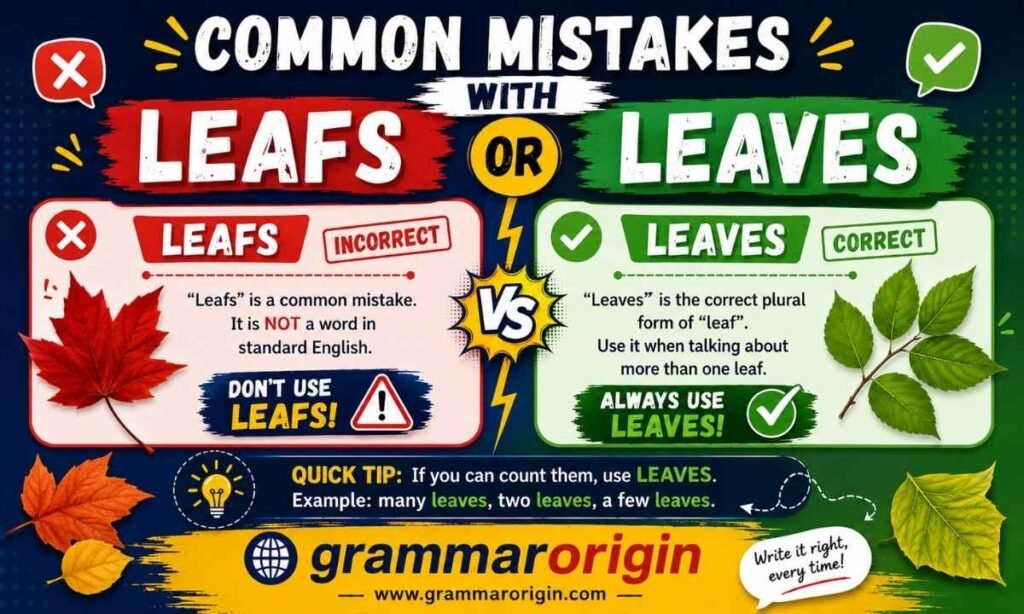
Most errors here come from applying a rule that works for other words but not this one. Roof becomes roofs, so it feels like leaf should become leafs too — except it doesn’t.
Mistake 1:
Writing “the plant has many leafs” instead of leaves.
Mistake 2:
Assuming a sports team name proves the grammar rule can bend elsewhere — it can’t. Names get their own exceptions; regular nouns don’t.
Mistake 3:
Mixing up leaves the plural noun with leaves the verb (“he leaves the office at five”). Same spelling, completely different job in the sentence.
Leaf vs Leaf’s vs Leafs vs Leaves — Possessive Confusion Explained
These four forms trip people up because they look almost identical but mean completely different things. Once you separate them by function, the confusion mostly disappears.
- Leaf — one single leaf (singular noun)
- Leaf’s — something belonging to one leaf, like “the leaf’s edge was brown”
- Leafs — a verb form, or part of a proper name
- Leaves — more than one leaf (standard plural noun)
The apostrophe is the giveaway. If you’re showing ownership, you need the possessive form leaf’s. If you’re counting more than one, you need leaves — never a stray apostrophe, and never a plain “leafs.” The only time a bare “leafs” is correct is as a third-person verb or inside a proper name.
Leafs or Leaves in Everyday Examples
Seeing the word in real contexts makes the rule stick faster than any explanation does.
In writing:
“Rain knocked most of the leaves off the maple by Tuesday.”
In conversation:
“Can you rake the leaves before it gets dark?”
In school work:
“Deciduous trees lose their leaves once temperatures drop, and autumn leaves are a classic example of this cycle.”
In the rare verb sense:
“He leafs through the report before every meeting.”
Notice how leafs only appears once, and only as an action — never once describing something you’d find on a branch.
Also Read this Divet or Divot
Leafs or Leaves – Google Trends & Usage Data
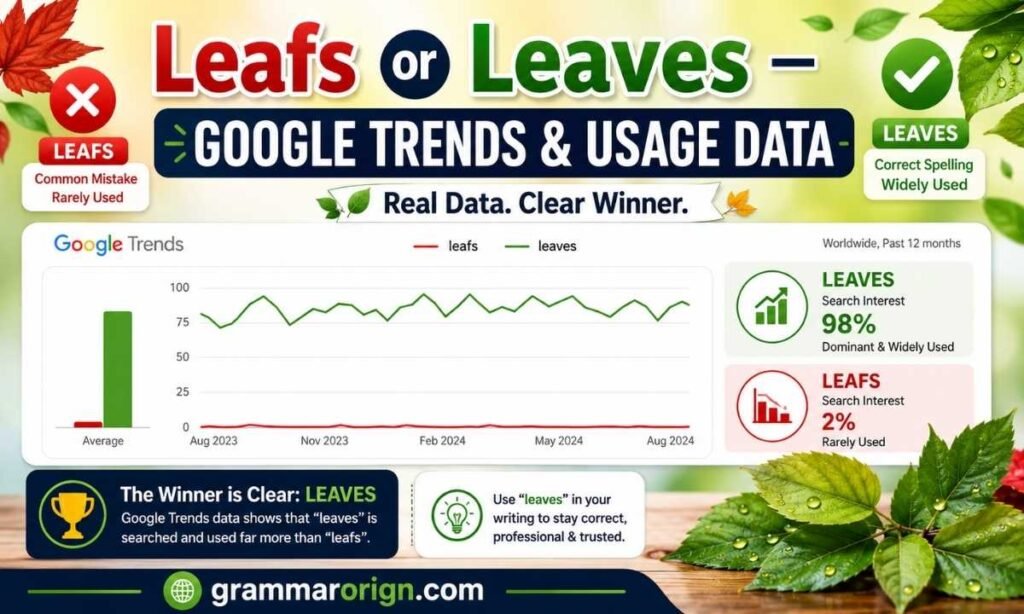
Search and usage data consistently show leaves far outpacing leafs in everyday writing, news coverage, and published books. That gap has stayed steady for decades rather than shifting with trends.
| Metric | Leafs | Leaves |
| Use in published writing | Rare | Standard |
| Use in casual search queries | Common (as a search, not correct usage) | Common |
| Recommended in style guides | No (except proper nouns) | Yes |
People still type “leafs” into search bars constantly — that’s exactly why this topic keeps trending. But typing it and writing it correctly are two different things, and the data makes clear which one professional writing settles on.
Comparison Table: Leafs vs Leaves
| Feature | Leafs | Leaves |
| Correct plural for plants | No | Yes |
| Works as a verb | Yes | No |
| Appears in proper names | Yes (e.g., hockey team) | No |
| Safe for exams and formal writing | No | Yes |
| Used in idioms (“turn over a new leaf”) | No | N/A (idiom uses singular “leaf”) |
| Regional variation (US/UK) | None | None |
Frequently Asked Questions
Which is correct, leafs or leaves?
Leaves is correct for the plural of leaf in nearly every situation. Leafs only applies as a verb or inside a specific proper name.
Is it leaves or leafs on a tree?
Always leaves. Trees, bushes, and plants take the standard irregular plural, with no exceptions for casual or formal writing.
Why leafs instead of leaves?
Leafs shows up mainly in the verb sense, as in “she leafs through a book,” or as part of a fixed name like a sports team. It isn’t an alternate spelling of the plant noun.
Leafs or leaves pronunciation?
Leaves is pronounced with a soft “v” sound, like “leevz.” Leafs, when it’s used as a verb, keeps the harder “f” sound, closer to “leefs.”
Leafs or leaves meaning?
Leaves means more than one leaf, or refers to the verb “to leave.” Leafs means someone is flipping through pages, or it’s part of a proper name.
Leafs or leaves drawing?
If you’re labeling a drawing of a plant, tree, or branch with multiple leaf shapes, the correct label is leaves. Leafs would only fit if the drawing were illustrating someone turning pages.
Cheque leafs or leaves?
Individual pages torn from a chequebook are called cheque leaves, not cheque leafs. The same plural rule that applies to trees applies here, since “leaf” keeps its irregular plural across every context except verbs and proper names.
Final Thoughts
Leaves is the plural you’ll reach for almost every single time, whether you’re writing about trees, filling out schoolwork, or drafting a professional email. Leafs sticks around only in two corners of the language: as a verb describing page-turning, and inside proper names that were never meant to follow standard grammar anyway.
Once that distinction clicks, the leafs or leaves question stops being confusing. Pick leaves by default, save leafs for those two specific exceptions, and you’ll be right nearly every time you write.

Muhammad Waqas is an English language teacher and grammar expert with over 8 years of experience helping students and professionals improve their writing skills. He specializes in English grammar, vocabulary, communication, and practical language learning. Through GrammarOrigin, Waqas shares clear, easy-to-understand content that helps readers write and speak English with confidence.