
You typed “knaw,” stared at it for a second, and something felt off. That instinct was right — gnaw is the correct spelling, and the knaw or gnaw mix-up is one of English’s more common silent-letter mistakes.
Still, the story is a little more layered than a flat “wrong word” verdict. Knaw shows up in old texts and in a few dialect spellings, and knowing why helps settle the knaw or gnaw question for good.
Knaw or Gnaw – Quick Answer
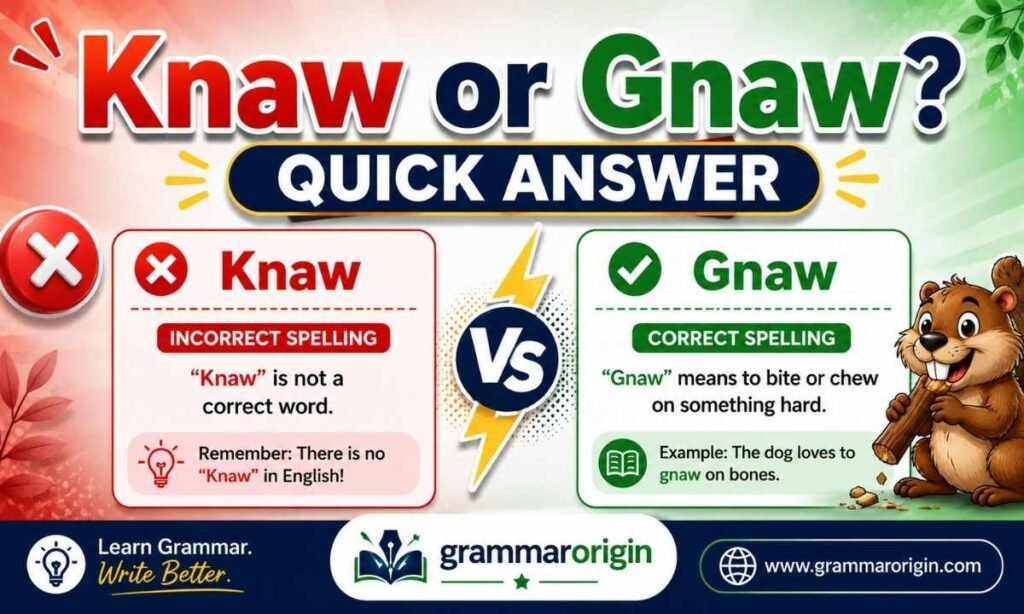
Gnaw is correct. Knaw is not accepted in modern, standard English, so if you’re weighing knaw or gnaw for a sentence, gnaw is the safe choice every time.
Use it like this: the beaver gnawed through the branch in under a minute. Swap in “knaw” and any editor, teacher, or spell-checker will flag it as a spelling error immediately. The silent g at the start is the whole reason this particular confusion exists — your ear never hears it, so your hand wants to write what it hears instead.
Knaw Meaning (Is It a Real Word?)
Knaw isn’t part of standard modern English, but it isn’t pure nonsense either — it has two narrow, old-fashioned uses that explain why the knaw or gnaw question keeps coming up.
Older printed texts sometimes used knaw as a variant spelling of gnaw, back when English spelling hadn’t fully standardized. Separately, some dialect and eye-dialect writing uses “knaw” to represent a regional pronunciation of the word “know” — a completely different word with a completely different meaning. Neither use belongs in everyday or professional writing today, so if you’re choosing a word for an email, essay, or article, gnaw is the only real option.
The Origin of Knaw or Gnaw
Gnaw traces back to the Old English word gnagan, which already meant to bite or chew. A related form existed in Old High German too, so this isn’t a one-off spelling quirk — it’s part of a much older Germanic word origin.
English kept a handful of other “gn-” words from that same root family, and every one of them dropped the hard g sound while keeping the letter on the page:
- gnaw
- gnat
- gnash
- gnome
Knaw never developed through that same history, which is exactly why the knaw or gnaw comparison tends to confuse people who assume every silent letter follows the same pattern. It’s simply what happens when someone spells a word by ear instead of by memory, since “kn-” already exists in familiar words like knee, knife, and knock.
British English vs American English Spelling
There’s no regional split in the knaw or gnaw debate — British and American English both write it the exact same way.
That puts gnaw in a different category from spelling pairs like colour/color or realise/realize, where the two dialects genuinely diverge. No matter which side of the Atlantic your reader is on, the spelling doesn’t change.
Comparison Table
| Region | Spelling Used | Sample Sentence |
| American English | Gnaw | The mice gnawed a hole in the cereal box. |
| British English | Gnaw | Guilt gnawed at him for weeks. |
| Australian English | Gnaw | Termites gnaw through untreated timber fast. |
| Canadian English | Gnaw | The puppy wouldn’t stop gnawing the rug. |
Which Spelling Should You Use?
Write gnaw. Every time, for every audience, in every English-speaking country — there’s no version of the knaw or gnaw choice where “knaw” wins.
There’s no formal-versus-casual distinction to weigh here either — gnaw works equally well in a text message and a research paper. The only version of this word that belongs in modern writing is the one with the silent g.
Also Read This Leafs or Leaves
Common Mistakes with Knaw or Gnaw
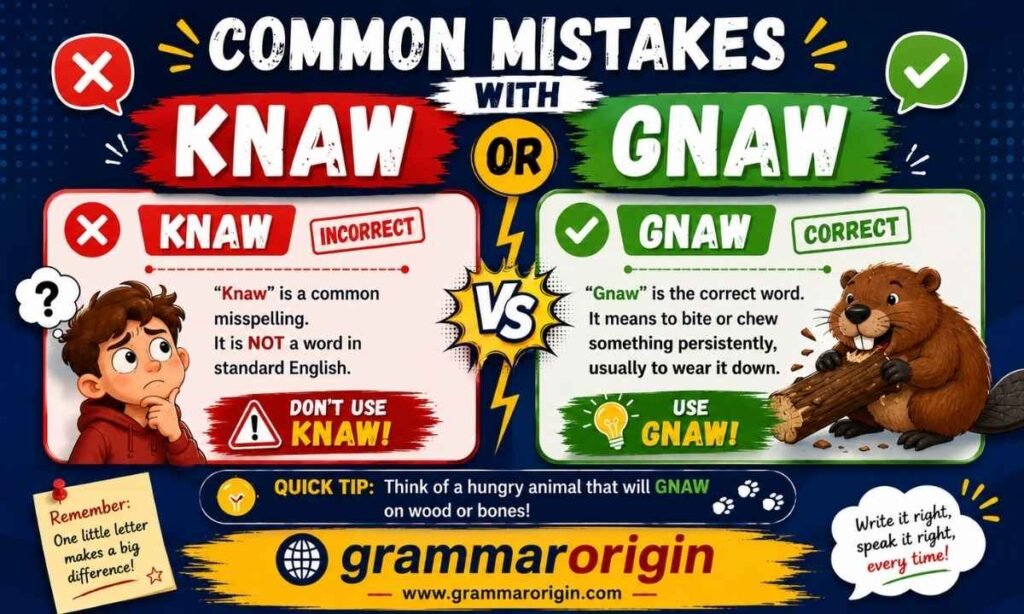
Most mistakes tied to the knaw or gnaw question come down to sound-based guessing rather than a lack of vocabulary.
| Wrong | Right |
| The dog started to knaw its bone. | The dog started to gnaw its bone. |
| Doubt began to knaw at her decision. | Doubt began to gnaw at her decision. |
| Squirrels knaw through wooden fences. | Squirrels gnaw through wooden fences. |
A second, smaller mistake: treating “knaw” as some kind of British spelling. It isn’t regional at all — it’s simply a common misspelling that happens to look plausible because of how English hides silent letters.
Gnaw meaning
Gnaw means to bite or chew on something with small, repeated bites rather than one large one — and by extension, to slowly wear something down.
That covers two different situations. Physically, an animal or insect can gnaw wood, bone, or fabric down over time. Figuratively, a feeling — worry, guilt, hunger, doubt — can “gnaw at” someone, meaning it keeps bothering them without letting up. Dictionaries list both senses under the same entry, which is worth knowing if you’re double-checking the knaw or gnaw definition yourself.
How to pronounce gnaw
Gnaw is pronounced /nɔː/ — it rhymes with “law,” “saw,” and “paw.”
The g is completely silent; you never voice it, not even softly. If you’re used to sounding out unfamiliar words letter by letter, this is one case where that habit will actively mislead you, and it’s the main reason the knaw or gnaw spelling error happens in the first place.
Knaw or gnaw pronunciation
Because gnaw sounds exactly like “naw,” the spoken word gives you zero clues about which letter comes first — g or k.
That’s precisely why the misspelling spreads. English learners, and plenty of native speakers, hear a word for years before ever writing it down, and by the time they do, the ear has already made a guess the eye can’t confirm. This is the core reason the knaw or gnaw pronunciation question and the spelling question are really the same problem.
Knaw or gnaw synonym
If you want a different word for the same idea, several synonyms cover similar ground, though none matches gnaw’s sense of slow, repeated action exactly.
- Nibble — smaller, gentler bites
- Chew — general biting and grinding
- Erode — wearing away gradually, often used for non-living things
- Munch — casual, often food-related
- Crunch — biting with an audible crack
- Chomp — a heavier, more forceful bite
For the figurative sense — worry that won’t go away — “erode” or “eat away at” come closest to gnaw’s meaning, and neither one raises a knaw or gnaw spelling question at all.
Knaw or gnaw reddit
Search this exact phrase and you’ll find it pop up across grammar subreddits and ESL forums, usually from someone who just typed “knaw” and had autocorrect leave it alone.
There’s no single famous thread that settled the knaw or gnaw question once and for all — it’s more of a recurring, low-key question than a viral debate. The consistent answer across those communities matches what dictionaries say: gnaw is correct, and knaw is a typo that autocorrect sometimes misses because it does technically resemble a word.
Gnaw in a sentence
Seeing the word in different settings makes the correct spelling easier to remember than any rule does, and it settles most knaw or gnaw doubts on sight.
- The rat had gnawed straight through the cardboard overnight.
- A quiet worry gnawed at her all through the meeting.
- Beavers gnaw tree trunks down to sharp points before they fall.
- He gnawed on his pen cap while he thought through the problem.
- The unresolved argument kept gnawing at both of them for days.
Knaw or Gnaw in Everyday Examples
Different types of writing call for slightly different tones, but the knaw or gnaw answer never shifts with the setting.
Emails
Keep it plain and professional: “The delay has started to gnaw at the client’s confidence in our timeline.” Short, direct, and it fits a status update without sounding overdramatic.
News
Journalists lean on the figurative sense often: “Uncertainty continues to gnaw at investor sentiment ahead of the announcement.” It’s a compact way to describe a slow-building tension.
Social Media
Casual and quick: “My dog has been gnawing on that same toy for three days straight lol.” Informal tone, correct spelling — the two aren’t in conflict.
Formal Writing
Academic and business writing use it too: “Long-term uncertainty may gnaw away at institutional credibility if left unaddressed.” It reads as precise rather than casual, which is part of why it works in formal contexts.
Also Read This Leafs or Leaves
Knaw or Gnaw – Google Trends & Usage Data
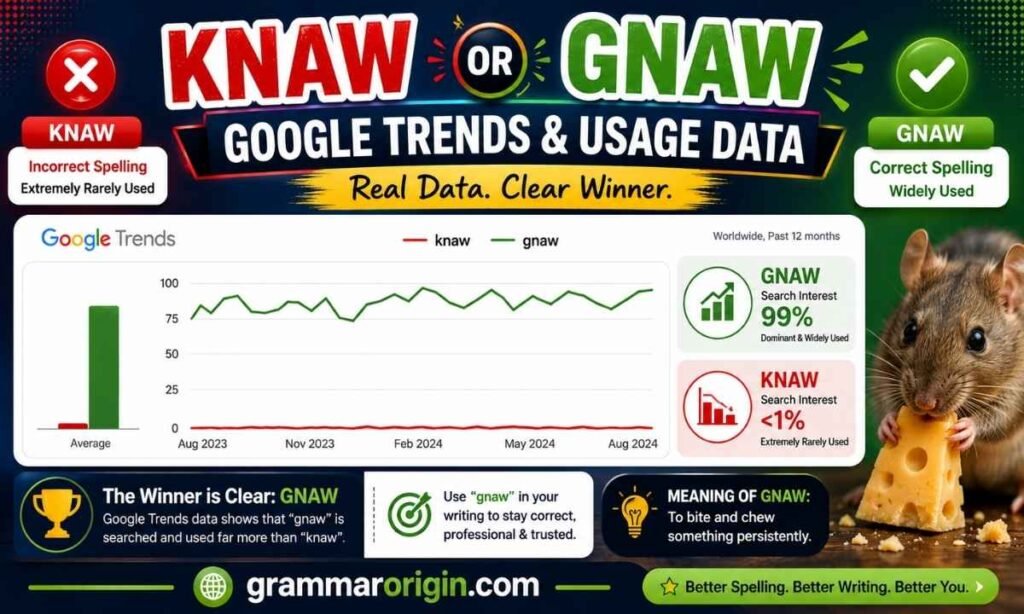
Exact public search-volume numbers for the knaw or gnaw query aren’t something any site can verify without direct platform access, so treat any specific figure you see elsewhere with some skepticism.
What’s observable instead is the pattern: this is a classic silent-letter search, similar in shape to queries like “knight or nite” or “gnome or nome.” Traffic for these grammar questions tends to come from students, ESL learners, and writers double-checking themselves mid-sentence — not from people debating regional dialects, since (as covered above) there’s no regional split to debate.
Comparison Table: Knaw vs Gnaw
| Feature | Gnaw | Knaw |
| Standard modern spelling | Yes | No |
| Found in major dictionaries | Yes | Only as an archaic/dialect note |
| Historical root | Old English gnagan | No independent origin |
| Safe for formal writing | Yes | No |
| Regional variant | None (same everywhere) | Sometimes used as dialect eye-spelling of “know” |
Frequently Asked Questions
Is knaw ever correct in modern English?
No. Modern dictionaries and style guides only recognize gnaw as the standard spelling; knaw survives only in old texts and dialect writing.
Why is the g silent in gnaw?
It comes from the word’s Old English root, where the “gn-” combination was written but never pronounced with a hard g, a pattern that carried through into modern spelling.
What part of speech is gnaw?
Gnaw is a verb. It conjugates as gnaw, gnawed, and gnawing.
Can gnaw be used figuratively?
Yes. It’s commonly used for a feeling — worry, guilt, doubt, hunger — that keeps bothering someone over time, as in “guilt gnawed at him.”
Does British English spell gnaw differently than American English?
No. Both use the identical spelling, unlike pairs such as colour and color, so the knaw or gnaw answer stays the same across every English-speaking country.
What is the past tense of gnaw?
Gnawed, as in “the beaver gnawed through the branch overnight.”
Is knaw or gnaw a common autocorrect mistake?
Yes. Knaw is the more common typo in the knaw or gnaw pair, largely because “kn-” already exists in familiar words like knee and knife, so it feels like a believable guess even though it’s wrong.
Conclusion
Gnaw is the correct spelling in every English-speaking country, in every writing context, with no exceptions worth worrying about. Knaw survives only as a historical footnote and an occasional dialect spelling of “know” — not as an alternative for the word you’re actually looking for.
Once you connect gnaw to gnat and gnash, the silent g pattern becomes automatic, and the knaw or gnaw question shouldn’t cost you a second thought again.

Muhammad Waqas is an English language teacher and grammar expert with over 8 years of experience helping students and professionals improve their writing skills. He specializes in English grammar, vocabulary, communication, and practical language learning. Through GrammarOrigin, Waqas shares clear, easy-to-understand content that helps readers write and speak English with confidence.