
If you’ve ever typed this word into a sentence and paused before adding an ending, you’re not the only one. It looks a lot like “thief,” and thief becomes thieves, so it’s easy to assume the same shift applies here.
It doesn’t. The correct plural form is chiefs, not chieves — and once you see the reasoning, you’ll never second-guess the spelling again. This guide covers the pluralization rule, the singular-to-plural noun formation behind it, and how it compares to similar irregular and regular plurals like cliff, gulf, belief, and handkerchief.
Quick Answer
The correct plural is chiefs. It’s formed the regular way — just add an -s to the singular noun, with no spelling change and no exceptions.
- Correct: chiefs
- Incorrect: chieves
That’s the entire grammar rule. This word doesn’t shift its ending the way irregular plurals like knife or leaf do, and there’s no British-versus-American split to worry about either.
Chief vs Chieves Clearing the Confusion
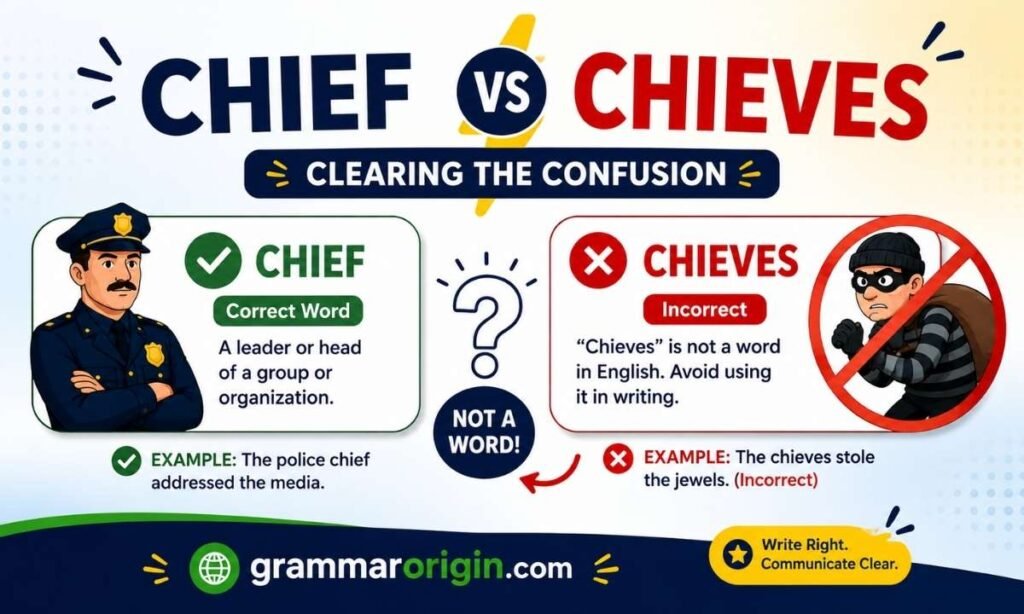
The mix-up happens because English has a well-known group of nouns ending in -f that swap to -ves in the plural: knife becomes knives, leaf becomes leaves, wolf becomes wolves. Thief, its closest lookalike, becomes thieves.
Seeing that pattern, it’s natural to guess this noun should follow suit. But it sits in a different camp entirely. The final sound stays intact, and it simply takes an -s, landing on the same plural form every time — police leaders, tribal elders, or a corporate head of staff, all pluralized the same way.
Once you separate the two lookalike words in your head, the confusion tends to disappear for good.
English Plural Rules for Nouns Ending in -F
Nouns ending in -f or -fe don’t all behave the same way when forming a plural noun, and that inconsistency is really the root of the confusion. There are three loose groups worth knowing.
| Pattern | Rule | Examples |
| Add -s only | No spelling change | chief → chiefs, roof → roofs, cliff → cliffs |
| Change f to ves | f or fe replaced with ves | leaf → leaves, knife → knives, wolf → wolves |
| Both accepted | Either ending works | scarf → scarfs/scarves, hoof → hoofs/hooves |
There’s no single spelling trick that predicts which category a singular noun falls into — native English speakers mostly learn these irregular plurals through repeated exposure. This particular word belongs firmly to the first, regular group, alongside roof and cliff.
Why Chief Follows the Regular Plural Rule
This word traces back to Old French “chef,” meaning head or leader, which itself comes from the Latin “caput.” Words that entered the English language through French tend to keep a steadier spelling pattern than nouns with older Germanic roots, like wolf or knife.
That Germanic group is where most of the f-to-ves shifts happen in English grammar. Since this particular noun came from a different linguistic branch, it never picked up that shift — it just follows the standard pluralization pattern used across thousands of regular English nouns.
There’s also a sound-based clue. Say the correct plural out loud, then try the incorrect version. The first sounds natural; the second feels forced, because native speakers never actually developed that pronunciation.
Example Sentences Using Chiefs
Seeing the plural noun in real sentences makes it stick faster than memorizing a rule.
- The regional fire chiefs met to review last winter’s response times.
- Three tribal chiefs signed the new land agreement on Tuesday.
- Company leaders from across the industry gathered for the summit.
- Regional supervisors in the district are testing a new patrol schedule.
- Several department heads briefed the committee before the vote.
Notice that the plural form always refers to more than one leader or head of a group — the meaning stays consistent no matter the setting.
Related Plurals of Similar Words
A side-by-side list makes the pattern easier to remember than any single grammar rule on its own.
| Word | Plural | Pattern |
| Chief | Chiefs | Add -s |
| Cliff | Cliffs | Add -s |
| Gulf | Gulfs | Add -s |
| Belief | Beliefs | Add -s |
| Handkerchief | Handkerchiefs | Add -s |
| Roof | Roofs | Add -s |
| Thief | Thieves | Change f to ves |
| Leaf | Leaves | Change f to ves |
| Knife | Knives | Change f to ves |
| Wolf | Wolves | Change f to ves |
Bookmark this table. Whenever a new noun ending in -f trips you up, checking it against a reference list like this beats guessing by analogy.
Common Grammar Mistakes
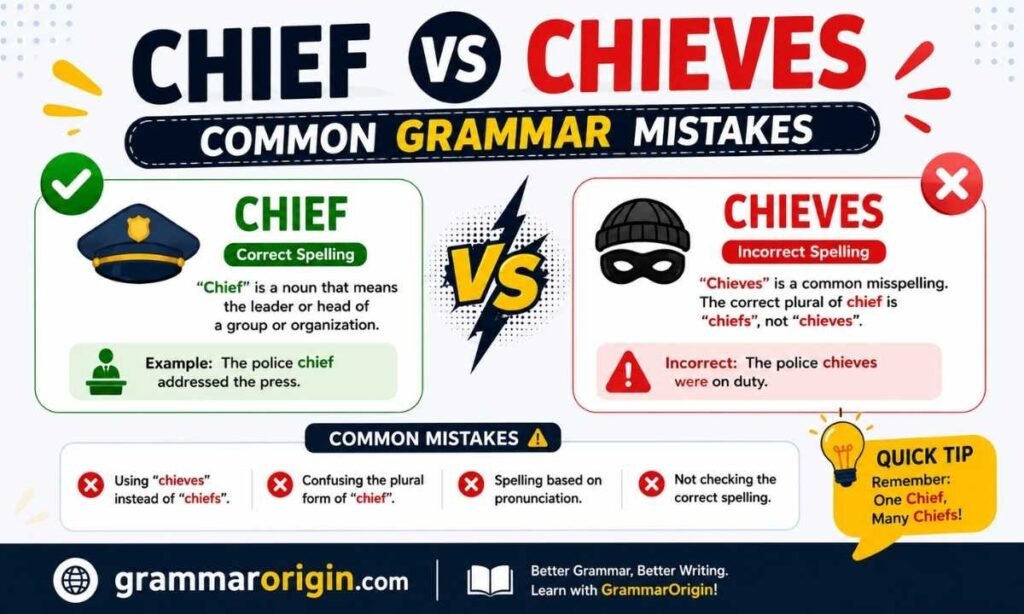
The single biggest slip is writing the irregular-looking form instead of the correct one, almost always because the writer’s brain jumps straight from “thief” without double-checking.
A second common error is mixing up the plural with the possessive form — “the leader’s report” belongs to one person, while “the leaders’ report” belongs to several. A third slip shows up in compound job titles, where writers sometimes pluralize the wrong word entirely, since the first word in such titles usually acts as an adjective rather than the noun being pluralized.
Reading a sentence back out loud usually catches these grammar errors before a reader does, and it’s a quick habit worth building into any proofreading routine.
Also Read This Which of the Following
Quick Grammar Tip
Say the plural out loud before you write it down. If it sounds smooth — like roofs or beliefs — it’s almost certainly a regular -s plural. If it sounds like it wants a v sound, like thieves or wolves, it likely belongs to the irregular group instead.
It’s not a perfect test for every noun in the English language, but for this word and its close relatives, your ear will rarely steer you wrong.
Plural of chief is chieves
This is incorrect. “Chieves” isn’t a recognized English word — it doesn’t appear in Merriam-Webster, Oxford, or Cambridge, and no style guide treats it as an accepted variant, formal or informal.
The correct form is always the regular -s plural, with no exceptions across contexts or regions.
Why is the plural of chief chiefs and not chieves
This noun keeps the regular -s ending because of where it came from. It entered the English language through Old French rather than Old English or Germanic roots, and French-derived nouns generally resist the f-to-ves shift that reshaped words like wolf and leaf.
Pronunciation backs this up too — the final sound never naturally softened the way it did in thief, so the plural stayed simple.
Plural of chief in english
In standard English, this plural noun takes only one accepted form, no informal variants. This holds true whether you’re writing a news report, a business memo, or casual conversation.
There’s no informal or regional exception anywhere in the English-speaking world — this plural form is the only one dictionaries and grammar authorities recognize.
Plural of chief in british English

British English uses exactly the same plural noun as American English. There’s no UK-specific spelling variant the way there sometimes is with words like “colour” versus “color.”
| Region | Plural of Chief |
| American English | Chiefs |
| British English | Chiefs |
You’ll see it in UK contexts just as often — “the armed forces’ senior leaders met in London,” or “regional police heads issued a joint statement” — with the spelling never changing.
Plural of cliff
The plural of cliff is cliffs. Like the word above, it simply adds -s with no spelling change, even though it ends in the same letter as words like leaf that do shift to -ves.
Example: The coastal cliffs along that stretch of shoreline draw hikers every summer.
Plural of gulf
The plural of gulf is gulfs. It follows the same regular add-s pattern, with the final sound staying intact in the plural form.
Example: Several gulfs along the coastline serve as natural harbors for fishing boats.
Also Read This Which of the Following
Plural of belief
The plural of belief is beliefs. This word shares the same -ief ending as our focus word, and that shared pattern is part of why both nouns take the regular -s plural instead of shifting to -ves.
Example: Their beliefs about the project shaped every decision the team made.
Plural of handkerchief
The plural of handkerchief is handkerchiefs. Even though it’s a compound word built partly from the same root, it follows the exact same rule — add -s, no change to the ending.
Example: She kept a drawer full of embroidered handkerchiefs from her grandmother.
Frequently Asked Questions
What is the plural of chief?
The plural of chief is chiefs. You form it by adding -s to the singular noun, with no change to the spelling or ending.
Is it chiefs or chieves?
It’s chiefs. Chieves isn’t a real word in any recognized English dictionary, despite how natural it might sound next to “thieves.”
Why doesn’t this word follow the same pattern as thief?
The two nouns share a similar ending but different word histories. This one comes from Old French and keeps the regular -s plural, while thief has older roots that produced the -ves shift.
Does British English use a different plural form?
No. British and American English both use the same plural, with zero regional variation.
How do you pluralize compound titles like “chief executive officer”?
You pluralize the noun that follows it, since the first word acts as an adjective there — so it’s “chief executive officers,” not the reverse. An exception is “chief of staff,” which becomes “chiefs of staff,” since “of staff” is a prepositional phrase rather than a noun directly attached to the lead word.
What’s the plural of chef, and is it different from chief?
The plural of chef is chefs — same regular -s pattern, but the two words are entirely different. A chef cooks; the other word refers to a leader. They’re easy to mix up in casual writing, but the meanings don’t overlap.
Are there any other -ief words that behave the same way?
Yes — belief, relief, brief, and grief all take the regular -s plural too. The -ief ending is one of the more reliable patterns in this otherwise inconsistent corner of English grammar.
Final Thoughts
The plural of chief is chiefs, formed the regular way by adding -s, with chieves never being a valid alternative in any dictionary or style guide. The confusion makes sense given how many nouns ending in -f do shift to -ves, but this word’s Old French roots keep it firmly in the regular camp alongside cliff, gulf, belief, and handkerchief.
Next time you’re writing about police chiefs, tribal leaders, or company heads, you can use this plural with full confidence — no need to double-check it again.

Muhammad Waqas is an English language teacher and grammar expert with over 8 years of experience helping students and professionals improve their writing skills. He specializes in English grammar, vocabulary, communication, and practical language learning. Through GrammarOrigin, Waqas shares clear, easy-to-understand content that helps readers write and speak English with confidence.