
Ever stared at a quiz question starting with “which of the following” and wondered if you should say “is” or “are”? Or whether “followings” is even a real word? You’re dealing with one of English’s most common test-writing phrases, and getting it right matters more than you’d think.
This phrase is the correct, standard form always singular “following,” never “followings.” Below, we’ll cover exactly how to use it, when to pick “is” versus “are,” and where most learners trip up.
Quick Answer
“Which of the following” is correct. It asks a reader to pick an answer from a list that comes right after the question, and the word “following” never takes an “s.”
Use “is” when you expect one correct answer, and “are” when more than one option could be right. That single rule solves most of the confusion people have with this phrase.
What Does “Which of the Following” Mean?
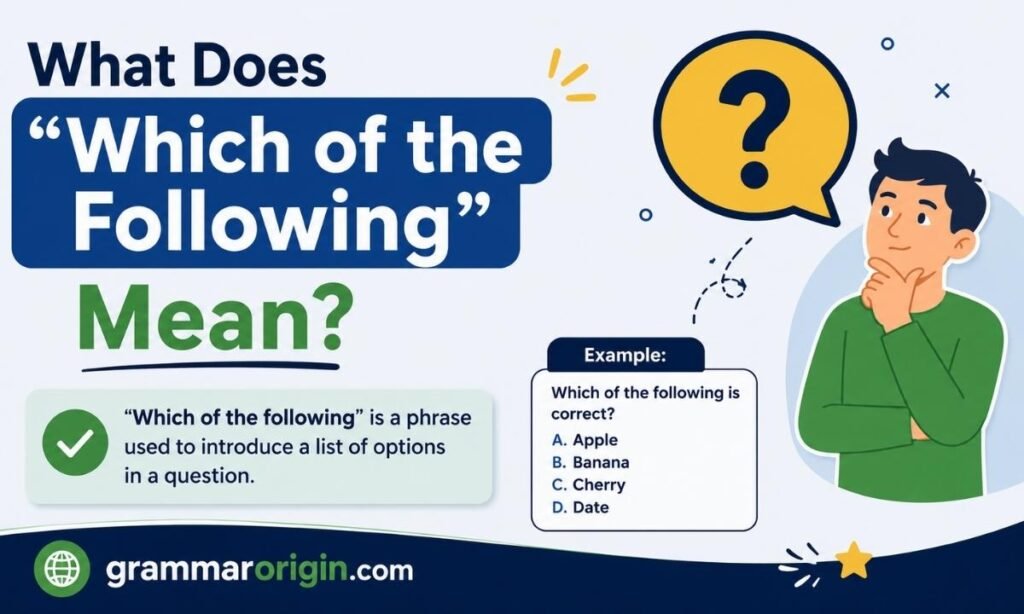
This phrase asks someone to choose the right answer from a list of options placed directly after the question. It’s a selection prompt, not a statement.
Here’s a simple example:
Which of the following is a metaphor? A) The sun is bright. B) Time is a thief. C) She ran quickly. D) The dog barked.
The correct answer is B the list narrows the reader’s focus to four specific choices instead of leaving the question open-ended.
Teachers, researchers, and test designers reach for this structure because it’s precise. It tells readers exactly where to look for the answer, cutting down on guesswork before they even start reading the options.
How to Use “Which of the Following” Correctly
Use this phrase whenever you’re building a question that hands the reader a list to choose from quizzes, surveys, or classroom exercises all fit.
The basic pattern looks like this:
[Question stem] + verb + subject or category?
Following that pattern keeps the sentence easy to scan the options that come next slot in immediately, either as a list or inline in the sentence.
Keep the wording tight. Long, wordy lead-ins before the options bury the point and make readers reread the question twice.
Is It “Which of the Following Is” or “Are”?
Both are correct the choice depends on how many answers you expect, not on subject-verb agreement with the words in the list itself.
Use “is” when only one option should be correct:
Which of the following is a prime number?
Use “are” when multiple options can be correct:
Which of the following are common punctuation marks?
A trick that helps: ask yourself how many boxes a test-taker should check. One box means “is.” More than one means “are.” The list’s length has nothing to do with it.
“Which of the Following” vs “Which of the Followings”
Only the two-word form is correct. The pluralized version is a grammar mistake that shows up constantly in ESL writing and rushed test questions.
Here’s why: “following” in this phrase works like an adjective doing a noun’s job grammarians call this a substantive adjective, not a collective noun. Adjectives don’t pluralize in English, so “following” stays fixed no matter how many items sit in the list.
Interestingly, “followings” is a real word just not this one. It refers to groups of fans or supporters, as in “the singer built a loyal followings across three countries” completely unrelated to test questions or option lists. That’s the source of most of the confusion: people assume any noun-like word can take an “s,” but this particular usage never does.
Examples of “Which of the Following” in Sentences
Seeing the phrase across different fields makes the grammar pattern easier to remember than any rule on its own.
Academic Example
Which of the following best explains the causes of the French Revolution?
Science Example
Which of the following are examples of renewable energy sources?
Grammar Example
Which of the following sentences uses the correct verb tense?
Survey Example
Which of the following best describes how often you exercise each week?
Professional Example
Which of the following strategies would most improve team communication?
Notice how the sentence structure barely changes only the subject after the phrase shifts to match the topic.
Why Multiple-Choice Questions Use This Phrase
Test writers use this structure because it removes ambiguity the reader knows immediately that the answer sits among a fixed set of choices, not somewhere open-ended.
It also standardizes question format across an entire exam. When every question follows the same pattern, students spend less time figuring out what’s being asked and more time actually answering.
Search engines and content platforms treat it the same way as a signal of instructional, selection-based intent, which is why it shows up so often in study guides, standardized tests, and online quizzes.
Common Grammar Mistakes With “Which of the Following”
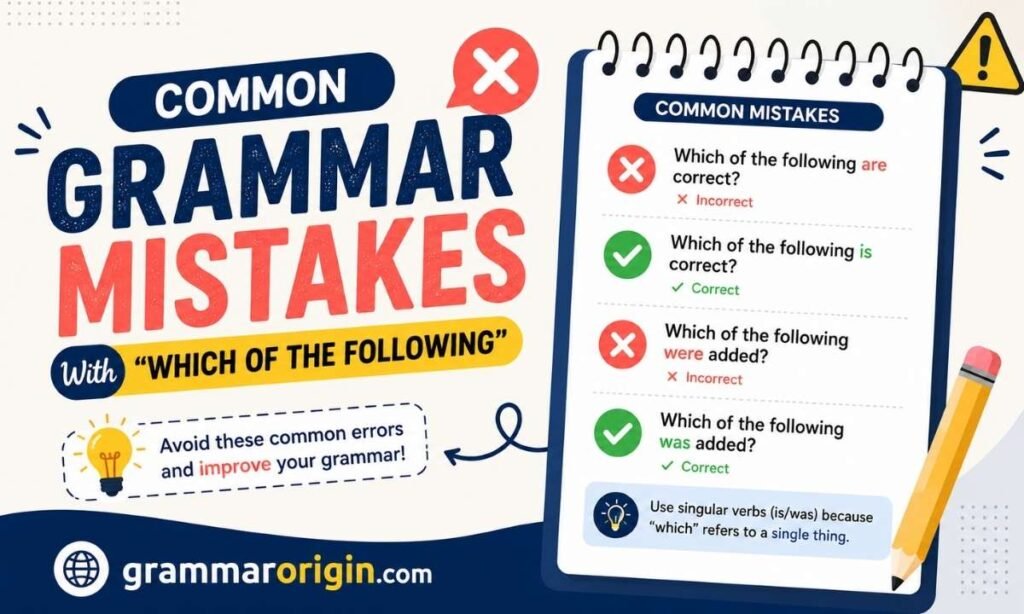
Most errors here come down to verb mismatch or the “followings” slip-up both are easy to fix once you know what to look for.
Incorrect: Which of the followings is a mammal? Correct: Which of the following is a mammal?
Other common slips include mismatched verbs (using “are” when only one answer fits), vague answer options, questions that give away the answer through grammar clues, and sentences that ramble before reaching the actual question.
Quick Grammar Rules to Remember
A handful of short rules cover nearly every situation you’ll run into with this phrase.
Rule 1: Use “following,” not “followings”
“Following” stays singular in this context no exceptions, regardless of how many items appear in the list below it.
Rule 2: Match the verb with the answer
Pick “is” for one expected answer and “are” for multiple expected answers the noun that follows doesn’t decide this, the answer count does.
Rule 3: Keep the sentence clear
Short, direct wording works better than a long setup readers should reach the actual question within the first few words.
Rule 4: Use the phrase for selection questions
Save this structure for genuine list-based choices it feels awkward if there’s nothing for the reader to actually select from.
“Which of the Following” in Academic Writing
This phrase shows up constantly in research papers, standardized tests, and classroom worksheets because it keeps questions objective and easy to grade.
A professor writing a survey might ask readers to identify which factor most influenced their career choice, listing several options below. That phrasing forces respondents to pick from a defined set rather than write open-ended answers.
Academic style guides generally treat it as acceptable formal English, provided the verb agreement and pluralization rules stay correct throughout the document.
How AI and Search Engines Understand This Phrase
Search engines read this phrase as a strong signal of educational or instructional intent the kind of query someone types while studying, not casually browsing.
That’s why pages built around this phrase often surface in featured snippets and “People Also Ask” boxes rather than standard blue-link results. Google’s systems recognize the question-and-answer-list pattern and prioritize content that answers it directly.
For writers, this means front-loading the answer, keeping examples concrete, and avoiding vague filler AI-driven search tools reward clarity here more than keyword repetition.
Alternative Phrases You Can Use Instead
Repeating the same question stem across dozens of items gets monotonous fast, so swapping in alternatives keeps writing fresh.
- Which one of these
- Choose the correct answer
- Select the best option
- Which statement is true
- Pick the correct response
Each carries a slightly different tone some feel more like direct instructions, others stay closer to a formal question.
Read Also This Of Course or Ofcourse
Difference Between “Which of the Following” and Similar Phrases
These phrases share a similar job but land differently depending on how formal or direct you want the question to sound.
| Phrase | Tone | Best Use Case | Example |
| Which of the following | Formal, academic | Exams, standardized tests | “Which of the following is a noun?” |
| Which of these | Conversational | Casual quizzes, surveys | “Which of these do you prefer?” |
| Choose the correct answer | Direct instruction | Worksheets, forms | “Choose the correct answer below.” |
| Select one | Brief, functional | Online forms, surveys | “Select one option.” |
“Which of the Following”
Sounds structured and exam-like the natural pick for academic or standardized testing content.
“Which of These”
A shorter, more casual cousin of the same idea, common in everyday conversation and informal surveys.
“Choose the Correct Answer”
Skips the question format entirely and gives a direct command instead useful when brevity matters more than tone.
“Select One”
Common in digital forms and dropdown menus, where space is limited and formality isn’t the priority.
Tips for Writing Better Multiple-Choice Questions
Good questions stay short, fair, and free of accidental hints toward the right answer.
Keep options clear
Avoid vague or overlapping choices that could confuse even someone who knows the material.
Use consistent grammar
Every option should match the question’s grammatical form mixing tenses or structures signals which answer is “different.”
Avoid grammar clues
Don’t let the correct answer stand out just because it’s phrased more naturally than the wrong ones.
Use simple language
Complicated vocabulary tests reading comprehension more than actual subject knowledge.
Remove unnecessary words
Trim anything that doesn’t help the reader understand what’s being asked shorter questions get answered faster and more accurately.
Which of the following is not
This negative variation flips the usual pattern instead of finding what’s true, the reader identifies the one option that doesn’t belong.
Example: “Which of the following is not a primary color?” A) Red B) Blue C) Green D) Yellow the answer here is C, since green is a secondary color.
This format tests careful reading as much as subject knowledge, since it’s easy to instinctively pick a correct-sounding answer instead of the odd one out.
Which of the following statements
This version asks readers to judge entire sentences rather than single words or short phrases, usually to test comprehension or factual accuracy.
Example: “Which of the following statements accurately describes photosynthesis?” Each option presents a full claim, and only one holds up under scrutiny.
It’s especially common in science and reading-comprehension sections, where nuance in wording often separates the correct statement from a near-miss.
Read Also This Of Course or Ofcourse
Which of the following is an example of
Here, the phrase asks readers to match a specific instance to a broader category or concept already introduced in the question.
Example: “Which of the following is an example of a chemical reaction?” The options list several processes, and only one actually fits the category being tested.
This structure works well for checking whether someone can apply a concept, not just recall its definition.
Which of the following meaning
At its core, this phrase simply means “which option from this list is correct or true.” It’s a fixed, formal way of asking someone to choose.
People search this exact phrase when they’ve seen it in a test or worksheet and want a plain-language explanation before answering. The meaning doesn’t shift based on subject grammar, science, or general trivia all use it the same way.
Frequently Asked Questions
What does “which of the following” mean?
It asks the reader to pick the correct answer from a list of options placed right after the question.
Is “which of the following” singular or plural?
The phrase itself stays singular in form, but the verb that follows “is” or “are” depends on how many correct answers are expected.
Can you say “which of the followings”?
No. Standard English never pluralizes “following” in this construction, even though “followings” exists as an unrelated word meaning fan bases or audiences.
Why do exams use this phrase so often?
It standardizes question format and removes ambiguity, letting test-takers know exactly where to find the correct answer.
Is “which of the following” formal English?
Yes, it’s considered formal and academic, common in tests, research surveys, and professional assessments.
What’s a good alternative to avoid repeating the phrase?
Try “which one of these,” “select the best option,” or “choose the correct answer” depending on how formal you need the question to sound.
How do you decide between “is” and “are”?
Use “is” if you expect a single correct answer and “are” if more than one option could be correct the answer count decides, not the noun.
Final Thoughts
This structure stays singular in every context “followings” only exists as a separate word with a completely different meaning. Getting the is/are choice right just comes down to how many correct answers the question expects.
Once you’ve got that pattern down, the phrase works the same way across academic writing, surveys, and everyday quizzes. It’s a small grammar rule, but one that quietly signals careful, professional writing wherever it shows up.

Muhammad Waqas is an English language teacher and grammar expert with over 8 years of experience helping students and professionals improve their writing skills. He specializes in English grammar, vocabulary, communication, and practical language learning. Through GrammarOrigin, Waqas shares clear, easy-to-understand content that helps readers write and speak English with confidence.