
You ask a friend when they’ll show up, and they text back one word: “soon.” No time, no hour, nothing you can actually plan around. How long is soon exactly? Honestly, it depends on who’s talking and what they’re talking about.
That single word covers everything from a five-minute wait to a launch date that’s still months away. This guide breaks down what soon really means in texts, at work, in relationships, and beyond, so you stop guessing and start understanding what people actually mean when they say it.
Quick Answer
Soon has no fixed length. It just signals that something will happen before too much time passes, and the actual wait can run from a few minutes to several months.
A waiter promising your order “soon” and a startup promising a product “soon” are not talking about the same clock. Context is what fills in the blank, not the word itself.
What Does “Soon” Mean?
“Soon” means something is expected to happen in the near future, without pinning down an exact moment. It’s a relative time word, not a measurable unit like “an hour” or “next Tuesday.”
Say your sister texts, “I’ll be there soon.” She’s not giving you a deadline — she’s giving you a rough promise that she’s on her way and it won’t be forever. The word carries intention more than precision.
That’s the trade-off with soon: it feels reassuring, but it leaves the listener filling in the blanks based on their own experience with the speaker.
This is really the heart of the soon definition — a promise of nearness, not a countdown clock, which is exactly why people keep asking how long is soon in the first place.
Why Soon Does Not Have an Exact Time Limit
Soon skips a fixed time limit because English never built one into the word. Unlike “ten minutes” or “next week,” it was designed to stay flexible.
People reach for soon precisely because they don’t want to commit to a number. Maybe they don’t know the exact timing yet, or maybe pinning down a minute-by-minute promise just isn’t worth the effort for a small task.
The situation itself does most of the work. A pot of pasta cooking on the stove and a company rolling out new software both get called “soon,” but nobody expects those two things to finish at the same pace.
Rather than hunting for a universal number, pay attention to what’s actually happening. That’s usually a better clue than the word itself.
How Long Is Soon Exactly?
There’s no exact answer — soon shifts depending on who says it and what they’re referring to. Ask ten different people and you’ll likely get ten different guesses.
If a coworker says the report is coming soon, you might picture the next hour or two. If a company teases a product launch as “coming soon,” your brain probably jumps to weeks or months instead. Same word, wildly different expectations.
The gap between those two reactions is exactly why “how soon is soon” keeps showing up as a genuine question people search for — it’s subjective by design, not by accident.
Typical Timeframes for “Soon” in Different Situations
The clearest way to understand soon is to look at how it plays out across common, everyday situations. Below is a snapshot of what people usually mean when they use the word.
| Situation | Typical Meaning of Soon |
| Text message reply | A few minutes to a few hours |
| Meeting up with a friend | 10–60 minutes |
| Workplace task or email | A few hours to a few days |
| Customer support response | 1–7 days |
| Package delivery | Same day to about a week |
| Dating or relationship check-in | Hours to a few days |
| Product or feature launch | Weeks to a few months |
| Large business project | Several months or longer |
Notice how the wait grows alongside the size of the task. Small, personal exchanges tend to stay close to the “soon” end of soon; big projects stretch it much further.
Soon in Text Messages
In texting, soon usually points to a short wait — minutes rather than days. Most people expect a reply sometime within the hour, though habits vary a lot from person to person.
Someone glued to their phone might reply in five minutes flat. Someone at work all day might not circle back until evening, even though they meant “soon” just as sincerely.
Soon at Work
At work, soon generally signals that a task sits somewhere between “already started” and “done within a reasonable stretch.” That stretch could be a few hours for a small fix or several days for something that needs sign-off from other people.
Managers often use it deliberately, since committing to an exact hour isn’t always realistic when priorities shift. It’s less about vagueness and more about leaving room for reality to interfere.
Soon in Relationships
Between partners or close friends, soon depends heavily on how the relationship works day to day. One couple might treat “I’ll call you soon” as within the hour, while another treats it as sometime this week.
Mismatched expectations here are common. Someone who grew up in a fast-response household might read a two-day gap as a red flag, while their partner sees nothing unusual about it at all.
Read Also This Plural of Chief
Why Is the Word “Soon” So Vague?
Soon stays vague because it has no built-in boundary — it lets the listener fill in the blank using their own sense of time. That flexibility is the whole point of the word.
People experience waiting differently. A three-day wait for a refund might feel painfully slow to a customer but perfectly normal to the business processing it.
Personal habits play a role too. Someone raised on instant replies might hear soon and think minutes, while someone more relaxed about scheduling hears the same word and thinks days.
That’s also why the question of how long is soon feels so ambiguous no matter how many times you ask it — the word was never built to answer that with a number.
This same flexibility is why so many communication coaches suggest swapping soon for something more concrete whenever the exact timing genuinely matters to either side.
Why People Use the Word “Soon” Instead of Giving Exact Times
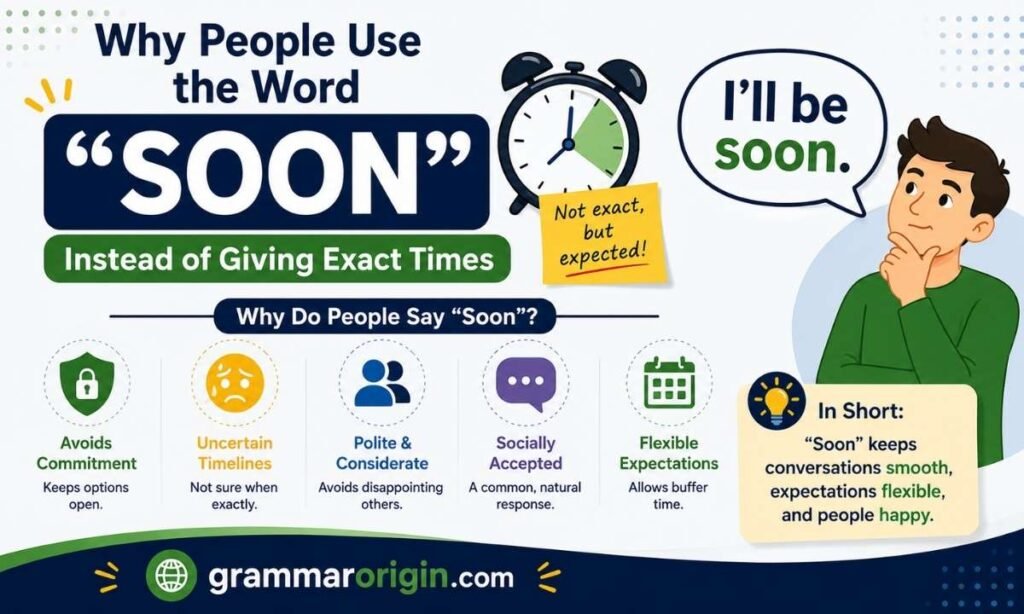
People choose soon because they often don’t know the exact timing themselves, and they’d rather stay honest than promise a date they might miss. It’s a way of committing to action without overcommitting to a clock.
A manager might say a report is coming soon simply because the finish line isn’t locked in yet — not because they’re stalling. Customer service reps lean on it constantly while waiting on updates from other departments they don’t control.
There’s also a softer, more social reason. Saying “soon” feels warmer than saying “I don’t know,” even when the honest answer is closer to the second one.
Unpredictable delays play into this too. Traffic, staffing, technical hiccups — soon gives people room to acknowledge that something is happening without locking themselves into a promise they can’t guarantee.
How to Interpret “Soon” Correctly
To interpret soon accurately, look past the word itself and focus on the situation surrounding it. The activity almost always tells you more than the promise does.
Start with scale. A quick document is a different kind of soon than a company-wide software rollout, and most people intuitively size up the task before reacting to the word.
Next, think about the person. Some people use soon loosely and mean it sincerely even when it takes days; others use it conservatively and follow through within the hour.
Urgency matters too — a kitchen preparing your dinner order runs on a completely different clock than a team building a new product feature.
And if the timing genuinely matters to you, just ask. A quick “roughly when do you mean?” clears up more confusion than trying to decode the word on your own.
Working through these small checks is really how you figure out how long is soon for any given expected timeframe, without ever getting a straight number from the person who said it.
Real-Life Examples of “Soon”
Seeing soon in action makes the pattern easier to spot. Here’s how a few common phrases usually play out.
“I’ll be there soon” almost always points to a short wait, typically somewhere between five and thirty minutes, depending on distance.
“I’ll get back to you soon” shows up constantly in emails and workplace chats, and it can mean anywhere from a couple of hours to several business days.
“Coming soon” is a marketing staple, and in that world it often stretches to weeks or even months before anything actually launches.
“Talk to you soon” is more of a farewell than a promise — it signals intent to reconnect without any real schedule attached.
“See you soon” behaves the same way. It’s friendly shorthand, and it might mean tomorrow or it might mean sometime next month.
Does “Soon” Mean Minutes, Hours, Days, or Weeks?
Soon can mean any of these, and the deciding factor is always the situation, not the word. It stretches or shrinks depending on what’s being described.
When Soon Means Minutes
Food orders, rides, and in-person meetups usually fall into the minutes category. If someone’s already on their way, soon typically means under half an hour.
When Soon Means Hours
Texts, emails, and small day-to-day tasks commonly land in the hours range. This is probably the most common everyday use of the word.
When Soon Means Days
Customer support tickets, document reviews, and approval processes often take a few days, even though the initial response promised something “soon.”
When Soon Means Weeks or Months
Big projects, hiring decisions, and product launches routinely stretch soon into weeks or months. The scale of the work simply demands more time than a casual conversation ever would.
Soon vs Other Time Expressions
Comparing soon to similar words highlights exactly where it fits on the timeline. The table below lines them up side by side.
| Expression | General Meaning | Example |
| Soon | Sometime in the near future, timing unclear | “I’ll message you soon.” |
| Shortly | Very near future, slightly tighter than soon | “The doctor will see you shortly.” |
| Later | Any point in the future, often vague and open-ended | “We’ll talk about it later.” |
| Immediately | No delay at all | “Call an ambulance immediately.” |
| Eventually | Will happen, but the timeline is long and uncertain | “The company will eventually expand overseas.” |
| Early | Before the expected or planned time | “She arrived early for the meeting.” |
Soon vs Shortly
Shortly tends to sound a notch tighter than soon, often implying the wait is measured in minutes rather than hours. Both point to the near future, but shortly carries a bit more urgency.
Soon vs Later
Later is looser than soon and can stretch across hours, days, or longer with no real sense of urgency attached. Soon at least implies the person isn’t planning to sit on it indefinitely.
Soon vs Immediately
Immediately rules out any delay whatsoever. Soon, on the other hand, always leaves a little breathing room, even if that room is small.
Soon vs Eventually
Eventually stretches the timeline much further and carries less certainty about when — or sometimes even whether — something happens. Soon at least implies the person expects it fairly soon in real terms.
Soon vs Early
This pairing trips people up more than the others. Soon describes a short time from now, while early describes something happening before an expected or scheduled time — they’re not interchangeable, even though they get confused often.
Arriving “soon” means you’re close to showing up. Arriving “early” means you beat the clock you were supposed to meet. One is about proximity in time; the other is about beating an expectation.
Read Also This Plural of Chief
Common Misunderstandings About the Word “Soon”
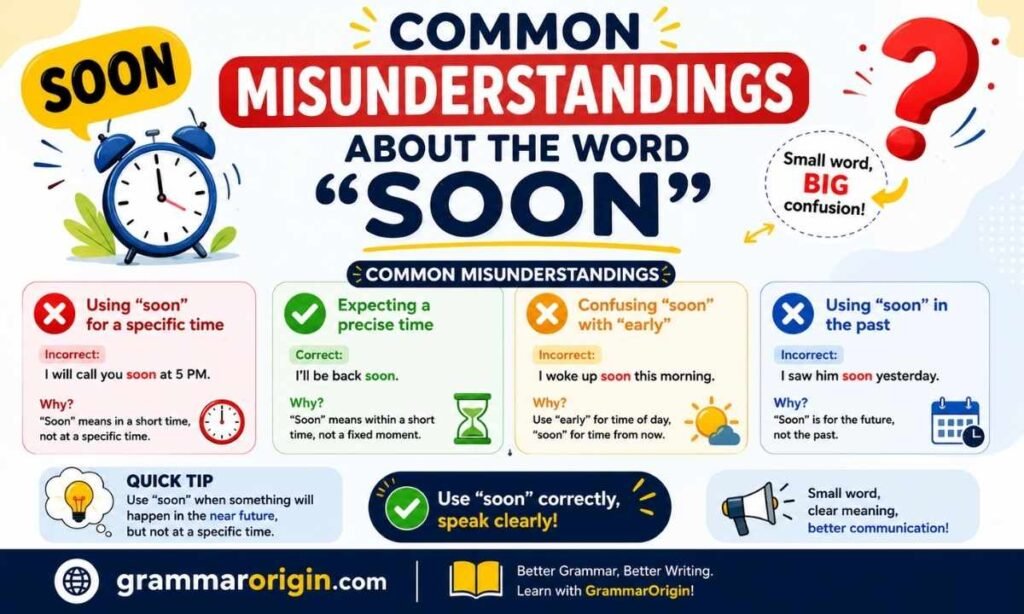
Most confusion around soon starts when people quietly assume everyone shares their personal definition of it. That assumption rarely holds up.
One common mix-up: expecting an exact number when the speaker never gave one. Another happens when someone interprets soon through their own habits rather than the other person’s intent.
Relationships run into this constantly — one partner expects contact within hours, while the other genuinely believes a day or two counts as soon.
Workplaces aren’t immune either. A manager’s version of soon and a client’s version of soon can be miles apart, even when both parties think they’re being perfectly clear.
Most of these mix-ups boil down to the same root question — how long is soon — being answered differently in two people’s heads at once.
How Different Industries Use the Word “Soon”
Every industry bends soon to fit its own normal pace, which is exactly why the word means something different depending on where you hear it.
In marketing, “coming soon” builds anticipation and often covers a launch window of weeks or months rather than days.
In tech, developers lean on soon when a release date genuinely isn’t locked yet, since software timelines shift constantly during testing.
In customer support, soon frequently means the rep is waiting on another department, so the actual timing is partly out of their hands.
In project management, soon often describes a milestone that’s approaching but hasn’t been finalized on the calendar yet.
Interestingly, one field actually gives soon a fixed, technical meaning. In maritime weather forecasting, “soon” is a defined term meaning the event is expected between six and twelve hours after the forecast was issued — a rare case where the word isn’t vague at all.
Where Does the Word “Soon” Come From?
“Soon” traces back to Old English “sona,” which originally meant “immediately” or “at once” — a much stronger sense of urgency than the word carries today.
Over centuries, its meaning gradually softened from “right now” to “before long,” which is the looser, more flexible sense we use in modern English. That drift is part of why the word feels so open to interpretation now — it’s been loosening its grip on urgency for a very long time.
Alternatives to Saying “Soon”
Swapping soon for a specific phrase removes the guesswork entirely and helps both sides plan with confidence. It also sidesteps the whole how long is soon debate before it even starts.
| Instead of Saying | Say This Instead |
| I’ll call you soon. | I’ll call you this afternoon. |
| The update is coming soon. | The update launches next week. |
| We’ll get back to you soon. | We’ll respond within two business days. |
| It’ll be ready soon. | It’ll be ready by 5 PM. |
| I’ll visit soon. | I’ll visit sometime next weekend. |
Precise language builds trust faster than any reassurance ever could. When exact timing isn’t possible, even a rough window like “within two days” beats a bare “soon.”
How Long Is Soon Meaning
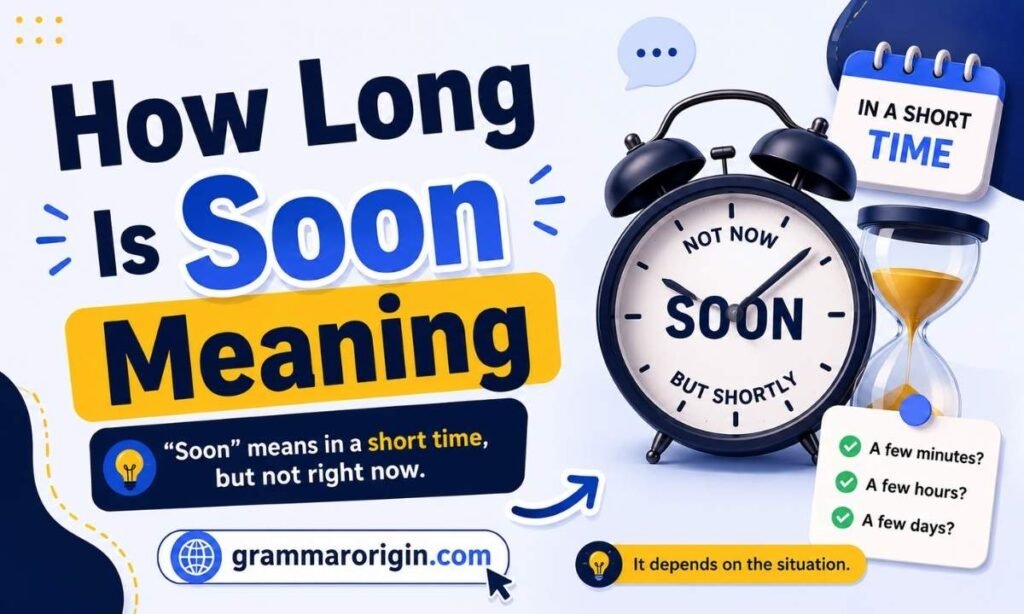
At its core, the meaning of soon is “before long” or “in the near future,” without any specific unit of time attached to it. It’s a feeling of proximity to now, not a countdown.
Dictionaries define it the same flexible way — phrases like “in a short time” or “before too long” show up again and again, and none of them pin down an actual number. That’s intentional; the word was built to flex.
How Long Is Soon in Days
In day-to-day terms, soon commonly lands somewhere between same-day and about a week, depending on what’s involved. Here’s a rough breakdown.
| Context | Typical Days |
| Casual text reply | Same day |
| Customer service response | 1–3 days |
| Package shipping | 2–7 days |
| Job application follow-up | 3–10 days |
| Small workplace task | 1–5 days |
Anything beyond about ten days usually starts drifting toward “a couple of weeks” in most people’s minds, rather than staying inside the “soon” bucket.
How Long Is Soon for a Guy
When a guy says soon — whether it’s about texting back, planning a date, or making plans official — it usually means somewhere between a few hours and a few days, shaped heavily by his own communication habits rather than any universal rule.
Dating research has actually pushed back on the old “three-day rule” idea. Studies on post-date texting suggest that reaching out the next morning, rather than waiting days, tends to land better than the drawn-out wait many people assume is the “smart” move.
Early in a match or a new connection, response times of thirty minutes to a full day are considered normal, since the other person has a whole life outside the conversation. If someone consistently replies within that range and keeps the conversation moving forward, that’s a decent sign of real interest — the word “soon” from a guy is less about a promise and more about where his attention currently sits.
How Long Is Soon Quotes
Sometimes a short line captures the idea better than a definition ever could. Here are a few sayings that echo the same idea in different words.
- “Soon is a word that means nothing and everything at the same time.”
- “The trouble with soon is that it never comes with a clock attached.”
- “Soon is a promise wrapped in a question mark.”
- “Everyone’s soon runs on a different watch.”
- “Patience is the price you pay for someone else’s version of soon.”
These aren’t fixed definitions — they’re reminders that soon is more about intent than timing, which is exactly why it trips people up so often.
How Long Is Soon in Years
On a much longer scale, soon can stretch into years, especially in fields where projects naturally take a long time to unfold. Scientific research is the clearest example.
| Context | Typical Meaning of Soon |
| Space missions and exploration | Several years |
| Long-term medical research | 1–5 years |
| Major construction or infrastructure | 2–10 years |
| Climate or environmental projections | 5–20+ years |
In these settings, soon isn’t dishonest or exaggerated — it’s simply scaled to match how long the underlying work genuinely takes. A scientist saying results are coming “soon” on a five-year study isn’t misusing the word; they’re just speaking on a different timeline than a text message conversation would use.
Frequently Asked Questions
Does soon mean today?
Not necessarily. Soon can mean today in casual conversation, but in business or larger projects it often stretches well beyond that single day.
Can soon mean tomorrow?
Yes. Plenty of people use soon when they’re actually referring to something happening the next day or within the next couple of days.
How long is soon usually in a text message?
In texting, soon typically points to a wait of a few minutes up to a few hours, though this depends heavily on the other person’s habits.
Is soon longer than shortly?
Generally, shortly sounds a bit more immediate and tighter than soon, though both point to the near future.
How long should I wait if someone says soon?
There’s no universal number — weigh the task, the person’s usual habits, and how urgent the situation actually is before assuming a timeframe.
Is soon a specific amount of time?
No. Soon is intentionally flexible and depends entirely on context rather than a fixed duration.
Why do people use soon instead of an exact time?
Often because they don’t know the precise timing yet, or because committing to an exact hour isn’t realistic given how the situation might change. It’s part of why how long is soon remains such a common question in everyday conversation.
Final Thoughts
So, how long is soon? There’s no single number attached to it — the real answer depends on the situation, the person speaking, and how much is actually at stake in the wait.
Instead of chasing an exact definition, pay attention to context and ask for clarification when timing genuinely matters. The next time someone tells you “soon,” you’ll know it’s less of a deadline and more of a promise waiting to take shape.

Muhammad Waqas is an English language teacher and grammar expert with over 8 years of experience helping students and professionals improve their writing skills. He specializes in English grammar, vocabulary, communication, and practical language learning. Through GrammarOrigin, Waqas shares clear, easy-to-understand content that helps readers write and speak English with confidence.