
Mixing up oxymoron vs juxtaposition is one of the most common mix-ups in grammar and literature classes. Both devices rely on contrast, and both show up constantly in poetry, novels, and everyday speech. But once you see how each one actually works, the confusion clears up fast.
This guide breaks down oxymoron vs juxtaposition in plain terms, with a comparison table, real examples, and answers to the questions people search for most — including how these two literary devices relate to paradox, contrast, and antithesis.
Quick Answer: Oxymoron vs Juxtaposition
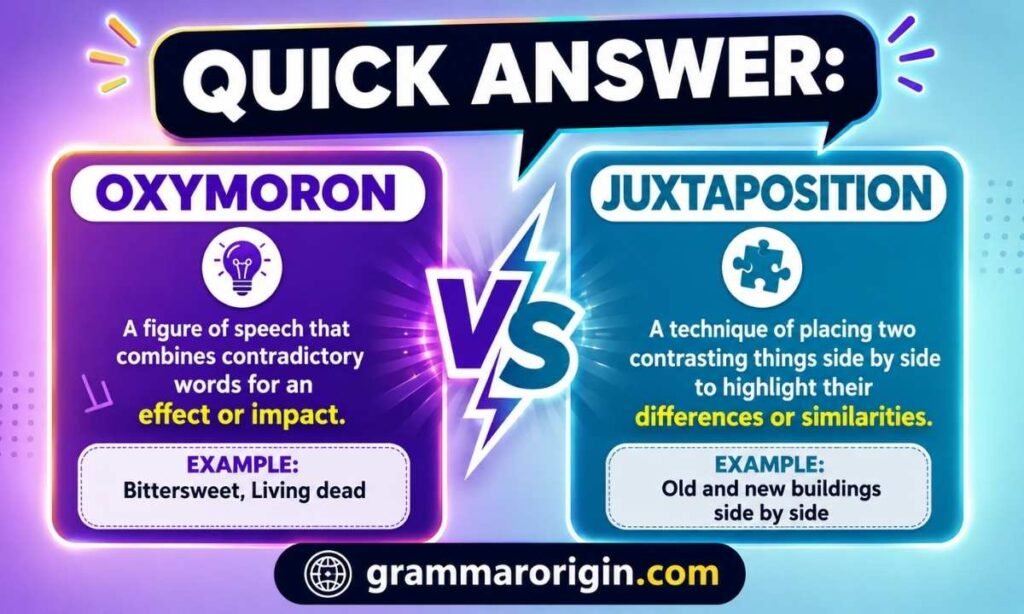
An oxymoron squeezes two opposite words into a single phrase, like “controlled chaos.” Juxtaposition places two different ideas, images, or characters near each other so a reader notices the contrast between them.
Put simply: an oxymoron works at the word level, while juxtaposition works at the idea level. Both are forms of figurative language, but one is a tight little contradiction, and the other is a wider comparison that can stretch across a sentence, a scene, or an entire book.
Oxymoron vs Juxtaposition Comparison Table
Seeing both devices side by side makes the split easier to remember than reading paragraphs of explanation.
| Feature | Oxymoron | Juxtaposition |
| Definition | Two contradictory words combined in one phrase | Two different ideas, images, or characters placed near each other |
| Scale | Word or phrase level | Sentence, scene, or theme level |
| Length | Usually two to three words | Can span a line, a paragraph, or an entire story |
| Purpose | Creates irony, wit, or emphasis | Highlights contrast or similarity between two things |
| Example | “Deafening silence” | A wealthy city street shown beside a struggling neighborhood |
What Is an Oxymoron?
An oxymoron is a rhetorical device — a short phrase that pairs two words with opposite meanings to create a new, often striking, meaning. Think “jumbo shrimp” or “organized chaos” — on paper the words fight each other, but together they land a specific idea fast.
Writers reach for oxymorons because they’re compact. A single phrase can carry humor, tension, or irony without needing extra explanation. That’s part of why they show up so often in headlines, dialogue, and casual conversation, not just formal writing.
Shakespeare leaned on this trick constantly. In Romeo and Juliet, Romeo calls his goodbye to Juliet “such sweet sorrow” — two words that shouldn’t belong together, yet somehow capture exactly how bittersweet farewells feel.
What Is Juxtaposition?
Juxtaposition is a literary device where a writer places two different elements — people, settings, emotions, or ideas — close together so their differences (or surprising similarities) stand out. It doesn’t need contradictory wording; it just needs proximity.
Unlike an oxymoron, juxtaposition isn’t locked into a two-word format. A novelist might juxtapose two characters across an entire book, or a photographer might juxtapose a skyscraper against a crumbling building in a single frame.
Charles Dickens opens A Tale of Two Cities with a string of juxtapositions — “the best of times,” “the worst of times,” “the age of wisdom,” “the age of foolishness.” Each pair sets up the divided, unstable world the novel is about to explore.
Is an oxymoron and juxtaposition the same thing?
No, an oxymoron and juxtaposition are not the same thing, though they’re closely related. An oxymoron is really a tiny, word-level version of juxtaposition — a special case rather than a separate category entirely.
The easiest way to tell them apart: if the contrast lives inside a two- or three-word phrase, you’re looking at an oxymoron. If the contrast plays out between two larger elements — scenes, characters, or ideas — that’s juxtaposition.
So while every oxymoron technically juxtaposes two opposite words, not every juxtaposition qualifies as an oxymoron. The scale is what separates them.
Also Read This How Long Is Soon?
What are 5 examples of oxymorons?
Oxymorons are everywhere once you start noticing them, from casual conversation to classic literature. Here are five common ones:
- Deafening silence — a quiet so total it feels loud
- Bittersweet — happiness and sadness tangled together
- Organized chaos — a mess that somehow still functions
- Original copy — a copy that’s meant to be treated as the real thing
- Act naturally — a request to behave like you’re not performing
Each pairing works because the contradiction forces the reader to pause and reconcile two ideas that shouldn’t fit — and that friction is exactly what gives an oxymoron its punch.
What are 5 examples of juxtaposition?
Juxtaposition shows up in literature, film, and everyday storytelling far more often than most readers realize. Here are five clear examples:
- A war scene cut directly against a quiet family dinner, to sharpen how different the two worlds feel
- Dickens opening A Tale of Two Cities by pairing wisdom against foolishness and hope against despair
- Fitzgerald placing old-money East Egg beside new-money West Egg in The Great Gatsby
- A children’s playground built right next to an abandoned factory in a photograph
- Two roommates — one meticulous, one chaotic — sharing the same apartment in a sitcom
Notice that none of these examples rely on opposite words in one phrase. The contrast comes from placement, not vocabulary — which is the core difference from an oxymoron.
What is a paradox vs. juxtaposition?
A paradox is a full statement or situation that seems to contradict itself but reveals a deeper truth once you think it through — like “the only constant is change.” Juxtaposition, on the other hand, is simply placing two different things side by side.
The distinction is about function, not size. A paradox asks you to resolve a logical tension in your head; juxtaposition asks you to notice a contrast without necessarily resolving anything.
A classic paradox example is Joseph Heller’s Catch-22: pilots who are insane can ask to stop flying, but the very act of asking proves they’re sane enough to keep flying. That’s a paradox — a self-contradicting loop, not just two things sitting near each other.
Key Differences Between Oxymoron and Juxtaposition
The biggest gap between these two figurative language devices comes down to scale and intent. Oxymorons compress contradiction into a tight phrase; juxtaposition spreads contrast across a wider canvas, the same way a metaphor can stretch across a whole poem instead of a single line.
A few more distinctions worth remembering:
- Structure: Oxymorons are locked into short, fixed phrasing. Juxtaposition has no length limit at all.
- Word requirement: An oxymoron needs opposite words. Juxtaposition just needs two different elements placed near each other — the words themselves don’t have to contradict.
- Effect on the reader: Oxymorons tend to land as wit or irony in a single beat. Juxtaposition builds meaning gradually, often across a whole passage.
- Frequency in speech: Oxymorons pop up constantly in casual talk (“pretty ugly”). Juxtaposition is more common in structured writing, film, and visual art.
Oxymoron vs juxtaposition examples
Putting a few pairs directly next to each other helps cement the difference between the two devices in practice.
Oxymoron example: “The silence was deafening” — two opposing words fused into one description.
Juxtaposition example: A story that alternates chapters between a soldier at war and his family waiting at home — two very different realities placed side by side without a single contradictory word between them.
Read enough of both, and the pattern becomes automatic: oxymorons surprise you inside a sentence, while juxtaposition builds its effect across a bigger stretch of the story.
Juxtaposition vs oxymoron vs paradox
All three devices lean on contrast, but they operate at different scales and for different reasons.
| Device | What it does | Typical length |
| Juxtaposition | Places two different elements near each other to highlight contrast | A phrase to an entire work |
| Oxymoron | Fuses two opposite words into one short phrase | Two or three words |
| Paradox | Presents a statement that seems contradictory but reveals a hidden truth | A full sentence or idea |
Think of it as a spectrum: oxymoron is the smallest and most compact, juxtaposition is the most flexible in size, and paradox is the one that demands actual logical resolution rather than just noticing a contrast.
Juxtaposition vs oxymoron vs contrast
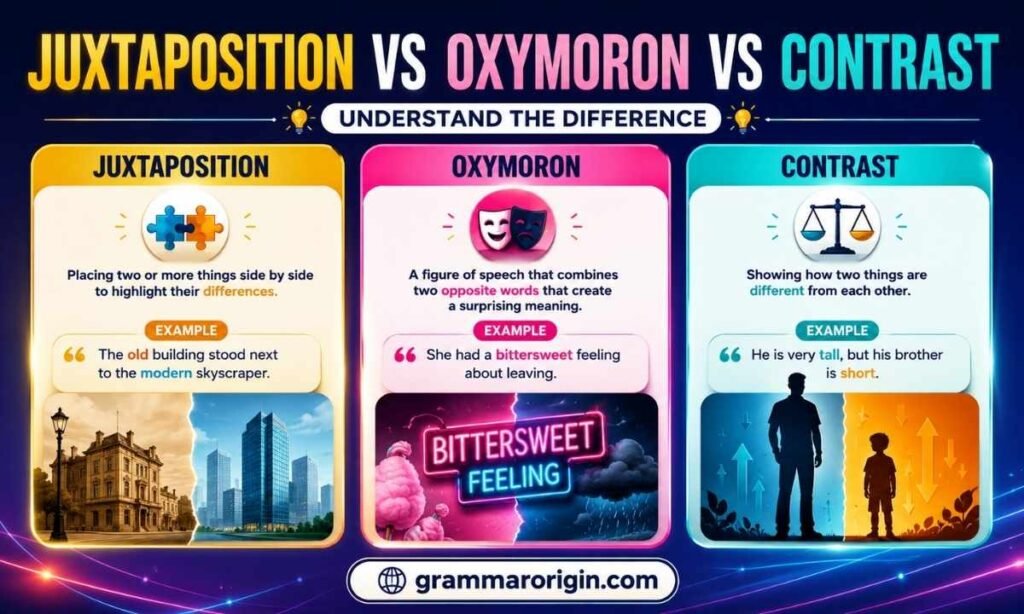
Contrast is really the umbrella term here — both juxtaposition and oxymoron are specific tools used to create contrast, but “contrast” itself is broader and less structured.
Contrast simply means showing how two things differ, and it can happen through description alone, without any special literary technique attached to it. Saying “the desert was dry; the coast was humid” is contrast, plain and simple.
Juxtaposition and oxymoron are more deliberate versions of that same idea. Juxtaposition arranges the contrast spatially or narratively, while oxymoron packs it into a single phrase — both are contrast with a specific shape.
Also Read This How Long Is Soon?
Oxymoron vs antithesis
An oxymoron combines two contradictory words into one phrase, while antithesis is a rhetorical device that sets up two opposing ideas across a balanced sentence structure, usually for rhetorical weight.
A well-known antithesis example is Neil Armstrong’s “one small step for man, one giant leap for mankind” — two opposing scales (small vs giant) balanced in parallel grammar across a full sentence, not fused into a single phrase.
So while both devices use opposites, an oxymoron is about compression — squeezing contradiction into two or three words — and antithesis is about balance, stretching the contrast across a complete, symmetrical statement.
Oxymoron vs juxtaposition worksheet
Try labeling each example below as either an oxymoron or an example of juxtaposition before checking the answers underneath.
- “The clown’s cheerful face barely hid the sadness in his eyes.”
- “Original copy”
- A rich tourist walking past a beggar on the same street corner
- “Pretty ugly”
- A story that alternates between a character’s dreams and their harsh reality
Answers: 1) Juxtaposition — two contrasting images (cheerful face, sad eyes) shown together. 2) Oxymoron — contradictory words fused into one phrase. 3) Juxtaposition — two different realities placed side by side. 4) Oxymoron — two opposite words combined. 5) Juxtaposition — a structural contrast spread across the narrative.
Use exercises like this in a classroom or study session — spotting the scale of the contrast is usually the fastest way to tell which device you’re looking at.
Oxymoron vs juxtaposition reddit
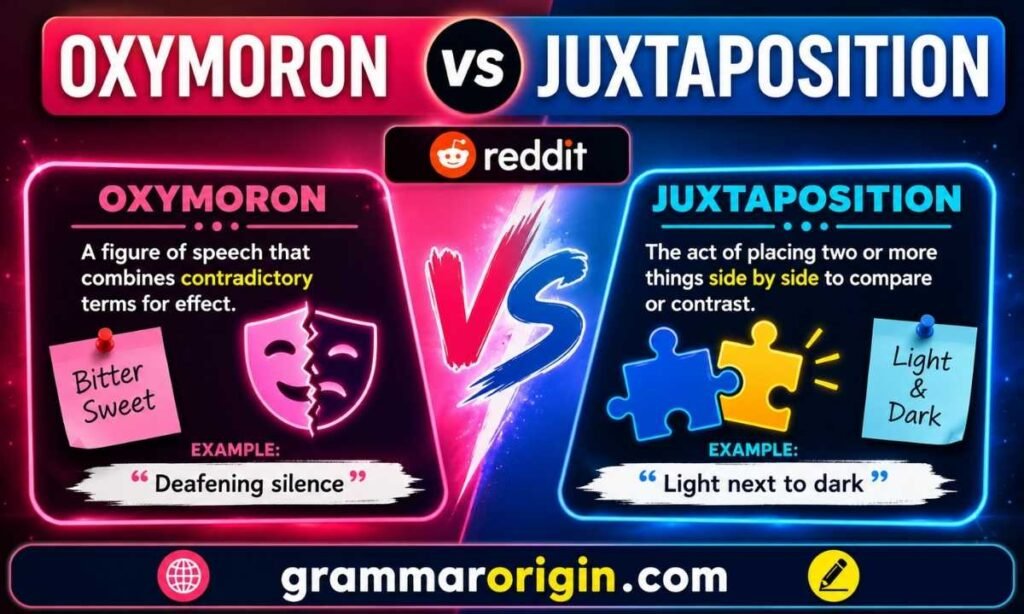
Students and writers online tend to run into the same sticking point again and again: they can spot the contrast in a sentence but can’t decide which label fits it.
The most common confusion in these discussions is treating every contradictory phrase as an oxymoron, even when the contrast actually spans a whole scene or sentence rather than two fused words — which makes it juxtaposition instead.
A useful rule that regularly comes up in these conversations: if you can circle just two words that contradict each other, it’s probably an oxymoron. If you’d need to underline a whole sentence or compare two different moments in a story or piece of prose, it’s juxtaposition.
Is oxymoron a type of juxtaposition?
Yes, an oxymoron can reasonably be considered a type of juxtaposition — just a very compressed, word-level version of it. Both devices rely on placing contrasting elements close together.
The relationship only runs one direction, though. Every oxymoron juxtaposes two words, but juxtaposition doesn’t require the contradictory wording that defines an oxymoron — most juxtapositions are built from full ideas, not opposite terms.
So it’s fair to say oxymoron sits inside the broader category of juxtaposition, while juxtaposition itself covers a much wider range of techniques that go well beyond word-level contradiction.
Frequently Asked Questions
Is an oxymoron always intentional?
Not always. Most oxymorons are used deliberately for effect, but some — like “act naturally” — slip into everyday speech without anyone consciously building the contradiction.
Can juxtaposition happen in a single sentence?
Yes. Juxtaposition doesn’t need a whole scene or story — a single sentence that places two contrasting images or ideas together, like Dickens’ opening lines, counts as juxtaposition too.
What’s the easiest way to spot an oxymoron in a sentence?
Look for two words sitting right next to each other that technically contradict — “jumbo shrimp,” “seriously funny,” “living dead.” If the contradiction fits in two or three words, it’s an oxymoron.
Is “bittersweet” an oxymoron or juxtaposition?
“Bittersweet” is an oxymoron. It fuses two opposite sensations — bitter and sweet — into a single compact word, which is exactly how an oxymoron works.
Do oxymoron and juxtaposition ever appear in the same passage?
Yes, often. A writer might juxtapose two characters across a scene while also dropping an oxymoron into the dialogue — the two devices aren’t mutually exclusive and frequently work together.
Why do writers use juxtaposition instead of just describing contrast directly?
Juxtaposition lets the contrast speak for itself instead of the writer explaining it outright. Placing two images or ideas side by side is often more powerful than stating “these two things are different.”
Which is more common in poetry, oxymoron or juxtaposition?
Both appear often, but oxymorons tend to show up more in short, punchy lines, while juxtaposition tends to shape the structure of a whole poem — pairing stanzas, images, or moods against each other.
Conclusion
Oxymoron vs juxtaposition really comes down to scale: an oxymoron packs contradiction into two or three words, while juxtaposition spreads contrast across a sentence, a scene, or an entire story. Once that distinction clicks, spotting each device in the wild gets a lot easier.
Both remain some of the most useful tools a writer has for creating tension, irony, and emotional depth — whether that’s a single striking phrase or a contrast that builds slowly across an entire piece of writing.

Muhammad Waqas is an English language teacher and grammar expert with over 8 years of experience helping students and professionals improve their writing skills. He specializes in English grammar, vocabulary, communication, and practical language learning. Through GrammarOrigin, Waqas shares clear, easy-to-understand content that helps readers write and speak English with confidence.