
You toss a banana peel and an empty cereal box in the same bin every morning, but only one of them is technically “garbage.” The other is trash. It sounds like a small thing, yet the trash vs garbage question trips up more people than you’d expect — including native speakers.
This guide breaks the confusion down in plain terms: what each word actually means, where they overlap, how American and British English treat them differently, and where the line gets blurry in real life.
Quick Answer
Garbage is wet, organic waste — food scraps, spoiled leftovers, anything that rots. Trash is dry waste — paper, plastic, broken items, packaging. In everyday speech, though, most people use the two words as if they were the same thing, and nobody corrects them for it.
That’s really the whole trick to this topic: there’s a technical distinction, and there’s how people actually talk. Both are true at once.
What Does “Trash” Mean?
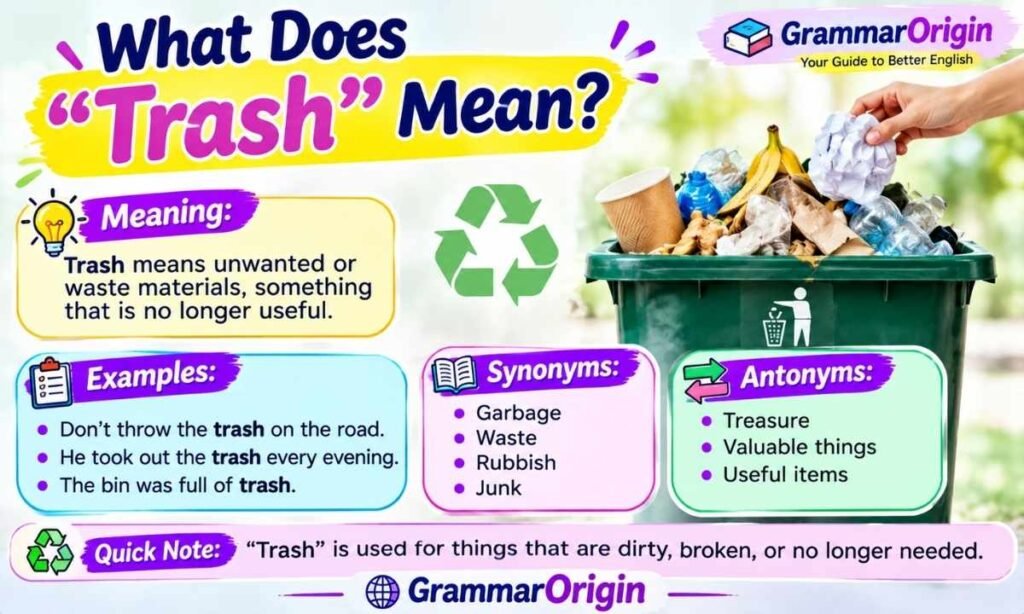
Trash is the dry stuff you clear out of a room, not a fridge. Think crumpled paper, broken toys, cardboard, plastic wrap, old batteries.
The word carries a slightly broader sense too — it can mean anything worthless or discarded, not just physical waste. A “trashy” novel isn’t made of banana peels; it just means low quality. That secondary meaning is part of why “trash” gets used so loosely for all kinds of junk, not only kitchen leftovers.
Practically, trash tends to sit in bedrooms, offices, garages, and living rooms. It’s the waste that piles up from daily activity rather than daily meals. “Take out the trash” is the phrase Americans grew up hearing, and it usually meant the whole bag, food scraps included — which is exactly where the strict definition starts to fall apart.
What Does “Garbage” Mean?
Garbage, in its narrow sense, is wet or organic waste — the stuff that smells if you leave it out. Vegetable peels, meat scraps, expired dairy, used tissues.
Historically, the word had an even more specific meaning: in the 1400s, “garbage” referred to the giblets and waste parts of a butchered bird. That food-adjacent root is still visible in how the word behaves today — it clings to kitchens and anything perishable.
Because garbage rots, it’s the category municipalities often worry about most — smell, pests, and the need for faster collection. A “garbage disposal” unit under your sink exists for exactly this reason: it handles food waste specifically, not paper or plastic.
Trash vs Garbage – Key Differences (Comparison Table Explanation)
On paper, the split is straightforward. Trash covers dry, non-perishable waste. Garbage covers wet, perishable, food-related waste. One rots, the other doesn’t.
| Aspect | Trash | Garbage |
| Waste type | Dry (paper, plastic, packaging) | Wet (food scraps, organic waste) |
| Smell | Usually low or none | Often strong, especially after a day or two |
| Common source | Living rooms, offices, garages | Kitchens, bathrooms |
| Decomposition | Slow or non-biodegradable | Fast, biodegradable |
| Typical container | Trash can, trash bag | Garbage bin, garbage disposal |
| Region most used | United States | United States (kitchen-specific), Australia (garbo) |
That said, the table only holds up under close inspection. Toss a coffee filter and a candy wrapper in the same bag, and nobody’s sorting them by technical category — both just went “in the trash.”
Are Trash and Garbage the Same?
Not exactly, but close enough that most speakers don’t bother separating them. The dictionary distinction is real; the daily-use distinction has mostly worn away.
You’ll hear someone call spoiled leftovers “trash” just as often as you’ll hear dry packaging called “garbage.” Municipal collection services rarely split the two either — one truck, one bin, one pickup day, regardless of whether the contents are wet or dry.
Where the difference still matters is composting and recycling programs. Cities that run separate food-waste collection do care about the trash-vs-garbage line, because contaminating a compost bin with plastic causes real processing problems.
Trash vs Garbage in American English vs British English
Americans use both trash and garbage regularly, often without thinking about which one technically applies. British English skips both in favor of a single catch-all word: rubbish.
A Londoner puts rubbish in a dustbin and waits for the dustman. An American puts trash — or garbage — in a can and waits for the trash collector, or in parts of Australia, the “garbo.” Same job, three different vocabularies, one shared habit of complaining about collection day — a neat little snapshot of how dialect shapes even the most mundane chores.
Australian English adds its own layer: bin instead of can, skip instead of dumpster, and “garbage” carries a secondary insult meaning — calling something “garbage” there can mean it’s worthless, separate from the physical-waste sense entirely.
Real-Life Examples of Trash and Garbage in Sentences
Seeing the words in context makes the pattern click faster than any definition does.
- “Can you take the trash out before the truck comes?” — general household waste, dry-leaning.
- “The garbage in the kitchen bin is starting to smell.” — food waste, specifically.
- “Don’t talk trash about your coworkers.” — figurative, meaning gossip or insults.
- “That movie was absolute garbage.” — figurative, meaning low quality.
- “She sorted the trash from the recyclables before pickup day.” — dry waste, sorting context.
Notice how the figurative uses show up for both words almost interchangeably — “talking trash” and “that’s garbage” mean roughly the same thing, even though their literal meanings split apart.
Trash Can vs Garbage Bin – Are They Different?
Functionally, no — both are containers for household waste. The naming split is regional and habitual rather than a strict rule about contents.
Americans reach for “trash can” in living spaces and offices, and “garbage bin” or “garbage can” closer to the kitchen — though plenty of households use the terms without any such pattern at all. It’s less a rule and more a leftover habit from how the words originally split.
Outside the US, “bin” alone does most of the work — wheelie bin, rubbish bin, recycling bin — without needing trash or garbage attached to it at all.
Is a Dumpster the Same as a Trash Can or Garbage Bin?
Not quite — a dumpster is a large, commercial-scale container, usually metal, meant for bulk waste rather than daily household use. Trash cans and garbage bins are personal or curbside; dumpsters serve apartment buildings, construction sites, and businesses.
Size aside, the contents rule stays the same: dumpsters mix trash and garbage together just like household bins do. Crime dramas love placing bodies in dumpsters partly because they’re large enough to conceal something — a detail that says more about storage capacity than about waste classification.
Some cities do run separate dumpsters for recyclables or yard waste, which is the closest a dumpster gets to the trash-vs-garbage distinction most people otherwise ignore.
Also Read This Is It Too Cute Vs To Cute
What Happens After You Throw Trash or Garbage?
Collection trucks pick everything up on a set schedule and haul it to a sorting or transfer facility as part of the wider waste disposal chain. Sanitation crews handle this daily, and from there, the material gets split by type — recyclable, compostable, or destined for a landfill.
Dry trash like paper, glass, and certain plastics often gets pulled for recycling at this stage. Wet garbage, when a city has the infrastructure for it, may go to composting instead of a landfill, cutting down on methane produced by rotting food buried in the ground.
Everything else — non-recyclable, non-compostable — ends up in a landfill or, in some regions, an incinerator. The trash-vs-garbage split you ignored at home is exactly what a sorting facility spends its day trying to reconstruct.
Types of Household Waste
Most homes produce four broad categories of waste, whether or not anyone’s sorting them consciously.
- Dry waste — paper, cardboard, plastic packaging (typically “trash”)
- Wet waste — food scraps, spoiled produce (typically “garbage”)
- Recyclable waste — glass, metal, certain plastics
- Non-recyclable waste — items with no current reuse or reprocessing path
Hazardous waste deserves a mention too, even though it’s technically its own category — batteries, paint, electronics. Mixing these into regular trash or garbage isn’t just inaccurate labeling; it’s often against local disposal rules, and proper waste segregation at home makes the whole downstream sorting process faster.
Common Mistakes People Make When Using Trash and Garbage
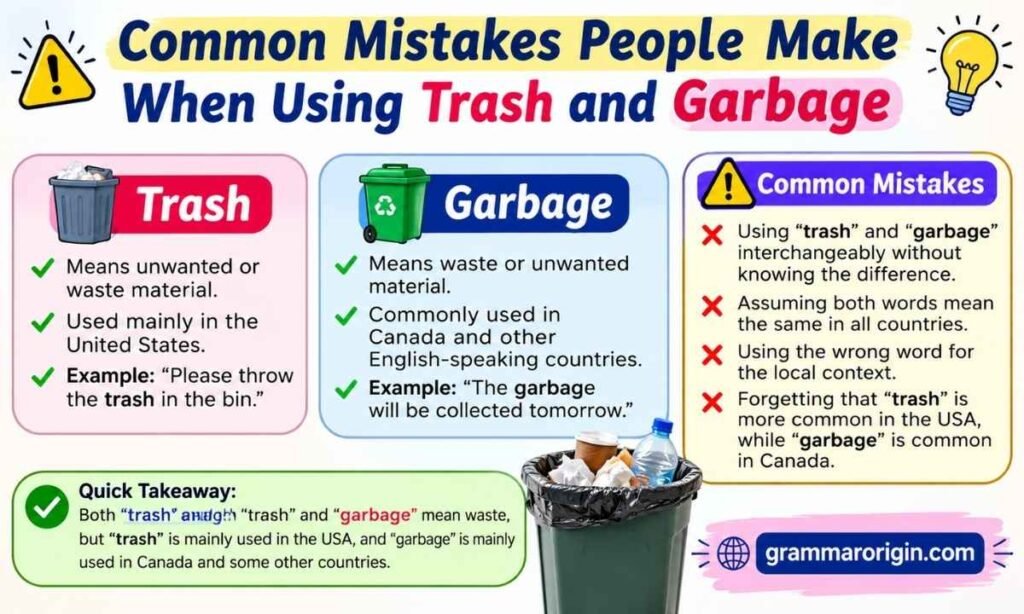
The biggest mistake is treating the trash-vs-garbage split as a strict grammar rule instead of a loose, mostly-ignored guideline. English speakers don’t sort their vocabulary by moisture content.
A second mistake is assuming British or Australian listeners will follow the American split at all — say “take out the garbage” to someone raised on “rubbish,” and they’ll understand you, but the word choice will sound distinctly American to their ear.
A smaller, easily missed error: using “garbage” for anything non-food when writing formally about waste management, where industry terminology sometimes does draw the line more precisely than casual speech does.
Quick Summary Table
| Point | Trash | Garbage |
| Core meaning | Dry, general waste | Wet, food-related waste |
| Interchangeable in casual speech? | Yes | Yes |
| Preferred region | United States | United States, Australia |
| Figurative use | “Talking trash” (insults, gossip) | “That’s garbage” (low quality) |
| British equivalent | Rubbish | Rubbish |
Rubbish vs Garbage – American or British?
Rubbish is the British default; garbage and trash are the American defaults. Australia sits in between, using bin and garbo alongside occasional British-leaning terms like rubbish.
| Region | Common Term | Collector | Container |
| United States | Trash / Garbage | Trash collector | Trash can / Garbage bin |
| United Kingdom | Rubbish | Dustman | Dustbin |
| Australia | Rubbish / Garbage | Garbo | Bin / Skip |
None of these terms is more “correct” than the others — they’re regional defaults, and using the wrong one just marks your accent, not your grammar.
Difference Between Rubbish and Litter
Rubbish is waste that’s properly contained — in a bin, a bag, ready for collection. Litter is waste dropped or left in the wrong place — a street, a park, a beach.
The distinction matters legally in a lot of countries: littering carries fines specifically because it’s waste that escaped proper disposal, not because the material itself is different from what’s sitting in your bin at home. A crushed can in your rubbish bin is rubbish; the same can tossed out a car window is litter.
Also Read This Is It Too Cute Vs To Cute
Garbage Pronunciation
Garbage is pronounced GAR-bij (/ˈɡɑːrbɪdʒ/) — stress on the first syllable, with the ending sounding closer to “-ij” than a hard “-age” like in “cottage.”
Trash, by comparison, is a single syllable — trash (/træʃ/) — which is part of why it feels like the quicker, more casual word of the two in speech.
Junk, Waste, Rubbish, Litter – How They All Differ
These four words overlap heavily but each carries a slightly different shade of meaning.
- Junk — unwanted items that may still have some use or resale value (old furniture, broken electronics).
- Waste — the broadest umbrella term, covering any discarded material, industrial or domestic.
- Rubbish — the British everyday word for general household waste, equivalent to trash and garbage combined.
- Litter — waste specifically dropped in public places rather than disposed of properly.
Trash and garbage sit inside this larger family as the two most common American subcategories — one dry, one wet, both eventually just “waste” once they leave the house.
Garbage Pollution and Environmental Impact
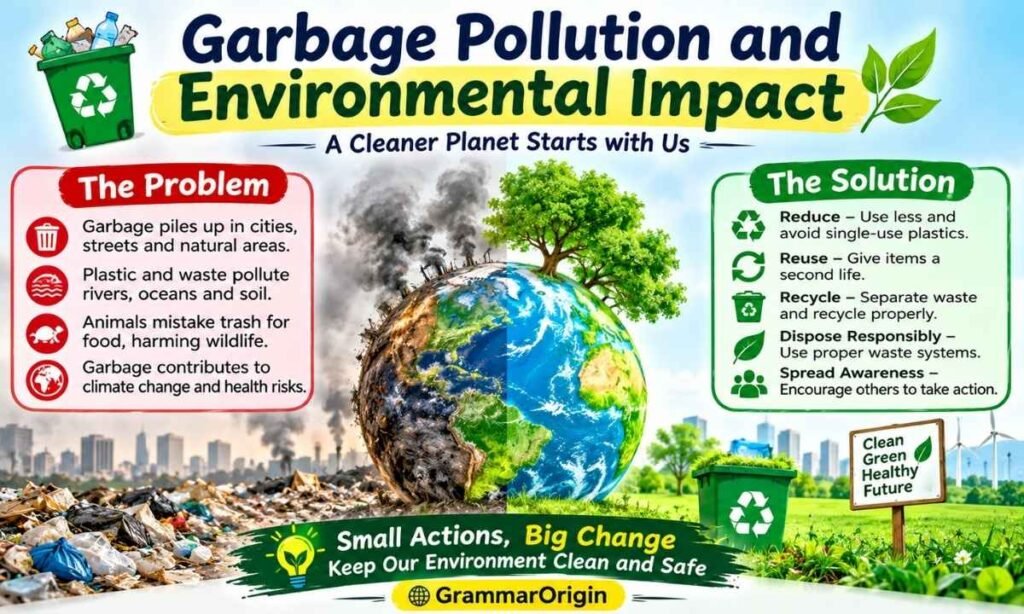
Garbage’s organic content is actually a double-edged issue: it decomposes fast, but when buried in a landfill without oxygen, that decomposition produces methane — a greenhouse gas far more potent than carbon dioxide over the short term.
Trash, especially plastic packaging, causes the opposite problem — it barely decomposes at all, sticking around in landfills and oceans for decades or centuries. Marine plastic pollution traces almost entirely back to “trash” in the technical sense, not garbage.
Separating the two at the household level — composting garbage, recycling trash — is one of the more effective things an individual household can do, since it cuts both the methane problem and the plastic-persistence problem at the source. It’s a small habit, but it plugs directly into the bigger sustainability push toward a circular economy, where materials get reused instead of buried.
“Rubbish” as a Person – What Does It Mean?
Calling someone “rubbish” — mostly in British and Australian English — means they’re bad at something, not that they’re literally trash. “He’s rubbish at cooking” just means his cooking skills are poor.
American English reaches for “garbage” the same way in some contexts — “his excuse was garbage” — though calling a person “garbage” directly is a much harsher insult than the lighter “rubbish at [skill]” phrasing typically implies.
Garbage Etymology – Where the Word Comes From
Garbage first appeared in English around 1422, originally referring to the giblets and waste parts of a butchered fowl — not household waste in general. The food-specific root explains why the word still leans toward kitchen and organic waste centuries later.
Trash has a different, likely Scandinavian origin, tracing back to words for fallen leaves, twigs, and rags around 1518. It wasn’t applied to household waste specifically until 1906 in the United States — making “trash,” in its modern sense, actually younger than you’d guess.
Rubbish, meanwhile, dates to around 1400, from a word related to rubble, of uncertain origin — making it the oldest of the three by a slim margin.
Frequently Asked Questions
Is garbage only food waste?
Mostly, yes — garbage traditionally refers to wet, organic waste like food scraps. In casual speech, though, people often use it for any household waste, food-related or not.
What’s the actual difference between trash and garbage?
Trash is dry waste (paper, plastic, packaging); garbage is wet, organic waste (food scraps, spoiled leftovers). The line blurs heavily once the words leave the dictionary and enter everyday conversation.
Do Americans and British people use the same word for waste?
No — Americans typically say trash or garbage, while British English almost always uses rubbish for the same thing.
Is rubbish the same as litter?
No. Rubbish is waste that’s properly disposed of; litter is waste dropped in the wrong place, like a street or park, and often carries legal penalties.
How do you pronounce garbage correctly?
Garbage is pronounced GAR-bij, with stress on the first syllable — not “gar-BAHJ” or “gar-BAGE.”
Can trash and garbage be used interchangeably?
Yes, in everyday speech, most people use them interchangeably without any issue. The technical wet-versus-dry distinction survives mostly in formal waste-management contexts.
Why does garbage sometimes mean something is bad quality?
The figurative sense grew out of the literal one — since garbage rots and becomes unusable, calling an idea, product, or argument “garbage” implies it’s just as worthless.
Conclusion
Trash and garbage split cleanly on paper — dry versus wet, packaging versus food scraps — but that split barely survives contact with how people actually talk. Both words get used for whatever’s in the bin, regardless of moisture content.
What’s worth remembering is the regional layer underneath it: trash and garbage mark American speech, rubbish marks British and much of Australian speech, and none of these choices says anything about which word is “correct.” They’re just different names for the same weekly chore.

Muhammad Waqas is an English language teacher and grammar expert with over 8 years of experience helping students and professionals improve their writing skills. He specializes in English grammar, vocabulary, communication, and practical language learning. Through GrammarOrigin, Waqas shares clear, easy-to-understand content that helps readers write and speak English with confidence.