
You typed a caption, stared at it for two seconds, and second-guessed yourself: is it “too cute” or “to cute”? You’re not the only one — this mix-up happens constantly because the two words sound identical when spoken out loud.
Here’s the short version before we go further: “too cute” is correct, and “to cute” is a spelling mistake, not an alternate phrase. This guide breaks down too cute vs to cute in plain terms, so stick around and you’ll never second-guess it again.
Quick Answer
“Too cute” is the only correct form — “too” works as an adverb meaning “extremely” or “very.” “To cute” isn’t real English; “to” can’t sit in front of an adjective like “cute” on its own. If you’re describing something adorable, always reach for the extra “o.”
Too Cute vs To Cute at a Glance
| Phrase | Correct? | What it does |
| Too Cute | Yes | Intensifies “cute” — means extremely adorable |
| To Cute | No | Not a valid English phrase or grammar structure |
The pattern is simple once you see it laid out. “Too” adds strength to an adjective, while “to” points toward a place, a person, or a verb — it has no business standing next to “cute” on its own.
What Does “Too Cute” Mean?
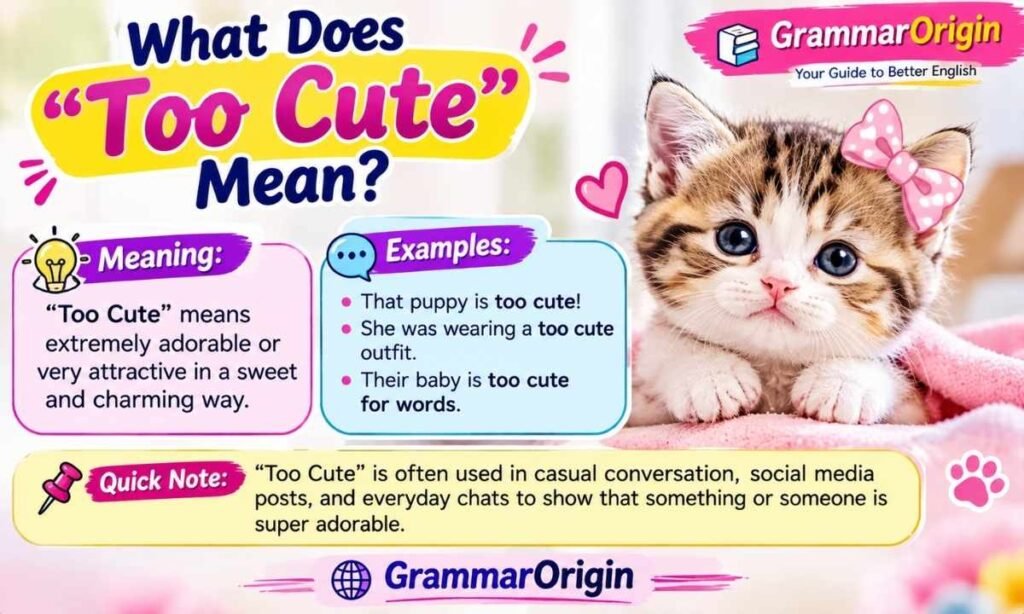
“Too cute” describes something so adorable it almost feels like a lot to handle — a puppy, a toddler, a handwritten note, anything that hits you right in the feelings. It’s rarely meant literally, as in “too much”; it’s a compliment dressed up as exaggeration.
Think about how people actually talk. Nobody complaining about excess cuteness wants less of it — “too cute” is just a warmer, punchier way of saying “extremely cute.”
You’ll hear it everywhere:
- “Stop, that’s too cute.”
- “Your dog’s little raincoat is too cute.”
- “This card is too cute, I’m keeping it forever.”
Why Is “To Cute” Incorrect?
“To cute” fails because “to” can’t function as an intensifier — it simply isn’t built for that job. English gives “to” two main roles, and neither one fits in front of an adjective.
“To” either shows direction (“heading to work”) or introduces a verb (“wants to sleep”). Cute is an adjective, not a destination or a verb, so pairing it with “to” leaves the sentence with no real meaning.
The confusion almost always comes down to sound, not logic. “To” and “too” are pronounced exactly the same way, so autocorrect and quick typing let the wrong one slip through unnoticed.
To vs Too: Understanding the Difference
| Word | Function | Example |
| To | Preposition or infinitive marker | “Drive to the coast.” / “I like to read.” |
| Too | Adverb meaning “very” or “also” | “It’s too loud.” / “Count me in too.” |
Once you separate their jobs, the choice gets automatic. “To” connects two things — a place, a person, a verb. “Too” stands alone and boosts whatever comes next to it.
A trick that sticks: the extra “o” in “too” mirrors the extra intensity it adds. One “o,” direction. Two “o’s,” more of something. This is the core of the difference between to and too, and it applies to every adjective, not just “cute.”
How to Use “Too Cute” Correctly
Drop “too cute” right after the noun you’re describing, and you’re set. It reads naturally whether you’re speaking, texting, or writing a caption.
- “Her outfit is too cute for a Monday.”
- “That cartoon fox is too cute, honestly.”
- “You two look too cute together in this photo.”
It fits almost any casual context — comments, captions, group chats, even a quick compliment in person. Save the more formal synonyms for professional writing.
What Does “You’re Too Cute” Mean?
“You’re too cute” is a compliment, and how warm it lands depends on who’s saying it. Between friends, it usually just means “you’re sweet” or “that was adorable of you.”
In a romantic context, it can carry a flirtier edge — think attraction dressed up as playful teasing. Tone and timing decide which version you’re getting.
Either way, it’s almost never an insult. Even when it’s said with a laugh or a raised eyebrow, the underlying message stays positive.
Too Cute Meaning in Texting and Social Media
Online, “too cute” moves fast and light — it’s a quick reaction, not a full sentence’s worth of thought. You’ll see it dropped under photos, paired with heart emojis, or shortened even further to “too cute omg.”
- “This puppy video is too cute 🥹”
- “Your nephew is too cute, stop it”
- “You guys are too cute together”
Platforms like Instagram and TikTok have basically turned it into a comment-section reflex. It signals genuine warmth without asking the commenter to write anything longer.
Also Read This Targetted or Targeted
Examples of “Too Cute” in Sentences
Seeing the phrase in different settings makes the pattern click faster than any rule does.
- “That kitten chasing its tail is too cute.”
- “Their wedding invitation was too cute, we framed it.”
- “This is too cute — where did you find it?”
- “The way she waves at strangers is too cute.”
- “That handwritten thank-you note was too cute.”
Notice “too” is always sitting directly beside “cute,” strengthening it rather than replacing it.
Common Mistakes People Make
| Wrong | Right |
| That’s to cute | That’s too cute |
| Your to cute for words | You’re too cute for words |
| Shes to cute | She’s too cute |
Most of these grammar mistakes come from typing fast or trusting autocorrect a little too much. A quick proofread before hitting send catches nearly all of them, and it’s the fastest way to stop mixing up too cute vs to cute for good.
Two other habits worth watching: dropping the apostrophe in “you’re,” and mixing up “too” with “two.” All three sound alike but mean completely different things.
Similar Expressions to “Too Cute”
Repeating “too cute” in every sentence gets old fast, so swap it in when you want variety:
- Adorable
- Precious
- Charming
- Endearing
- Delightful
- Too sweet for words
Each carries a slightly different weight — “precious” feels tender, “charming” leans a bit more sophisticated. Keeping a short list of too cute synonyms on hand makes your writing feel less repetitive, so pick based on tone, not just meaning.
Why People Confuse To and Too
The root cause is pronunciation — “to” and “too” are homophones, so your ears give you zero clues about which spelling to use. Your brain has to make the call from memory alone.
Add in fast typing, autocorrect suggestions, and casual texting habits, and the mix-up becomes almost inevitable. Even confident writers slip occasionally when they’re rushing.
The fix isn’t complicated: pause for half a second before sending anything, especially messages you’d be embarrassed to misspell.
Can “Too Cute” Ever Be Negative?
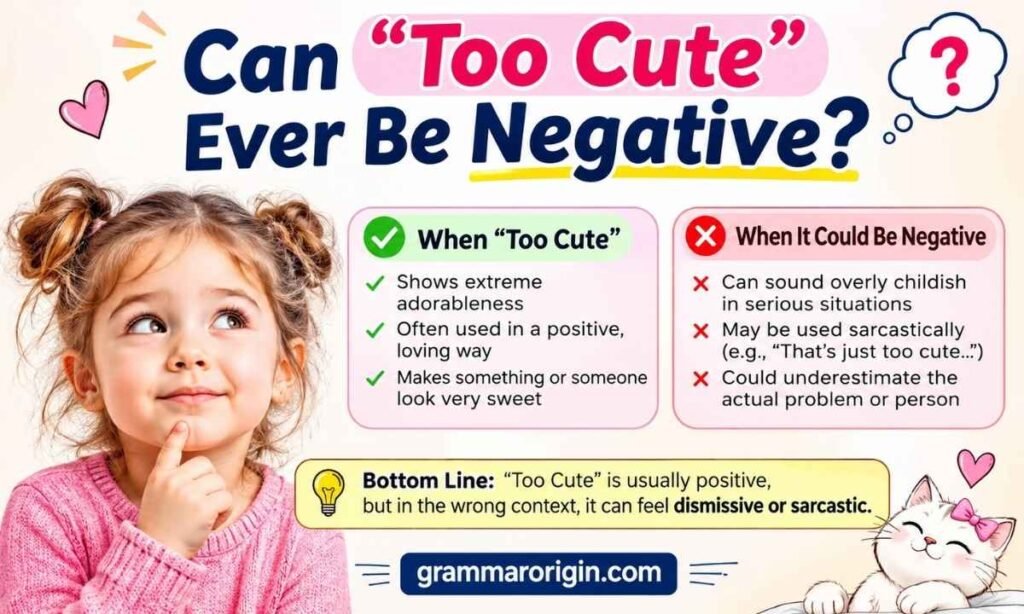
Yes, occasionally — “too cute” can turn sarcastic when someone’s cuteness feels performed rather than genuine. Think of a coworker being overly sweet right before asking for a favor.
Native speakers sometimes use it this way on purpose, letting tone of voice do the heavy lifting. “Oh, that’s too cute” said flatly can quietly mean “I see what you’re doing.”
Even then, it’s rarely harsh. It reads more as a knowing wink than a real complaint, and most listeners pick up on the shift immediately from context alone.
Also Read This Targetted or Targeted
Mini Grammar Quiz
Test yourself before scrolling to the answers.
- Which is correct — “to cute” or “too cute”?
- Fill in the blank: “The kitten is ___ cute to ignore.”
- True or false: “to” can intensify an adjective.
Answers:
- “Too cute” — “to” can never intensify an adjective on its own.
- “Too” — it’s boosting the adjective “cute.”
- False — “to” only shows direction or introduces a verb.
Too cute vs to cute synonyms
Looking for words that carry the same warmth without repeating “too cute”? Try adorable, precious, endearing, or charming depending on the situation.
For a slightly playful spin, “cuteness overload” or “too sweet for words” both land the same feeling in a fresher way.
Too cute vs to cute grammar
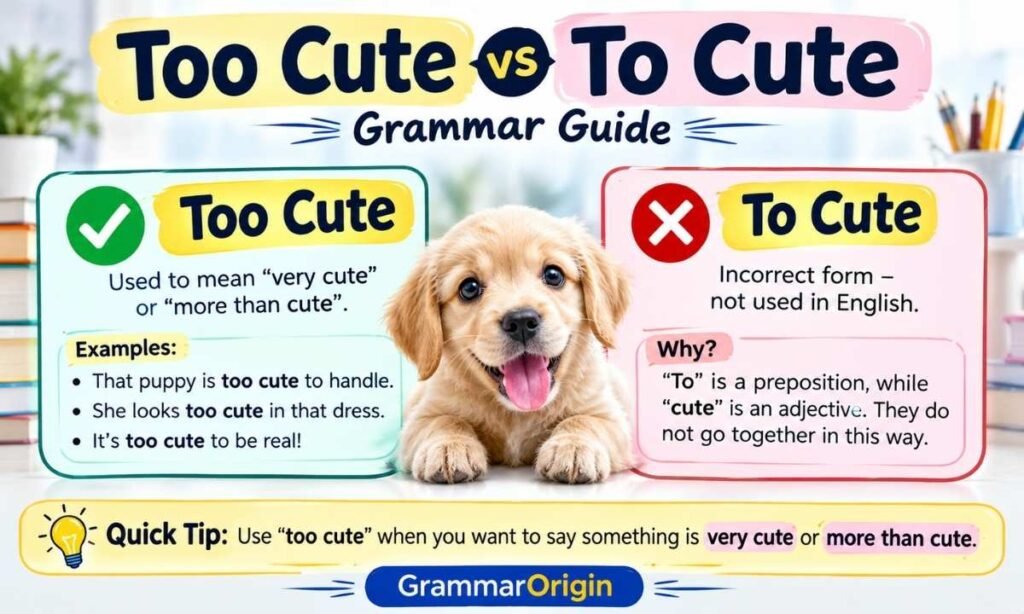
Grammatically, only one version survives scrutiny: “too” is an adverb, and adverbs are exactly what adjectives like “cute” need for emphasis. “To” simply has no grammatical lane that fits here.
Every major style guide agrees on this point — there’s no version of standard English where “to cute” functions as a real phrase.
Too cute vs to cute examples
A side-by-side glance settles any remaining doubt:
- Correct: “Their new puppy is too cute.”
- Incorrect: “Their new puppy is to cute.”
- Correct: “You’re too cute when you’re annoyed.”
- Incorrect: “Your to cute when you’re annoyed.”
Once you see the wrong version written out, it tends to look obviously off — that’s usually enough to make the correct spelling stick.
Frequently Asked Questions
Is it “too cute” or “to cute”?
“Too cute” is correct. When people debate too cute vs to cute, “to cute” always loses — it isn’t a valid phrase in English grammar.
What does “too cute” mean?
It means something is extremely adorable or charming, almost overwhelmingly so.
Why can’t you say “to cute”?
Because “to” only shows direction or introduces a verb — it can’t intensify an adjective like “cute.”
Is “too cute” a compliment?
Yes, in nearly every case. It expresses genuine admiration, even when said playfully.
Can “too cute” sound sarcastic?
Occasionally, yes. Tone can flip it into a knowing, lightly teasing remark rather than a straight compliment.
What’s an easy way to remember “too” vs “to”?
Picture the extra “o” in “too” as extra emphasis — more letters, more intensity.
Is “too cute” okay to use in formal writing?
It works better in casual writing. For formal contexts, “delightful” or “charming” reads more polished.
Conclusion
When it comes down to too cute vs to cute, only one holds up — “too cute,” every single time. The extra “o” is doing real grammatical work, turning “cute” into something stronger and more expressive.
Next time your fingers hesitate over the keyboard, remember the trick: extra letter, extra emphasis. That’s all it takes to get it right without a second thought.

Muhammad Waqas is an English language teacher and grammar expert with over 8 years of experience helping students and professionals improve their writing skills. He specializes in English grammar, vocabulary, communication, and practical language learning. Through GrammarOrigin, Waqas shares clear, easy-to-understand content that helps readers write and speak English with confidence.