
Typing fast and suddenly second-guessing yourself on message vs messege? You’re not the only one — this is one of the most Googled spelling mix-ups in everyday English. The confusion usually starts with how the word sounds, not how it’s built.
Here’s the short version: message is the only correct spelling, and messege doesn’t exist in any dictionary. Stick around and you’ll walk away knowing exactly why the mistake happens, how to remember the right form for good, and where the word actually comes from.
Quick Answer
Message is correct. Messege is a spelling error with no dictionary entry anywhere.
A message is any piece of information passed from one person to another — spoken, written, or typed. Whenever the message vs messege question pops up mid-sentence, default to the version with an “a,” never an “e,” in the middle.
Message vs Messege at a Glance
A side-by-side view clears up the confusion faster than paragraphs of explanation ever could.
| Feature | Message | Messege |
| Correct spelling | Yes | No |
| Found in dictionaries | Yes | No |
| Safe for professional writing | Yes | No |
| Recognized by spell-check tools | Yes | Flagged as an error |
| Search volume online | Lower (correct term) | Higher (people typing the mistake) |
Notice that last row — “messege” actually gets searched a lot, but that’s because people are trying to fix the mistake, not because it’s an accepted word. Every major style guide, from AP to Chicago, only recognizes message.
What Does “Message” Mean?
A message is a piece of communication — spoken, written, digital, or even symbolic — sent from one party to another.
It works as both a noun and a verb. As a noun, it’s the actual content: “I read your message.” As a verb, it describes the action: “Message me when you land.”
You’ll run into the word constantly:
- Emails and text threads
- Voicemails and phone calls
- Social media DMs
- Formal letters and memos
- Error messages on apps and websites
- Symbolic meaning, like “the film carries a strong message”
That short message definition covers almost every situation you’ll ever need it for — whether you’re asked to leave a message after a beep or read one flashing on a screen. Because it shows up in so many contexts, getting the spelling wrong stands out more than most typos would.
Is “Messege” a Real Word?
No. “Messege” has zero standing in English — no dictionary lists it, and no grammar authority accepts it as an alternate spelling.
It’s purely a typo that spread because it sounds plausible. Search engines and spell-checkers treat it the same way they’d treat any misspelling: they flag it and suggest “message” instead.
You’ll still spot “messege” in rushed texts, comments, and social posts, but that’s evidence of a common slip, not evidence of a valid word. If you’re writing anything that needs to look credible — a resume, an email to a client, a school assignment — “messege” is one to eliminate on sight.
Why Do People Confuse Message and Messege?
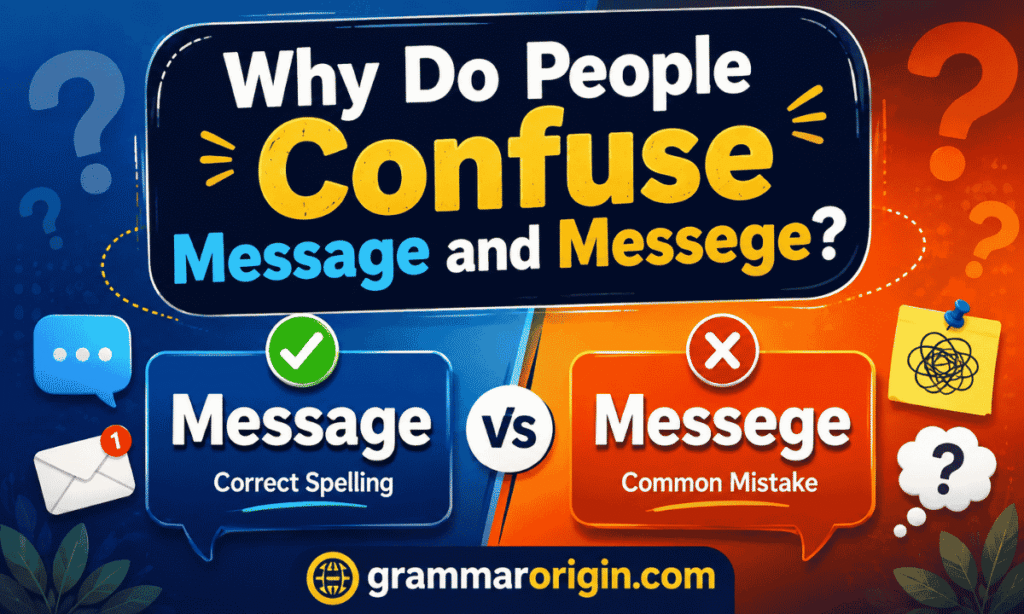
The mix-up traces back to pronunciation, not logic. English doesn’t always spell words the way they sound, and “message” is a textbook example.
Say the word out loud: the middle syllable comes out soft, almost like “ij” or “ej.” That vagueness makes some writers guess “e” when the correct letter is actually “a.”
A few other habits pile on top of that:
- Typing speed — fast texting skips the pause needed to think through spelling.
- Autocorrect gaps — not every keyboard catches this specific error.
- Pattern-matching — learners sometimes copy the “-ege” ending from unrelated words.
- Visual similarity — “-age” and “-ege” look almost identical at a glance.
None of this makes the mistake embarrassing — it’s a predictable outcome of how English sounds versus how it’s written. If you’re still asking yourself which is correct, message or messege, the pronunciation quirk explained above is almost always the root cause.
Also Read This Vagrant vs Hobo
How to Remember the Correct Spelling
The fastest fix is breaking the word into two familiar chunks: mess + age = message.
Both pieces are words you already spell correctly without thinking twice, so chaining them together removes the guesswork. Picture a message as literally “the age of your mess” if that helps it stick.
A second trick: message shares its ending with dozens of other common words — storage, package, baggage, voyage. None of those end in “-ege,” and neither does this one.
Writing the word out a few times in real sentences — not just in isolation — trains your hand and eye together, which tends to stick longer than rote repetition alone.
Examples of Message in Sentences
Context makes the message vs messege distinction easier to internalize than any rule on its own.
Formal Examples
- Please find the attached message regarding your application status.
- The committee will review your message before Friday’s session.
- We appreciate your message and will respond within two business days.
Informal Examples
- Hey, did you catch my message from last night?
- I’ll shoot you a message once I’m free.
- She left me the sweetest message on my birthday.
Workplace Examples
- The team lead posted an urgent message in the group chat.
- HR sent a company-wide message about the new leave policy.
- Please forward this message to the relevant department head.
Common Misspellings of Message
“Messege” spelling tops the list, but it’s far from the only variation people type by accident.
- Messege
- Mesage
- Messge
- Messsage
- Messeage
Spotting these during proofreading is half the battle. If any of these show up in your draft, swap them for message before hitting send — spell-checkers catch most of them, but not always in casual chat apps.
Related Communication Terms
“Message” rarely stands alone — it’s usually paired with another word that narrows down the medium.
Text Message
A short written note sent through SMS or a messaging app, typically read and replied to within minutes.
Voice Message
An audio recording left for someone to play back later, common on phones and apps like WhatsApp.
Instant Message
A message exchanged in real time through chat software — think Slack, Messenger, or Teams.
Direct Message
A private message sent through a social platform, usually shortened to “DM” in casual conversation.
Message vs Other Frequently Misspelled Words
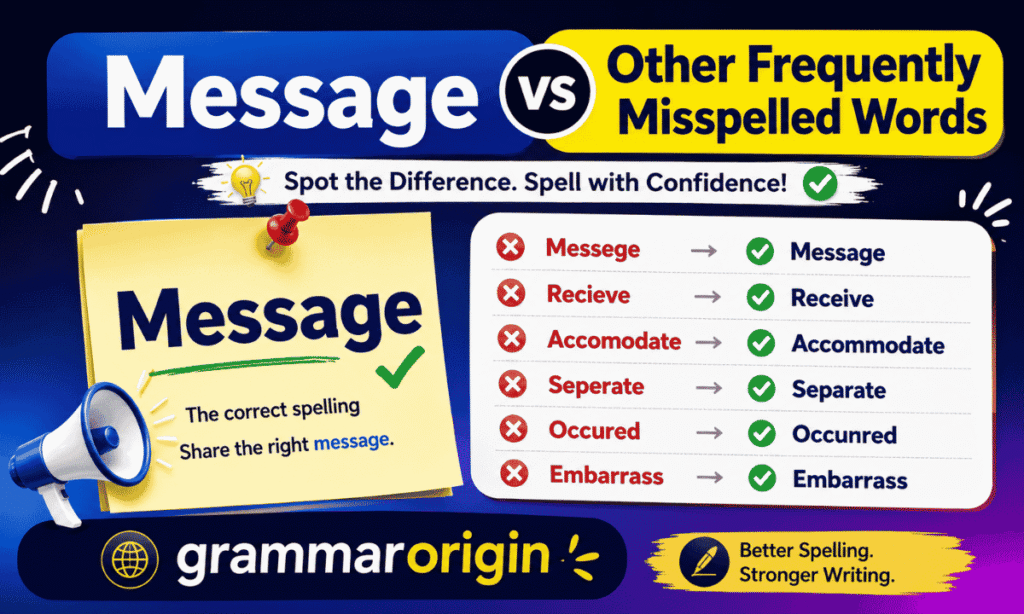
Several look-alikes trip people up alongside “messege,” and each one deserves its own quick clarification.
Message vs Massage
A message is information you send; a massage is a physical treatment that relieves muscle tension. Swapping the “e” for an “a” turns a work email into something awkward fast.
Message vs Mesage
“Mesage” simply drops a letter — it’s another misspelling, not a shortened or informal form. The rule stays the same: two S’s, one A.
Message vs Messenger
A messenger is the person, app, or service that carries the message — not the message itself. You send a message through a messenger, whether that’s a courier or an app like Facebook Messenger.
Message Pronunciation Guide
Say it as MES-ij in American English, with the stress landing on the first syllable — that’s the sound that trips writers into guessing “messege.”
Message vs massage
They rhyme in the first syllable but diverge after that: “message” ends softly (MES-ij), while “massage” carries a firmer, French-influenced ending (muh-SAHZH).
Message meaning
At its core, a message is content — an idea, instruction, or update — that travels from a sender to a receiver, in any format.
Message vs massage pronunciation
Listen for stress placement: message stresses the first syllable, while massage stresses the second, giving it that distinct French rhythm.
Messege or message download
If you’re searching this phrase hoping to download an app, template, or file, the spelling you want in your search bar is still message — “messege” won’t pull up official app store or software listings.
How to spell messages
The plural simply adds an “s”: messages. No other letters change — “messeges” is just as incorrect as the singular typo.
Messages app
Apple’s default texting app is called Messages, not “Messeges” — a detail worth knowing if you’re searching app stores or settings menus.
To send a message
This everyday phrase always keeps the “a” in the middle: “I need to send a message before the meeting starts.” The same rule applies when you want to message someone directly instead of calling — the spelling never shifts based on the platform.
Messenger
Spelled with an “e” after the double-S, unlike “message” — Messenger is also the name of Meta’s standalone chat app, built specifically around sending messages.
Also Read This Vagrant vs Hobo
The Importance of Correct Spelling
Small spelling slips like message vs messege carry more weight than they seem to, especially once your writing leaves your inbox and reaches someone else’s eyes.
Enhancing Your Writing Skills
Every corrected mistake sharpens your instinct for the next one. Writers who actively fix errors like “messege” tend to catch other typos faster too.
The Evolution of Messaging
Messages once meant handwritten letters carried by runners; today they travel instantly through apps and cloud servers. The spelling has stayed fixed even as the technology behind it changed completely.
The Impact of Digital Communication
Texting, DMs, and email have made “message” one of the most-typed words in the English language — which is exactly why the “messege” typo spreads so widely online.
Professionalism and Clarity
A misspelled word in a client email or job application can quietly undercut how careful and competent you appear, even if the rest of the message is well-written.
Building Language Skills
Mastering commonly confused words like this one builds a foundation that carries over to harder vocabulary later on.
Language in the Digital Age
Autocorrect helps, but it isn’t foolproof — some apps let “messege” slip through uncorrected, especially in casual typing modes.
Proofread Your Work
A quick second read before sending catches errors that autocorrect misses, particularly in longer emails or reports.
Use Spell Check Tools
Built-in spell-checkers, Grammarly, and similar tools flag “messege” instantly — but only if you actually run the check before sending.
Break Down Complex Words
Splitting a tricky word into smaller, familiar chunks (like mess + age) makes it far easier to recall under pressure.
Practice Writing Regularly
The more often you write the correct spelling in real sentences, the less likely your fingers are to default to the wrong one out of habit.
Message Origin & Etymology
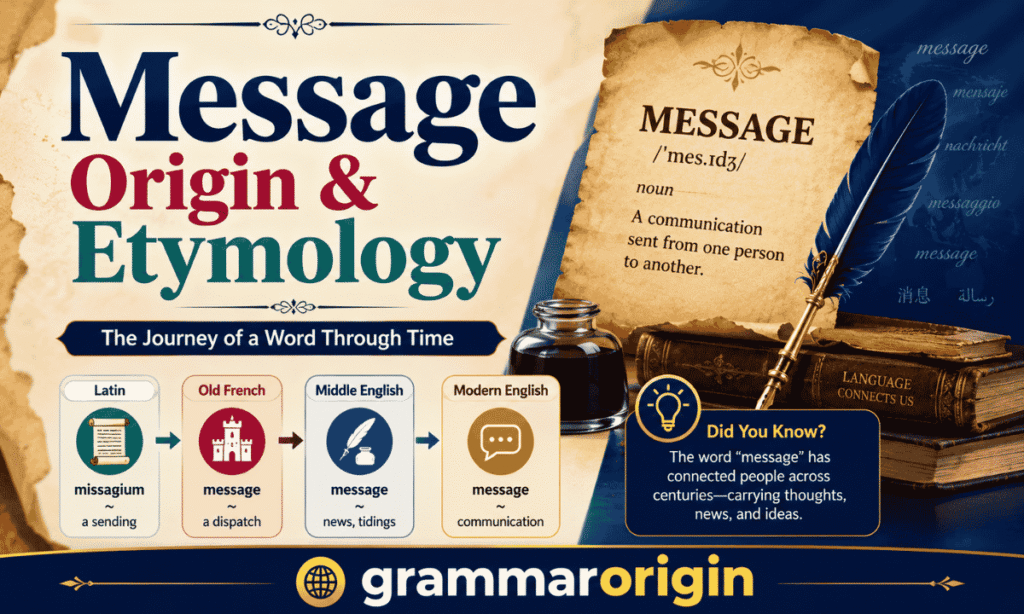
“Message” traces back to Old French message, itself rooted in the Latin missus — meaning “sent.”
That Latin root explains a lot: a message has always been something dispatched from one person to reach another, whether by messenger on foot centuries ago or by a push notification today. The spelling has held onto its French-derived “-age” ending the entire time, which is part of why “-ege” never became a legitimate alternative under standard English spelling rules.
Etymology also explains why message vs messege isn’t really a toss-up — the word’s roots never included an “e” in that spot to begin with. Knowing the origin makes this one of the easier common spelling mistakes to fix for good.
Frequently Asked Questions
Is messege a word?
No. “Messege” isn’t recognized in any standard English dictionary — it’s a common misspelling of message, nothing more.
How do you spell message correctly?
M-E-S-S-A-G-E. The letter directly after the double-S is always “a,” never “e.”
Why do people write messege instead of message?
Mostly because of how the word sounds when spoken — the middle syllable is soft enough that “e” feels like a reasonable guess, even though it’s wrong.
What is the plural of message?
Messages — just add an “s” to the correct singular form.
Is message a noun or a verb?
Both. As a noun it’s the content itself (“I got your message”), and as a verb it describes the act of sending one (“Message me later”).
Does autocorrect always fix messege?
Not always. Some messaging apps and quick-reply keyboards don’t catch it, so relying on autocorrect alone isn’t a safe habit.
What’s the difference between message and messenger?
A message is the actual content being sent; a messenger is the person, app, or service that delivers it.
Final Thoughts
Between message vs messege, only one has ever been correct: message. The other is a sound-based typo that never earned a place in the dictionary, no matter how often it shows up online.
Keep the mess + age trick in your back pocket, glance twice before hitting send, and this particular spelling slip won’t catch you off guard again.

Muhammad Waqas is an English language teacher and grammar expert with over 8 years of experience helping students and professionals improve their writing skills. He specializes in English grammar, vocabulary, communication, and practical language learning. Through GrammarOrigin, Waqas shares clear, easy-to-understand content that helps readers write and speak English with confidence.