
Most people learn “and” and “or” as kids, yet mix them up as adults without realizing it. One word adds things together. The other forces a choice. Get them backward in an email, a contract, or an exam answer, and the whole meaning can flip.
This guide breaks down and vs or from every angle — meaning, grammar rules, symbols, legal use, and real sentences you can copy. By the end, you won’t just know the difference; you’ll know exactly which word fits your sentence and why.
Quick answer
“And” combines two or more things so that all of them apply. “Or” presents options so that only one (sometimes more) needs to apply. Think of “and” as a plus sign and “or” as a fork in the road.
If your sentence needs everything mentioned to be true at once, reach for “and.” If it needs just one item from a list to happen, “or” is the correct pick. That single test solves most and vs or confusion.
What Does “And” Mean?
“And” is a coordinating conjunction that links words, phrases, or full sentences that belong together. It tells the reader: both of these are happening, or both of these are true.
- We ordered soup and salad.
- The manager reviewed the report and approved it.
- Tired and hungry, she finally sat down.
Notice how nothing gets left out in any of these lines. “And” never removes an option — it stacks one idea on top of another. That’s the core of the and vs or distinction: “and” is additive by nature.
What Does “Or” Mean?
“Or” is a coordinating conjunction that separates two or more possibilities, where usually only one needs to be picked. It signals a fork rather than a pile-up.
- Do you want the aisle seat or the window seat?
- You can email me or call the front desk.
- Pick a starter, a salad, or nothing at all.
In everyday speech, “or” often allows for either option — or occasionally both, depending on context. That flexibility is exactly why this word trips people up, and why the and vs or comparison matters so much in careful writing.
Also Read this Message vs Messege
And vs Or: Key Differences (Easy Table)
The fastest way to lock in and vs or is a side-by-side look. Here’s the breakdown in one glance.
| Aspect | And | Or |
| Core function | Adds items together | Presents a choice |
| What it implies | Everything listed is included | Usually one item applies |
| Sentence result | Combination | Alternative |
| Example | Bring your ID and your ticket. | Bring your ID or your ticket. |
| Verb agreement | Usually takes a plural verb | Verb agrees with the nearer subject |
Keep this table in mind and most and vs or mistakes disappear on their own.
When to Use “And” (With Real Examples)
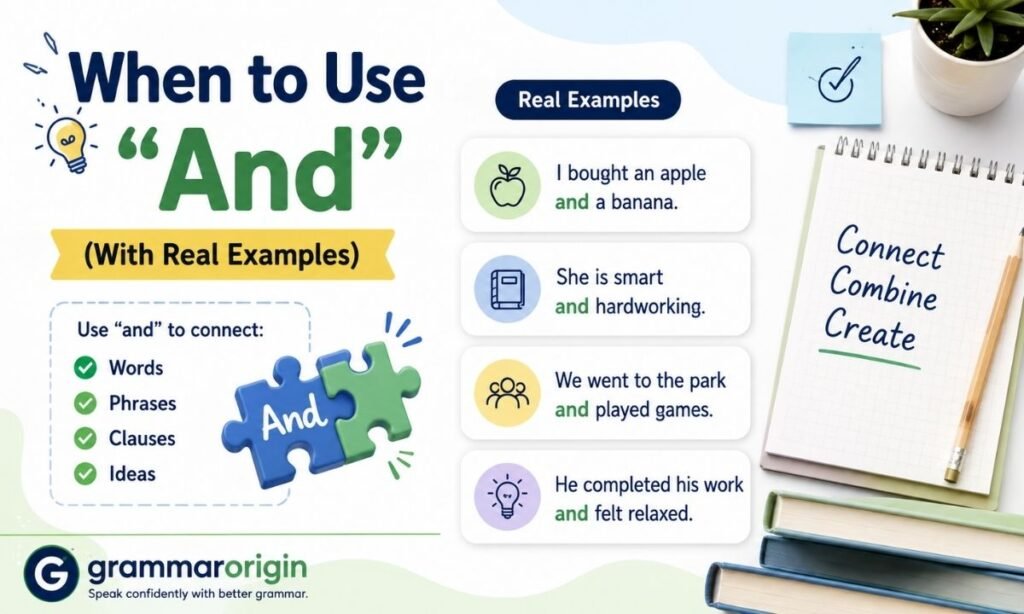
Use “and” whenever every item in your sentence needs to be true, present, or included at the same time. There’s no picking and choosing involved.
Common situations for “and”:
- Joining a list: I need flour, sugar, and eggs.
- Linking two actions: He locked the door and left.
- Describing multiple traits: The apartment is small and bright.
- Connecting requirements: Applicants must submit a resume and a cover letter.
A quick test works here — ask yourself, “does the sentence need all of these together?” If yes, “and” is doing its job correctly.
When to Use “Or” (With Real Examples)
Use “or” whenever the sentence offers a choice between two or more items, and typically only one is expected. It’s the natural word for decisions and alternatives.
Common situations for “or”:
- Offering choices: Would you rather have tea or coffee?
- Listing possible outcomes: The flight leaves at 6 a.m. or 9 a.m.
- Giving an ultimatum: Finish the report or explain the delay.
- Presenting a range: Choose paper, plastic, or reusable bags.
If swapping in “and” would force everything to happen together and that doesn’t match your intent, stick with “or.”
And vs Or in Real-Life Situations
Grammar rules feel abstract until you see them play out in ordinary moments. Restaurants, shopping lists, and instructions are full of and vs or decisions.
At a restaurant: “I’ll have rice and chicken” means both items arrive on the plate. Say “rice or chicken” instead, and the waiter brings only one.
At the store: “Buy milk and bread” means two errands, not one. “Buy milk or bread” leaves room to skip one item entirely.
These small shifts show why and vs or isn’t just a grammar rule — it changes what actually happens next.
Common Mistakes with “And” and “Or”
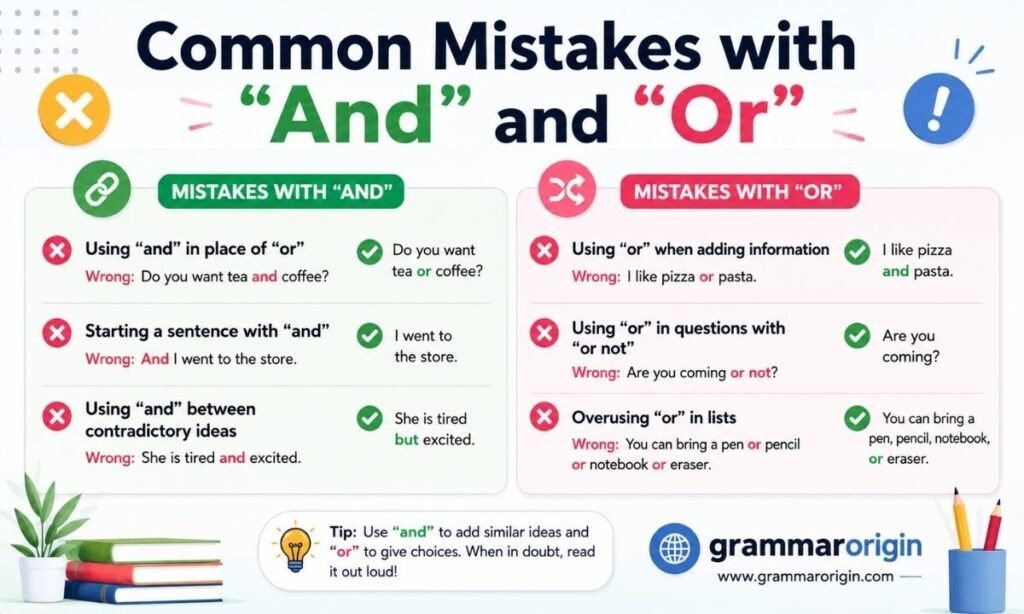
The most frequent slip-up is using “and” where a real choice was intended, or the reverse — using “or” when everything listed is actually required.
- Wrong: Submit your ID and passport or driver’s license. (unclear which items are mandatory)
- Better: Submit your ID and either a passport or a driver’s license.
- Wrong: I like tea or coffee. (if the speaker genuinely likes both)
- Better: I like tea and coffee.
Another common error shows up in instructions and forms, where vague and vs or phrasing leads to real confusion about what’s optional. Before finalizing a sentence, ask whether you mean “all of this” or “just one of these” — then pick accordingly.
Can You Use “And” and “Or” in the Same Sentence?
Yes, “and” and “or” can sit in the same sentence as long as the logic stays clear. Each word keeps its own job even when they appear together.
Example: You can order a salad or soup, and a drink comes free with either.
Here, “or” sets up the choice between salad and soup, while “and” adds the free drink on top of whichever option gets picked. Commas and careful phrasing keep sentences like this from turning into a puzzle.
Advanced Tip: Inclusive vs Exclusive “Or”
“Or” isn’t always as strict as it looks. Logicians and grammarians split it into two types — inclusive and exclusive — and the difference matters more than most guides admit.
Exclusive or means only one option applies, never both: “You can have the refund or the replacement” (not both).
Inclusive or allows one, the other, or both: “Students or teachers can enter the library” (both groups are welcome).
Standard English doesn’t use separate words for these two versions of “or” — context alone tells you which one is meant. That ambiguity is a big reason legal and technical writers treat and vs or so carefully.
And vs Or in Writing vs Speaking
Spoken English treats “or” loosely, often letting “either one is fine” bleed into casual conversation. Formal writing can’t afford that same looseness.
In speech: “Grab a snack or something, whatever’s around.”
In writing: “Applicants must provide a passport or a national ID card.”
The written version needs a precise choice because readers can’t ask a follow-up question. When precision matters — contracts, instructions, academic work — and vs or clarity becomes non-negotiable.
Also Read this Message vs Messege
Quick Practice Sentences (Test Yourself)
Fill in the blank with “and” or “or,” then check your answers below.
- She packed a jacket ___ an umbrella before the trip.
- Would you like the blue shirt ___ the black one?
- He was tired ___ irritable after the long shift.
- Bring your laptop ___ a notebook to the meeting.
- You can pay now ___ settle the bill later.
Answers: 1. and, 2. or, 3. and, 4. or, 5. or
And vs Or Logic
In formal logic, “and” and “or” have exact symbols with fixed meanings, unlike everyday English where context does some of the work.
- AND (∧): True only when both statements are true. “Rainy ∧ Cold” means it’s both rainy and cold.
- OR (∨): True when at least one statement is true. “Rainy ∨ Cold” means it’s rainy, cold, or both.
| Logic Symbol | Meaning | Example |
| ∧ (AND) | Both conditions must be true | It is raining ∧ it is cold |
| ∨ (OR) | At least one condition is true | It is raining ∨ it is cold |
This logical framing is exactly why programmers and mathematicians rarely confuse and vs or — the symbols leave zero room for guessing.
And vs Or Examples
Seeing both words in matched pairs makes the contrast click faster than any rule ever could.
- And: The store sells shoes and bags. / Or: The store sells shoes or bags.
- And: Call me and text me when you land. / Or: Call me or text me when you land.
- And: The room is clean and organized. / Or: The room is clean or organized (but maybe not both).
Read each pair aloud, and the shift in meaning becomes obvious within seconds.
And vs Or Symbol
Outside of formal logic, everyday writing uses a few shorthand symbols to represent these two words. Knowing them helps you read forms, spreadsheets, and technical text faster.
- “&” stands in for “and” in brand names, headers, and informal notes (e.g., Smith & Co.).
- “/” sometimes replaces “or” in casual shorthand (e.g., pass/fail).
- “and/or” is a hybrid symbol-phrase used mainly in legal and business writing to mean “one, the other, or both.”
Formal writing generally avoids these shortcuts, saving them for tables, headlines, or space-limited text.
And vs Or in a List
Lists are where and vs or confusion shows up most often, especially in instructions and requirements. The last connector in a list changes the entire meaning of everything before it.
- “Bring a pen, paper, and a calculator” means all three items are required.
- “Bring a pen, paper, or a calculator” means only one of the three is needed.
Some lists mix both: “Bring a pen and either paper or a tablet” — here “and” locks in the pen as mandatory, while “or” gives a choice for the second item.
And vs Or Rules
A handful of simple rules cover almost every and vs or decision you’ll ever face in writing.
- Use “and” when every item listed must apply together.
- Use “or” when only one item from the list needs to apply.
- Use “and/or” sparingly, mainly in legal or technical contexts, to mean “either or both.”
- With “and,” the compound subject usually takes a plural verb.
- With “or,” the verb agrees with whichever subject sits closest to it.
Keep these five rules nearby, and and vs or stops being a guessing game.
Legal Difference Between And and And/Or
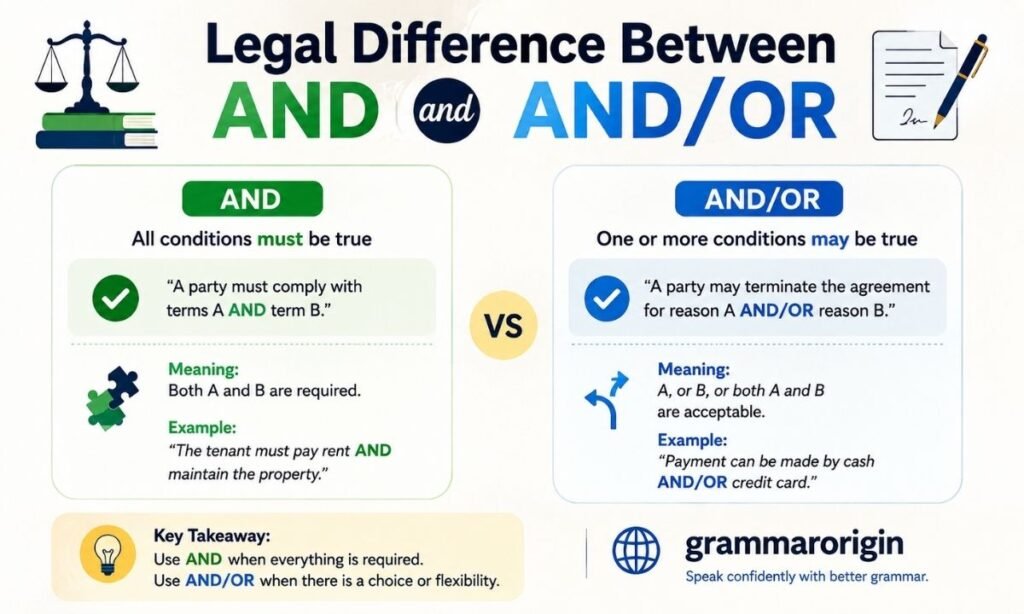
In legal writing, “and” requires every listed condition to be met, while “and/or” allows for one, the other, or both — a distinction that has actually ended up in courtrooms. Contracts, statutes, and pleadings all lean on this difference constantly.
A clause reading “the buyer and the agent shall be liable” holds both parties responsible together. Change it to “the buyer and/or the agent,” and liability could fall on either party alone or both at once.
Some legal scholars have criticized “and/or” as vague, and certain courts have refused to enforce clauses built around it. Even so, it remains common in contracts and patent claims because it captures three outcomes — A, B, or both — in a single phrase. Jury instructions and search warrants tend to avoid it entirely, since those documents need one exact meaning, not three possible ones.
Difference Between And Punctuation
Punctuation around “and” changes depending on how many items you’re joining and whether you’re linking full sentences or just words.
- Two items: no comma needed — bread and butter.
- Three or more items (Oxford comma): apples, oranges, and bananas.
- Joining two independent clauses: use a comma before “and” — She left early, and he stayed behind.
- Joining short clauses: the comma is often optional — She left and he stayed.
Getting this punctuation right keeps sentences from running together awkwardly, especially in longer, more formal writing.
10 Sentences With Or
Here are ten ready-to-use sentences that show “or” doing its job in different contexts.
- Do you want water or juice?
- You can walk to the station or take a taxi.
- Choose a window seat or an aisle seat.
- We can meet on Monday or Tuesday.
- Pay the deposit or lose your reservation.
- Answer true or false for each question.
- You may email the form or drop it off in person.
- Pick a name for the file or leave it blank.
- The package will arrive today or tomorrow.
- Sign here or ask for more time to review.
Additional Words for Clarity
When “and” or “or” alone feels too vague, a few extra words can sharpen the meaning without changing the core structure.
- Use “both” to stress inclusion: I’ll take both the salad and the soup.
- Use “either… or” to stress exclusivity: Take either the salad or the soup, not both.
- Use “neither… nor” to reject both: Neither the salad nor the soup appealed to her.
- Use “at least one of” for technical clarity: Submit at least one of the following documents.
These small additions remove the guesswork that plain “and” or “or” sometimes leaves behind.
And = Joining Independent Clauses
“And” can connect two complete sentences into one, as long as each half could stand alone as its own sentence. This is one of its most useful jobs beyond simple lists.
- She finished the report, and she sent it to her manager.
- The rain stopped, and the sun came out.
Each half of these sentences works fine on its own, which is exactly what makes them independent clauses. A comma before “and” is standard here, though very short clauses sometimes drop it in casual writing.
Subject-Verb Agreement With And/Or
Subject-verb agreement changes depending on whether “and” or “or” links the subjects, and this is one of the most commonly missed and vs or rules in everyday writing.
- “And” creates a compound subject that usually takes a plural verb: The teacher and the students are ready.
- “Or” makes the verb agree with the nearer subject: The teacher or the students are ready. / The students or the teacher is ready.
This rule matters most in formal writing, where a mismatched verb can make an otherwise correct sentence look like an error.
Exceptions
Grammar rules for and vs or aren’t absolute — a couple of common exceptions are worth knowing so you don’t second-guess correct sentences.
Exception #1
Some subjects joined by “and” still take a singular verb when they refer to one combined idea. Example: Bread and butter is my favorite breakfast (treated as one dish, not two separate items).
Exception #2
“Or” can imply “both are acceptable” rather than a strict either/or choice, especially in casual or inclusive contexts. Example: Volunteers or staff members can check people in (either group, or a mix of both, is fine).
Frequently Asked Questions
What is the basic difference between and vs or?
“And” combines items so all of them apply, while “or” presents a choice where usually only one applies. That single distinction covers most everyday sentences.
Can and and or be used in the same sentence?
Yes, as long as the sentence structure keeps each word’s role clear. Commas and careful phrasing prevent the meaning from getting muddled.
What does and/or mean in a contract?
“And/or” means one item, the other item, or both together. It’s common in legal writing but can create disputes when the surrounding context is unclear.
Is or always exclusive?
No, “or” can be inclusive (one, the other, or both) or exclusive (only one, never both), and standard English doesn’t use separate words to tell them apart — context decides.
Does and always take a plural verb?
Usually yes, since “and” creates a compound subject. There are a few exceptions where the joined items are treated as a single unit, like “bread and butter.”
How do I choose between and and or in a list?
Ask whether every item needs to apply together or whether just one item is enough. If it’s everything, use “and.” If it’s just one, use “or.”
Why do people confuse and vs or so often?
Because in casual speech, “or” sometimes allows both options anyway, blurring the line between the two words. Formal writing needs a stricter, more deliberate choice.
Final thoughts
The and vs or difference comes down to one simple test: does your sentence need everything included, or just one option from the list? “And” adds things up, and “or” hands over a choice.
Once that test becomes automatic, mistakes in lists, contracts, and everyday writing become far less common. Keep the rules from this guide close by, and picking the right word will stop feeling like a guess.

Muhammad Waqas is an English language teacher and grammar expert with over 8 years of experience helping students and professionals improve their writing skills. He specializes in English grammar, vocabulary, communication, and practical language learning. Through GrammarOrigin, Waqas shares clear, easy-to-understand content that helps readers write and speak English with confidence.