
You’ve typed it both ways at least once — “in front” with a space, or “infront” jammed together. Only one of these is real English, and mixing them up in an email or a school assignment is a fast way to look careless.
The short version: “in front” is correct, and “infront” is a spelling mistake. This guide breaks down the grammar rule behind it, shows you the meaning, walks through real sentence examples, and answers the exact questions people search for when they’re stuck on in front or infront.
Quick Answer
“In front” is correct. “Infront” is not a word in standard English.
Write it as two separate words every single time — as a greeting card, a report, a text message, or a tweet, it doesn’t matter. “In” is a preposition, “front” is a noun, and English keeps them apart. You’ll see “infront” scattered across comment sections and casual chats, but no dictionary recognizes it, and no style guide accepts it in formal writing.
Is It “In Front” or “Infront”?
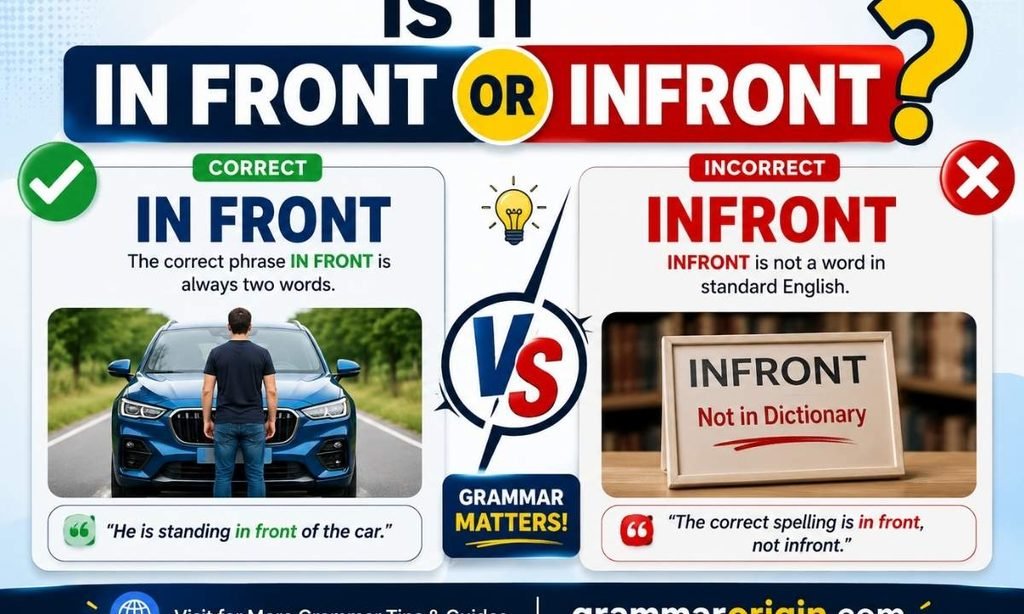
It’s “in front” — always two words, never one.
The phrase works as a prepositional phrase, which is exactly why it can’t be squeezed into a single word. Think about how “in front” behaves in a sentence: you can slot other words between “in” and “front” (like “in the front”), which is something a true single word would never allow. Try that with “inside” or “into” and the sentence falls apart — that’s the giveaway that “in front” was never meant to merge.
If you’ve typed “is infront one word” into a search bar, now you have the answer: no, and it never was.
Why “In Front” Is the Correct Form
The rule comes down to grammar, not preference. “In” carries the relationship, and “front” names the location — two different jobs, two different words.
Compare this to compounds that genuinely did merge over centuries, like “inside” or “into.” Those words fused because English speakers started treating them as single units with one meaning. “In front” never went through that shift. It’s stayed a two-word phrase through every edition of every major dictionary, and there’s no sign of that changing.
Writers sometimes assume “infront” should follow the same pattern as “inside,” but the two phrases took different paths historically, and only one of them arrived at a single word.
What Does “In Front” Mean?
“In front” describes a position ahead of, or facing, something else.
You’ll hear it used for physical space — “the dog sat in front of the fireplace” — and also more loosely, like standing “in front” of a crowd or a camera. It answers the question “where,” specifically pointing to the forward or leading spot relative to another person, object, or group.
Because the meaning is entirely about location, “in front” pairs naturally with “of” in most everyday sentences: in front of the house, in front of the class, in front of everyone.
Can “Infront” Ever Be Correct?
No — not in any dictionary, any grammar guide, or any formal writing context.
Some people justify “infront” by pointing to how casually it’s used online, but frequency isn’t the same as correctness. Plenty of misspellings show up constantly in texts and comments without ever becoming acceptable. “Infront” falls into that category: common, but wrong.
If you’re proofreading a document and spot “infront,” treat it the same way you’d treat any typo — fix it before you send anything out.
In Front vs. Infront (Comparison Table)
A side-by-side view makes the difference obvious at a glance.
| Feature | In Front | Infront |
| Correct spelling | Yes | No |
| Listed in dictionaries | Yes | No |
| Acceptable in formal writing | Yes | No |
| Acceptable in casual writing | Yes | Not recommended |
| Grammatical status | Prepositional phrase | Spelling error |
| Example sentence | The bike is parked in front of the gate. | The bike is parked infront of the gate. ❌ |
Every entry in that right column stays the same for a reason — “infront” doesn’t have a different meaning or a niche use case. It’s simply not a word.
How to Use “In Front” Correctly in Sentences
Using “in front” correctly just means keeping the space and usually pairing it with “of” before a noun.
- The taxi waited in front of the airport terminal.
- She practiced her speech in front of the mirror.
- A queue formed in front of the ticket booth.
- The kids raced each other in front of the school gates.
- He set the trophy in front of the entire team.
Notice that “in front” can also stand alone without “of,” especially when the reference point is already clear from context — “she sat in front” during the drive, for instance.
Common Mistakes People Make
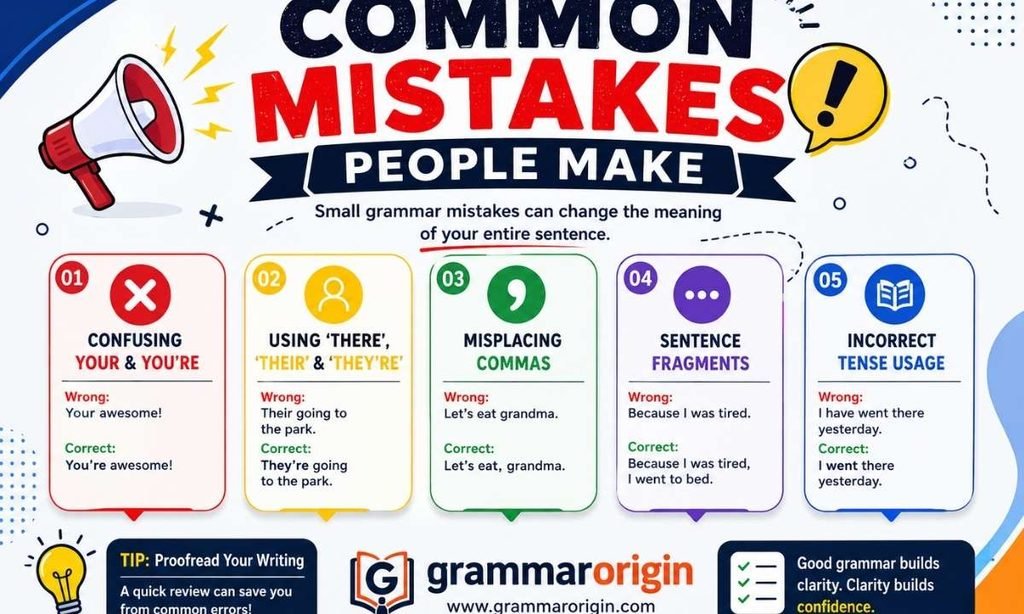
The most frequent mistake is assuming “in front” behaves like “inside” or “into” and merging it out of habit.
Autocorrect doesn’t always catch this one, especially on mobile keyboards where predictive text sometimes suggests the wrong version. Another common slip is dropping “of” entirely in sentences that need it — writing “in front the house” instead of “in front of the house.” Both errors are easy to miss on a quick read-through, which is exactly why a deliberate proofreading pass matters.
Similar Word Pairs That Follow the Same Rule
“In front” isn’t alone — English has a whole family of two-word phrases that people mistakenly merge.
- Into vs. In To
- Onto vs. On To
- Everyday vs. Every Day
- Setup vs. Set Up
- Login vs. Log In
- Workout vs. Work Out
- Anymore vs. Any More
Each pair has its own logic for when it splits and when it merges, so memorizing “in front” won’t automatically solve the others — but recognizing the pattern helps you slow down and check.
Easy Tricks to Remember the Correct Spelling
The fastest test: try inserting “the” between the two words.
“In front” becomes “in the front” and still makes sense — that’s your confirmation it’s meant to stay separate. Reading the sentence out loud works too; if it sounds like you’re naming a location, keep the space. Before you hit publish or send, a quick search for “infront” in your document catches the mistake before anyone else does.
Also Read This Forever Grateful vs Forever Be Grateful
Does American English or British English Use “Infront”?
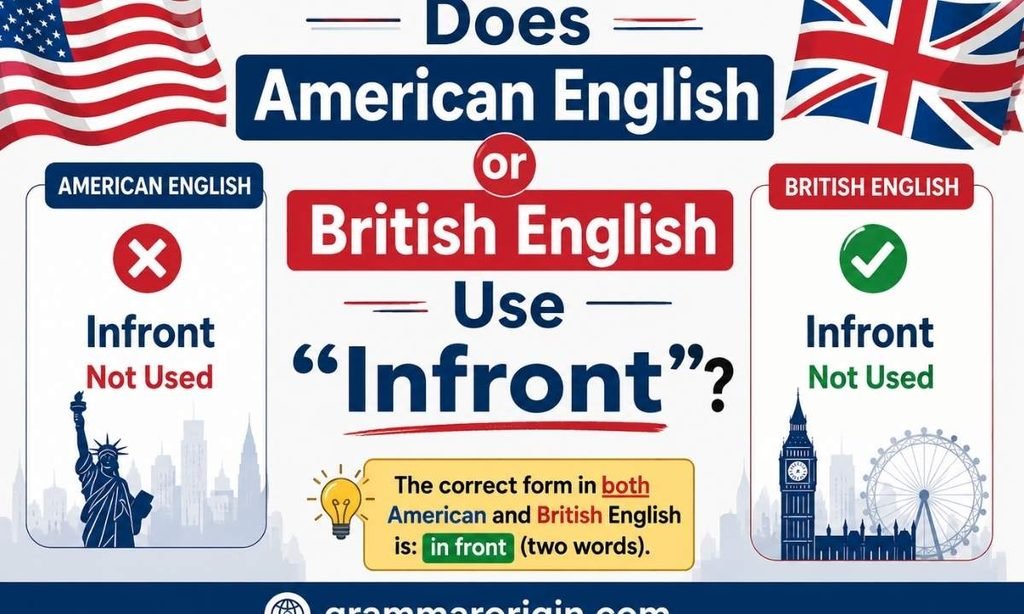
Neither. Both American and British English treat “in front” as the only correct spelling.
This is one of the rare cases where region doesn’t matter at all — there’s no US-vs-UK variation like you’d see with “color” and “colour.” Newspapers, textbooks, and official government sites on both sides of the Atlantic write it the same way: two words, always.
infront or in front examples
Every correct example follows the same pattern — two words, usually followed by “of” and a noun.
- The mailbox sits in front of the driveway.
- Please don’t stand in front of the projector.
- Their house is right in front of the park entrance.
- The band performed in front of a packed stadium.
Flip any of those to “infront” and you’ve introduced a spelling error, no matter how natural it might sound when spoken quickly.
infront meaning
“In front” means positioned ahead of, or facing, someone or something else.
It’s a spatial term first and foremost, describing where an object, person, or group sits relative to a reference point. The word “infront” itself carries no separate meaning — it’s not a variant definition, just an incorrect spelling of the same phrase.
infront of you meaning
“In front of you” means positioned directly ahead, within your line of sight or physical reach.
It’s commonly used both literally (“the remote is in front of you on the table”) and figuratively, as in describing an opportunity or challenge that’s immediately present — “the decision is in front of you now.”
is infront a word
No. “Infront” doesn’t appear as an entry in Oxford, Cambridge, or Merriam-Webster.
Search engines sometimes autocomplete it because so many people type it, but volume of searches isn’t the same as dictionary recognition. The correct entry you’ll find in every one of those references is “in front,” listed as a phrase, not a single word.
in front of everyone
“In front of everyone” means done or said publicly, with a group of people watching or present.
It shows up often in stories about embarrassment or public speaking — “he tripped in front of everyone” — where the phrase emphasizes visibility rather than just physical position.
infront company
“Infront” also exists as a proper noun — the name of an international sports marketing and media company headquartered in Switzerland.
That’s worth mentioning because a search for “infront company” isn’t asking about grammar at all; it’s looking for a business. As a brand name, capitalization and spelling rules for companies work differently, so this “Infront” isn’t an exception to the grammar rule — it’s simply a separate, unrelated proper noun.
is in front a preposition
Not exactly — “in front” functions as a prepositional phrase, and it’s typically followed by “of” to form the full preposition “in front of.”
“In” on its own is the preposition; “front” is a noun. Together, especially with “of” attached, the whole unit works the way a single preposition would, connecting a noun or pronoun to the rest of the sentence.
in front of you
“In front of you” places an object, person, or situation directly ahead of the person being addressed.
It’s one of the most common real-world uses of the phrase, showing up constantly in directions, instructions, and everyday spoken English — “your keys are in front of you” is a sentence most people hear or say weekly.
Also Read This Forever Grateful vs Forever Be Grateful
Is infront a single word?
No, and it never has been recognized as one.
Every major English dictionary lists “in front” as a two-word phrase. Treating “infront” as a single word is a spelling habit that spread through casual writing, not a legitimate alternate form.
What does it mean to be in front?
Being “in front” means occupying the leading or forward position, whether that’s physical, competitive, or situational.
A runner “in front” during a race is leading. A speaker standing “in front” of an audience is positioned to be seen and heard by everyone. The core idea — forward position, relative to others — stays consistent across these different contexts.
Do we say “in the front” or “at the front”?
Both are correct, but they’re used differently depending on context.
“In the front” usually refers to a specific section or area, like sitting “in the front” of a car or a classroom. “At the front” often points to the very leading edge of a line, queue, or movement, as in “she pushed to the front of the line.” “In front” (without “the”) is the more general, all-purpose version used in most everyday sentences.
Frequently Asked Questions
Is “infront” a typo or an accepted informal spelling?
It’s a typo. “Infront” has no accepted status anywhere, formal or informal, and dictionaries list it only as a common misspelling of “in front.”
Can I use “infront” in casual texting?
You can, and plenty of people do, but it’s still technically incorrect. If clarity and credibility matter even a little, sticking with “in front” costs nothing extra.
Is “in front” formal or informal?
It’s neutral and works in both registers. You’ll find it in academic papers, business emails, and casual conversation without any adjustment needed.
What’s the opposite of “in front”?
“Behind” is the direct opposite, describing a position at the back rather than the front.
Does “in front of” always need “of”?
No. “In front” can stand alone when the reference point is already clear from context, though “in front of” is more common when a specific noun follows.
Is “infront” used in British English?
No. British English follows the same rule as American English — “in front” is the only correct spelling in either variety.
How do you remember not to combine “in front”?
Try inserting “the” between the words. If “in the front” still makes sense, you know the phrase is meant to stay separated.
Final Thoughts
Between “in front” and “infront,” only one belongs in your writing. “In front” is the version recognized by every major dictionary and used consistently across American and British English, while “infront” remains a common but avoidable spelling mistake.
Next time you’re unsure, run the quick “the” test, keep the space between the words, and your sentence will be correct every time.

Muhammad Waqas is an English language teacher and grammar expert with over 8 years of experience helping students and professionals improve their writing skills. He specializes in English grammar, vocabulary, communication, and practical language learning. Through GrammarOrigin, Waqas shares clear, easy-to-understand content that helps readers write and speak English with confidence.