
If you’ve ever typed a caption and paused halfway through, wondering whether it’s “reel” or “real,” you’re not alone. The reel vs real confusion trips up native speakers just as often as learners, mostly because the two words sound identical but mean completely different things.
This guide breaks down every meaning of both words — from fishing reels to Instagram Reels to being genuinely “real” with someone — so you never second-guess your spelling again.
Quick answer
Real describes something true, genuine, or actually existing. Reel refers to a spinning object (like a film or fishing reel), a type of dance, or the short videos you scroll through on Instagram.
They sound exactly alike but share no meaning in common. Context is the only thing that tells you which one to use.
What Does “Real” Mean in English?

Real is an adjective meaning something that actually exists, is genuine, or isn’t faked. It’s the opposite of imaginary, artificial, or staged.
You’ll hear it in everyday lines like “that’s a real problem” or “she gave a real answer.” It also works as an adverb in casual speech — “the food was real good” — though that usage stays informal.
Real shows up in a few unexpected places too. In math, a real number is any value on the number line, positive or negative. In finance, “real” describes figures adjusted for inflation, as in real wages or real GDP.
What Does “Reel” Mean in English?
Reel is trickier because it carries several unrelated meanings. As a noun, it’s a cylindrical spool — think fishing reel, film reel, or a reel of thread.
As a verb, reel means to stagger or lose your balance, often from shock, dizziness, or a physical blow. And in the last few years, “reel” has picked up a brand-new meaning: a short-form video on Instagram or TikTok.
One more sense worth knowing — reel is also a fast-paced folk dance, especially in Scottish and Irish tradition, along with the music written for it.
Reel vs Real: Key Differences Explained
The core difference is simple: real deals with truth and existence, while reel deals with objects, motion, or video content. One is about authenticity; the other is about a physical or digital format.
Grammatically, real is almost always an adjective, which is a basic grammar rule worth remembering. Reel, by contrast, works as both a noun and a verb, which gives it far more range in a sentence.
Pronunciation offers zero help here — both are said the same way, which is exactly why this pair causes so many typos in fast typing and voice-to-text.
Reel vs Real in Sentences (Clear Examples)
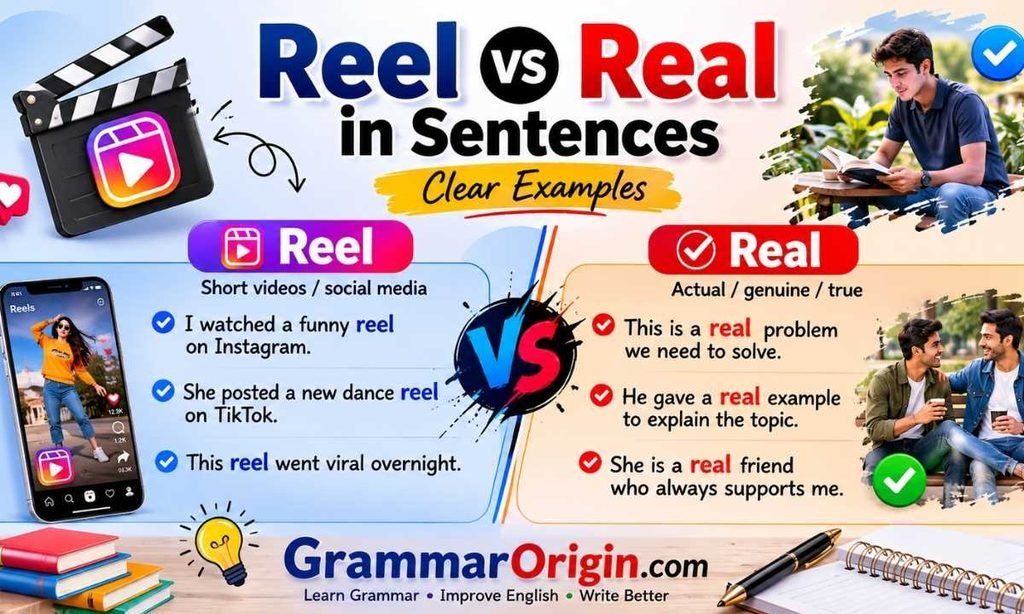
Seeing both words in context makes the split obvious. Here’s real in action:
- “Is this diamond real, or is it cubic zirconia?”
- “I want a real conversation, not small talk.”
- “Her fear in that moment was completely real.”
And here’s reel doing its own thing:
- “He wound the fishing line back onto the reel.”
- “She posted a 30-second reel of her morning routine.”
- “He reeled backward when he heard the news.”
Swap the words in any of these, and the sentence stops making sense — that’s the quickest test for which one belongs where.
Are “Reel” and “Real” Homophones?
Yes — reel and real are true homophones, meaning they’re pronounced identically but spelled and defined differently. Both are said as /riːl/, rhyming with “feel” and “peel.”
This is why the mix-up rarely happens in speech and almost always happens in writing. Your ear can’t catch a spelling mistake that sounds perfectly fine out loud.
English has plenty of these pairs — think “flower” and “flour” — but reel and real are among the most commonly searched because of how often “reel” now appears in social media conversation.
Common Mistakes Learners Make
The most frequent slip is writing “reel” when the sentence actually needs “real,” especially in phrases about truth or emotion. “That was a reel shock” should read “real shock.”
The reverse happens too, usually around video content: people write “I watched a real on Instagram” instead of “reel.” Autocorrect doesn’t always catch this because both are valid words.
A quick fix — if you can replace the word with “genuine” or “true” and the sentence still works, you need real. If you can replace it with “spool” or “clip,” you need reel.
Real vs Reel in Writing and Communication
In formal writing, real does most of the heavy lifting — describing facts, authentic experiences, or verified information. It’s the word you’ll use in essays, reports, and professional emails.
Reel earns its place in more specific contexts: film reviews, fishing content, music genre write-ups, and now, social media marketing copy. Brands writing about “reel strategy” mean video content, not authenticity.
Getting this right matters more than it seems — the wrong word can quietly shift a sentence’s meaning without the writer even noticing.
Can “Reel” Also Mean to Be Thrown Off Balance?
Yes, reel as a verb describes staggering or being knocked off balance, whether physically or emotionally. “He reeled from the punch” and “she reeled from the news” both use this sense correctly.
This meaning predates the video-clip usage by centuries and comes from the same root as the spinning-wheel sense — something reeling spins or sways out of control.
You’ll spot it often in news writing and fiction, where it adds motion and urgency: “The company reeled after losing its biggest client.”
How Is “Real” Related to Reality TV?
Reality TV takes its name directly from “real” — the genre claims to show unscripted, “real” people in real situations, as opposed to actors following a script. That’s the entire branding premise.
Of course, viewers have long debated how “real” reality television actually is, given editing, staged scenarios, and producer influence. This is exactly where the reel-vs-real conversation gets philosophical.
That tension — polished reel content versus messy real life — is also why phrases like “reel life vs real life” have become such a common way to describe the gap between social media and everyday reality.
Can “Reel” Refer to a Type of Dance?
Yes, a reel is a lively folk dance, most associated with Scottish and Irish tradition, danced to fast, rhythmic music of the same name. Think ceilidh nights and traditional fiddle tunes.
The dance involves quick footwork and circular or figure-eight patterns between partners, which is likely how the word connects back to “spinning” — the same idea behind a film or fishing reel.
You’ll still see this meaning in music genres, festival programs, and traditional dance instruction, even if it’s the least common usage in daily conversation today.
Is “Reel-to-Reel” a Type of Recording Method?
Yes, reel-to-reel refers to an audio recording format where magnetic tape runs between two spinning reels — one supply reel and one take-up reel — instead of being enclosed in a cassette.
It was the dominant professional recording technology through much of the 20th century, prized by audio engineers for its sound quality, and it’s still used today by some musicians chasing that analog warmth.
The name is a direct callback to reel’s original meaning: a spool that winds and unwinds material, whether that’s tape, film, or fishing line.
Also Read This In Front or Infront
Quick Comparison Table: Reel vs Real
| Aspect | Real | Reel |
| Part of speech | Adjective (mainly) | Noun and verb |
| Core meaning | True, genuine, existing | Spool, video clip, dance, or to stagger |
| Common contexts | Facts, emotions, identity | Film, fishing, social media, music |
| Example | “This is a real story.” | “She posted a new reel.” |
| Pronunciation | /riːl/ | /riːl/ |
This table is the fastest way to double-check your choice before you hit publish or send.
Memory Trick to Never Confuse Reel and Real Again
Picture the extra “e” in “reel” as a tiny spinning wheel — a visual nudge toward spools, film, and video. Whenever motion or a clip is involved, that shape should come to mind.
For “real,” link it to “reality” — both start the same way and both point toward truth. If the sentence is about something genuine, real is your word.
One more trick that works well for social content specifically: reels are what you record, real is what you live.
Practice Section: Test Your Understanding
Try filling in the blanks before checking your answers.
- This bracelet is made of ______ gold.
- She uploaded a 15-second ______ this morning.
- He ______ backward after hearing the shocking news.
- The fisherman’s ______ jammed mid-catch.
- Is her friendship with him ______, or just for the cameras?
Answers: 1. real, 2. reel, 3. reeled, 4. reel, 5. real.
Reel vs Real Movie

The phrase “reel vs real” shows up constantly in movie discussions, usually comparing a film’s dramatized version of events to what actually happened. A “reel” story is the cinematic one; the “real” story is the true one it’s based on.
Biopics and true-crime dramas get this comparison the most, since audiences want to know how much was changed for entertainment.
Reel or Real Instagram
On Instagram, “reel” refers specifically to the app’s short-form video feature, while “real” describes authenticity — as in content that isn’t staged or filtered. “Keeping it real” on Instagram means posting genuine, unedited moments.
Marketers and content creators often play with this exact pairing, urging people to post “real” content, not just polished, heavily edited “reels.”
Reel vs Real Pronunciation
Both words are pronounced identically: /riːl/, rhyming with “feel,” “peel,” and “steel.” There is no accent, dialect, or speed of speech that separates them audibly.
Because pronunciation gives no clue, the only reliable way to choose correctly is to check the meaning you intend before you write, not after.
Reel vs Real Dhurandhar
Big-budget films inspired by real events — a pattern popular in recent Bollywood releases — often spark “reel vs real” comparisons online, where fans dig into how closely the movie’s version matches documented facts.
This kind of comparison isn’t unique to any single film; it’s become a standard way audiences discuss dramatized storytelling versus historical accuracy.
Real or Reel Korean Show
Korean dramas and reality-format shows get the same treatment — viewers frequently ask whether emotional moments are “real” reactions or “reel” (scripted, produced) sequences. Survival and dating-format shows especially invite this scrutiny.
The distinction matters to fans because it shapes how much trust they place in what they’re watching.
Reel or Reels
“Reel” is singular — one video clip. “Reels” is plural, referring to multiple clips or the feature as a whole, as in “check out my Reels” or “I’ve posted three reels this week.”
Instagram capitalizes “Reels” when referring to the feature by name, but lowercase “reel” or “reels” is fine in general use.
Reel Video Meaning
A reel, in video terms, is a short-form vertical clip — typically 15 to 90 seconds — designed for quick, scrollable viewing on platforms like Instagram and Facebook. It’s the platform’s answer to TikTok-style content.
The format favors fast cuts, music, and trends, which is part of why “reel life” content often looks more polished than everyday “real life.”
What Is a Reel to Real?
This phrase usually points back to reel-to-reel recording — tape running between two open reels rather than sealed in a cassette. It’s occasionally misspelled as “reel to real” because of the homophone.
If someone means the audio format, the correct spelling is always “reel-to-reel,” with no “a” in the second word.
Is It Fishing Reel or Real?
It’s “fishing reel.” The reel is the spool-and-handle mechanism mounted on a fishing rod that lets you cast out and wind back your line.
“Fishing real” is a common misspelling caused entirely by the homophone — there’s no meaning of “real” connected to angling equipment.
Is It Highlight Reel or Real?
It’s “highlight reel.” This refers to a compiled clip of someone’s best moments — common in sports, gaming, and now social media portfolios.
Again, “highlight real” is a spelling slip, not an alternate valid phrase.
Can “Reel” Be Used as Both a Noun and a Verb?
Yes, and this dual role is one of reel’s defining features. As a noun, it’s an object — “hand me that reel” — or a video — “she made a reel.”
As a verb, it describes motion — “reel in the fish” — or losing balance — “he reeled after the hit.” Real, by comparison, stays almost entirely in adjective territory.
Does “Reel” Have Any Other Meanings in Different Contexts?
Beyond spools, videos, dance, and staggering, “reel” occasionally appears in older or regional English to describe a whirling sensation, as in “my head is reeling.” It’s the same root sense of spinning, just applied to a feeling rather than an object.
Industry-specific uses also exist — filmmakers still talk about a movie’s “final reel,” a holdover from physical film projection even though most cinemas have gone fully digital.
Also Read This In Front or Infront
If Someone Is “Reeling” in a Figurative Sense, What Might That Mean?
Figuratively, “reeling” describes being overwhelmed, shocked, or emotionally destabilized by news or an event. “The team is still reeling from the loss” means they haven’t recovered from the blow yet.
This usage works for individuals, companies, or entire communities, and it always implies a disruption significant enough to throw normal footing off balance.
Frequently Asked Questions
Is it “real life” or “reel life”?
It’s “real life” when talking about your actual, lived experience. “Reel life” is a deliberate wordplay used to describe curated content on video platforms, not a standard grammatical term.
Why do people confuse reel and real so often?
Because they’re homophones — pronounced exactly the same way — the confusion happens almost entirely in writing, where autocorrect and quick typing don’t catch the meaning mismatch.
What is the plural of reel?
The plural is “reels,” used for multiple physical spools or multiple video clips, as in “I saved five reels to watch later.”
Does “real” ever function as a noun?
Yes, though rarely in everyday English — “real” is also the name of Brazil’s currency and, historically, a small Spanish coin. In math, “the reals” refers to the set of real numbers.
Can “reel” describe a feeling of dizziness?
Yes, “my head was reeling” describes a spinning, disoriented sensation, whether from illness, shock, or overwhelming information.
Is “reel vs real” only relevant to social media?
No — the pair matters across fishing, filmmaking, music, dance, and grammar in general. Social media has simply made the comparison more visible in recent years.
How can I quickly check which word I need?
Ask if the sentence is about truth (real) or about a spool, clip, dance, or staggering motion (reel). If neither fits cleanly, re-read the sentence for context clues.
Final Thoughts
Reel and real sound identical but point in completely different directions — one toward truth and authenticity, the other toward spools, videos, dance, and motion. Once you separate the two meanings, the spelling choice becomes automatic.
Keep the memory tricks and comparison table handy for the next time you’re typing fast, and you’ll never let a homophone slip past you again.

Muhammad Waqas is an English language teacher and grammar expert with over 8 years of experience helping students and professionals improve their writing skills. He specializes in English grammar, vocabulary, communication, and practical language learning. Through GrammarOrigin, Waqas shares clear, easy-to-understand content that helps readers write and speak English with confidence.