
Ever paused mid-sentence, unsure whether to type “skillset” or “skill set”? You’re not alone. Job seekers, HR writers, and bloggers hit this exact fork in the road every day, and most guides just tell you to pick one without explaining why.
This article settles it clearly: which spelling dictionaries actually recognize, when the one-word version is fine, and how to use skill set correctly in resumes, emails, and everyday writing — with real examples, not just rules.
Quick Answer
“Skill set” (two words) is the standard, dictionary-recognized spelling for professional and academic writing. “Skillset” (one word) shows up constantly online and isn’t wrong exactly, but it’s still treated as an informal variant by most style guides and grammar checkers.
If you’re drafting a resume, cover letter, or any ATS-friendly document, stick with the two-word form. Save the one-word version for casual posts, internal Slack messages, or quick social captions where tone matters more than precision.
- Formal writing, resumes, academic work → skill set
- Casual blog posts, social media, internal notes → either works
- One narrow exception: Skillset (capitalized) is the actual name of an Australian nonprofit organization, so in that specific context, one word is correct
What Is a Skill Set?
A skill set is the full range of abilities, knowledge, and competencies a person brings to a task, job, or field. It’s not one skill — it’s the whole collection working together.
Think about a graphic designer. Their range of abilities might include software fluency, color theory, client communication, and time management all at once. None of those things alone would earn that label — together, they do.
People build this kind of expertise through school, training, hobbies, and plain repetition on the job. A nurse’s mix of competencies looks nothing like a software engineer’s, but both are made up of the same basic ingredients: learned ability plus practical experience.
Recruiters scan for this exact language constantly, which is exactly why the spelling you choose on a resume matters more than it seems.
Skillset vs Skill Set: What’s the Difference?
There’s no difference in meaning — only in spelling and formality. Both refer to the same collection of abilities; the two-word form is just the version dictionaries and style guides recognize as standard.
| Skillset | Skill Set | |
| Word count | One word (closed compound) | Two words (open compound) |
| Formal writing | Not recommended | Recommended |
| Dictionary status | Rarely listed as its own entry | Listed in Merriam-Webster, Cambridge |
| Common context | Blogs, casual writing, tech culture | Resumes, job postings, academic papers |
| Grammar checkers | Often flagged | Rarely flagged |
Grammatically, the two-word version works as an open compound noun — similar to “living room” or “real estate,” where two separate words combine to describe one concept. The closed, one-word form is what linguists call an emerging compound: a phrase that’s slowly fusing together the way “web site” eventually became “website.” It just isn’t fully there yet.
Also Read This Reel vs Real
Is “Skillset” Correct or Incorrect?
This spelling isn’t technically wrong, but it’s not the preferred or dictionary-standard choice. It’s best described as an informal variant that hasn’t been fully adopted by major style authorities.
Search Merriam-Webster, Cambridge Dictionary, or Dictionary.com for it, and you’ll typically get redirected to the two-word entry instead. That redirect is a strong signal — dictionaries are telling you which form they consider primary.
Style guides like AP and Chicago also lean toward the open form. So while spellcheck might let the closed version slide, and you’ll see it constantly on LinkedIn and in tech job listings, it still reads as informal in anything you’d call formal writing.
Examples of Skill Set in Sentences
Seeing correct and incorrect usage side by side makes the rule stick faster than any explanation.
Correct usage (two words)
- Her communication skill set made her the obvious pick for the client-facing role.
- I’ve spent the last year building a stronger technical skill set.
- The job posting listed a diverse skill set as a top requirement.
- His problem-solving abilities carried the whole project.
Informal usage (one word — fine casually, avoid formally)
- She’s got a solid skillset for this kind of work.
- Our team’s skillset covers everything from design to backend code.
Notice the pattern: swap the closed spelling for the open one in either of those informal examples, and the sentence instantly reads more polished. That’s the entire difference in practice.
Types of Skill Sets
This kind of collection generally breaks down into three broad categories: hard skills, soft skills, and transferable skills. Most people carry a mix of all three without ever labeling them that way.
Hard skills
Teachable, measurable abilities — coding in Python, operating machinery, speaking a second language, or building a financial model. You can usually test or certify these directly.
Soft skills
Behavioral and interpersonal traits — communication, adaptability, conflict resolution, leadership. Harder to measure, but often what actually determines whether someone thrives on a team.
Transferable skills
Abilities that move with you across industries entirely. Project management, negotiation, and critical thinking work the same whether you’re running a restaurant or managing a software rollout.
A well-rounded professional mix of all three is exactly what hiring managers are scanning resumes for.
Why Skill Sets Matter in Career Growth
A strong, well-defined skill set is often the single biggest factor separating candidates who get hired from those who get passed over. Employers aren’t just checking boxes — they’re picturing you doing the actual job.
Beyond hiring, this kind of expertise shapes promotions, salary negotiations, and career pivots. Someone who keeps adding relevant abilities stays valuable even as an industry shifts around them; someone who doesn’t tends to get left behind by automation or changing demand.
There’s also a confidence side to this that’s easy to overlook. People who can clearly name their own strengths — not just vaguely feel competent — tend to negotiate harder and pursue roles they’d otherwise talk themselves out of.
Growth here doesn’t require reinventing yourself. Sharpening two or three high-impact abilities a year compounds fast over a five- or ten-year career.
Common Mistakes to Avoid
Most errors here are small, but they’re exactly the kind of thing an editor or recruiter notices immediately.
- Using the closed spelling in formal documents. Fine casually, but it undercuts polish on a resume or cover letter.
- Adding a hyphen (“skill-set”). Neither dictionaries nor style guides support the hyphenated form — it’s not a real third option.
- Listing abilities without focus. A resume with twenty vague entries is weaker than one with six specific, relevant ones.
- Blending hard and soft categories with no structure. Separate them clearly so a reader can scan quickly.
- Copying generic lists from templates. Recruiters recognize boilerplate immediately — tailor the language to the actual role.
- Getting the plural wrong. “He has many skill set” is incorrect; it should read “many skill sets.”
Fixing even two or three of these instantly makes a resume or article read as more deliberate and professional.
Skill Set vs Related Terms
“Skill set,” “ability,” “competency,” and “experience” get used interchangeably in casual speech, but they mean genuinely different things.
| Term | Meaning | Example |
| Skill | One specific, learnable ability | Public speaking |
| Skill set | A full collection of related skills | Public speaking + writing + persuasion |
| Ability | Natural or general capacity to do something | Ability to learn quickly |
| Competency | Skill combined with applied knowledge | Project management competency |
| Experience | Time spent actually doing the work | Five years in customer service |
| Expertise | Deep, advanced mastery within a skill set | Expertise in tax law |
A skill is the single building block. A skill set is the whole structure built from several of those blocks. Experience, meanwhile, isn’t a skill at all — it’s the track record that proves those abilities actually work in practice.
Skill Set: US vs UK Usage
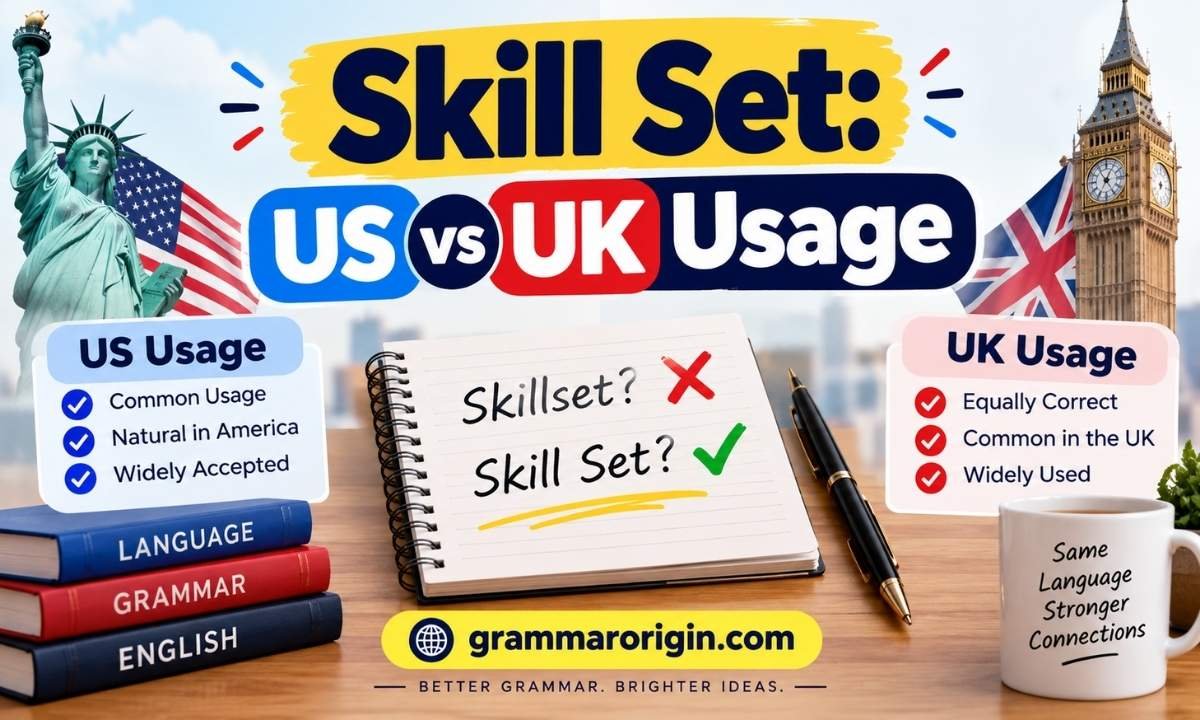
Both American and British English prefer the open, two-word form — there’s no real transatlantic split on the spelling itself.
Where usage differs slightly is tone: UK job postings and CVs lean a touch more formal overall, so the two-word version appears almost universally, while the closed spelling shows up more often in casual UK tech and startup writing, mirroring US patterns. Neither Oxford nor Cambridge Dictionary lists the one-word form as a standalone preferred entry.
Bottom line — if you’re writing a CV for a UK employer or a resume for a US one, the safe choice is identical: two words, no hyphen.
Also Read This Reel vs Real
Quick Summary
- Skill set (two words) → correct, standard, dictionary-recognized
- Skillset (one word) → informal, common online, avoid in formal writing
- Skill-set (hyphenated) → not supported by any major style guide
- Plural → skill sets, not “skill set” or “skillsets”
- Exception → Skillset (capitalized) refers to a specific Australian organization
Frequently Asked Questions
Is skillset one word or two words?
The standard, dictionary-preferred spelling is two words: “skill set.” “Skillset,” written as one word, is an increasingly common informal variant but isn’t the version most style guides recommend for formal writing.
What is a skillset?
A skillset — more properly spelled “skill set” — is the complete range of abilities, knowledge, and competencies a person has for a particular job or task. It covers both hard skills, like technical know-how, and soft skills, like communication.
What’s the difference between skill and skill set?
A skill is one specific, learnable ability, like writing or coding. A skill set is the broader collection of multiple related abilities a person has combined, which together shape what they can actually do on the job.
What does skillset mean in a resume?
On a resume, this term refers to the specific abilities you’re highlighting for a role — usually a mix of technical and interpersonal strengths matched to the job description. Using the two-word spelling here signals attention to formal writing conventions.
Is skillset or skill set the correct spelling for UK English?
UK English follows the same rule as US English: the two-word form is the standard, dictionary-recognized spelling. The closed version appears informally in UK writing too, but it isn’t the preferred form in CVs or professional documents.
What is a synonym for skill set?
Common synonyms include expertise, competencies, capabilities, proficiencies, and toolkit. None are exact matches — each carries a slightly different shade of meaning — but they’re often used interchangeably in casual writing.
What is the plural of skill set?
The plural is “skill sets,” formed by adding -s to the second word, just like “toolboxes” or “job titles.” Using it with a plural verb but no added -s is a common grammar mistake.
The Bottom Line
“Skill set” — written as two words — is the correct, dictionary-backed spelling for resumes, job descriptions, and any formal writing. “Skillset” isn’t a hard error, but it reads as the casual, still-emerging version.
When in doubt, default to two words. It’s a small habit that makes your writing look sharper, and it’s one less thing a recruiter or editor can flag before they even get to what you’re actually saying.

Muhammad Waqas is an English language teacher and grammar expert with over 8 years of experience helping students and professionals improve their writing skills. He specializes in English grammar, vocabulary, communication, and practical language learning. Through GrammarOrigin, Waqas shares clear, easy-to-understand content that helps readers write and speak English with confidence.