
Getting born in or born on right is one of those small grammar details that instantly makes your English sound polished — or slightly off if you get it wrong. The confusion is completely normal, especially for learners moving between languages that don’t split time and place prepositions the same way English does.
This guide breaks the rule down in plain terms, gives you real examples for both forms, and clears up the mistakes people make most often — including the tricky “born at” cases and the differences between American and British English.
Whether you’re filling in a birth date on a form, writing a short biography, or just chatting about someone’s birth year, knowing when to use each time expression makes your English sound natural to native speakers.
Quick Answer
Use “born in” for years, months, seasons, decades, centuries, and places like cities or countries. Use “born on” for a specific day, date, or holiday.
So you’d say “I was born in 1998” but “I was born on July 14, 1998.” Place gets “in,” an exact calendar point gets “on” — that’s the whole rule in one line.
What Does “Born In” Mean?
“Born in” points to something broad — a stretch of time or a location, not a single fixed point. Think of it as being placed inside a bigger container.
Years, months, seasons, decades, centuries, cities, and countries all fall under “in.” You can’t point to one exact day inside a year or a country, so English treats these as containers rather than pins on a calendar.
- She was born in 1994.
- He was born in April.
- They were born in the 1980s.
- My grandmother was born in Pakistan.
- The twins were born in spring.
What Does “Born On” Mean?
“Born on” locks the birth to one precise point — a single day you could circle on a calendar. There’s no room for a range here; it’s exact.
Full dates, days of the week, and holidays all use “on” because each one names a specific 24-hour window, not a stretch of time.
- She was born on March 5.
- He was born on a Tuesday.
- I was born on July 4, 1995.
- The baby was born on Christmas Day.
- Diana was born on July 1, 1961.
Born In vs Born On: The Main Difference
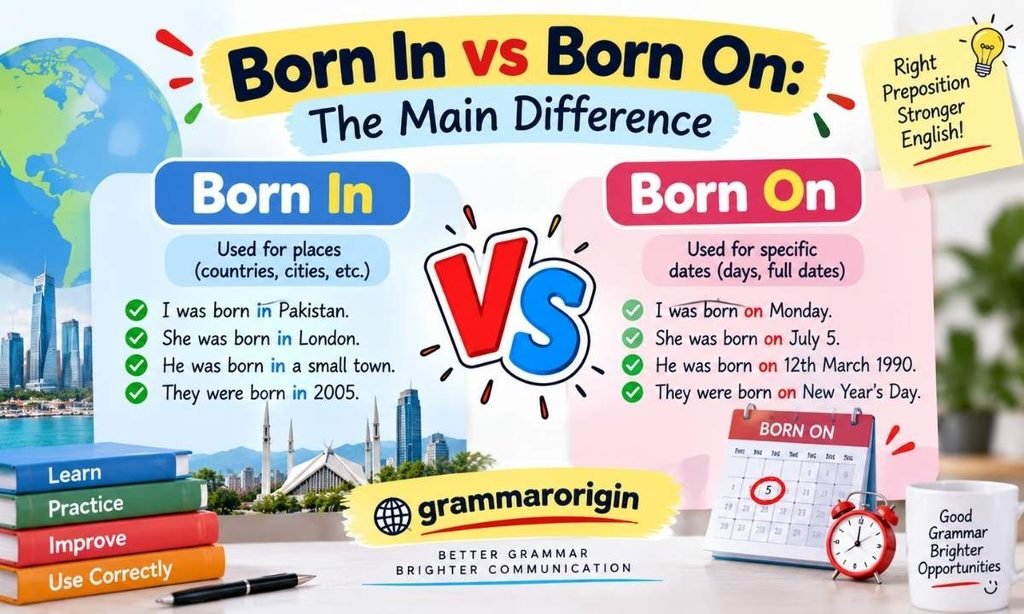
The core difference comes down to scope: is the time reference broad, or is it a single fixed point? “In” handles the broad stuff, “on” handles the exact stuff, and “at” steps in only for precise clock times or exact street-level locations.
| Preposition | Used For | Example |
| Born in | Years, months, decades, seasons, centuries, cities, countries | Born in 2001, Born in Lahore |
| Born on | Specific dates, days of the week, holidays | Born on May 5, Born on Monday |
| Born at | Exact time of day, specific address or building | Born at 6 a.m., Born at City Hospital |
Once you see it laid out this way, the pattern becomes automatic. Ask yourself: “Am I naming a period, or am I naming one exact point?” That single question solves almost every case.
Also Read This Skillset or Skill Set
Examples of Born In
Here are more natural sentences showing “born in” across different contexts — years, months, seasons, and places.
- Malala was born in Pakistan.
- I was born in December.
- He was born in the nineteenth century.
- We were born in the same neighborhood.
- She was born in winter, right before the first snow.
- My father was born in 1975, and my mother was born in 1978.
Examples of Born On
These examples show “born on” being used for full dates, weekdays, and named holidays — always something you could point to on a single calendar square.
- I was born on October 12.
- He was born on a rainy Sunday.
- The actress was born on New Year’s Eve.
- She was born on June 18, 1998.
- My brother was born on his father’s birthday, which felt fitting to the whole family.
Common Mistakes People Make
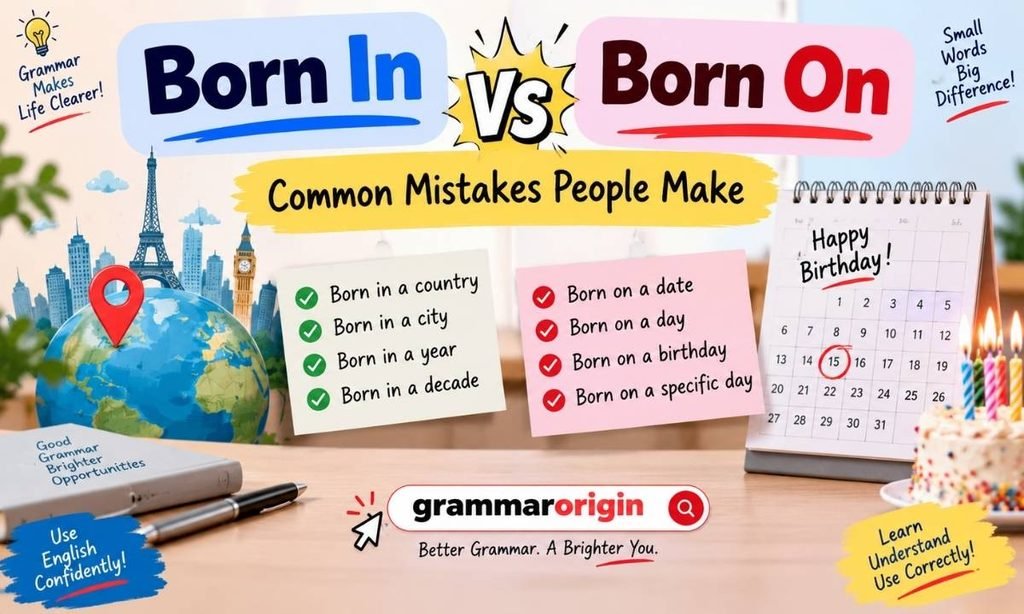
Even confident English speakers slip up here, usually by pairing “on” with a broad time reference or “in” with a specific date. A few patterns show up again and again.
- Saying “born on 1990” instead of “born in 1990” — years always take “in.”
- Saying “born on July” instead of “born in July” — a month alone is still broad, not a fixed day.
- Writing “born in July 4th” instead of “born on July 4th” — once a day number appears, switch to “on.”
- Using “born at Paris” instead of “born in Paris” — cities take “in,” not “at,” unless you’re naming an exact building.
- Mixing tenses, like “born on Monday, 1995” without the day number — this needs to include the specific date to justify “on.”
Why This Grammar Rule Matters
This isn’t just a classroom rule — it shows up constantly in biographies, resumes, legal paperwork, and everyday conversation. Getting it wrong can make writing look careless, even when the rest of the sentence is fine.
Employers, universities, and official documents expect this level of precision. A resume that says “born on 1998” instead of “born in 1998” is a small error, but it’s the kind of detail that quietly signals whether English is second nature to the writer or still a work in progress.
This is exactly why the born in or born on distinction shows up in formal writing guides, style manuals, and English-language courses — it’s a small rule with a big impact on how polished your writing looks.
Also Read This Skillset or Skill Set
Time Prepositions Related to Birth
Birth-related prepositions don’t stop at “in” and “on.” A third one, “at,” covers situations neither of the first two can handle — exact clock times and specific physical locations.
- Born at 3 p.m. — a precise time, not a date.
- Born at St. Mary’s Hospital — a named building, not just a city.
- Born at home — a specific setting rather than a broad location.
Born At: The Third Option
“Born at” gets left out of most guides, but it matters just as much once you’re naming something more exact than a city. If you can point to a building, an address, or a clock time, “at” is the correct choice.
Compare: “She was born in Chicago” (general city) versus “She was born at Northwestern Memorial Hospital” (the exact building). Both are correct — they just answer different levels of detail.
American vs British English
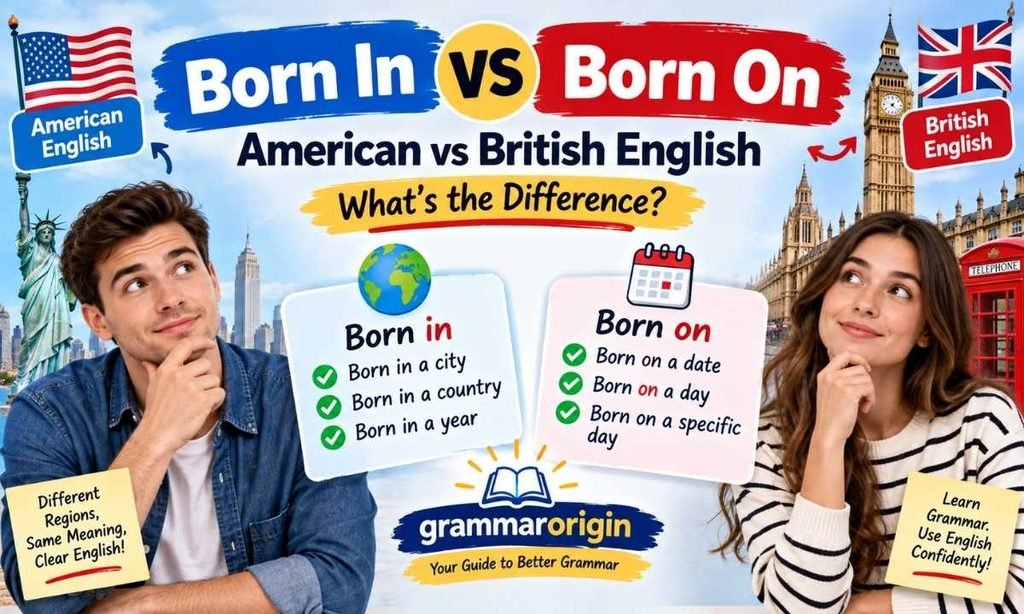
The core rule stays the same on both sides of the Atlantic, but a few small habits differ. These are style preferences, not grammar errors.
- Americans usually say “born in the hospital”; British English often drops the article and says “born in hospital.”
- Some American speakers say “born on the weekend,” while British English leans toward “born at the weekend.”
- Both varieties agree completely on years, months, and full dates — “born in 2000” and “born on May 5” work identically in both.
Tips to Remember the Difference
A couple of simple mental tricks make this rule stick without needing to memorize a list.
- Picture years and months as boxes — you’re always “in” a box, never “on” one.
- Picture a specific date as a pin stuck into a calendar — you land “on” a pin, not inside it.
- If you can attach a number to a single day (the 5th, the 14th), the answer is almost always “on.”
- If the phrase is just a name of a place, decade, or season with no exact day attached, the answer is almost always “in.”
Frequently Aasked Questions
Do we say “born in” or “born on” a country?
Always “born in” for a country. Countries are broad locations, so they follow the same rule as cities: “She was born in Canada,” never “born on Canada.”
Do we say “born in” or “born on” a date?
A full date takes “on.” Once a day number is involved — like “May 5” or “the 14th” — the phrase needs “on,” as in “He was born on May 5, 1990.”
Should I say “born in 1971” or “born on 1971”?
“Born in 1971” is correct. Years are broad time spans with no single fixed day, so “on” never pairs with a year alone — the same rule applies to “born in 2002.”
Is it “born in” or “born on” a month?
Months always take “in.” You’d say “born in June,” not “born on June,” since a month covers roughly thirty days rather than one specific point.
Is it “born in” or “born at” a city?
Use “born in” for a city name on its own, like “born in Lahore.” Switch to “born at” only when naming something more exact within that city, such as a hospital or address.
Was she “born in” or “born on” that event?
It depends on what follows. If the reference is a place or broad period, use “in” (“She was born in Karachi”); if it’s a specific day or named occasion, use “on” (“She was born on Eid”).
Why do English learners often mix up “born in” and “born on”?
Many languages don’t separate time prepositions the way English does, so learners — including Tagalog speakers translating directly — sometimes carry that pattern over into English. Running a sentence through a grammar checker like Quillbot can help catch these slips while you’re still building the habit, though understanding the underlying rule works better long-term than relying on a tool alone.
Summery
Once you treat “in” as the preposition for broad time and place, and “on” as the preposition for one exact day, the whole born in or born on question stops being confusing. The pattern repeats the same way across years, months, cities, dates, and holidays.
Keep the container-versus-pin image in mind, and you’ll get it right in conversation, writing, and official documents without needing to pause and second-guess yourself. Master the born in or born on rule once, and it becomes second nature every time you mention a birth date, birth year, or place of birth.

Muhammad Waqas is an English language teacher and grammar expert with over 8 years of experience helping students and professionals improve their writing skills. He specializes in English grammar, vocabulary, communication, and practical language learning. Through GrammarOrigin, Waqas shares clear, easy-to-understand content that helps readers write and speak English with confidence.