
Trying to decide between reinforce or reenforce? Only one of these is correct in modern English, and the mix-up happens more often than you’d think. Even confident writers pause here because the extra “e” looks like it could be a valid variant.
Here’s the short version: reinforce is the word you want, every single time you’re writing for today’s readers. This guide breaks down the meaning, the grammar, real example sentences, and the mistakes that trip people up, so you never second-guess this spelling again.
Quick Answer
Reinforce is the only standard spelling in modern English. Reenforce is an old, faded variant that dictionaries barely acknowledge anymore.
If you’re writing an email, an essay, or a social post, reach for reinforce without hesitation. There’s no scenario in current writing where reenforce is the safer or more correct choice.
Meaning of Reinforce vs Reenforce
Both words point to the same core idea, but they don’t carry equal weight in real-world usage. One is active and expected; the other reads like a leftover from an earlier century.
Reinforce
To reinforce something means to make it stronger, sturdier, or more effective than it currently is. It works for physical objects, arguments, habits, and feelings alike.
A contractor might reinforce a wall with steel beams. A parent might reinforce a rule by repeating it calmly. The verb flexes across contexts without losing its core meaning.
Reenforce
Reenforce carries the exact same meaning as reinforce, but it’s a spelling that’s largely dropped out of everyday use. You’ll occasionally spot it in older documents or dusty legal texts.
Modern dictionaries either skip it entirely or tag it as a rare variant. It isn’t wrong in a historical sense, but using it today just reads as an error to most readers.
Why Reinforce Is the Preferred Spelling

Reinforce won out because English spelling tends to settle on the version that’s easier to read and pronounce. The “in” in reinforce flows more naturally than the double “e” in reenforce.
There’s also a simple word-history reason behind this. Reinforce traces back to Old French “renforcer,” while reenforce popped up later as a literal “re- + enforce” spelling that never really caught on outside a handful of old texts.
Style guides, newspapers, and academic publishers settled on reinforce decades ago, and that consensus hasn’t shifted. When a spelling gets this much institutional backing, straying from it just signals a typo rather than a stylistic choice.
Major references like Merriam-Webster and the Oxford English Dictionary list reinforce as the primary entry, while reenforce rarely earns more than a passing historical mention. That kind of dictionary-wide agreement is a strong signal of which spelling actually holds up today.
Comparison Table: Reinforce vs Reenforce
| Factor | Reinforce | Reenforce |
| Current usage | Standard and widespread | Rare, mostly historical |
| Dictionary status | Fully listed, primary entry | Listed only as a variant, if at all |
| Best for | All modern writing | Quoting old text only |
| Reader perception | Professional, correct | Looks like a typo |
| Spellcheck behavior | Accepted | Usually flagged or auto-corrected |
The pattern here is straightforward: reinforce covers every situation you’ll realistically run into, so there’s little reason to keep reenforce in your active vocabulary.
Also Read This Roofs vs Rooves
Common Mistakes Writers Make
Most people don’t choose reenforce on purpose. It usually slips in because of a shaky assumption about how English prefixes work.
- Assuming “re-” always attaches cleanly to “enforce”
- Treating reenforce as a British spelling (it isn’t)
- Believing the two words mean slightly different things (they don’t)
- Trusting autocorrect blindly instead of double-checking
None of these assumptions hold up under a quick dictionary check, which is exactly why catching them early saves you an editing headache later.
American vs British English Differences

Reinforce is one of the rare words that doesn’t split along American and British lines. Unlike “color” versus “colour,” there’s no regional variant fighting for space here.
Writers in London, New York, Sydney, or Toronto all land on the same spelling. Reenforce isn’t the British counterpart to anything it’s simply outdated everywhere English is spoken.
When to Use Reinforce (Real-Life Contexts)
Reinforce shows up across a surprising range of situations, from construction sites to therapy sessions. Here’s how it plays out in practice:
- Physical: Crews reinforce a bridge before winter storms hit.
- Emotional: A friend’s kind words can reinforce your confidence before a big interview.
- Academic: New data often reinforces a hypothesis a researcher already suspected.
- Behavioral: Small rewards reinforce good habits in kids and adults alike.
Notice how the meaning barely shifts between these it’s always about adding strength or support to something that already exists.
Synonyms of Reinforce (LSI Keywords)
Swapping in a synonym now and then keeps your writing from sounding repetitive, especially in longer pieces. A few solid alternatives include:
- Strengthen
- Bolster
- Fortify
- Support
- Solidify
- Back up
- Intensify
For example, instead of writing “the report reinforces our concerns,” you could say “the report bolsters our concerns” without losing any meaning.
Memory Trick to Avoid Confusion
Here’s a quick mental shortcut: reinforce equals “put force back in.” Read it as re + in + force, and the correct spelling locks into place.
Spot a version with two e’s in a row after the r? That’s your signal something’s off. One clean “in” is all reinforce ever needs.
Example Sentences Showing Correct Usage
Seeing the word in action tends to stick better than any rule. Here are a few natural examples:
- The new locks reinforce the door’s security.
- Her calm tone reinforced everyone’s trust in the plan.
- Extra tutoring sessions reinforced what he’d learned in class.
- The company reinforced its safety policies after the audit.
Incorrect: “The workers reenforced the fence before the storm.” Correct: “The workers reinforced the fence before the storm.”
Reinforce vs Reenforce Synonym
The closest synonym for reinforce, in almost every context, is “strengthen.” It captures the same sense of adding stability or support without changing tone.
Reenforce doesn’t have its own separate synonym list, since it’s not a distinct word it’s just an outdated spelling of reinforce sharing the exact same meaning and, by extension, the exact same synonyms.
Reinforce vs Reenforce Examples
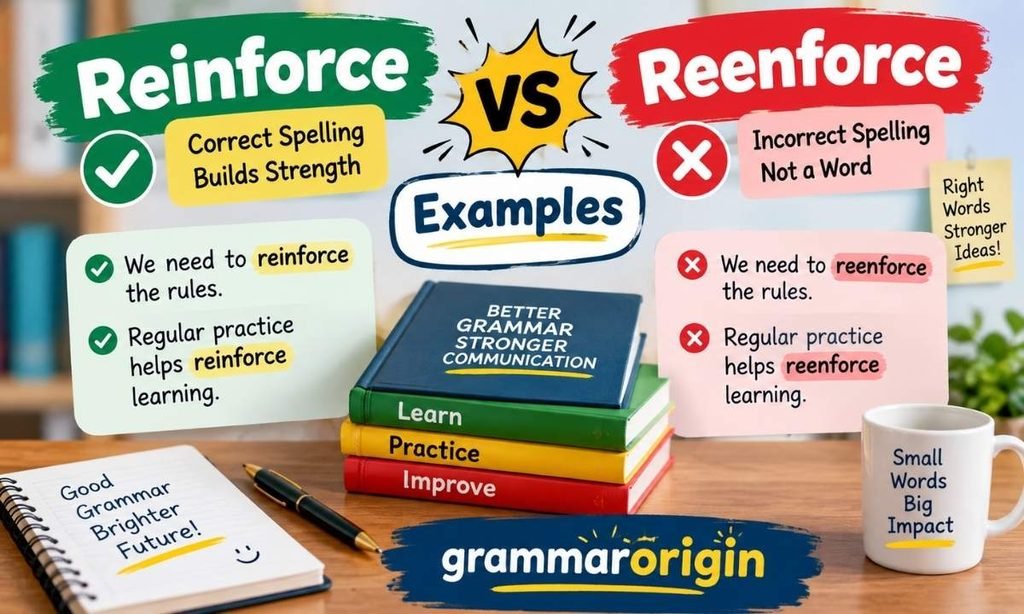
Side-by-side examples make the gap obvious fast. “The teacher reinforced the lesson with a quiz” reads naturally and correctly. “The teacher reenforced the lesson with a quiz” reads like a typo slipped past a spellchecker.
Every example sentence in modern writing, from news articles to textbooks, defaults to reinforce. You’d have to dig into texts from over a century ago to find reenforce used without raising an eyebrow.
Also Read This Roofs vs Rooves
Reinforce vs Reenforce Grammar
Grammatically, both spellings would function as a verb, but only reinforce has active, recognized forms across tenses. Here’s how the verb behaves:
| Form | Word |
| Base verb | reinforce |
| Present participle | reinforcing |
| Past tense | reinforced |
| Noun | reinforcement |
| Adjective | reinforced |
Reenforce technically could take the same endings (reenforced, reenforcing), but you won’t find these forms in current dictionaries or style guides, which is another reason to steer clear of the whole spelling family.
Reinforce vs Reenforce Reddit
There isn’t much genuine discussion of this specific spelling question on Reddit or other forums, since reenforce is rare enough that it rarely sparks debate. Most threads that do mention it simply confirm reinforce as correct and move on.
If you search grammar-focused subreddits, you’ll find plenty of threads on trickier pairs like “affect vs effect,” but reinforce vs reenforce barely registers as a contested topic among regular posters.
Reinforce Meaning
At its core, reinforce means to make something stronger, more secure, or more convincing than it was before. It applies just as easily to a physical structure as it does to an idea or a habit.
Whether you’re talking about steel rebar in concrete or a compliment that boosts someone’s confidence, the meaning holds steady: something existing gets extra strength added to it.
Frequently Asked Questions
Is reenforce ever acceptable to use?
Only if you’re directly quoting a historical document. In everyday or professional writing, reinforce is the only choice that won’t raise questions.
Does British English spell it differently?
No. Reinforce is standard in both American and British English, with no regional split like you’d see in words such as “organize” versus “organise.”
What part of speech is reinforce?
Reinforce is primarily a verb. Its noun form, reinforcement, shows up often in contexts like construction, military terminology, and psychology.
Will spellcheck catch reenforce?
Most modern spellcheck tools will flag reenforce and suggest reinforce instead, since reenforce isn’t recognized as standard in current dictionaries.
Why did reenforce exist in the first place?
It likely came from writers treating “re-” and “enforce” as two separate building blocks rather than recognizing reinforce as its own established word, a pattern common in older English texts.
Is there a meaning difference between the two spellings?
No. Both refer to the exact same concept of strengthening or supporting something; the only real difference is which spelling modern English actually recognizes.
So is it reinforce or reenforce, once and for all?
It’s reinforce. Every dictionary, style guide, and modern publication agrees on this, so there’s no real debate left to settle.
Can reenforce be considered a typo?
In most modern contexts, yes. Unless someone is deliberately referencing historical usage, reenforce showing up in a sentence is almost always an accidental misspelling of reinforce.
Final Thoughts
When it comes down to reinforce or reenforce, the answer stays the same no matter the context: reinforce is the spelling that belongs in your writing, whether you’re drafting an email, an essay, or a technical report. Reenforce isn’t a regional variant or a stylistic option; it’s simply a version that modern English has moved past.
Keep the “re + in + force” trick in your back pocket, and you’ll never have to second-guess this one again. One correct spelling, used consistently, does more for your credibility than most writers realize.

Muhammad Waqas is an English language teacher and grammar expert with over 8 years of experience helping students and professionals improve their writing skills. He specializes in English grammar, vocabulary, communication, and practical language learning. Through GrammarOrigin, Waqas shares clear, easy-to-understand content that helps readers write and speak English with confidence.