
Whether you are drafting a business proposal, writing an essay, or editing a property listing, knowing the correct plural of roof is essential for maintaining professional, polished writing. While words like knife and wolf shift to knives and wolves, English grammar handles roof differently—making roofs the universally accepted standard in modern English, while rooves remains an outdated, rare variant.
This guide breaks down everything you need to know about roofs vs. rooves, including dictionary guidelines from Oxford and Merriam-Webster, regional usage across American, British, and Australian English, key pronunciation differences, and an easy trick to never make this common grammar mistake again.
Quick Answer
Roofs is the correct plural of roof in every form of modern English. Rooves isn’t wrong exactly, but it’s old-fashioned and rarely shows up outside poetry or historical writing.
If you’re typing an email, a school paper, or a caption right now, go with roofs. That single fact solves 95% of the confusion around roofs vs rooves.
- ✅ Standard today: roofs
- ⚠️ Old/rare: rooves
Example: Three houses on our block got new roofs this year.
What Does “Roof” Mean?
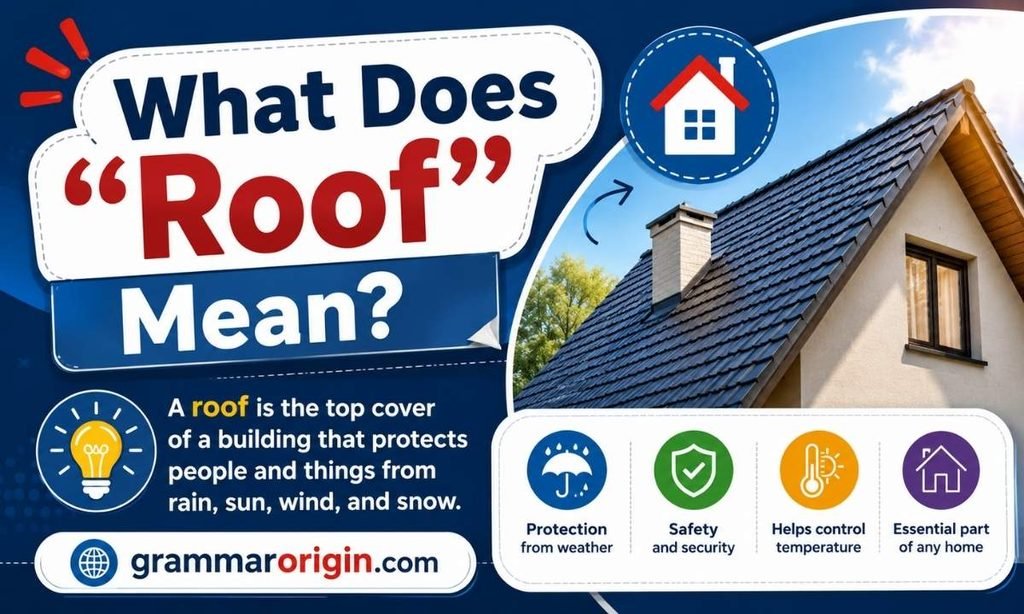
A roof is the covering that sits on top of a building, car, or shelter and keeps out rain, wind, and sun. It’s one of the first parts of a structure people notice, and one of the most expensive to fix.
The word works as a singular noun. Add more than one, and you need its plural — which is exactly where the roofs vs rooves debate begins.
Examples of “roof” in sentences
- Rain hammered against the tin roof all night.
- A cat got stuck on the neighbor’s roof.
- We finally patched the leak in the roof.
Roofs vs Rooves: The Main Difference
The core difference isn’t about meaning — both words point to the same thing. It’s about era. Roofs belongs to modern English; rooves belongs to older or stylistic English.
| Word | Function | Where It’s Used Today |
| Roofs | Standard plural of roof | Everyday writing, business, schoolwork, journalism |
| Rooves | Older/alternate plural | Poetry, period fiction, some regional speech |
Every major style guide, newsroom, and English teacher will point you toward roofs. Rooves survives, but only on the edges of the language.
Why Do People Think “Rooves” Is Correct?
People guess “rooves” because English trained them to expect it. A whole family of words ending in -f swap that ending for -ves in the plural, and roof looks like it belongs to that family.
Think about how naturally these shifts happen:
- leaf → leaves
- wolf → wolves
- knife → knives
Given that pattern, “roof → rooves” feels like the safe bet. The catch is that roof quietly sits in a different, smaller group of -f words that just tack on an -s instead:
- roof → roofs
- chief → chiefs
- proof → proofs
English never promised consistency here, and that’s really the whole story behind the confusion.
Is “Rooves” Ever Correct?
Yes, in a narrow sense — rooves isn’t a made-up error, it’s a genuine older plural that simply lost the popularity contest. You’ll still bump into it in specific corners of writing.
It tends to show up in:
- Older poems and ballads
- Period novels set before the 20th century
- Some regional British dialects, used informally
Outside those contexts, rooves reads as either a mistake or an intentional stylistic choice — rarely anything in between.
Example from older-style writing
Snow settled thick on the village rooves, and chimney smoke curled into the frost.
That line works in a period piece. Drop “rooves” into a business report, though, and it just looks like a typo.
American vs British English: Roofs or Rooves?
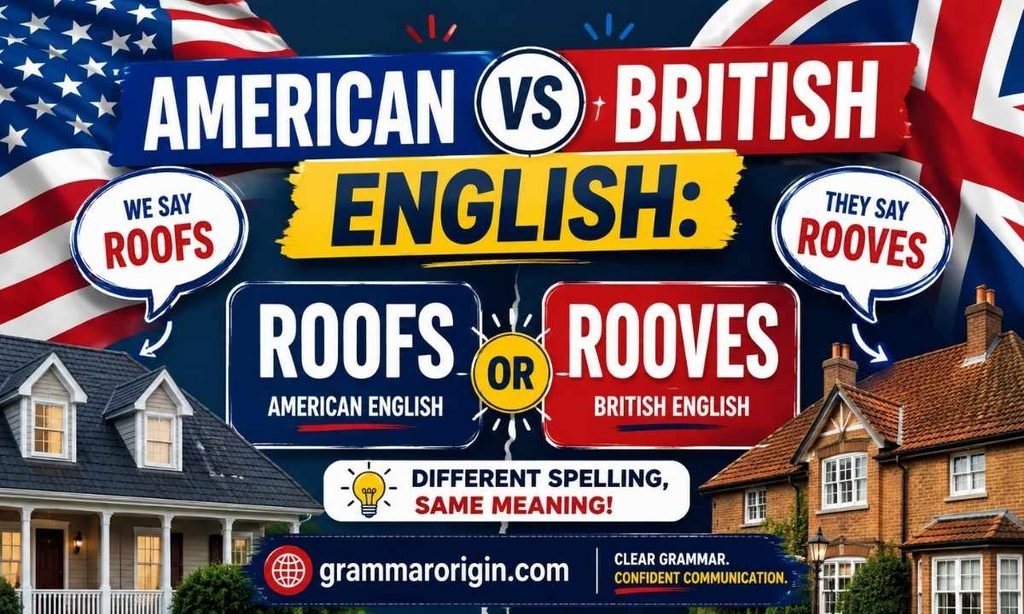
This is one spelling debate where American and British English actually agree. Neither variety treats rooves as the standard plural.
American English
American style guides, from AP to Chicago, list roofs as the only accepted plural. Rooves doesn’t appear in US textbooks or professional writing.
British English
British dictionaries also favor roofs. Rooves lingers in some regional speech and older texts, but it’s not the form taught in UK schools or used by British newspapers.
So for anyone specifically searching roofs or rooves UK, the short version is: British English never really left roofs behind in the first place.
Also Read This Interested In or On?
Is Rooves Used in Australian English?
Rarely, and mostly by older speakers or in casual regional speech — not in formal Australian writing. Australian English generally follows the same plural rule as American and British English here.
Australian dictionaries, including the Macquarie Dictionary, list roofs as the standard form. “Rooves” does turn up occasionally in older Australian texts and everyday conversation, especially among speakers who grew up hearing it from parents or grandparents, but it’s not what you’ll find in Australian newspapers, contracts, or classrooms.
So if you’re wondering about roofs vs rooves in an Australian context specifically, the answer lines up with the rest of the English-speaking world: roofs is the safe, correct choice.
Pronunciation Difference
Pronunciation actually feeds into this mix-up more than most people realize. The two plural forms don’t just look different — they sound different too.
| Form | Typical Pronunciation |
| Roof (singular) | /ruːf/ or /rʊf/ |
| Roofs (plural) | /ruːfs/ |
| Rooves (rare plural) | /ruːvz/ |
“Roof” pronunciation
Some speakers say roof so it rhymes with “proof,” others say it closer to “hoof” with a shorter vowel. Both are considered acceptable — but neither pronunciation changes which spelling is correct for the plural. That decision rests on grammar, not sound.
What Do Dictionaries Say? (Oxford, Merriam-Webster, Cambridge)
Every major English dictionary lists roofs as the standard plural, with rooves noted at most as a rare or dialectal variant. None of them treat rooves as equally correct today.
| Dictionary | Standard Plural | Note on “Rooves” |
| Oxford English Dictionary | Roofs | Lists rooves as a rare or dialectal variant |
| Merriam-Webster | Roofs | Doesn’t promote rooves as standard usage |
| Cambridge Dictionary | Roofs | Treats rooves as nonstandard in modern English |
When a search asks “roofs or rooves oxford dictionary,” this is the answer: Oxford backs roofs as the primary form, and treats rooves as a historical footnote rather than an equal option.
Examples of Correct Usage
Seeing the word in context makes the rule stick faster than any explanation does.
Everyday sentences
- The roofs on that street are all the same shade of gray.
- A storm tore shingles off several roofs downtown.
- Kids love watching squirrels run across the roofs.
Professional and construction-related examples
- The inspector flagged two roofs as needing urgent repair.
- Metal roofs handle heavy snow loads better than shingle ones.
- Our contractor quoted separate prices for flat roofs and pitched roofs.
Common Mistakes People Make
Most roofs vs rooves errors come from the same handful of habits. Spotting them is the fastest way to stop making them.
Mistake #1: Writing “rooves” automatically
❌ The old barn had two rooves. ✅ The old barn had two roofs.
Autopilot typing is usually the culprit — writers default to the pattern they half-remember from words like “hooves.”
Mistake #2: Assuming all -f words become -ves
Not every -f noun follows the wolf-to-wolves pattern. Chiefs, cliffs, proofs, and roofs all just add an -s, and there’s no shortcut for memorizing which group a word falls into besides learning the exceptions individually.
Mistake #3: Mixing formal and archaic styles
Using “rooves” in a cover letter or a client email doesn’t read as poetic — it reads as a mistake. Save the archaic form for fiction where that tone is intentional.
Also Read This Interested In or On?
Grammar Rule Behind Roofs
English doesn’t have one clean rule for -f nouns in the plural — it has two competing patterns, and roof happens to fall in the smaller, quieter one.
Words that shift to -ves:
| Singular | Plural |
| Knife | Knives |
| Calf | Calves |
| Half | Halves |
| Shelf | Shelves |
Words that simply add -s:
| Singular | Plural |
| Roof | Roofs |
| Safe | Safes |
| Proof | Proofs |
| Chief | Chiefs |
There’s no shortcut formula here — the safest approach is memorizing the exceptions as you meet them, the same way you’d learn any irregular vocabulary.
Related Words and LSI Keywords
Understanding roofs vs rooves gets easier once you see it inside the bigger picture of English pluralization. Related ideas worth knowing:
- Irregular plural nouns and how they form
- The roof plural rule specifically, as opposed to general -f pluralization
- Rooves definition and why dictionaries still record it
- Roofs pronunciation compared with rooves pronunciation
- British vs American spelling patterns more broadly
- Archaic English word forms that survive in literature
These threads all connect back to one idea: English plurals don’t follow a single formula, and roof is one of the clearer examples of that.
Roofs in Real-Life Contexts
The word roofs shows up constantly outside grammar lessons — in industries where getting the spelling right actually matters for credibility.
You’ll see it in:
- Real estate listings and property descriptions
- Construction contracts and repair quotes
- Insurance claims after storm damage
- Weather reports covering wind or hail damage
- Architecture and urban planning discussions
Examples
- Green roofs are gaining popularity in dense cities for their insulation benefits.
- Clay tile roofs are a signature feature of Mediterranean-style homes.
- High winds ripped roofs off three warehouses last spring.
Historical Background of “Rooves”
Rooves isn’t a modern typo — it’s a leftover from a time when English spelling was far less standardized than it is now. Centuries ago, plural forms varied by region, scribe, and even mood.
During the Middle English period, before printing presses and dictionaries locked spelling into place, writers used rooves, hoofs, wharfs, and similar forms somewhat interchangeably. There was no single authority telling anyone which version was “correct.”
Timeline: When Did Rooves Become Roofs?
- Pre-1500s (Middle English): Plural forms for -f nouns varied widely; rooves appeared alongside roofs in regional writing.
- 1600s–1700s (Early Modern English): Printed books and early dictionaries began pushing toward consistent spelling, favoring roofs.
- 1800s onward: Roofs became firmly dominant in published English, while rooves faded into dialect and literary use.
- Today: Roofs is universal in standard English; rooves survives mainly as a stylistic or historical choice.
So when someone searches “when did rooves become roofs,” the honest answer is that it wasn’t a single event — it was a slow standardization that played out over roughly three centuries.
Which Form Should You Use Today?
For nearly everything you write in 2026, the answer is simple and doesn’t change based on audience or region.
Roofs
Use roofs for:
- Emails and business communication
- School and university writing
- Journalism and blog content
- Everyday conversation and texting
- Legal, insurance, and construction documents
Reach for rooves only when you’re deliberately writing in an old-fashioned or poetic voice — and even then, expect some readers to assume it’s a typo.
If you’re still unsure when to use roofs vs rooves in a specific piece of writing, default to roofs. It’s the safer, more universally accepted choice in nearly every situation you’ll actually run into.
Easy Memory Trick
Pair roof with a word you already spell correctly without thinking: proof. Both end the same way, both just add an -s, and both skip the -ves ending entirely.
Say it as a pair: proofs, roofs — no v sound in either one. That small rhyme is often enough to stop “rooves” from creeping back into your writing.
Frequently Asked Questions
Do you say roofs or rooves?
You say roofs. It’s the plural form recognized by every major English dictionary and used across American, British, and Australian English alike.
Why is the plural of roof not rooves?
Roof belongs to a group of -f nouns that simply add -s in the plural, rather than the smaller group that shifts to -ves. There’s no deeper rule beyond that — English pluralization has multiple patterns, and roof follows the -s pattern.
Is rooves used in the UK?
Rarely, and mostly in older or regional speech rather than standard writing. British dictionaries and style guides list roofs as the correct plural, matching American usage.
What does rooves mean?
Rooves means exactly the same thing as roofs — more than one roof. It’s simply an older plural form that’s fallen out of standard use, though it still appears in historical texts and poetry.
Why roofs not rooves, if hoof becomes hooves?
Hoof and roof look similar but didn’t follow the same historical path. Hoof kept its -ves shift in most dictionaries, while roof standardized around the simpler -s ending over the past few centuries.
Is rooves grammatically wrong?
Looking at rooves vs roofs grammar strictly, rooves isn’t a hard violation so much as an outdated form. Using it in modern formal writing will likely read as an error, even though it has genuine historical roots.
Which spelling do Oxford and Merriam-Webster recommend?
Both list roofs as the standard, current plural. Rooves appears in these dictionaries only as a rare or historical variant, not as an equally valid modern choice.
Conclusion
Whichever context you’re writing in — American, British, or Australian English — roofs is the plural that will always read as correct. Save rooves for the rare moment you want a deliberately old-fashioned or literary tone.
Getting this one small detail right helps your writing look polished, whether it’s a school assignment, a client email, or a construction report.

Muhammad Waqas is an English language teacher and grammar expert with over 8 years of experience helping students and professionals improve their writing skills. He specializes in English grammar, vocabulary, communication, and practical language learning. Through GrammarOrigin, Waqas shares clear, easy-to-understand content that helps readers write and speak English with confidence.