
You typed “its called” in a sentence, then paused. Something felt off, but you couldn’t say why. That tiny apostrophe is the whole problem.
This guide clears up its called vs it called for good when each one works, why the apostrophe changes everything, and how to stop second-guessing yourself mid-sentence.
Quick Answer
- “Its called” Grammatically broken. It’s missing the verb “is,” so the sentence never actually finishes its thought.
- “It’s called” Correct when you’re naming or labeling something. Short for “it is called.”
- “It called” Correct only in past tense, when something (a person, a machine, an event) performed the action of calling.
If you’re introducing a name, reach for it’s called. If you’re describing something that already happened, it called is your phrase.
Also Read This What Kind of vs What Kinds of
Meaning and Explanation
Both phrases sound almost identical out loud, which is exactly why writers mix them up on the page. The difference comes down to grammar function and verb tense: one names something in the present, the other reports a completed action in the past.
Its Called
“Its called” isn’t really a phrase it’s a typo wearing a phrase’s clothes. Drop the apostrophe from “it’s,” and you accidentally turn a contraction into a possessive pronoun, which doesn’t pair naturally with “called” at all.
Think of “its” the way you’d think of “his” or “her” it shows ownership, not action or identity. “Its tail,” “its color,” “its price” all work because something belongs to “it.” But “its called” leaves the sentence hanging, waiting for a verb that never shows up.
It Called
“It called” earns its place in a sentence only when something is genuinely performing an action in the past. A phone can call. A storm can call for shelter. A committee can call a meeting to order.
The catch is context: “it called” needs an object or a clear follow-up to make sense. “It called yesterday” works fine. “It called a laptop” doesn’t that’s a naming situation, and naming needs “it’s called.”
Its Called vs It Called Common Mistakes
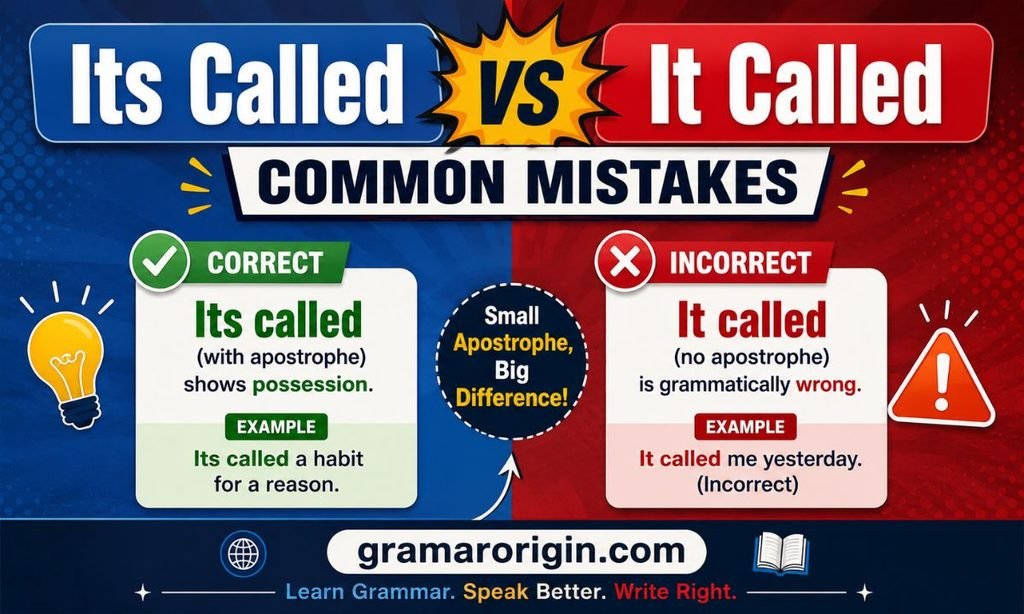
Most writers don’t confuse the underlying grammar rule itself they confuse it under pressure, typing fast and skipping the apostrophe key. These slips fall into three predictable patterns of sentence structure and word choice.
- Dropping the apostrophe entirely. Typing “its called” when you mean “it’s called” is the single most common slip, especially on phones.
- Reaching for “it called” when naming something. “It called a smartphone” sounds like a translation error, not a naming statement.
- Mixing up possession with contraction. “Its” shows ownership (its wheels, its shape). “It’s” always means “it is” or “it has.” They’re never interchangeable.
A fast fix: say the sentence out loud and replace “it’s” with “it is.” If the sentence still makes sense, the apostrophe belongs there.
Its Called vs It Called: Comparison Table
| Phrase | Grammatically Correct? | Example | When to Use |
| Its called | No | ~~Its called a violin~~ | Never missing verb, always a typo |
| It’s called | Yes | It’s called a violin | Naming or labeling something, present tense |
| It called | Yes | It called for backup | Describing a past action with context |
Its Called vs It Called American vs British English
The grammar rule itself doesn’t shift across the Atlantic “it’s called” is correct everywhere standard English is written, and “its called” is wrong everywhere too. Apostrophe rules and punctuation conventions aren’t regional, even though dialect and word choice can be.
What does shift is tone. American writing leans on contractions freely, even in blog posts and marketing copy, so “it’s called” shows up constantly. British formal writing sometimes stretches it out to “it is called” for a slightly more buttoned-up register, particularly in academic or technical documents but that’s a style choice, not a grammar requirement.
Examples in Everyday Sentences
- Correct: It’s called Spotify, and it’s used for streaming music.
- Incorrect: Its called Spotify, and its used for streaming music.
- Correct (past action): It called the front desk twice before anyone picked up.
- Incorrect (naming): It called the front desk a “help line.”
Read these out loud and the pattern gets obvious fast naming always leans on “it’s,” action always leans on the bare “it called.”
its called vs it’s called
This is the comparison people actually mean to search for, even when they type it without the apostrophe. “Its called” isn’t a competing grammatical option it’s simply the incorrect spelling of “it’s called.”
There’s no context where “its called” wins the argument. If you’re ever unsure which one to type, default to “it’s called” and check whether “it is called” still makes sense in the sentence.
its called vs it called
Here the confusion is real, because both “it’s called” and “it called” are valid they just do different jobs. “It’s called” introduces a name. “It called” reports a completed action.
Swap them and the sentence breaks. “It called a golden retriever” sounds like a rough translation. “It’s called for backup” sounds like a machine somehow requested help technically grammatical, but almost never what you meant.
it called or it’s called
Pick “it called” when your subject already did something dialed, requested, announced, summoned. Pick “it’s called” when you’re handing the reader a label or a definition.
A simple test: if you can insert “is” between “it” and “called” without changing meaning, you want “it’s called.” If the sentence describes something finished, in the past, you want “it called.”
Also Read This What Kind of vs What Kinds of
it’s called or it’s named
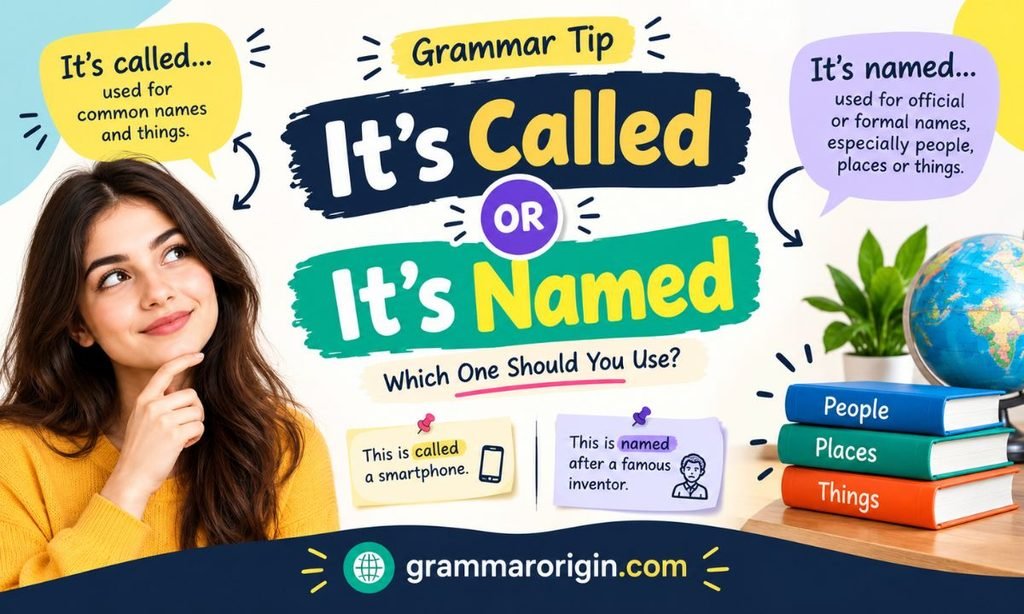
These two overlap more than people expect, but they’re not perfect twins. “It’s called” tends to describe how something is referred to informally a nickname, a common term, a casual label people use.
“It’s named” leans more formal and often implies a deliberate, official act of naming a ship named after someone, a law named for its sponsor. “It’s called a hurricane” sounds natural; “it’s named a hurricane” sounds stiff, because storms get categorized, not christened.
Quick Comparison Table
| Phrase | Verdict |
| Its called | ❌ Always wrong |
| It’s called | ✅ Correct for naming |
| It called | ✅ Correct for past action |
The Apostrophe Changes Everything
One punctuation mark separates a possessive pronoun from a contraction, and that single mark decides whether your sentence names something or describes an event. Skip it, and readers stumble even if only for half a second, and sentence clarity takes the hit.
Writing that respects small details like this reads as more careful, more credible, and more polished. The apostrophe isn’t decoration. It’s the difference between “its” and “it’s” doing completely different grammatical jobs, and getting it right is part of basic subject-verb agreement and clear written English.
Frequently Asked Questions
Is “its called” ever correct?
No. “Its called” is always a mistake it’s missing the verb “is” and never forms a complete grammatical structure, regardless of context.
What’s the actual difference between “its” and “it’s”?
“Its” is a possessive pronoun showing ownership, like “its color” or “its engine.” “It’s” is a contraction that always means “it is” or “it has.”
Can “it called” ever replace “it’s called”?
Only if you’re describing a past action with an object, like “it called the office.” It can never replace “it’s called” in a naming context.
How do I quickly check which phrase to use?
Try substituting “it is” into the sentence. If the meaning holds, use “it’s called.” If the sentence describes something that already happened, use “it called.”
Does this mistake actually matter in professional writing?
Yes. Apostrophe errors are one of the fastest ways to signal carelessness to a reader, especially in resumes, emails, and client-facing documents.
Is the rule different in British English?
No, the grammar rule stays identical. British writing sometimes favors the fuller “it is called” in formal contexts, but that’s a stylistic preference, not a separate rule.
What’s a simple trick to remember the difference for good?
Whenever you’re naming something, picture the full phrase “it is called” in your head first, then contract it. If you’re describing an action already finished, skip the apostrophe entirely.
Final Thoughts
The whole debate around its called vs it called comes down to one small mark doing a lot of work. “It’s called” introduces a name. “It called” reports something that already happened. “Its called” isn’t really in the running it’s just a missing apostrophe.
Once that distinction clicks, you won’t need to pause and second-guess it again. Say the sentence out loud, test whether “it is” fits, and the right phrase picks itself.

Muhammad Waqas is an English language teacher and grammar expert with over 8 years of experience helping students and professionals improve their writing skills. He specializes in English grammar, vocabulary, communication, and practical language learning. Through GrammarOrigin, Waqas shares clear, easy-to-understand content that helps readers write and speak English with confidence.